
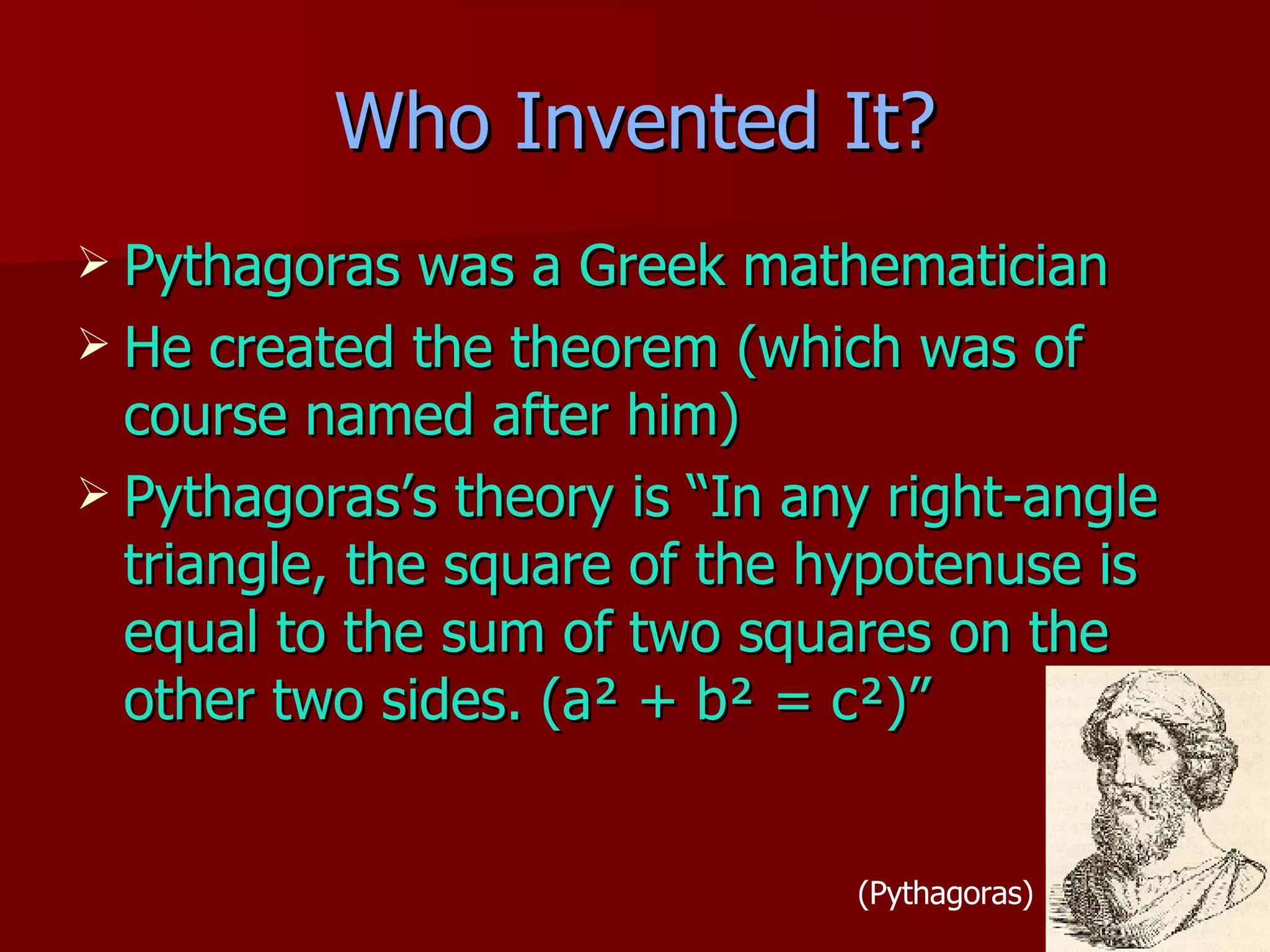
The Pythagorean theorem was not invented by a single person, but rather discovered independently by several ancient civilizations. While named after the Greek philosopher Pythagoras (c. 570–495 BC), historical evidence from Babylonian tablets, Indian Vedic texts, and Chinese manuscripts proves that the mathematical principle was known and used at least 1,000 years before Pythagoras was born.
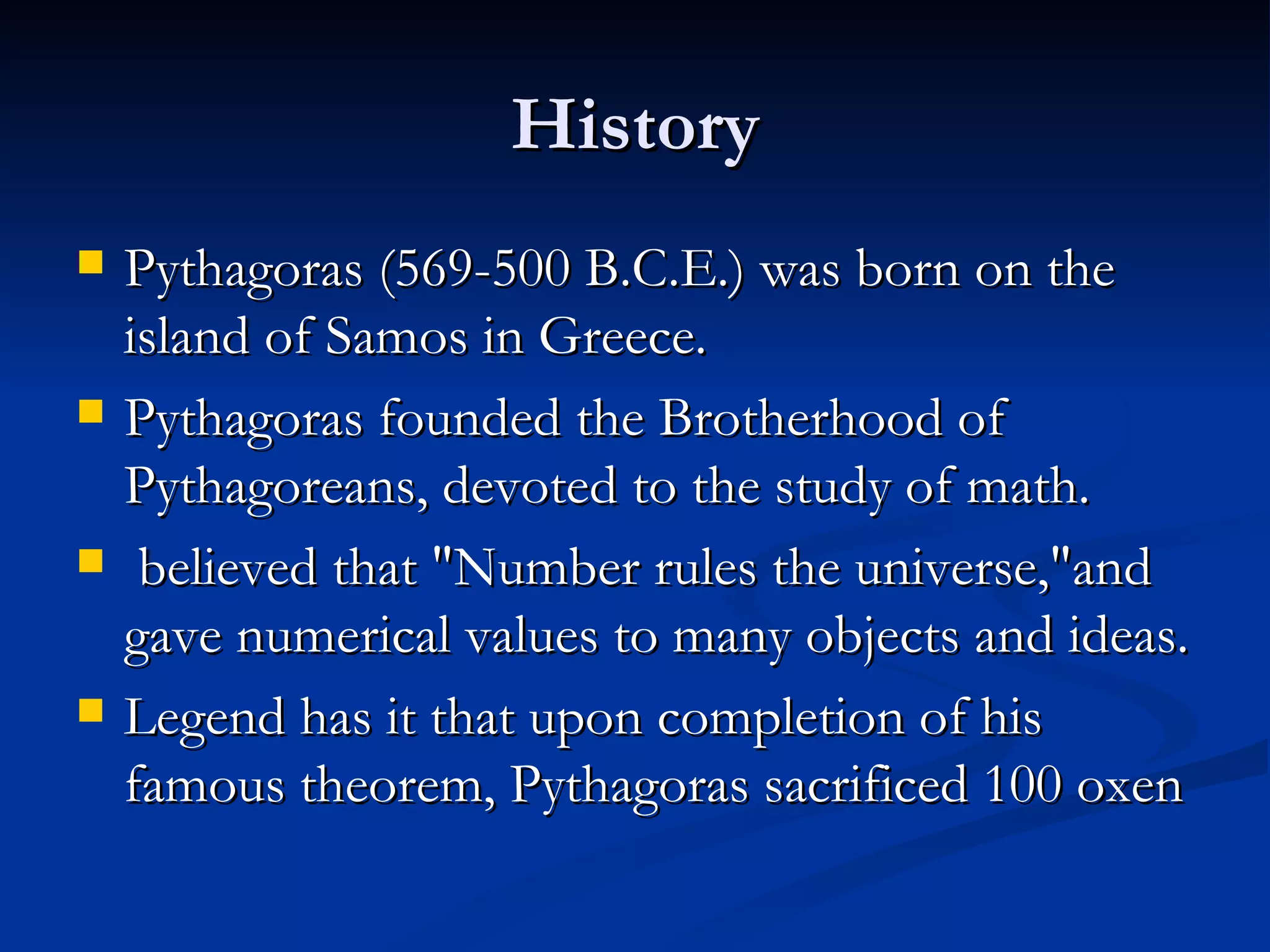
The Pythagorean theorem—stating that in a right-angled triangle, the square of the hypotenuse is equal to the sum of the squares of the other two sides ($a^2 + b^2 = c^2$)—is a fundamental pillar of Euclidean geometry. In the Western educational tradition, the discovery is almost universally attributed to Pythagoras of Samos. However, as we look at the historical record from the vantage point of 2026, it is clear that mathematical history is far more collaborative and cross-cultural than previously taught.
To understand who "invented" or first formalized this theorem, we must look beyond the shores of ancient Greece and examine the records of Mesopotamia, the Indus Valley, and the Yellow River.
The Babylonian Precedents (1800–1600 BC)
Long before the birth of Pythagoras, the Old Babylonian period produced some of the most sophisticated mathematical artifacts found in the ancient world. The most famous of these is the Plimpton 322 tablet, currently housed at Columbia University. Dated to approximately 1800 BC, this clay tablet contains a table of four columns and fifteen rows of numbers written in cuneiform script.
Archaeological analysis has revealed that Plimpton 322 is not just a random list of numbers but a sophisticated table of Pythagorean triples. These are sets of three integers (like 3, 4, 5 or 5, 12, 13) that perfectly satisfy the theorem. The presence of these triples suggests that the Babylonians were not merely stumbling upon these relationships by accident; they possessed a systematic method for generating them.
Another crucial piece of evidence is the YBC 7289 tablet. This small circular tablet shows a square with its diagonals drawn in. Along the diagonal, the Babylonian scribe wrote a numerical approximation of the square root of two to six decimal places. This demonstrates that they understood the relationship between the side of a square and its diagonal—a direct application of the Pythagorean theorem. For the Babylonians, geometry was a practical tool used for land measurement, taxation, and architectural engineering.
Ancient Egypt and the "3-4-5" Triangle
The construction of the Great Pyramids and the seasonal re-measurement of fields after the Nile floods required the Egyptians to have a mastery of right angles. While there is no surviving Egyptian papyrus that states the Pythagorean theorem in a general, algebraic form, there is significant evidence of its practical application.
Egyptian "rope-stretchers" (harpedonaptai) used knotted ropes to create perfect right angles. By using a loop of rope with 12 equally spaced knots, they could form a triangle with sides of 3, 4, and 5 units. Because $3^2 (9) + 4^2 (16) = 5^2 (25)$, this created a perfect 90-degree angle. The Berlin Papyrus 6619, dating back to the Middle Kingdom (c. 2000–1800 BC), contains a problem involving the areas of two squares, further suggesting that the concept of "squaring" sides to find lengths was part of their mathematical repertoire.
The Indian Sulba Sutras (800–500 BC)
In ancient India, the roots of the theorem are found in the Sulba Sutras, which are appendices to the Vedas that provide instructions for the construction of sacrificial altars (agnis). The most famous of these is the Baudhayana Sulba Sutra, estimated to have been written between 800 BC and 500 BC—well before or contemporary with the early life of Pythagoras.
Baudhayana’s text contains a explicit statement of the theorem:
"The cord which is stretched across the diagonal of a rectangle produces an area which the vertical and horizontal sides make together."
Unlike the Babylonians, who seemed to focus on the numerical triples, the Indian mathematicians articulated the geometric principle itself. They used the theorem to convert circles into squares of the same area and to build complex altars made of specific numbers of bricks. The Sulba Sutras also provide a numerical approximation for the square root of two, which was necessary for calculating the diagonal of a square altar.
The Chinese Zhoubi Suanjing and the Gougu Theorem
In China, the theorem is historically known as the Gougu Theorem (Gou meaning base and Gu meaning altitude). The earliest Chinese record of the theorem appears in the Zhoubi Suanjing, an astronomical and mathematical text. While the compiled version of the text dates to the Han Dynasty (202 BC – 220 AD), it is believed to preserve traditions and mathematical knowledge from the Western Zhou era (c. 1046–771 BC).
The Zhoubi Suanjing includes a diagram known as the Zhao Shuang's string-figure, which provides a visual, non-algebraic proof of the theorem. The Chinese approach was highly visual and algorithmic. They used the theorem not just for land surveying but for celestial navigation and calculating the distance to the sun. The "broken bamboo" problem, a classic Chinese mathematical puzzle, requires the use of the Gougu Theorem to find the height at which a bamboo stalk was broken based on where its tip touches the ground.
Pythagoras and the Samos School
If so many cultures knew the theorem before him, why does Pythagoras get the credit? The answer lies in the nature of Greek intellectual culture and the later historians who recorded it.
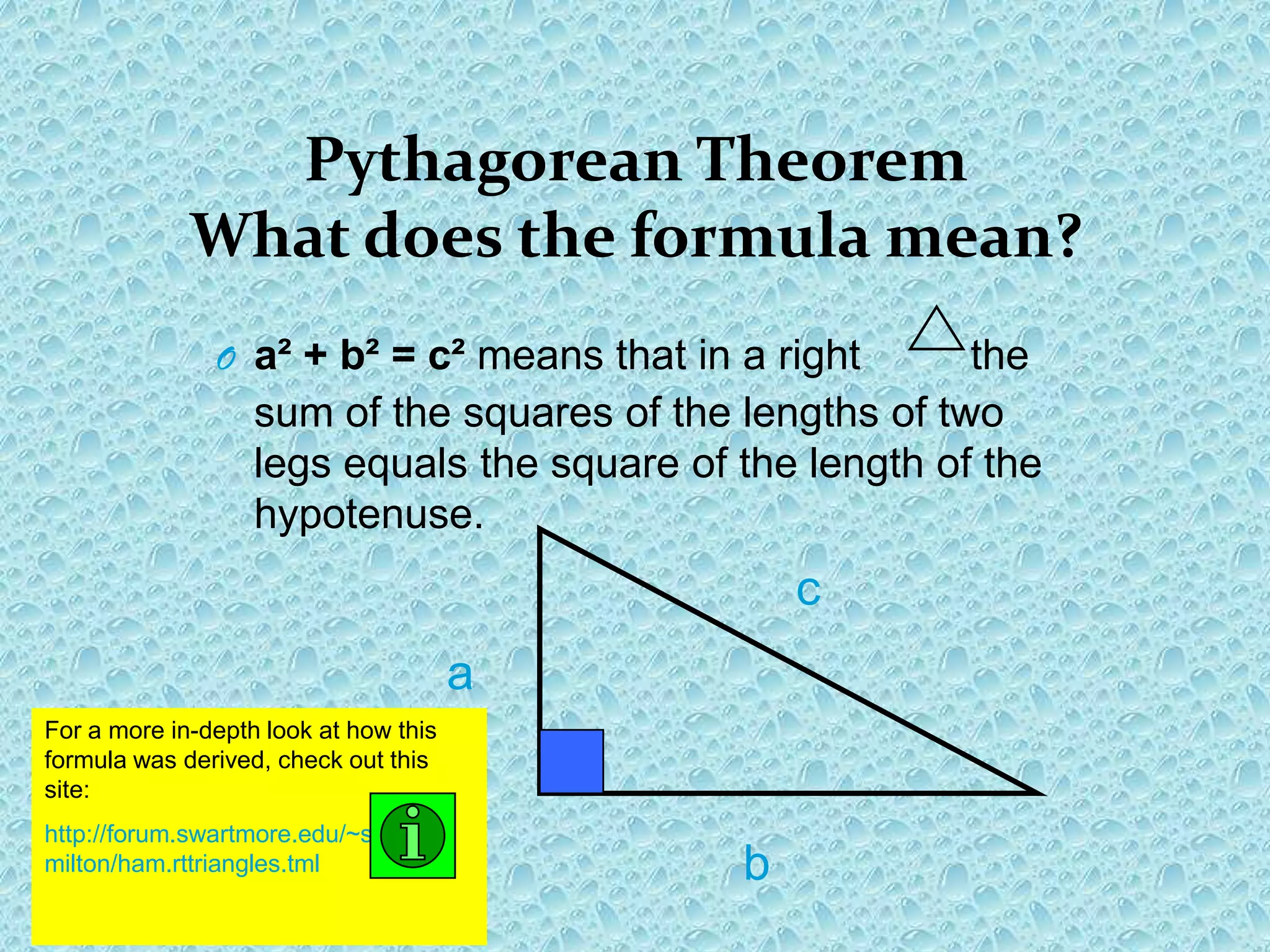
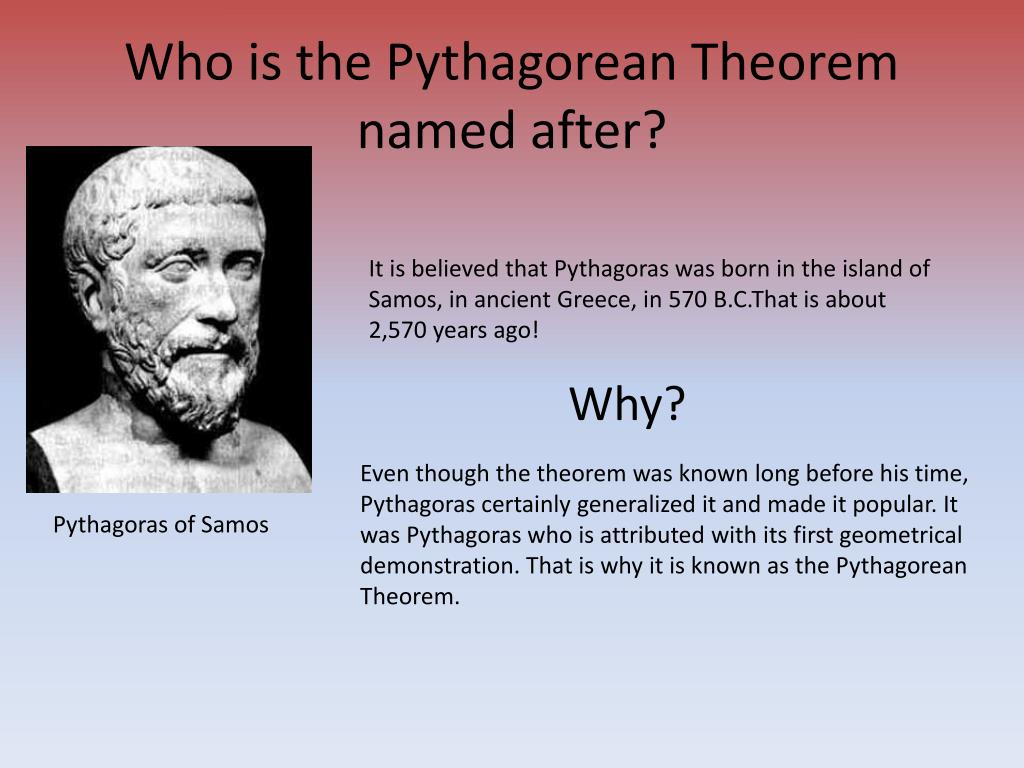
Pythagoras was born on the island of Samos and eventually established a semi-religious, semi-mathematical community in Croton, Southern Italy. The Pythagoreans believed that "all is number" and that the universe was built on mathematical harmonies. Because the school was a secretive society, Pythagoras himself left no written records. Everything we know about him comes from writers living centuries later, such as Diogenes Laertius and Porphyry.
The Greeks are often credited with the "invention" of the theorem because they were the first to move from empirical observation (noticing that the rule works) to deductive proof (demonstrating why the rule must work for every possible right triangle). While it is debated whether Pythagoras himself provided a formal proof, his followers certainly did. By the time Euclid wrote his Elements around 300 BC, the theorem was presented as Proposition 47 in Book I, featuring a rigorous geometric proof that is still taught in schools today.
Comparison of Ancient Mathematical Traditions
| Civilization | Key Evidence/Text | Approximate Date | Primary Usage |
|---|---|---|---|
| Babylonian | Plimpton 322, YBC 7289 | 1800–1600 BC | Land surveying, arithmetic tables |
| Egyptian | Berlin Papyrus 6619 | 2000–1800 BC | Architecture, pyramid alignment |
| Indian | Baudhayana Sulba Sutra | 800–500 BC | Altar construction, religious ritual |
| Chinese | Zhoubi Suanjing | 1000 BC – 200 AD | Astronomy, celestial navigation |
| Greek | Euclid's Elements | 500–300 BC | Theoretical geometry, formal proof |
The Diffusion of Knowledge: How the Theorem Traveled
A major point of discussion among mathematical historians is whether these different cultures discovered the theorem independently or if there was a "diffusion" of knowledge.
Pythagoras is said to have traveled extensively through Egypt and Babylon in his youth. It is highly probable that he learned the practical applications of the theorem from Egyptian priests or Babylonian magi and then brought that knowledge back to the Greek world. In the Greek context, the theorem was stripped of its purely practical "altar-building" or "land-measuring" utility and transformed into an abstract truth of the cosmos.
This transition from the practical to the theoretical is a hallmark of the Greek Golden Age. While the Babylonians were content to know that $3^2 + 4^2 = 5^2$ worked for their ledgers, the Greeks wanted to know if the relationship held true for irrational numbers—a discovery that supposedly caused a crisis in the Pythagorean school when they realized the square root of two could not be expressed as a simple fraction.
Practical Applications of the Theorem in 2026
Even in the modern era, the Pythagorean theorem remains one of the most used mathematical tools. Its "invention" or formalization allowed for advancements that still dictate our daily lives.
- Architecture and Construction: From ensuring that the corners of a new home are "square" to calculating the slope of a roof, the theorem is the primary tool for carpenters and engineers.
- Navigation and GPS: Modern Global Positioning Systems (GPS) use the principles of the theorem to determine the distance between coordinates. When your phone calculates the quickest route to a destination, it is essentially performing a high-speed version of $a^2 + b^2 = c^2$ in three dimensions.
- Computer Graphics: Every video game and 3D movie rendered today relies on the theorem. To move a character in 3D space, the computer must constantly calculate the distance between points (pixels or vertices), which is done using the Pythagorean distance formula.
- Data Science: In machine learning, the "Euclidean distance" between data points is a fundamental metric used to group similar pieces of information together.
Common Misconceptions About the Discovery
There are several persistent myths regarding who invented the Pythagorean theorem that deserve clarification.
Myth 1: Pythagoras was the first to prove it. There is no historical evidence that Pythagoras himself wrote a proof. The first written proof we possess in the Western tradition is from Euclid, who lived 250 years after Pythagoras. The Chinese Zhoubi Suanjing also contains a visual proof that may predate Euclid.
Myth 2: It was a "lost" secret of the ancients. The theorem was never really "lost." Instead, it was refined. The Babylonians used it for numbers, the Indians for ritual, and the Greeks for logic. Each culture added a layer of understanding to the same universal truth.
Myth 3: The theorem only works for 3-4-5 triangles. While the 3-4-5 triangle is the most famous example, the discovery by ancient cultures was that this relationship $(a^2 + b^2 = c^2)$ applies to every right-angled triangle, regardless of the length of the sides.
Frequently Asked Questions
Did Pythagoras really exist?
Yes, Pythagoras was a real historical figure, though much of his life is shrouded in legend. He was born in Samos and was a contemporary of Cyrus the Great and Buddha. However, because his school was a secret society, it is difficult to distinguish his personal discoveries from those of his students.
Why is it not called the Babylonian Theorem?
The naming of mathematical laws often follows the "Stigler's Law of Eponymy," which states that no scientific discovery is named after its original discoverer. The theorem is named after Pythagoras because the Greek tradition of mathematics, which emphasized formal proofs and written records, became the foundation for the Western scientific revolution.
What is the "Gougu Theorem"?
The Gougu Theorem is the Chinese name for the Pythagorean theorem. "Gou" refers to the shorter leg of a right triangle, and "Gu" refers to the longer leg. The Chinese developed this independently for use in astronomy and surveying.
How did the ancient Egyptians use the theorem?
The Egyptians used a "3-4-5" knotted rope to ensure that the bases of their pyramids and temples were perfectly square. By creating a triangle with these proportions, they could guarantee a 90-degree angle at the corners of their massive stone structures.
Is there a 3D version of the Pythagorean theorem?
Yes. In 3D space, the distance $d$ between two points $(x_1, y_1, z_1)$ and $(x_2, y_2, z_2)$ is found using an extension of the theorem: $d^2 = \Delta x^2 + \Delta y^2 + \Delta z^2$. This is fundamental to modern physics and aerospace engineering.
Summary and Next Steps
The question of who invented the Pythagorean theorem does not have a single name as an answer. Instead, it is a testament to human intelligence that civilizations separated by thousands of miles—from the banks of the Euphrates to the plains of the Ganges—all arrived at the same mathematical truth. Pythagoras remains the most famous figure associated with the theorem not because he was the first to find it, but because his school helped transition mathematics from a practical craft into a philosophical pursuit of universal laws.
If you are interested in exploring this topic further, consider visiting the British Museum's online collection of Babylonian mathematical tablets or reading Euclid's Elements to see the first formal Western proof of the theorem. Understanding the diverse origins of this simple equation provides a deeper appreciation for the shared heritage of human knowledge.
Image Gallery
Select an image to open it in a new tab.



Omar Farooq
EdTech Innovation and Virtual Pedagogy Journalist
