
Florida law requires all construction industry employers with one or more employees to maintain workers’ compensation insurance. This mandate includes corporate officers and limited liability company (LLC) members unless they have obtained a formal exemption from the Florida Division of Workers' Compensation. For non-construction contractors, the threshold for mandatory coverage is four or more employees.
Operating a construction business in Florida involves navigating a complex web of insurance regulations, exemption rules, and strict enforcement protocols. In 2026, the Florida Department of Financial Services (DFS) continues to prioritize compliance to ensure that workers injured on the job receive medical care and lost wage benefits without resorting to litigation. For contractors, understanding these requirements is not just about legal compliance; it is about protecting the financial viability of their business and ensuring they can bid on municipal and commercial projects that require proof of coverage.
Defining the "Construction Industry" Under Florida Law
The first step for any contractor is determining if their business falls under the "construction industry" designation. Florida Statute Chapter 440 provides a broad definition that encompasses almost any trade involved in the building, clearing, or improvement of land and structures.
If your business performs activities such as roofing, plumbing, electrical work, masonry, carpentry, or HVAC installation, you are classified within the construction sector. This classification is critical because the requirements for construction are significantly more stringent than those for general businesses. While a retail shop or a consulting firm may not need workers’ compensation insurance until they reach four employees, a solo contractor in the construction trades is required to have a policy or a valid exemption from day one.
The One-Employee Rule
In Florida, the definition of an "employee" includes any person who receives remuneration for their services. For construction businesses, the owners (corporate officers or LLC members) are legally considered employees of their own company. Therefore, a single-member LLC in the roofing trade technically has one employee—the owner—and must comply with the insurance mandate immediately upon formation.
The Exemption Process for Corporate Officers and LLC Members
Many small-scale contractors choose to exempt themselves from workers’ compensation coverage to reduce overhead costs. However, Florida has specific eligibility criteria and limitations on who can opt out.
Eligibility and Limits
To qualify for an exemption in the construction industry, an individual must be a corporate officer or a member of an LLC who owns at least 10% of the company. In 2026, the state continues to limit the number of exemptions to a maximum of three officers per corporation or LLC. Any person who is not an officer or who does not meet the ownership threshold cannot be exempt and must be covered by a policy.
The Application Procedure
Exemptions are not automatic. Contractors must apply through the Florida Division of Workers' Compensation (DWC) online portal. The process involves:
- Filing the Notice of Election to be Exempt: This is done via Form DWC-250.
- Paying the Fee: As of 2026, the filing fee for construction industry exemptions remains $50 per applicant.
- Verification of Business Status: The business must be active and in "Good Standing" with the Florida Department of State, Division of Corporations (Sunbiz).
- Maintaining Records: An exemption is valid for two years. Contractors must renew their exemptions before they expire to avoid a gap in legal coverage.
It is important to note that an exempt officer cannot perform work for a non-construction contractor and remain exempt under the same certificate. The exemption is specific to the individual and the business entity named on the certificate.

Managing Subcontractors and Certificates of Insurance (COI)
One of the most significant risks for general contractors (GCs) in Florida is "upstream liability." Under Florida law, if a subcontractor does not have workers’ compensation insurance and an injury occurs, the responsibility for providing benefits shifts to the contractor immediately above them in the hierarchy.
Verifying Coverage
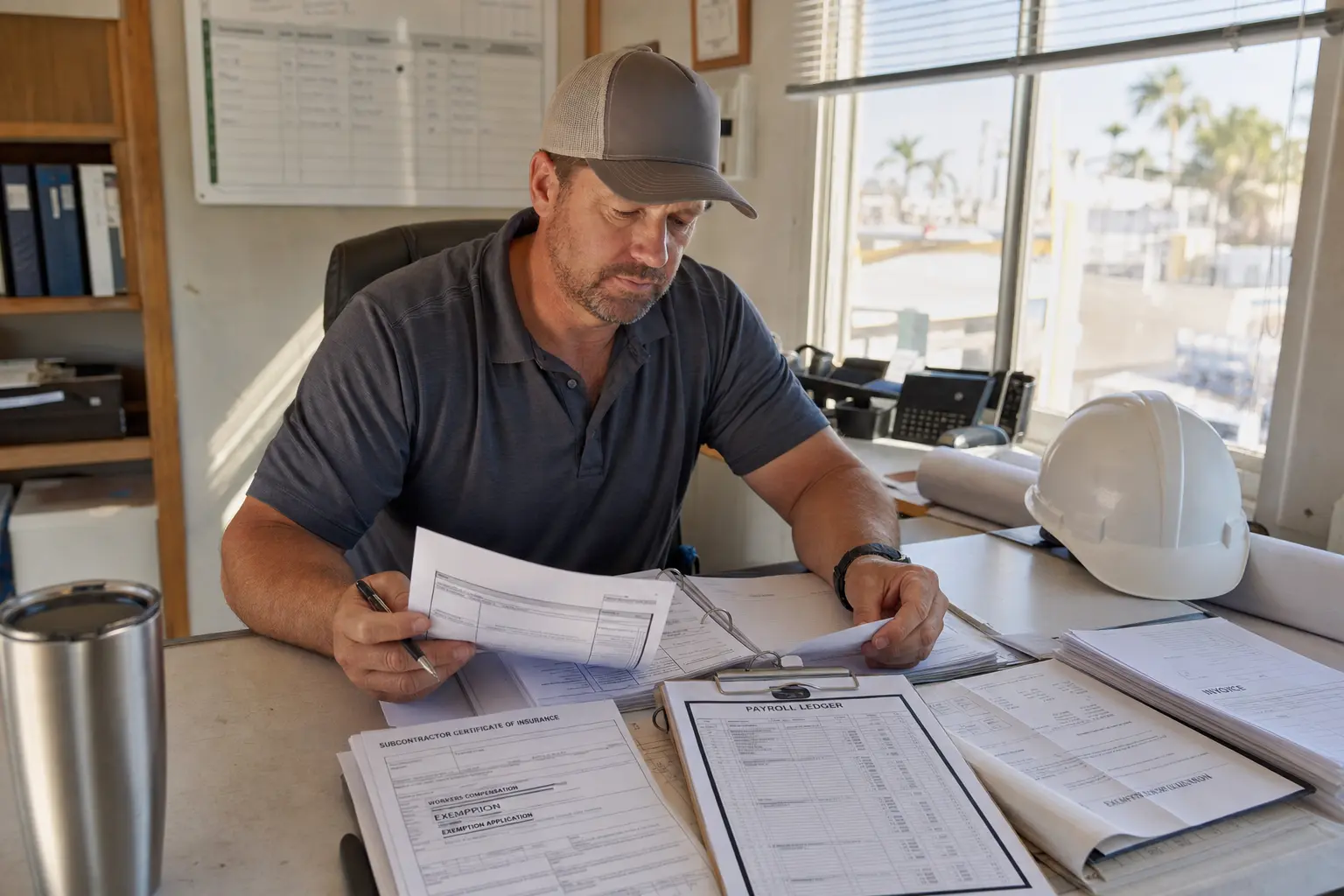
General contractors must be diligent in verifying the insurance status of every subcontractor they hire. This involves more than just collecting a piece of paper; it requires active verification.
- Check the DWC Database: The Florida DFS maintains an online Proof of Coverage database. GCs should check this to ensure a subcontractor's policy is active and has not been cancelled for non-payment.
- Verify Exemptions: If a subcontractor claims they are exempt, the GC must verify the exemption certificate on the state portal.
- Scope of Work: Ensure the subcontractor's policy covers the specific type of work they are performing. If a plumber is hired but their policy only lists "clerical" class codes, the insurance carrier may deny a claim, leaving the GC liable.
The "Statutory Employer" Concept
Florida law treats the general contractor as the "statutory employer" of all employees working on a project site. This legal fiction ensures that there is always a layer of insurance available for injured workers. To mitigate this risk, many GCs require subcontractors to provide a "Waiver of Subrogation" on their policies, which prevents the subcontractor’s insurance company from suing the GC to recover claim costs.
Florida Workers' Compensation Comparison: Construction vs. Non-Construction
| Feature | Construction Industry | Non-Construction Industry |
|---|---|---|
| Employee Threshold | 1 or more employees | 4 or more employees |
| Officer Coverage | Included by default (must exempt) | Included by default (must exempt) |
| Exemption Fee | $50.00 | No Fee |
| Max Exemptions | 3 per business entity | Unlimited for qualifying officers |
| Exemption Duration | 2 Years | 2 Years |
| Out-of-State Rules | Must have FL-licensed carrier | May use home-state policy if reciprocal |
Understanding Premium Costs and Class Codes
Workers’ compensation premiums in Florida are calculated based on payroll, the nature of the work (class codes), and the company’s claims history (Experience Modification Rate).
NCCI Class Codes
Florida utilizes the National Council on Compensation Insurance (NCCI) classification system. Each type of work is assigned a four-digit code with an associated rate. For example:
- Code 5403: Carpentry (higher risk, higher rate).
- Code 5183: Plumbing (moderate risk).
- Code 8810: Clerical Office Employees (low risk, very low rate).
Contractors must ensure their payroll is accurately allocated to these codes. Misclassifying high-risk labor as low-risk clerical work is considered "premium fraud" in Florida and can lead to criminal charges and heavy fines.
The Experience Modification Rate (EMR)
The EMR is a multiplier applied to the premium based on the contractor's safety record compared to other businesses in the same industry. An EMR of 1.0 is average. If a contractor has frequent or severe accidents, their EMR will rise (e.g., 1.25), increasing their premiums by 25%. Conversely, a safe contractor might earn an EMR of 0.85, resulting in a 15% discount. For many contractors in 2026, maintaining a low EMR is the difference between winning and losing competitive bids on large-scale infrastructure projects.
Compliance and Enforcement: The Bureau of Compliance
The Florida Bureau of Compliance is the enforcement arm of the DWC. They employ investigators who conduct unannounced inspections at construction sites throughout the state.
Stop Work Orders (SWO)
If an investigator finds that a contractor is operating without the required insurance or with an inadequate number of covered employees, they will issue a Stop Work Order. This requires all business operations to cease immediately. Violating a Stop Work Order is a second-degree felony in Florida.
Financial Penalties
The penalty for non-compliance is typically 1.5 to 2 times the amount of premium the employer would have paid for the period they were uninsured over the previous three years. These fines often reach tens of thousands of dollars, even for small businesses. In 2026, the DFS continues to use data-matching technology to compare payroll records with insurance filings to identify non-compliant employers even without a site visit.
Obtaining Coverage: Private Market vs. FWCJUA
Most Florida contractors obtain coverage through the private insurance market. However, those with a high-risk history or those who are new to the industry may find it difficult to secure a policy from traditional carriers.
The Florida Workers' Compensation Joint Underwriting Association (FWCJUA)
The FWCJUA serves as the "insurer of last resort." It is a state-created entity that provides coverage to employers who are in good faith entitled to insurance but are unable to purchase it in the voluntary market. While the FWCJUA ensures that every contractor can get covered, its premiums are significantly higher than those in the private market. Contractors usually move from the FWCJUA to the private market after demonstrating a clean safety record for several years.
Common Mistakes to Avoid
- Relying on "Independent Contractor" Status: In many industries, you can hire 1099 workers and avoid insurance. In Florida construction, the rules are much tighter. Unless the "independent contractor" has their own workers’ comp policy or a valid exemption, the state will likely view them as your employee during an audit.
- Letting Exemptions Expire: There is no grace period. If an exemption expires on a Tuesday and an officer is injured on a Wednesday, there is no coverage, and the business is in violation of the law.
- Underestimating Payroll: During the annual insurance audit, the carrier will check your tax filings (941s and UCT-6s). If your actual payroll was higher than what you estimated at the start of the policy, you will receive a large "audit premium" bill.
Frequently Asked Questions
Can I use an out-of-state workers' compensation policy for a project in Florida?
Generally, no. Florida law requires that any construction work performed within the state must be covered by a policy issued by an insurance carrier licensed in Florida. The policy must specifically list Florida in "Section 3A" of the information page. Out-of-state contractors must often obtain a Florida-specific endorsement or a separate policy entirely.
What happens if an exempt officer gets injured on the job?
An exempt officer is choosing to waive their right to benefits. If they are injured, the workers' compensation policy will not pay for their medical bills or lost wages. The officer would need to rely on their personal health insurance or disability insurance, though many health insurance policies have exclusions for work-related injuries.
Do I need workers' comp if I only hire subcontractors?
Yes, if you are in the construction industry. Even if you have no direct employees, as a contractor, you must either have a policy or a valid exemption for yourself. Furthermore, if any of your subcontractors fail to maintain their own insurance, you become their "statutory employer" and must provide coverage for their workers.
How do I check if a contractor's insurance is valid?
You should use the Florida Department of Financial Services, Division of Workers' Compensation "Proof of Coverage" search tool. By entering the business name or FEIN, you can see the policy number, the carrier, and the effective dates. Do not rely solely on a physical Certificate of Insurance, as these can be forged or may have been cancelled after the certificate was printed.
Is the $50 exemption fee per person or per company?
The fee is $50 per person. If a corporation has three officers who all wish to be exempt, the total cost would be $150 every two years. Each officer must meet the 10% ownership requirement and file an individual application.
Next Steps for Florida Contractors
To ensure full compliance and protect your business assets, your next action should be a thorough audit of your current insurance status. Verify that your exemption certificates are active on the Sunbiz and DWC portals. If you utilize subcontractors, implement a mandatory "COI Verification" process before any worker sets foot on a job site. Consult with a licensed Florida insurance agent who specializes in construction to review your class codes and ensure your payroll estimates are accurate for the 2026 policy year. Taking these proactive steps will prevent costly Stop Work Orders and ensure your business remains eligible for high-value contracts.
Image Gallery
Select an image to open it in a new tab.

Omar Farooq
EdTech Innovation and Virtual Pedagogy Journalist
