
A magnetic compass works by using a lightweight, magnetized needle that pivots freely to align itself with the Earth’s natural magnetic field. By pointing toward the Magnetic North Pole, the needle provides a consistent directional reference, allowing navigators to calculate headings, orient maps, and maintain a precise course across various terrains.
The Fundamental Physics: Earth as a Giant Magnet
To understand how a magnetic compass functions, one must first understand the planet’s magnetic properties. The Earth behaves like a massive spherical magnet due to the movement of molten iron and nickel in its outer core. This process, known as the geodynamo, generates a complex magnetic field that extends from the interior out into space.
The magnetic field lines emerge from the southern hemisphere and loop back into the northern hemisphere. A compass needle, which is essentially a small bar magnet, interacts with these invisible lines of force. According to the laws of magnetism, opposite poles attract. Therefore, the "North" pole of a compass needle is actually its north-seeking pole, which is attracted to the Earth's magnetic north.
As of 2026, the Earth’s magnetic poles are not static. The North Magnetic Pole has been migrating from the Canadian Arctic toward Siberia at a rate of approximately 40 to 50 kilometers per year. This movement is a critical factor for modern navigation, as it requires periodic updates to the World Magnetic Model (WMM) to ensure that compass readings remain accurate for aviation, maritime, and military operations.
Anatomy of a Modern Navigation Compass
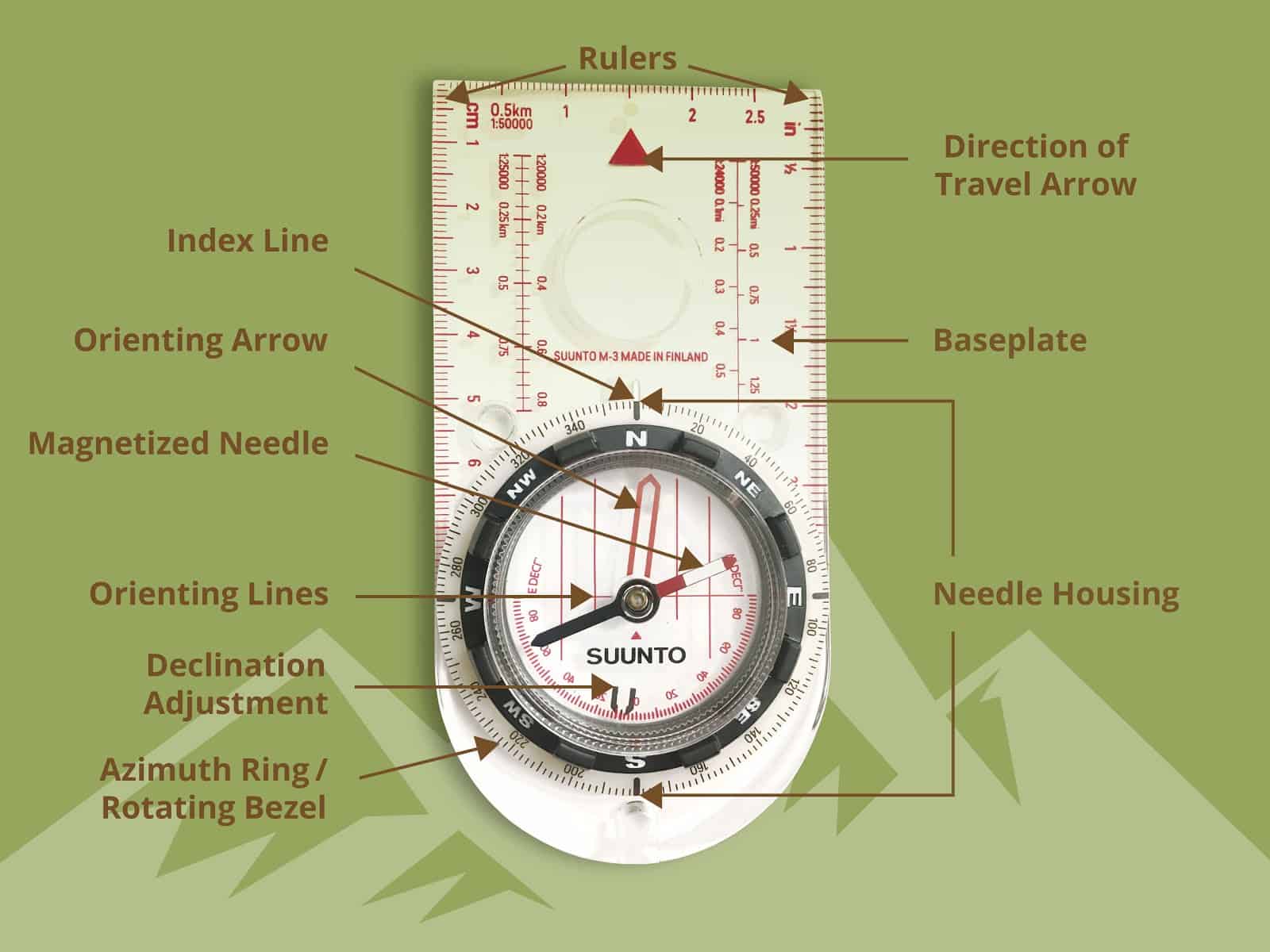
While the basic principle remains the same as it was centuries ago, modern navigation compasses are sophisticated instruments designed for high precision. A standard orienteering or baseplate compass consists of several specific components that facilitate accurate reading and map integration.
The Magnetic Needle
The needle is the core component. Usually made of magnetized steel or a composite alloy, it is balanced on a low-friction pivot point (often a synthetic ruby or sapphire bearing). The north-seeking end is traditionally painted red or coated with a luminous material for low-light visibility.
The Compass Housing and Fluid
The needle sits inside a circular "capsule" or housing. In high-quality models, this housing is filled with a clear, non-freezing liquid, such as specialized mineral oil or alcohol. This fluid serves a vital purpose called damping. Without liquid damping, the needle would oscillate wildly with every movement, making it nearly impossible to get a steady reading. The fluid slows the needle’s movement without hindering its ability to find north, allowing it to settle quickly.
The Rotating Bezel (Azimuth Ring)
The housing is surrounded by a rotating ring marked with degrees from 0 to 360. These markings represent the azimuth or bearing. By turning this bezel, a navigator can "capture" a heading and keep it as a physical reference.
The Baseplate and Scales
For land navigation, the compass is often mounted on a transparent rectangular baseplate. This plate includes scales (rallies) for measuring distances on maps, a magnifying lens for reading small topographical details, and a direction-of-travel arrow that points the way you should walk once your bearing is set.
The Mechanics of Orientation: "Red in the Shed"
The practical application of a compass relies on the relationship between the magnetic needle and the orienting arrow (often called the "shed") engraved on the bottom of the capsule.
When a navigator wants to follow a specific bearing, they rotate the bezel until the desired degree mark aligns with the index line on the baseplate. They then turn their entire body until the red end of the magnetic needle sits perfectly within the orienting arrow. This alignment—popularly taught as putting "the red in the shed"—ensures that the direction-of-travel arrow is pointing exactly toward the intended destination.
This mechanical alignment bridges the gap between the user's physical orientation and the Earth's magnetic field. It allows for movement in a straight line even when landmarks are obscured by fog, darkness, or dense foliage.
Magnetic Declination: Bridging the Gap Between Maps and Reality
One of the most complex aspects of compass navigation is declination. This is the angular difference between True North (the geographic North Pole at the top of the Earth's axis) and Magnetic North (where the compass needle points).
Maps are almost always drawn based on True North. However, because the magnetic pole is not located at the geographic pole, the compass needle will point slightly east or west of True North depending on the user's location on the planet.
The Impact of Declination
In some regions, such as the Pacific Northwest or parts of Europe, the declination can be as much as 15 to 20 degrees. Failing to account for this error can lead a navigator miles off course over a relatively short distance.
- Positive (Easterly) Declination: Magnetic North is east of True North.
- Negative (Westerly) Declination: Magnetic North is west of True North.
As of the 2025-2030 WMM cycle, navigators must check current isogonic charts—lines on a map connecting points of equal declination—to adjust their instruments. Many professional compasses feature a "declination adjustment" screw that allows the user to offset the orienting arrow permanently, effectively "calibrating" the compass to the local map.
Factors Affecting Compass Accuracy
A magnetic compass is highly reliable because it does not require batteries or satellite signals. However, it is susceptible to several environmental and physical interferences.
Magnetic Deviation
While declination is a natural phenomenon caused by the Earth, deviation is a local error caused by nearby magnetic objects. In a vehicle, boat, or aircraft, large amounts of iron, steel, or electrical wiring can deflect the compass needle. This is why marine compasses are often equipped with "compensating magnets" to cancel out the ship's internal magnetism. Even a hiker’s belt buckle, mobile phone, or trekking poles can cause a "side-pull" that introduces error.
Magnetic Inclination (Dip)
The Earth's magnetic field lines are only parallel to the surface at the equator. As you move toward the poles, the lines "dip" toward the ground. This causes a compass needle to tilt downward. If the needle tilts too far, it will rub against the bottom of the capsule and fail to rotate. To solve this, manufacturers produce compasses balanced for specific "zones" (e.g., Northern Hemisphere vs. Southern Hemisphere), though "global" compasses exist with specialized needle mountings to handle the dip in any latitude.
Mineral Deposits
In certain geographic areas, such as the Iron Range in Minnesota or volcanic regions like Iceland, large deposits of magnetite in the bedrock can render a magnetic compass useless. In these "magnetic anomalies," the needle may spin or point toward the ground rather than North.
Comparing Navigation Technologies
While GPS (Global Positioning System) and GNSS (Global Navigation Satellite System) have become the primary means of navigation in 2026, the magnetic compass remains a mandatory backup for professional mariners and wilderness experts.
| Feature | Magnetic Compass | GPS / Electronic Compass |
|---|---|---|
| Power Source | None (Passive) | Battery / External Power |
| Signal Dependency | None | Requires Satellite Line-of-Sight |
| Reliability | Extremely High (Mechanical) | Medium (Subject to software/hardware failure) |
| Accuracy | 1° to 2° (User dependent) | 0.1° to 3° (Signal dependent) |
| Declination | Must be manually adjusted | Automatically calculated |
| Durability | High (Waterproof/Shockproof) | Variable (Electronic components are fragile) |
Using a Compass for Navigation: Step-by-Step
Navigating with a compass typically involves two primary tasks: taking a bearing from the field and following a bearing from a map.
Taking a Bearing in the Field
If you see a distant peak and want to know its heading:
- Point the direction-of-travel arrow on your compass baseplate directly at the peak.
- Rotate the compass bezel until the "shed" (orienting arrow) aligns with the red magnetic needle.
- Read the degree mark at the index line. This is your magnetic bearing to that landmark.
Following a Bearing from a Map
To travel toward a destination marked on a map:
- Place the edge of the compass baseplate on the map, connecting your current location to your destination.
- Ensure the direction-of-travel arrow points toward the destination.
- Rotate the bezel until the orienting lines in the capsule are parallel with the map's North-South grid lines.
- Remove the compass from the map and adjust for local declination (if your compass doesn't have an internal adjustment).
- Turn your body until "red is in the shed." Follow the direction-of-travel arrow.
Maintenance and Troubleshooting
A compass is a precision instrument and requires proper care to maintain accuracy. One common issue is the development of a bubble in the liquid-filled housing. Small bubbles (the size of a pinhead) are often harmless and caused by changes in temperature or altitude. However, a large bubble can interfere with the needle's movement. If this occurs, the capsule seal may have failed, necessitating replacement.
Another risk is reversed polarity. If a compass is stored too close to a strong magnet (like a high-end speaker or a rare-earth magnet), the needle's magnetic field can be flipped. The "north" end will then point south. This can sometimes be fixed by "re-stroking" the needle with a strong magnet, but it is generally safer to replace the unit if this occurs.
To ensure longevity, always store your compass away from extreme heat (which can cause the liquid to expand and crack the capsule) and away from electronic devices that might cause demagnetization.
Frequently Asked Questions
Does a magnetic compass work at the North Pole?
As you approach the Magnetic North Pole, a standard compass becomes increasingly unreliable. Because the magnetic field lines are pointing almost straight down into the ground, the needle will attempt to point downward (dip) rather than horizontally. At the exact Magnetic North Pole, the needle will spin aimlessly or point to the bottom of the housing.
Why does my compass needle get stuck?
A stuck needle is usually caused by "magnetic dip" if you are using a compass balanced for a different hemisphere, or by a bubble in the housing. It can also happen if the compass is not held perfectly level. Ensure the baseplate is parallel to the ground for the needle to swing freely.
Is a smartphone compass as good as a magnetic one?
Smartphone "compasses" are actually magnetometer sensors. While they are convenient and can automatically adjust for declination, they are highly sensitive to electronic interference and require battery power. They are useful for casual use but are not a substitute for a mechanical compass in survival or professional maritime situations.
What is the difference between a bearing and a heading?
A bearing is the angle from your current position to a specific object or destination. A heading is the direction in which your vehicle or body is currently pointed. In a perfect world, your heading matches your bearing, but factors like wind or water currents often force navigators to maintain a heading that differs from the bearing to stay on course.
How often should I update my declination settings?
Because the Earth's magnetic field shifts, declination values change over time. For precise navigation, you should check for updates every 1-2 years, especially if you are traveling in areas near the poles where the rate of change is more pronounced. Reference the National Oceanic and Atmospheric Administration (NOAA) or the British Geological Survey for current data.
Practical Recommendation
For anyone relying on a compass for navigation in 2026, the best practice is to carry a high-quality, liquid-filled baseplate compass with adjustable declination. Models from reputable manufacturers such as Suunto, Silva, or Brunton are preferred for their durability and precision. Always pair your compass with a physical topographic map of the area, and practice "triangulation"—using multiple landmarks to find your exact position—before entering remote wilderness or open waters. A compass is only as effective as the skill of the person holding it.
Image Gallery
Select an image to open it in a new tab.


Akira Tanaka
International Academic Trends Correspondent
