The difference between Vanguard and Schwab fees determines how much of your investment returns you actually keep versus how much is diverted to corporate profits. While both offer low-cost access to markets, their diverging revenue models—Vanguard’s client-owned structure versus Schwab’s profit-driven "cash sweep"—can result in thousands of dollars in lost compounding over a 30-year horizon.
The Mathematics of Friction: Why Small Fee Differences Compound
To understand why the debate between Vanguard and Schwab fees remains central to modern investing in 2026, one must first master the mathematics of investment friction. In a vacuum, a fee of 0.03% versus 0.06% feels negligible. However, when applied to a portfolio of $500,000 over several decades, these microscopic fractions dictate the age at which you can retire and the legacy you leave behind.
Investment fees act as a "reverse compound interest" engine. While your assets grow through market appreciation and dividend reinvestment, fees are deducted regardless of performance. If the market returns an average of 7% annually and your total cost of ownership (TCO) is 0.50%, your net return is 6.5%. Over 30 years, that 0.50% "leakage" can reduce your final portfolio value by nearly 15%. When comparing Vanguard and Charles Schwab, the "sticker price" of an expense ratio is only the beginning of the calculation. Investors must weigh expense ratios against transaction costs, advisory overhead, and the opportunity cost of uninvested cash.
Ownership Structure: The Philosophical Divide
The primary reason fee structures differ between these two giants lies in their corporate DNA. This is not merely a marketing distinction; it is a legal and structural reality that dictates how each firm treats your capital.
Vanguard’s Mutual Structure
Vanguard is unique in the financial services industry because it is owned by its funds, which are in turn owned by the investors. There are no outside shareholders to satisfy. When Vanguard achieves economies of scale, it is structurally incentivized to lower expense ratios for its members. This "at-cost" model has historically forced the rest of the industry to lower prices—a phenomenon often called "The Vanguard Effect." For an investor in 2026, this means that as Vanguard grows, your costs typically decrease automatically.
Schwab’s Publicly Traded Model
Charles Schwab (SCHW) is a publicly traded corporation. It has a fiduciary duty to its clients, but it also has a primary responsibility to its shareholders to generate a profit and grow its stock price. To compete with Vanguard’s low expense ratios, Schwab often matches or beats Vanguard on the "sticker price" of popular ETFs. However, because they must generate profit, they often compensate for low fund fees through other revenue streams, most notably the "net interest margin" earned on client cash.
The Invisible Fee: The "Cash Sweep" Comparison
The most significant "hidden" fee in the Vanguard vs. Schwab debate is how each firm handles your uninvested cash. This is the capital sitting in your brokerage account waiting to be deployed or held as a safety net.
In 2026, interest rates remain a critical component of portfolio strategy. Vanguard’s default "settlement fund" is typically a high-yield money market fund, such as the Vanguard Federal Money Market Fund (VMFXX). This fund passes through the vast majority of current market interest rates to the investor, minus a very small expense ratio.
Conversely, Charles Schwab’s default "sweep" typically moves investor cash into Schwab Bank. Historically, the interest rate paid on these sweep accounts has been significantly lower than the prevailing rates found in money market funds. Schwab earns the "spread"—the difference between what they earn on your money and the pittance they pay you. For an investor holding $50,000 in cash within a large portfolio, the difference between a 4.5% yield at Vanguard and a 0.45% yield at Schwab represents an "invisible fee" of over $2,000 per year.
Expense Ratios: Comparing the Core Products
For the "buy and hold" index investor, the expense ratio is the most visible cost. Both firms offer "Penny-Rate" funds, where the cost of ownership is less than 0.10%.
| Asset Class | Vanguard Fund (ETF) | Expense Ratio | Schwab Fund (ETF) | Expense Ratio |
|---|---|---|---|---|
| Total Stock Market | VTI | 0.03% | SCHB | 0.03% |
| S&P 500 Index | VOO | 0.03% | SCHX | 0.03% |
| Total International | VXUS | 0.07% | SCHF | 0.06% |
| Total Bond Market | BND | 0.03% | SCHZ | 0.03% |
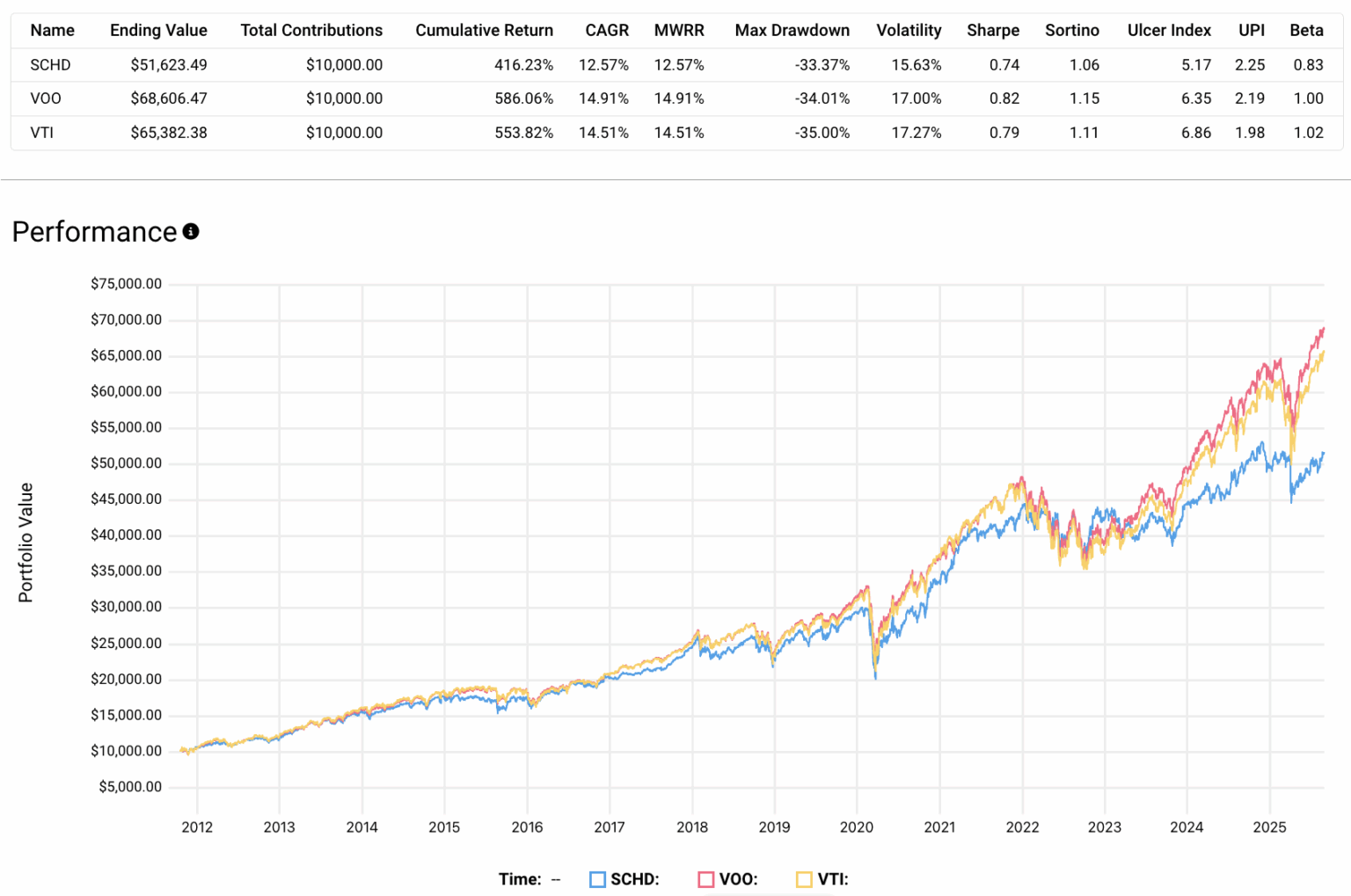
| Dividend Growth | VIG | 0.06% | SCHD | 0.06% |
As the table illustrates, the direct competition on broad-market ETFs is fierce. In many cases, Schwab is actually cheaper by a basis point or two on international or specialized funds. However, the "Why it matters" aspect comes into play with mutual funds. Schwab charges significant transaction fees (often up to $74.95) for purchasing non-Schwab mutual funds, whereas Vanguard allows for more flexibility within its ecosystem. If you prefer the automated investment features of mutual funds over ETFs, Vanguard’s "at-cost" mutual fund shares often provide a superior long-term value.
Advisory Fees and the "Robo-Advisor" Trap
As investors seek more guidance, both firms have expanded their advisory services. The fee structures here are radically different and require careful scrutiny.
Vanguard Personal Advisor
Vanguard generally charges a percentage of assets under management (AUM), typically starting around 0.30%. This is an explicit fee. For that 0.30%, you receive access to human advisors and a portfolio that is 100% invested in low-cost funds according to your risk tolerance. There is no hidden "cash drag."
Schwab Intelligent Portfolios
Schwab markets its basic robo-advisory service as having "no advisory fee." However, this is often criticized as a "stealth fee" model. To make the service profitable without an explicit AUM fee, Schwab requires a mandatory cash allocation—often between 6% and 15% of the total portfolio—which is swept into their low-yield bank. During bull markets, this "cash drag" acts as a significant fee, as that 10% of your portfolio is not earning market returns. Analysis has shown that in many market environments, the cost of the cash drag at Schwab is higher than the explicit 0.30% fee at Vanguard.
Transactional and Administrative Costs
Beyond the major fees, "friction" costs can nibble away at a portfolio. While $0 commissions on stocks and ETFs are the standard in 2026, other costs remain:
- Options Trading: Both firms charge per-contract fees. If you are an active derivative trader, Schwab’s "StreetSmart" platforms generally offer better value and execution than Vanguard’s more utilitarian interface, despite similar contract pricing.
- Account Minimums: Vanguard often requires $1,000 to $3,000 for its mutual funds, whereas Schwab has largely eliminated minimums for its branded funds, making Schwab more accessible for those just starting their journey.
- Transfer Fees: Both firms are generally friendly toward incoming assets, but "ACATS" out-bound transfer fees can apply if you decide to leave. Schwab is historically more aggressive with promotional "transfer bonuses," which can effectively offset years of small fee differences if your portfolio is large enough.
The Role of Tax Efficiency in Total Cost
A fee isn't just what you pay the broker; it’s also what you pay the IRS. Vanguard holds a unique patent on a "heartbeat trade" mechanism that allows its mutual funds to operate with the same tax efficiency as ETFs. This allows Vanguard investors to avoid capital gains distributions in their mutual funds, a benefit Schwab mutual funds haven't always been able to match perfectly. In a taxable brokerage account, a 1% tax hit due to inefficient fund management is far more damaging than a 0.03% expense ratio.
When Schwab Fees Are Actually Better
It is an oversimplification to say Vanguard is always cheaper. Schwab's fee structure is often superior for:
- Active Traders: The platform tools and execution quality at Schwab (especially after the integration of TD Ameritrade's thinkorswim) provide "value" that offsets minor fee differences.
- International Travelers: The Schwab Bank High Yield Investor Checking account (linked to the brokerage) offers unlimited ATM fee rebates worldwide and no foreign exchange fees. For a frequent traveler, this can save hundreds of dollars a year, far exceeding the cost of a slightly higher expense ratio on a niche fund.
- Small Balance Investors: Because Schwab allows for $1 investment minimums on many products, the "fee" of being unable to participate in the market (the opportunity cost) is lower for beginners at Schwab than at Vanguard.
Frequently Asked Questions
Does Vanguard or Schwab have lower expense ratios in 2026?
On average, they are nearly identical for core index funds (0.03% to 0.07%). Schwab is sometimes 0.01% cheaper on specific ETFs, while Vanguard is generally cheaper for mutual fund investors who want to avoid transaction fees on external products.
Why is the "cash sweep" rate so important?
The cash sweep is important because it represents an opportunity cost. If your broker pays you 0.45% while a money market fund pays 4.5%, you are losing 4% of your cash's value every year. For investors who keep a significant cash cushion, Vanguard's higher default rates usually make it the more cost-effective choice.
Are there hidden fees for transferring my account?
Most major brokerages, including Schwab and Vanguard, do not charge to receive an account. However, they may charge an Administrative Customer Account Transfer (ACATS) fee of $50–$100 to send your assets to another firm. Always check if the receiving firm will reimburse this fee.
Is Vanguard's 0.30% advisory fee worth it compared to Schwab's "free" robo-advisor?
It depends on your cash preference. Vanguard’s fee is transparent and allows your entire balance to be invested. Schwab’s "free" service requires a cash balance that Schwab profits from, which can cost you more in lost market gains than Vanguard's explicit fee during periods of high market growth.
Do I pay fees to trade ETFs at these firms?
As of 2026, both Vanguard and Schwab offer $0 commission trading for U.S.-listed stocks and ETFs online. Fees only typically apply to broker-assisted trades, certain foreign securities, or specialized mutual funds not on the "No Transaction Fee" list.
Final Recommendation: Choosing Based on Your Behavior
The question of "why Vanguard vs Schwab fees matter" ultimately depends on how you use the platform. If you are a "set it and forget it" index investor who holds a significant cash emergency fund within your brokerage, Vanguard’s ownership structure and high-yield settlement fund will likely save you more money over time. The structural alignment of an at-cost provider ensures that you are never the "product" being monetized through low interest rates.
However, if you are an active investor, a frequent traveler, or a beginner with less than $1,000, Schwab’s superior technology, banking integration, and lack of minimums provide a different kind of value. In these cases, the "cost" of Schwab's slightly less efficient cash sweep is a price paid for a much more robust and versatile financial toolkit.
To minimize fees, investors should regularly audit their "Total Cost of Ownership," which includes:
- Summing all expense ratios.
- Calculating the lost interest on "swept" cash.
- Accounting for any advisory or platform subscriptions.
By looking past the $0 commission headline, you can ensure that your chosen brokerage is working for your wealth, rather than at its expense.
Image Gallery
Select an image to open it in a new tab.


Declan O'Connor
Higher Education and Campus Culture Reporter
