Understanding the Net 30 Basis for Freelancers: Managing Payment Terms for Financial Stability

A "Net 30" payment term is a credit agreement where the full invoice amount is due 30 days after the date the invoice is issued or the services are rendered. For freelancers, this is a standard but sometimes challenging billing cycle that requires diligent cash flow management, clear contract stipulations, and proactive follow-up strategies to ensure timely compensation.
Defining the Net 30 Framework
In the professional services sector, a Net 30 agreement functions as a short-term interest-free loan extended by the service provider (the freelancer) to the client. When a freelancer issues an invoice with Net 30 terms, they are essentially granting the client a 30-day window to process the payment without incurring late fees or penalties.
This term is rooted in commercial trade practices designed to provide corporate accounts with enough time to navigate internal procurement, accounts payable, and budget reconciliation processes. While common in B2B (business-to-business) interactions, applying these terms as an individual freelancer requires an understanding of your own liquidity needs. Unlike large firms with substantial cash reserves, freelancers often operate on leaner margins, making the 30-day wait a significant factor in personal financial planning.
Why Freelancers Encounter Net 30 Terms
The prevalence of Net 30 terms in the gig economy often stems from historical business norms rather than the specific needs of independent contractors. Many enterprise-level clients utilize centralized accounting software that is hard-coded to standard payment cycles. When a freelancer is onboarded as a vendor, they are often subjected to the same payment policies as large-scale supply chain partners.
It is critical to distinguish between requested terms and negotiated terms. While a client may present a standard contract with Net 30, it is not an immutable law of commerce. Freelancers have the autonomy to negotiate for shorter terms, such as Net 15 or "due upon receipt," particularly if the project scope is small or the relationship is new. Understanding this allows the freelancer to shift from a passive recipient of payment terms to an active negotiator of their own revenue cycle.

Impact on Cash Flow and Working Capital
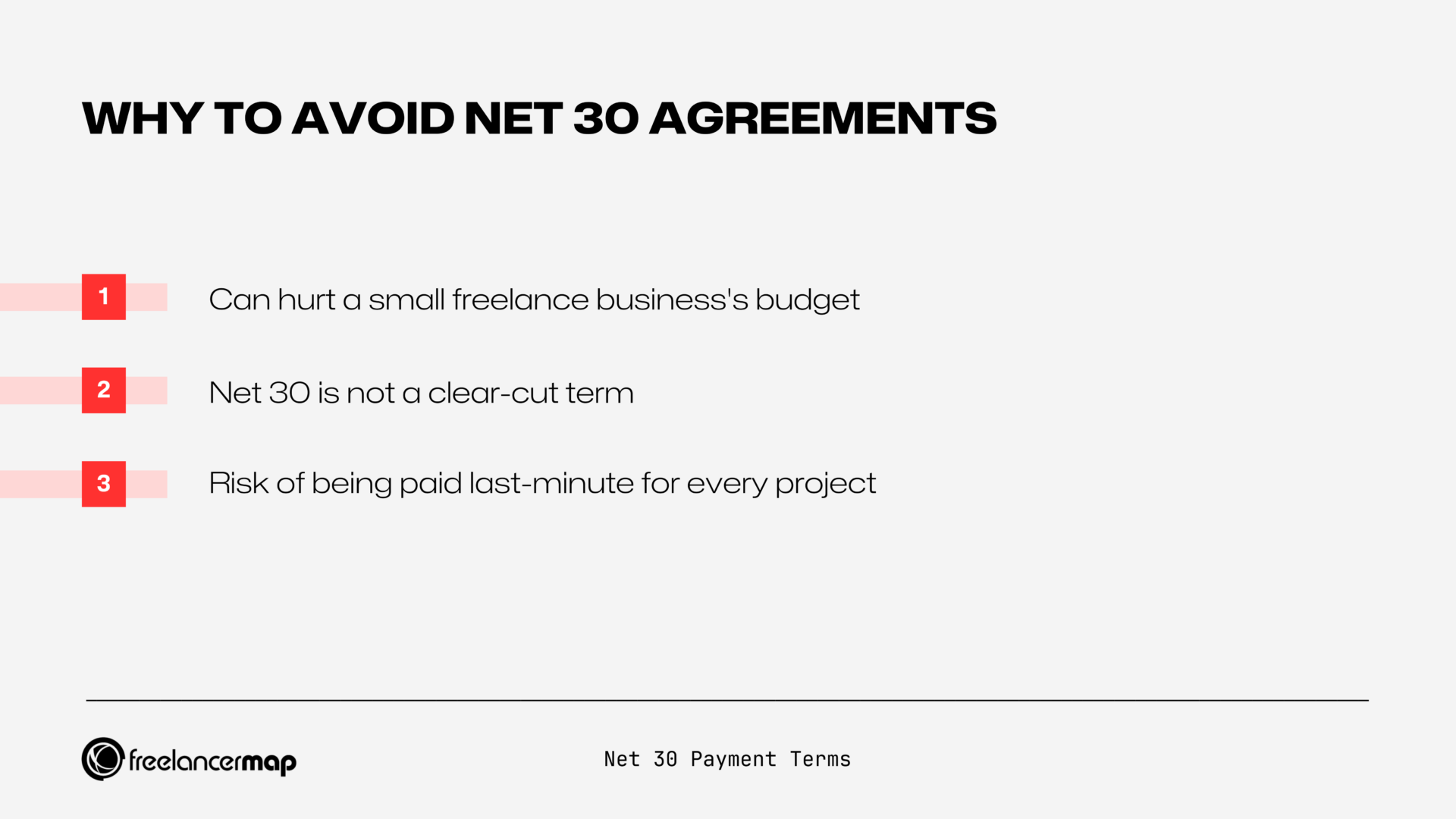
The primary risk associated with Net 30 is the "cash flow gap"—the period between the time you exert effort and incur expenses for a project and the time the actual cash hits your bank account. If you complete a project on January 1st and send an invoice the same day, you are not expecting funds until January 31st. If the client experiences an internal delay, that timeline can easily stretch to 45 or 60 days.
This gap can affect several areas of a freelance business:
- Operating Expenses: Software subscriptions, equipment maintenance, and administrative costs must be covered during the waiting period.
- Reinvestment: Delays in payment restrict your ability to invest in professional development, marketing, or business tools.
- Tax Obligations: Freelancers must account for quarterly estimated taxes. A significant portion of your income may be locked in Net 30 status, leaving you potentially short on liquid cash when tax payments are due.
Best Practices for Invoice Management
To mitigate the disadvantages of Net 30 terms, freelancers must treat the administrative side of their business with the same rigor as the creative or technical side.
1. Clear Contractual Language
Never begin work without a signed agreement that explicitly states the payment terms. If the contract says Net 30, ensure it also specifies the start date—is it 30 days from the date of invoice, or 30 days from the date of work completion? Eliminating ambiguity prevents the client from using "clarification delays" to push back payment.
2. Streamlined Invoicing
Use professional accounting software that allows you to automate invoice generation and recurring reminders. Modern platforms often provide client portals where invoices can be tracked. If an invoice is sent via email, ensure it includes the PO (Purchase Order) number if the client requires one. Missing a PO number is a common cause for automated payment rejection in large organizations.
3. The "Due Upon Receipt" Alternative
For new clients or one-off projects, propose "due upon receipt" terms. This sets an expectation that payment is expected promptly, rather than being delayed by a month-long cycle. If the client insists on Net 30, consider offering a discount for early payment (e.g., "2/10 Net 30," which means a 2% discount if paid within 10 days).
Comparison of Payment Term Strategies
Choosing the right payment term depends on your bargaining power, the size of the client, and your personal financial buffer.
| Term Type | Typical Window | Best For | Pros | Cons |
|---|---|---|---|---|
| Due Upon Receipt | 0–7 days | Small clients/New partners | Immediate cash flow | Can feel aggressive to some |
| Net 15 | 15 days | Mid-size projects | Faster liquidity | Slightly longer than immediate |
| Net 30 | 30 days | Enterprise clients | Industry standard | High risk of cash flow gap |
| Milestone-Based | Variable | Large, long-term projects | Consistent income | Requires tracking effort |
Handling Late Payments and Troubleshooting
What happens when day 30 arrives and the payment has not been received? This is where many freelancers falter due to a lack of professional assertiveness.
- The Friendly Nudge: Send an email on day 31. Keep it polite: "I’m checking in to ensure you received the invoice for [Project Name] and to see if there is any additional information needed from my end to process the payment."
- The Statement of Account: If the invoice is significantly overdue, attach a full statement of account. This professionalizes the request and provides the client with a clear view of their outstanding debt.
- Late Fees: If your contract includes a late fee clause (e.g., 1.5% interest per month on overdue balances), enforce it consistently. While some freelancers fear this might damage the relationship, it actually signals that you run a professional operation and value your time.
Legal and Professional Limitations
It is essential to recognize that as a freelancer, you are essentially providing unsecured credit. Unlike a bank, you do not have the legal apparatus to easily place a lien on a client's property for non-payment. If a client defaults, your options are often limited to small claims court or professional collection services, both of which take time and money.
Always consult with a legal or financial professional regarding the specific contract laws in your jurisdiction. While the advice provided here is intended for operational management, it does not constitute legal counsel. Protect your business by keeping your client base diversified; relying on a single client who operates on strict Net 30 (or slower) terms can create a single point of failure for your entire financial health.
Frequently Asked Questions
What should I do if a client asks for Net 60 instead of Net 30? Explain that your standard operating procedure is Net 30 to maintain cash flow for project expenses. If they insist on Net 60, consider adding a "convenience fee" to the project price or requesting a 50% deposit upfront to offset the waiting period.
How do I handle clients who use "Net 30" as an excuse for "Net 90"? Some clients suffer from "scope creep" in their accounts payable department. If a client is consistently late, stop accepting new work until the outstanding balance is cleared. Firm boundaries are the only way to prevent chronic late payers from draining your resources.
Is it standard to charge interest on late payments? Yes, it is common in B2B service agreements. Including a late-fee clause in your contract serves as a deterrent. Even if you choose not to enforce it for a minor delay with a valued client, having it in writing gives you the leverage to act when a client becomes difficult.
Should I change my terms for returning clients? For long-term, reliable clients, you might allow Net 30 without question. However, if their internal payment processes become unreliable, do not hesitate to renegotiate the terms to protect your bottom line.
What is a "retainer" and how does it relate to Net 30? A retainer is a pre-payment for services. It effectively eliminates the Net 30 wait time because the funds are secured before the work is performed. This is the gold standard for freelance financial stability.
Next Steps for Improving Your Payment Terms
Your financial health depends on your ability to enforce the terms you set. Start by auditing your current contracts: do they clearly define the payment deadline and the process for invoicing? If not, update your standard contract template today.
Next, move toward a "deposit-first" model. Requesting a 30% to 50% deposit before beginning work minimizes the amount of capital you have at risk. By controlling the payment cycle rather than letting it control you, you ensure that your freelance business remains sustainable throughout 2026 and beyond.
Image Gallery
Select an image to open it in a new tab.





Celine Dubois
Contemporary Living and Global Arts Columnist
