A Comprehensive Overview of Centrix Financial Software for Banking and Risk Management
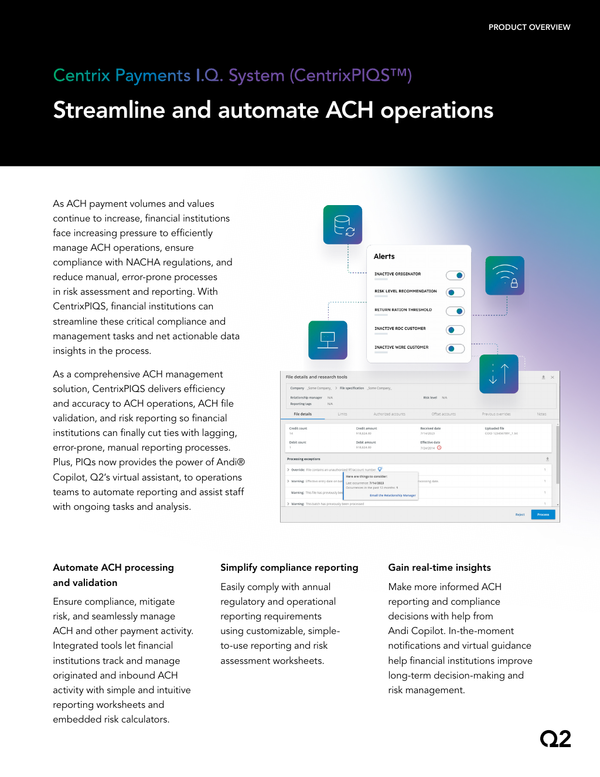
Centrix, a specialized suite of financial technology solutions now integrated into the Q2 ecosystem, provides financial institutions with critical tools for treasury management, risk mitigation, and compliance. This software overview explores the platform's core modules, technical requirements, and its role in modernizing Automated Clearing House (ACH) operations and dispute management for 2026 banking standards.
The primary function of Centrix software is to bridge the gap between core banking systems and the complex requirements of electronic payment oversight. By automating the monitoring of ACH transactions, Remote Deposit Capture (RDC), and regulatory disputes, Centrix allows banks and credit unions to scale their operations without a proportional increase in manual risk-management personnel.
The Evolution of Centrix in the 2026 Financial Landscape
As of 2026, the financial sector has seen a massive shift toward real-time payments and increasingly sophisticated fraud vectors. Centrix has evolved from a standalone risk tool into an integrated platform that manages the lifecycle of a transaction from inception to potential dispute resolution. While originally known as Centrix Solutions, its acquisition by Q2 has allowed it to leverage deeper data analytics and more robust API integrations.
The software is primarily utilized by community banks, regional banks, and credit unions that require "big bank" technology without the overhead of building proprietary systems. It addresses the specific pain points of compliance with Nacha (National Automated Clearing House Association) rules, Regulation E, and Regulation Z, which remain the pillars of consumer protection and operational integrity in the United States.
Core Modules and Functional Capabilities
Centrix is not a single application but a modular suite. Institutions typically select the modules that align with their specific service offerings, such as commercial treasury services or high-volume consumer checking.
1. ACH Specialist (Payments Oversight)
The ACH Specialist module is the flagship component of the Centrix suite. It serves as a centralized hub for all ACH-related activities, providing a layer of intelligence between the bank’s core processor and the Federal Reserve or private clearinghouses.
- Risk Monitoring: The software automatically monitors ACH files for anomalies, such as duplicate batches, unusually high dollar amounts, or unauthorized SEC (Standard Entry Class) codes.
- Reporting: It generates automated reports for both internal auditors and external regulators, ensuring that the institution can prove compliance with annual Nacha audits.
- Operational Efficiency: By automating the "warehousing" of future-dated ACH entries, the software reduces the burden on operations staff who would otherwise need to manually track these items.
2. Risk Management (RDM & RDC)
Remote Deposit Capture (RDC) and ACH risk management are handled through specialized monitoring tools. These tools establish "profiles" for commercial clients, setting hard and soft limits on how much a client can deposit or transmit within a specific timeframe.
In 2026, these limits are often dynamic. Centrix software utilizes historical data to suggest limit adjustments, flagging clients who consistently hit their ceilings or those whose behavior suggests a compromise of their business accounts. This proactive approach is essential for preventing Business Email Compromise (BEC) and other forms of corporate account takeover.
3. Dispute Management System (DMS)
The Dispute Management System is designed to handle the cumbersome process of managing consumer and commercial claims related to unauthorized transactions.
- Workflow Automation: DMS guides frontline staff through the specific questions required to initiate a claim under Regulation E (for electronic funds transfers) or Regulation Z (for credit cards).
- Deadline Tracking: One of the most significant risks for a bank is missing a regulatory deadline for provisional credit or final resolution. Centrix provides a visual dashboard of all active disputes, categorized by their proximity to regulatory expiration dates.
- Document Centralization: All correspondence, signatures, and evidence are stored within the dispute record, eliminating the need for physical folders or disjointed email chains.
Technical Architecture and Integration
Centrix is designed to be "core agnostic," meaning it can interface with major core banking providers like Fiserv, Jack Henry, and FIS. However, the depth of integration depends on the institution's deployment model.
Deployment Options
- SaaS (Software as a Service): The most common deployment in 2026, hosted within Q2’s secure cloud environment. This model ensures that security patches and Nacha rule updates are applied automatically.
- On-Premises: While less common for new implementations, some larger institutions maintain Centrix on local servers to satisfy specific internal data sovereignty requirements.
Data Interfacing and APIs
The software relies on the ingestion of daily files (often in the standard Nacha file format) from the core processor. In 2026, more institutions are moving toward real-time API polling, which allows Centrix to flag a fraudulent transaction before the file is even sent for processing. This shift from "detective" to "preventative" risk management is a hallmark of the current Centrix iteration.
Security and Compliance Standards
Given its role in the financial sector, Centrix adheres to stringent security protocols. It is subject to regular SOC 2 Type II audits and is designed to comply with the FFIEC (Federal Financial Institutions Examination Council) guidelines for cybersecurity.
| Feature | Specification/Standard | Operational Impact |
|---|---|---|
| Encryption | AES-256 (At rest and in transit) | Ensures data integrity and privacy of PII (Personally Identifiable Information). |
| Authentication | Multi-Factor Authentication (MFA) | Required for all administrative and user-level access to the management console. |
| Audit Trails | Immutable Transaction Logs | Every change to a risk limit or dispute status is logged with a timestamp and user ID. |
| Compliance Tracking | Nacha/Reg E/Reg Z | Automated alerts for regulatory deadlines and rule changes. |
| API Security | OAuth 2.0 / OpenID Connect | Securely connects the software to third-party fintech applications and core systems. |
Implementation Prerequisites and Process
Implementing Centrix software is a multi-month engagement that requires coordination between the bank’s IT department, the operations team, and the Centrix/Q2 implementation consultants.
Initial Requirements
- Core Data Access: The institution must be able to export specific transaction data in a format the software can consume (typically flat files or XML).
- Resource Allocation: A designated "Project Lead" from the operations side is necessary to define the risk parameters and workflows.
- Network Configuration: For on-premises or hybrid models, firewalls must be configured to allow secure communication between the local database and the Centrix application server.
The Implementation Lifecycle
- Discovery Phase: The Centrix team reviews the bank's current ACH and dispute volumes to calibrate the software's initial threshold settings.
- Configuration & Mapping: This is the most technical phase, where data fields from the core system are mapped to the Centrix database. This ensures that a "Transaction Type" in the core system is correctly identified as an "ACH Web Entry" in Centrix.
- Testing (UAT): User Acceptance Testing involves running parallel processes where the bank uses Centrix alongside its legacy methods to ensure accuracy.
- Go-Live and Optimization: After the software is live, the focus shifts to "fine-tuning" the alerts to reduce false positives in fraud detection.
Why Institutions Choose Centrix (Pros and Cons)
Advantages
- Regulatory Peace of Mind: The software's primary value is its ability to handle the "alphabet soup" of banking regulations. It acts as a safety net that prevents human error from leading to costly regulatory fines.
- Scalability: Small teams can manage massive transaction volumes. Without Centrix, a bank might need five employees to handle disputes; with it, they might only need two.
- Centralization: Having ACH, RDC, and disputes in one ecosystem (especially when paired with the broader Q2 platform) provides a 360-degree view of client risk.
Considerations and Limitations
- Implementation Complexity: This is not "plug and play" software. It requires significant upfront effort to map data correctly.
- Cost: Centrix is a premium enterprise solution. The licensing and implementation fees can be substantial for very small credit unions or start-up de novo banks.
- Learning Curve: The administrative interface is powerful but can be daunting for users who are not familiar with the technical nuances of Nacha rules or Regulation E.
Common Troubleshooting and Support
Most issues with Centrix software arise from data mismatches during the daily file import process. If the core banking system changes a file format slightly, the Centrix "import engine" may fail.
- File Import Failures: Usually resolved by verifying the file path and ensuring the core system has finished its end-of-day processing before Centrix attempts to pull the data.
- Alert Fatigue: If the risk thresholds are set too low, the system will generate too many warnings. The solution is to use the software's "Discovery Mode" to analyze historical data and set more realistic benchmarks.
- Browser Compatibility: As a web-based application, Centrix requires modern, updated browsers. In 2026, this typically means the latest versions of Chromium-based browsers or Safari, with legacy support for Internet Explorer completely phased out.
Comparison: Centrix vs. Manual Spreadsheets
Many smaller institutions still rely on spreadsheets for dispute tracking and manual reports for ACH oversight. The following comparison highlights the risks associated with manual processes.
- Auditability: Spreadsheets are easily altered and lack a true audit trail. Centrix provides a permanent, immutable record of all actions.
- Consistency: Manual tracking relies on an employee's interpretation of a rule. Centrix enforces the rule programmatically, ensuring every dispute is handled identically.
- Speed: A manual ACH audit can take weeks of preparation. A Centrix-powered audit can often be completed in a few days because the data is already organized and verified.
Frequently Asked Questions
Does Centrix software handle credit card disputes?
Yes, through the Dispute Management System (DMS) module. While many institutions use it primarily for ACH and debit card disputes (Regulation E), it is fully capable of handling credit card claims under Regulation Z. It streamlines the communication between the bank and the card network (Visa/Mastercard) to resolve chargebacks and merchant disputes.
Is Centrix only for banks that use Q2 for online banking?
No. While being a Q2 customer offers some integration benefits, Centrix remains a standalone suite that can be used by any financial institution regardless of their online banking or core processing provider. It is designed to be "vendor-agnostic."
How does Centrix handle the new Instant Payment standards?
By 2026, Centrix has integrated monitoring for FedNow and RTP (Real-Time Payments). The software applies similar risk-scoring logic to these instant transactions as it does to traditional ACH, though the window for intervention is much smaller. The system uses automated triggers to flag or hold suspicious instant payments based on pre-set liquidity and fraud parameters.
What are the training requirements for staff?
Typically, "Super Users" undergo 20–40 hours of intensive training during the implementation phase. Frontline staff who only use the Dispute Management System generally require only 2–4 hours of training to learn how to input claims and upload documentation.
Can Centrix help with anti-money laundering (AML) compliance?
While Centrix is not a dedicated AML/BSA (Bank Secrecy Act) platform, it provides critical data that supports these functions. By identifying unusual ACH patterns or frequent RDC limit increases, it serves as an "early warning system" that feeds into the bank’s broader AML monitoring strategy.
Summary and Next Actions
Centrix software remains a cornerstone for financial institutions seeking to professionalize their risk management and treasury operations. Its strength lies in its deep specialization in the "mechanics" of banking—the rules, the deadlines, and the complex file formats that define modern electronic movement of money.
For institutions considering an overhaul of their ACH or dispute departments, the next logical step is a Data Readiness Assessment. This involves determining if your current core banking system can provide the necessary data exports required to fuel the Centrix engine. Once data availability is confirmed, a demonstration focusing on the specific "Specialist" modules will reveal how much manual labor can be reclaimed through automation.
Image Gallery
Select an image to open it in a new tab.
Vivian Cho
Executive IT and Emerging Technologies Reporter
