Abbreviation of New Mexico: Official Postal, Editorial, and Technical Standards

The official two-letter postal abbreviation for New Mexico is NM, established by the United States Postal Service (USPS) for domestic mail delivery. In traditional print journalism and formal legal citations, the state is commonly abbreviated as N.M. or N. Mex., while international data systems designate it as US-NM under ISO 3166-2 standards.
Choosing the correct abbreviation for New Mexico depends on the context of your document, database, or correspondence. Using the wrong format can cause automated mail sorting errors, disrupt database integrity, or violate publication style guides.
Official Standards for Abbreviating New Mexico
State abbreviations in the United States are not universal; different industries and governing bodies have established distinct systems to serve specific operational needs. While a logistics dispatcher requires a machine-readable two-letter code, an appellate attorney must follow strict jurisdictional citation rules.
The following table summarizes the primary abbreviation formats for New Mexico across government, publishing, and international systems:
| Standard / System | Abbreviation | Primary Application | Punctuation & Capitalization Rules |
|---|---|---|---|
| USPS Postal Code | NM | Mail addressing, automated shipping, logistics | Uppercase, no periods, no spaces between characters |
| Traditional / Historical | N. Mex. | Archival materials, older prose, formal registers | Capitalized words, periods after each abbreviated component |
| Associated Press (AP) | N.M. / Spelled out | Journalism, press releases, news datelines | Periods after each letter; spelled out in body text |
| Chicago Manual (CMOS) | Spelled out / NM | Academic publishing, book manuscripts, formal text | Spelled out in running text; two-letter NM in citations/tables |
| Legal Citation (Bluebook) | N.M. | Court filings, statutory references, legal journals | Capitalized, periods after each letter, no spaces |
| U.S. Government (GPO) | N. Mex. | Congressional records, federal reports (traditional) | Capital "N." and "Mex.", periods after elements |
| ISO 3166-2 | US-NM | International trade, cross-border shipping, global data | Country prefix (US), hyphen, two-letter state code (NM) |
| ANSI / FIPS 5-2 Numeric | 35 | Census analysis, geographic information systems (GIS) | Two-digit integer with leading zero if required |
The USPS Two-Letter Standard (NM)
The United States Postal Service standardized all state abbreviations into two-letter, unpunctuated capitalized codes in October 1963. This change accompanied the rollout of the five-digit Zone Improvement Plan (ZIP) Code.
Before this change, sorting mail relied heavily on human clerks reading varied handwritten abbreviations. "New Mexico" was commonly written as "N.M.," "N. Mex.," or "New Mex." Because human handwriting often blurred the distinction between "N.M." (New Mexico), "N.Y." (New York), and "N.H." (New Hampshire), automated optical character recognition (OCR) systems struggled. The standard NM designation resolved this issue by providing a distinct two-character block that modern automated sorters can process instantly.
USPS Addressing Guidelines (Publication 28)
According to USPS Publication 28 (Postal Addressing Standards), mail intended for delivery in New Mexico must adhere to strict formatting criteria on the bottom lines of the address block:
RECIPIENT NAMESTREET ADDRESS OR PO BOXCITY NM ZIP+4
To maintain full compliance with automated sorting machinery:
- Use the capital letters NM with no periods, commas, or other punctuation.
- Separate the city name and "NM" with a single space.
- Separate "NM" and the five-digit (or ZIP+4) code with two spaces (or a minimum of one single space in electronic print).
- Avoid using lowercase letters (
nm) or interspersed punctuation (N.M.), as these can trigger manual sorting exceptions, delaying delivery.
Editorial and Style Guide Specifications
While postal workers and shipping APIs prioritize machine readability, professional editors prioritize typographic harmony and reading clarity. Major editorial authorities treat the abbreviation of New Mexico differently depending on whether the text appears in running narrative, bibliographic footnotes, or tabular layouts.
Associated Press (AP) Stylebook
For decades, AP Style mandated using traditional abbreviations for state names when paired with a city in datelines and narrative copy (e.g., "ALBUQUERQUE, N.M.—"). Under this system, New Mexico was written as N.M., requiring periods after both capital letters without an intervening space.
However, modern AP Style directs writers to spell out the names of all 50 U.S. states in the body of stories, whether standing alone or paired with a city:
- Correct in narrative text: "The research facility in Los Alamos, New Mexico, received federal approval."
- Incorrect in narrative text: "The research facility in Los Alamos, NM, received federal approval."
AP Style retains abbreviations primarily for:
- Datelines: Stories originating outside major self-identifying cities use
N.M.(e.g.,SANTA FE, N.M.—). Note that Albuquerque is classified by AP as a standalone dateline city requiring no state identifier. - Tabular Material and Lists: In dense statistical tables, sports rosters, or voting summaries where column width is restricted, AP permits the two-letter postal code NM.
- Photo Captions: Follows the same rules as narrative body copy, requiring the full state name unless space limits strictly necessitate abbreviations.
The Chicago Manual of Style (CMOS)
The Chicago Manual of Style emphasizes typographical elegance. CMOS generally discourages abbreviating state names within running text.
- Running Narrative: Spell out the full name: "They relocated from Denver, Colorado, to Taos, New Mexico."
- Parenthetical References and Notes: When space constraints require abbreviation within parenthetical citations, footnotes, or bibliographies, CMOS permits either the traditional abbreviation (N. Mex. or N.M.) or the two-letter postal code (NM). CMOS advises maintaining consistency: if you use two-letter postal codes for one state citation, apply them across all citations in the manuscript.
- Publisher Locations: In bibliographic entries for books published in lesser-known municipalities, CMOS prefers the standard two-letter postal abbreviation without periods (e.g., "Santa Fe: NM, Desert Press").
U.S. Government Publishing Office (GPO) Style Manual
The GPO Style Manual, which governs official publications produced by the United States Federal Government (including Congressional records and executive department publications), maintains an official list of state abbreviations.
Under GPO rules:
- The formal abbreviation is N. Mex. when following a geographic name (e.g., "White Sands, N. Mex.").
- In specialized tables, forms, and financial accounting schedules where column width is strictly limited, the GPO allows the USPS two-letter format (NM).
Legal Citations: The Bluebook
Legal practitioners and scholars writing court briefs, law review articles, and statutory compilations must adhere to The Bluebook: A Uniform System of Citation.
Under Bluebook Rule 10.2.1 and Table T10 (Geographic Terms):
- When abbreviating New Mexico in case names, court designations, or statutory sources, the mandatory format is N.M.
- It appears frequently in official reporter citations and legislative codes, such as:
- N.M. Stat. Ann. § 30-1-1 (New Mexico Statutes Annotated)
- State v. Martinez, 2021-NMSC-001, 478 P.3d 880 (N.M. 2021)
- Using "NM" or "N. Mex." in a formal legal brief submitted to the New Mexico Supreme Court or federal district courts violates standard Bluebook convention.
Technical and International Standards: ISO, FIPS, and ANSI
In software development, enterprise resource planning (ERP) databases, and cross-border shipping networks, state names must conform to standardized data schemas to ensure interoperability.
- Global Data Hierarchy: New Mexico
- [Alpha-2 Country: US]
- [ISO 3166-2: US-NM] — Global Trade / Logistics
- [ANSI / FIPS Alpha: NM] — Domestic Public Records
- [ANSI / FIPS Numeric: 35] — Federal GIS & Census
- [Alpha-2 Country: US]
ISO 3166-2:US-NM
The International Organization for Standardization publishes the ISO 3166 standard for country codes and their subdivisions. ISO 3166-2 covers principal subdivisions such as provinces, territories, and states.
- Code: US-NM
- Structure: The two-letter country code (
US), followed by a hyphen separator, followed by the two-letter subdivision code (NM). - Application: Used in electronic data interchange (EDI), global supply chain manifests, international customs declarations, and multinational software architectures where state names must be scoped to their host country.
FIPS 5-2 and ANSI INCITS 38:2009
The Federal Information Processing Standard (FIPS 5-2), later integrated into the American National Standards Institute (ANSI) as INCITS 38:2009, establishes numeric and alphabetic representations for states.
- Alpha Code: NM
- Numeric Code: 35
- Application: The numeric code
35is ubiquitous across federal datasets. The U.S. Census Bureau uses35as the starting two digits of Federal Information Processing System geographic codes for all counties, census tracts, and block groups located within New Mexico. For instance:- Bernalillo County, NM has the FIPS code
35001. - Santa Fe County, NM has the FIPS code
35049.
- Bernalillo County, NM has the FIPS code
Database architects use the numeric 35 representation in spatial data engines, geographic information systems (GIS), and public health reporting to avoid encoding inconsistencies caused by string-based abbreviations.
Historical Evolution of New Mexico's Abbreviations
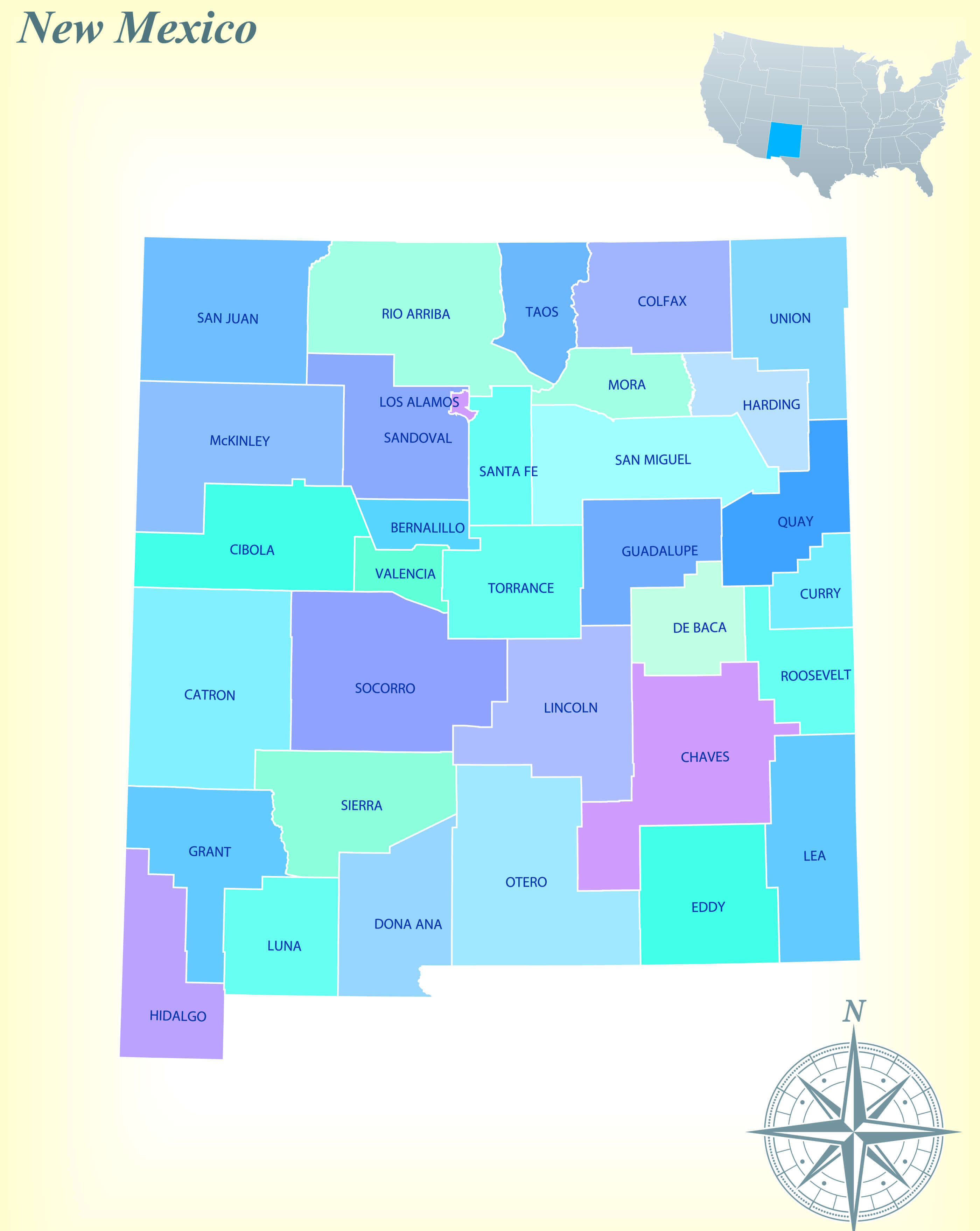
New Mexico was admitted to the Union on January 6, 1912, as the 47th state. Prior to statehood, the region operated as the Territory of New Mexico (1850–1912). The linguistic and operational evolution of its abbreviation reflects the transition from frontier telegraphy to mechanized processing.
Territorial and Early Statehood Usage (1850–1962)
During the nineteenth and early twentieth centuries, abbreviations were designed primarily for handwriting and manual typesetting. Because the name consists of two separate words, early cartographers and federal clerks oscillated between several forms:
- N.M. Ter. or N.M.T.: Extensively used in 19th-century military registers, dispatch documents, and federal land patents before 1912.
- N.M.: The most common shorthand in private letters and local newspapers throughout the early decades of the twentieth century.
- N. Mex.: The preferred long-form abbreviation chosen by early government typographers to clearly distinguish the newly admitted state from both New York (N.Y.) and Mexico itself.
The 1963 Modernization
When the USPS introduced the modern two-letter system in 1963, postal authorities were constrained by 23-character limits in mechanical sorting memory buffers. Every state name had to be compressed into exactly two capital letters with no punctuation.
For single-word states, the postal service generally took the first two letters (e.g., AL for Alabama) or the first and last letters (e.g., KY for Kentucky). For states composed of two words, the system followed a clean, predictable formula: take the first letter of the first word and the first letter of the second word.
Consequently, New Mexico became NM, following the same programmatic pattern as:
- New Hampshire (NH)
- New Jersey (NJ)
- New York (NY)
- North Carolina (NC)
- North Dakota (ND)
Common Mistakes, Ambiguities, and Practical Pitfalls
Despite the apparent simplicity of the two-letter abbreviation, writers, logistics managers, and administrative professionals frequently run into avoidable errors when writing or processing New Mexico's state name.
- Common Visual Confusions:
- NM (New Mexico)
- vs. NV (Nevada)
- vs. NE (Nebraska)
- vs. NH (New Hampshire)
Confusing "NM" with Similar State Codes
In high-volume data entry or handwritten operations, the abbreviation NM is frequently confused with other states beginning with "N":
- NV (Nevada): An inverted or hastily handwritten "M" is easily misread by warehouse workers or OCR hardware as a "V."
- NE (Nebraska): Keyboard slips occasionally substitute the "E" for "M," misrouting cargo across regions.
- NH (New Hampshire): Both states begin with "New," leading typists who rely on memory rather than standard lookup tables to choose the wrong code.
The "Foreign Country" Mail Routing Error
A well-documented administrative issue unique to New Mexico involves personnel outside the state confusing it with the sovereign nation of Mexico.
When addressing letters or packages, some senders append "USA" incorrectly or write out "New Mexico, Mexico." Even worse, postal and private courier clerks unfamiliar with domestic geography have occasionally returned domestic parcels bearing the NM abbreviation to the sender, claiming that the shipment lacked international customs documentation.
To prevent domestic delivery delays:
Always use the exact postal format:
[City] NM [ZIP Code].If sending from an international location into New Mexico, format the final lines as:
ALBUQUERQUE NM 87102UNITED STATES OF AMERICA
Never add "USA" between the state abbreviation and the ZIP code (e.g., avoid
Albuquerque, NM, USA 87102). Under USPS machine-sorting guidelines, placing the national identifier in the domestic city/state/ZIP line can confuse optical sorters.
Punctuation and Casing Inconsistencies
Different environments demand strict adherence to formatting rules:
- The Trailing Period Error: Writing
Albuquerque, NM.with a period after the postal code violates USPS standards. In a postal block, no periods should follow the state code. - The Hybrid Abbreviation: Forms like
N.M(one period omitted) orN.Mex(missing the second period) violate both AP and GPO editorial rules. Traditional abbreviations require a period after every abbreviated element: N. Mex. or N.M. - Database Casing: In relational databases with strict case-sensitive validation, submitting lowercase strings such as
nmcan cause API call rejections. Web application forms should automatically sanitize and transform state input strings to uppercaseNMbefore persisting data.
Technical Implementation in Software and Data Systems
When designing forms, database tables, and validation pipelines, handling state abbreviations correctly prevents downstream integration failures with shipping services and public records systems.
Database Schema Design
For relational databases (such as PostgreSQL or MySQL), the column used to store the state code should be strictly typed.
-- Optimal state column definition for US-only systems CREATE TABLE customer_addresses ( address_id SERIAL PRIMARY KEY, street_line1 VARCHAR(100) NOT NULL, street_line2 VARCHAR(100), city VARCHAR(50) NOT NULL, state_code CHAR(2) NOT NULL, postal_code VARCHAR(10) NOT NULL, CONSTRAINT chk_state_uppercase CHECK (state_code ~ '^[A-Z]{2}$') );
Implementation notes:
- Use a fixed-width
CHAR(2)data type rather than a variableVARCHARfield when storing USPS abbreviations. - Apply check constraints or foreign keys linking to a reference table of valid two-letter ISO/USPS codes to ensure invalid entries (like "NMX" or "N.M.") are rejected at the database level.
- If your application handles international addresses, decouple the subdivision field to handle
ISO 3166-2values (VARCHAR(6)to allow values likeUS-NM,CA-ON, etc.).
Front-End Input Validation
When building user registration or checkout flows:
- Drop-down Menus vs. Text Fields: Prefer structured
Image Gallery
Select an image to open it in a new tab.






Omar Farooq
EdTech Innovation and Virtual Pedagogy Journalist
