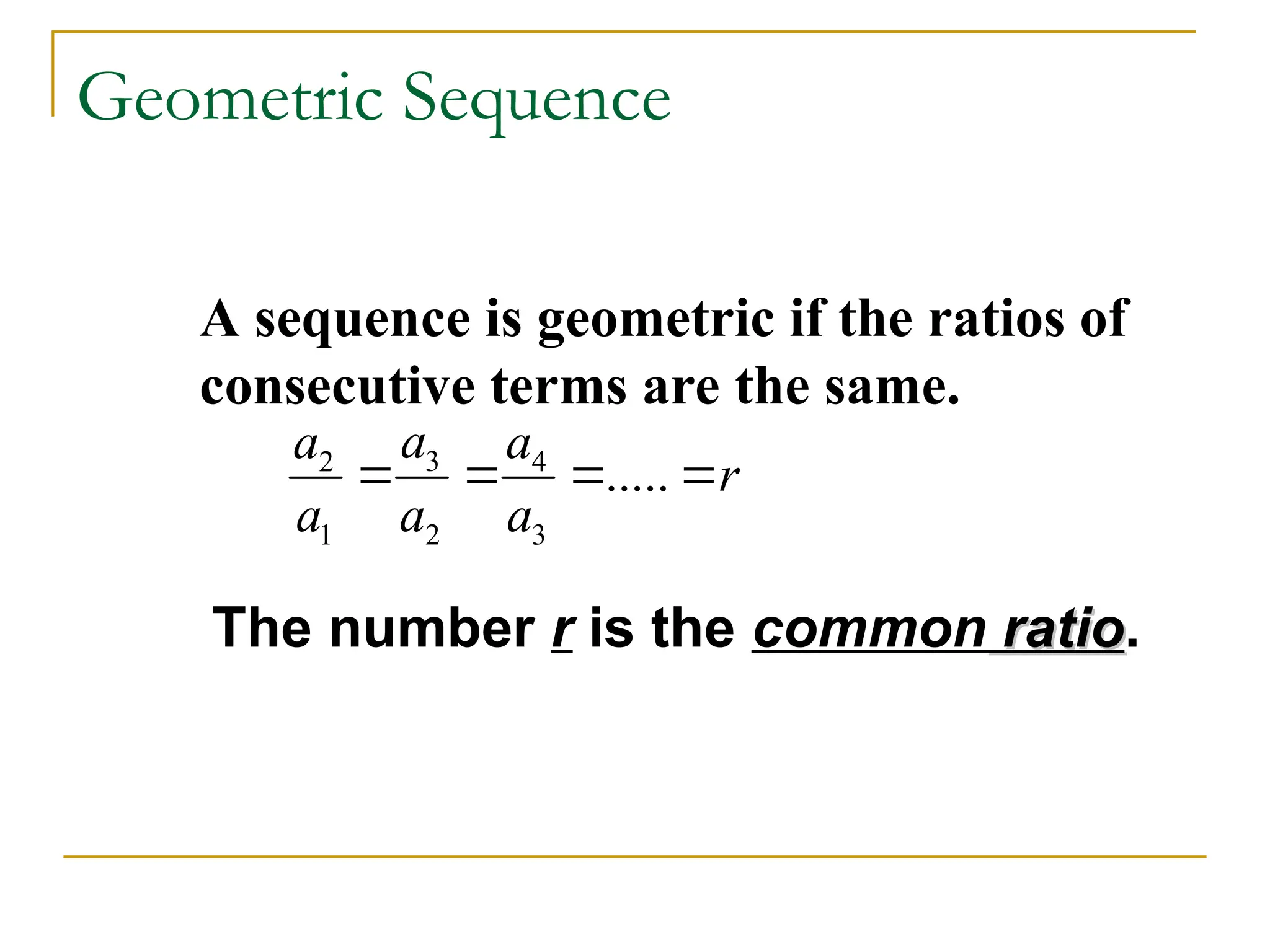
In a geometric series, the variable r represents the common ratio. This constant value is the factor by which each term in the sequence is multiplied to generate the subsequent term. By identifying r, one can determine the growth or decay pattern of the series, calculate missing terms, and assess whether the series converges or diverges.
The Definition of the Common Ratio
A geometric sequence is a sequence of numbers where each term after the first is found by multiplying the previous one by a fixed, non-zero number. This fixed number is the common ratio, denoted as r. Mathematically, if a sequence is denoted by terms $a_1, a_2, a_3, \dots, a_n$, then the common ratio is defined by the relationship:
$r = \frac{a_n}{a_{n-1}}$
For a sequence to be truly geometric, this ratio must remain constant for every pair of consecutive terms. If the ratio changes between different sets of terms, the sequence is not geometric. This foundational concept allows mathematicians to predict future values in a series without having to calculate every intermediate step, provided the first term and the common ratio are known.
How to Calculate r from a Given Series
To determine the value of r when provided with a sequence, you simply need to divide any term by the term that immediately precedes it. While dividing the second term by the first is the standard approach, choosing any two adjacent terms will yield the same result if the series is indeed geometric.
Consider the sequence 3, 6, 12, 24. To find r, calculate $6/3 = 2$ or $12/6 = 2$. In this instance, r equals 2. If the sequence is decreasing, such as 100, 50, 25, then $50/100 = 0.5$, meaning r is 0.5. Dealing with alternating signs is also common; for the sequence 5, -10, 20, -40, the ratio is $-10/5 = -2$. The sign of r indicates whether the terms will oscillate between positive and negative values as the series progresses.
The Significance of r in Geometric Series Formulas
The value of r is essential for the two primary formulas used in geometric series: the formula for the $n$-th term and the formula for the sum of a series.
The n-th Term Formula
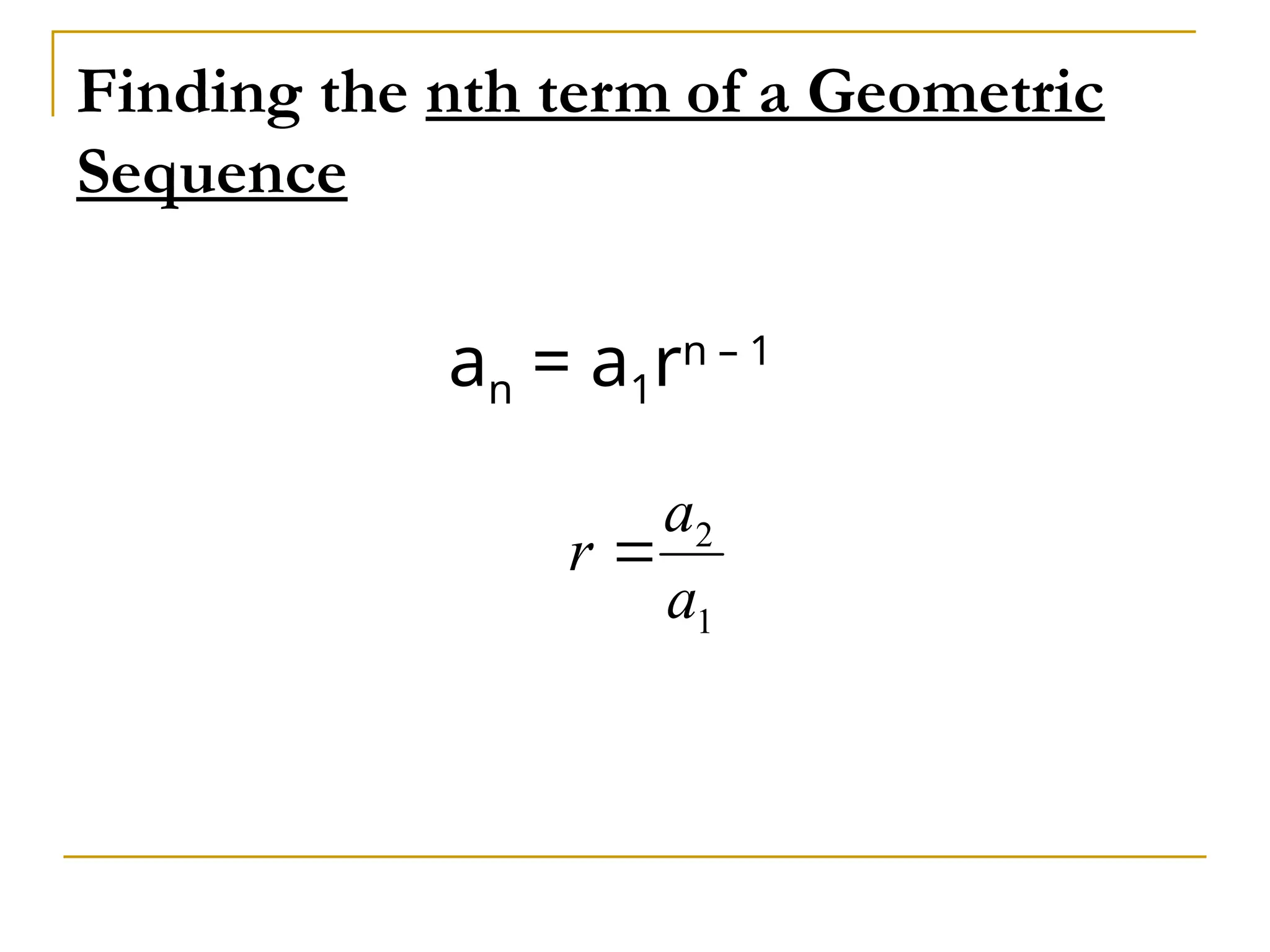
To find any specific term ($a_n$) in a geometric sequence, the formula is: $a_n = a_1 \cdot r^{n-1}$ Here, $a_1$ is the first term, and $n$ is the position of the term you wish to find. Because r is raised to the power of $(n-1)$, the common ratio dictates the rate at which the value grows or shrinks relative to the start of the sequence.
The Sum of a Finite Geometric Series
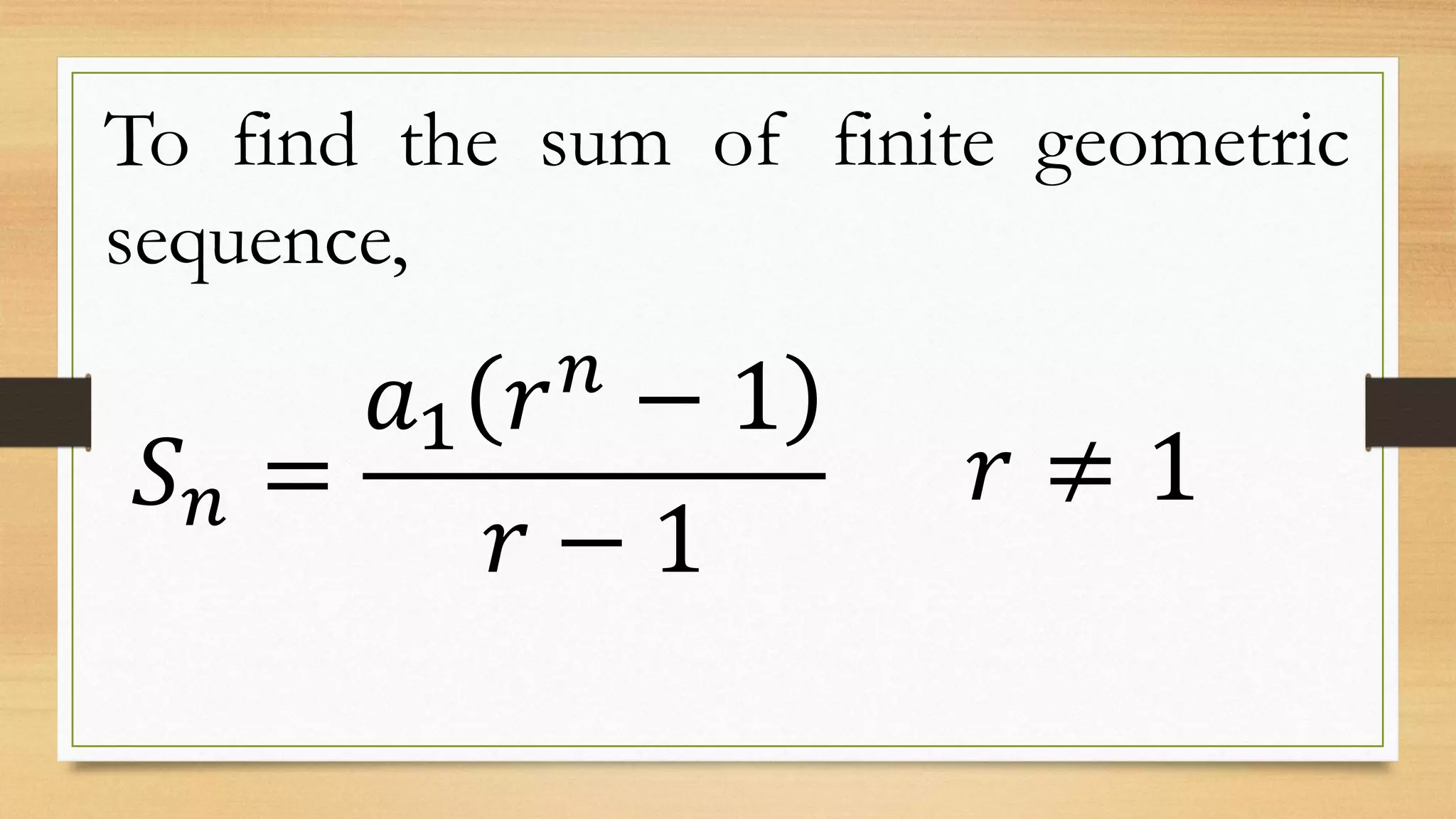
When calculating the sum ($S_n$) of the first n terms, the formula is: $S_n = \frac{a_1(1 - r^n)}{1 - r}$ This formula is valid as long as $r \neq 1$. If $r = 1$, the series is simply the first term repeated n times, making the sum $n \cdot a_1$. The common ratio's value significantly alters the denominator and the numerator, dictating how large the sum becomes as more terms are added.
Convergence vs. Divergence: The Role of r
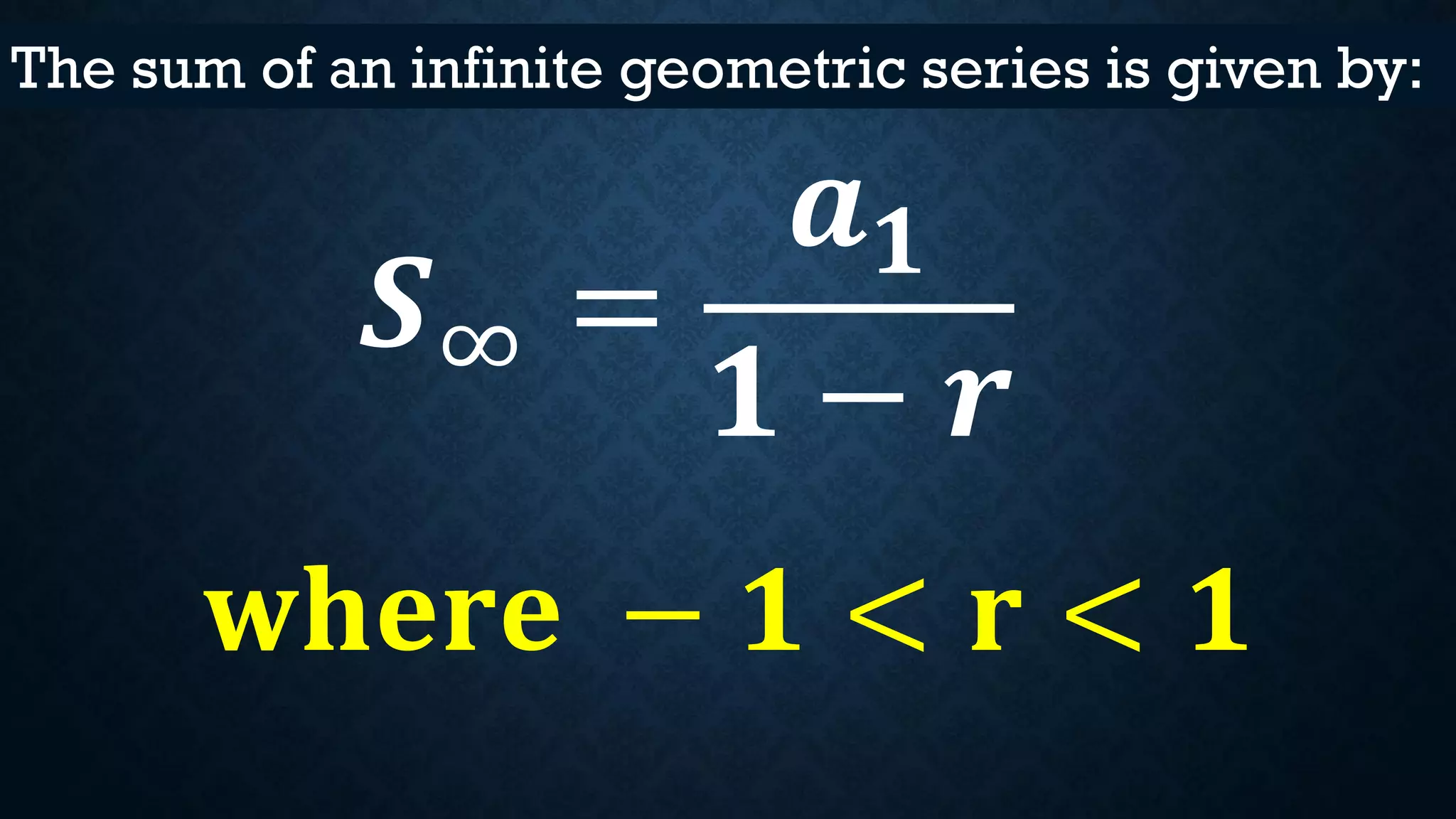
One of the most critical applications of r is determining whether an infinite geometric series converges or diverges. An infinite geometric series converges if and only if the absolute value of r is less than 1 (written as $|r| < 1$).
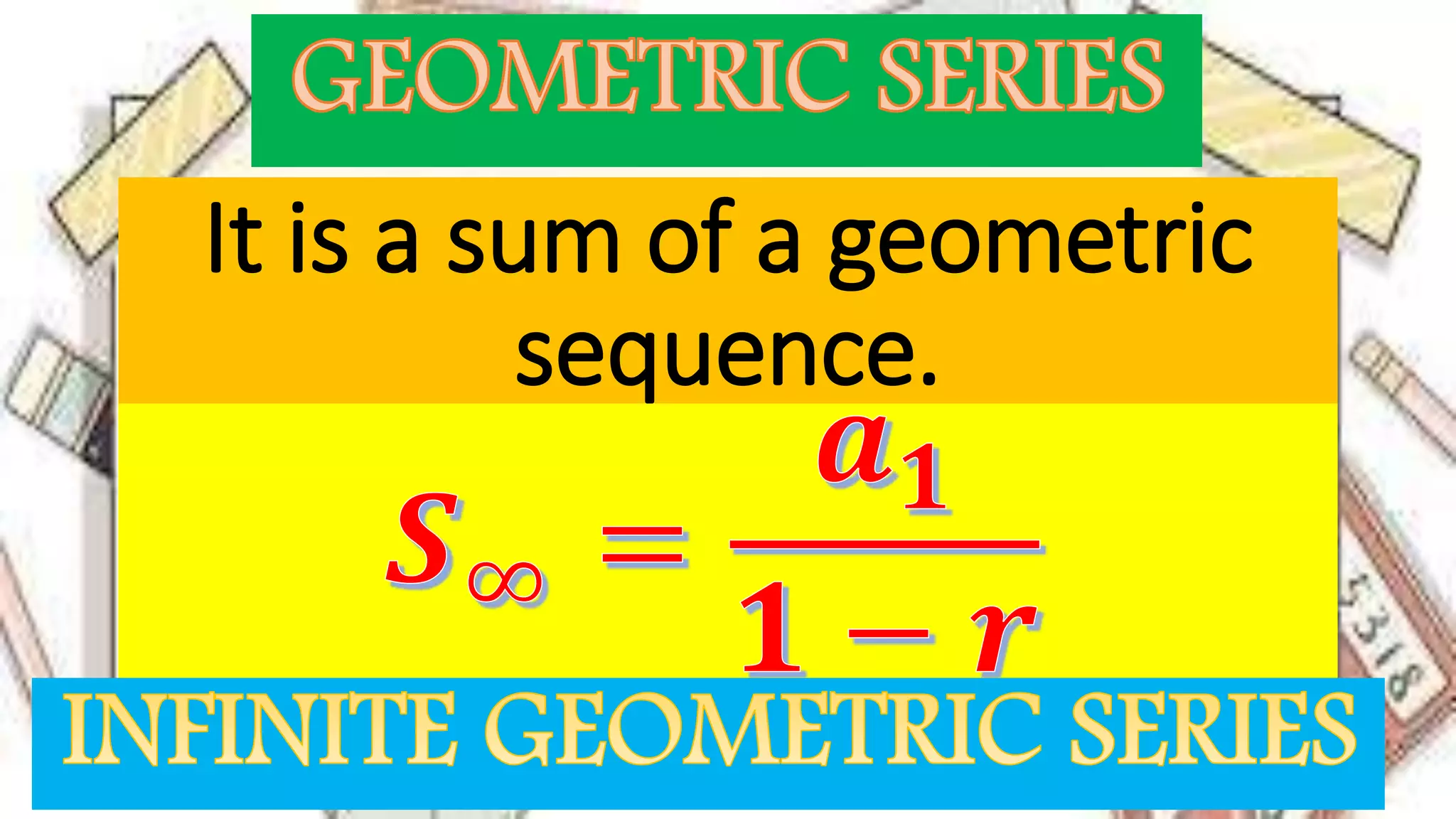
- Convergent Series ($|r| < 1$): If the ratio is a fraction between -1 and 1, the terms become progressively smaller, approaching zero. Consequently, the infinite sum approaches a specific, finite value. The formula for this sum is $S = \frac{a_1}{1 - r}$.
- Divergent Series ($|r| \geq 1$): If the absolute value of r is 1 or greater, the terms do not shrink toward zero. Instead, they stay the same or grow in magnitude, meaning the infinite sum will not settle on a single finite number; it effectively goes to infinity or oscillates without bound.
Comparative Behavior of the Common Ratio
The behavior of a geometric series is entirely contingent upon the value of r. The following table summarizes how different values of r affect the progression of terms.
| Value of r | Sequence Behavior | Convergence Status |
|---|---|---|
| $r > 1$ | Terms grow larger (Exponential growth) | Divergent |
| $r = 1$ | All terms are equal (Constant) | Divergent |
| $0 < r < 1$ | Terms shrink toward zero (Decay) | Convergent |
| $r = 0$ | The sequence effectively ends after the first term | Convergent |
| $-1 < r < 0$ | Terms shrink and oscillate signs | Convergent |
| $r \leq -1$ | Terms grow or oscillate without settling | Divergent |
Common Mistakes When Identifying r
Students and practitioners often make errors when calculating or applying the common ratio. Awareness of these pitfalls can improve accuracy in mathematical modeling.
- Forgetting to Check All Pairs: A common error is calculating the ratio between the first two terms and assuming it applies to the whole sequence. If the sequence is not verified as geometric, calculating only one ratio is insufficient. Always check at least two or three pairs of adjacent terms to ensure r is truly constant.
- Sign Errors with Negative Ratios: When $r$ is negative, terms alternate signs. Beginners often lose the negative sign when dividing a negative term by a positive one or vice versa. Always track the sign of the dividend and divisor carefully.
- Confusing $r$ with the Term Value: Distinguishing between the ratio r and the value of a specific term ($a_n$) is vital. A common ratio can be a fraction, a whole number, or a negative number, but it remains the multiplier, not the result of the multiplication.
- Misapplying the Sum Formula: When the number of terms ($n$) is large, the $(1-r^n)$ portion of the sum formula can lead to calculation errors if the order of operations is ignored. Always compute $r^n$ before subtracting from 1.
Practical Applications of the Common Ratio
Understanding r extends beyond classroom mathematics into fields such as finance, biology, and physics.
- Finance (Compound Interest): When calculating the growth of an investment where interest is added at regular intervals, the common ratio is $(1 + i)$, where i is the interest rate. If an account grows by 5% annually, r is 1.05.
- Physics (Half-Life): In radioactive decay, the substance remaining follows a geometric sequence. If half of the material decays over a specific period, the common ratio r is 0.5.
- Computer Science: Recursive algorithms often generate sequences where the time complexity follows a geometric progression. Identifying the ratio helps in understanding the efficiency and scalability of the code.
Frequently Asked Questions
Can the common ratio r be zero? If r is zero, the sequence becomes $a_1, 0, 0, 0, \dots$. While mathematically defined, it is often treated as a trivial case because all terms after the first are zero, making it less useful for the standard geometric series formulas that rely on r as a multiplier.
How do I find the sum of an infinite geometric series if r is 2? You cannot. Because $|r| = 2$, which is greater than 1, the series is divergent. There is no finite sum for an infinite series where the absolute value of the common ratio is 1 or greater.
What should I do if my series does not have a constant r? If the ratio between consecutive terms is not constant, the series is not geometric. It may be arithmetic (where there is a constant difference rather than a ratio) or a more complex sequence, such as a quadratic or Fibonacci-style sequence. Re-evaluate the series to determine if a different mathematical model is appropriate.
Is there a way to calculate r if I only know two non-consecutive terms? Yes. If you know term $a_n$ and term $a_m$ (where $n > m$), the relationship is $a_n = a_m \cdot r^{(n-m)}$. You can solve for r by dividing the terms and taking the $(n-m)$-th root: $r = \sqrt[n-m]{a_n / a_m}$.
Why is r sometimes called a common multiplier? The term "common ratio" is standard in algebra, but "common multiplier" is functionally equivalent because multiplying by a ratio is the mechanism that defines the progression. In most technical or academic settings, "common ratio" is the preferred terminology.
Recommendation for Further Analysis
If you are currently working with a series and need to determine its behavior, begin by calculating the ratio between the first three terms. If the ratio $a_2/a_1$ equals $a_3/a_2$, you have successfully verified the common ratio. Use this value to test for convergence by checking if $|r| < 1$. If you are modeling real-world data, ensure that your r value reflects the actual growth or decay rate observed, as even minor deviations in r can lead to significant discrepancies over a large number of terms.
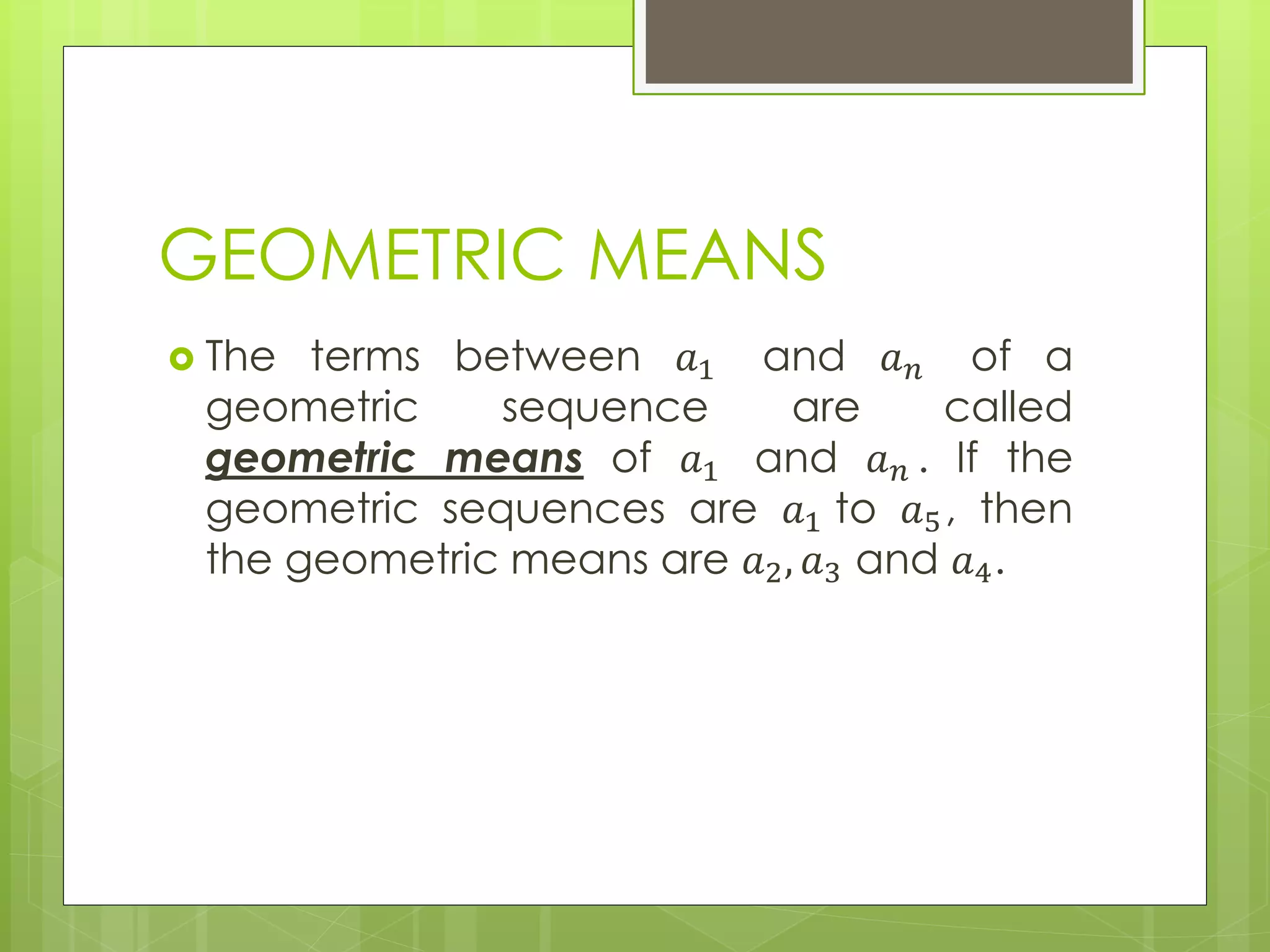
Image Gallery
Select an image to open it in a new tab.
Vivian Cho
Executive IT and Emerging Technologies Reporter
