An electronic signature is legally valid and enforceable in nearly every industrialized nation, provided it meets specific regulatory requirements. In the United States, the ESIGN Act and UETA establish that a signature cannot be denied legal effect solely because it is in electronic form. For a signature to be valid, it must demonstrate the signer's intent, record their consent to do business electronically, and be definitively linked to the document.
The Legal Foundation of Electronic Signatures
The question of whether an electronic signature (e-signature) is valid was largely settled at the turn of the millennium, but the technical standards and nuances of enforcement have continued to evolve. As of 2026, the legal framework remains robust, primarily resting on three major pillars of legislation: the Electronic Signatures in Global and National Commerce (ESIGN) Act, the Uniform Electronic Transactions Act (UETA), and the European Union’s eIDAS regulation.
The ESIGN Act (Federal-US)
Passed in 2000, the ESIGN Act is a federal law that ensures the validity of electronic signatures and records in interstate and foreign commerce. The core principle of the ESIGN Act is "non-discrimination." This means that a contract or signature cannot be ruled invalid or unenforceable simply because it was generated or stored electronically. This act provided the necessary confidence for the early growth of e-commerce and continues to serve as the baseline for electronic legal transactions today.
UETA (State-US)
The Uniform Electronic Transactions Act (UETA) was developed to provide a consistent framework for states to handle electronic transactions. Adopted by 49 states, the District of Columbia, Puerto Rico, and the U.S. Virgin Islands, UETA mirrors the ESIGN Act's goals but applies to state-level law. It focuses on the equivalence of paper-based and electronic records. In the few jurisdictions where UETA is not fully adopted, the ESIGN Act generally fills the gap to ensure federal consistency.
International Context: eIDAS (EU and Beyond)
In the European Union and much of the international community, the eIDAS regulation (Electronic Identification, Authentication, and Trust Services) defines the standards for e-signatures. Unlike the broad "catch-all" approach of the U.S., eIDAS categorizes signatures into three distinct levels of security: Simple, Advanced, and Qualified. This tiered system provides a more granular look at the technical reliability of a signature, which is often used as a global benchmark for high-stakes international contracts.
The Four Essential Requirements for a Valid E-Signature
Simply typing a name at the bottom of an email does not always constitute a legally "valid" e-signature in a high-stakes environment. For an e-signature to hold up under the scrutiny of a court or regulatory body in 2026, it must satisfy four distinct legal requirements.
1. Intent to Sign
Like a traditional wet-ink signature, the signer must demonstrate a clear intent to sign the document. In the digital world, this is often achieved through specific UI/UX cues. For example, a "Sign Here" button, a checkbox confirming the signature, or the act of drawing a signature on a touchscreen all serve as evidence of intent. If a signature is applied automatically without a conscious action by the user, its validity can be easily challenged in court.
2. Consent to Do Business Electronically
Parties involved in a transaction must agree to conduct that transaction electronically. While this consent can often be implied by the circumstances (such as responding to an electronic signature request), most professional e-signature platforms include a mandatory "Consumer Disclosure" or "Electronic Record Consent" click-through. This ensures that the signer is aware they are entering into a legally binding digital agreement and have the option to request a paper version instead.
3. Association of Signature to the Record
The electronic signature must be "attached to or logically associated with" the record being signed. This is a technical requirement. Modern e-signature software handles this by creating a secure digital "envelope" that contains both the document and the signature data. If the document is modified after the signature is applied, the association is broken, or a "tamper-seal" is triggered, signaling that the signature may no longer be valid for the current version of the document.
4. Record Retention
For a digital contract to remain valid, it must be capable of being retained and accurately reproduced for later reference by all parties. This means the e-signature system must provide the signer with a way to download, print, or store a copy of the signed document. If a service provider signs a document but refuses to give the client a copy, they risk the contract being ruled unenforceable under the ESIGN Act’s retention clauses.

Understanding Different Types of Electronic Signatures
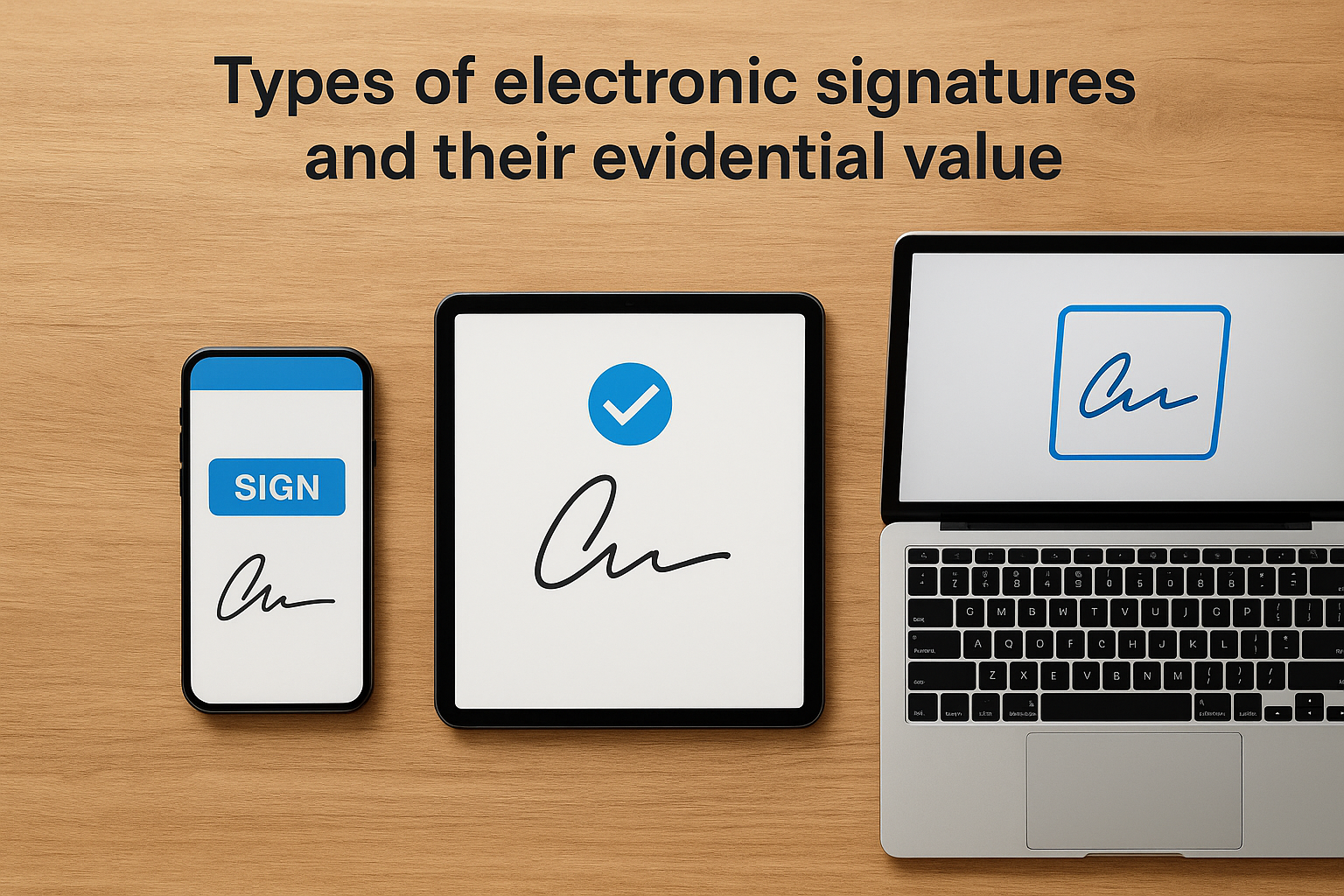
Not all e-signatures are created equal. Depending on the risk associated with a document, a simple digital mark might not be sufficient. In 2026, we distinguish between three primary levels of digital authentication.
Simple Electronic Signature (SES)
This is the most common and least secure form of e-signature. It includes scanned images of a handwritten signature, a typed name, or a "click-to-agree" button. While legally binding for low-risk documents like internal memos or basic purchase orders, an SES lacks a strong mechanism to prove who actually clicked the button.
Advanced Electronic Signature (AES)
An AES requires more stringent identification. It must be uniquely linked to the signer, capable of identifying the signer, and created using data that the signer can use under their sole control. Furthermore, it must be linked to the signed document in such a way that any subsequent change to the data is detectable. This is typically achieved through Public Key Infrastructure (PKI) and digital certificates.
Qualified Electronic Signature (QES)
A QES is the gold standard of digital signatures, primarily used in the EU and for high-value transactions globally. It is an Advanced Electronic Signature that is created by a "qualified electronic signature creation device" and based on a "qualified certificate for electronic signatures." In many jurisdictions, a QES has the same legal effect as a handwritten signature and is automatically afforded a higher "presumption of validity" in legal disputes.
| Feature | Simple E-Signature (SES) | Advanced E-Signature (AES) | Qualified E-Signature (QES) |
|---|---|---|---|
| Legal Recognition | Valid in most cases | High legal weight | Highest legal weight |
| Identity Verification | Basic (Email/IP) | Multi-factor / Digital Certs | Face-to-face or equivalent |
| Tamper Detection | Minimal | Cryptographic hashing | High-level encryption |
| Common Use Cases | HR forms, NDAs | Commercial contracts | Mortgages, Notarial acts |
| Burden of Proof | Higher on the requester | Lower; verifiable audit trail | Presumed valid in court |
The Role of the Audit Trail and Metadata
One of the greatest advantages of an e-signature over a wet-ink signature is the "Audit Trail." While a paper signature can be forged with a pen, a digital signature generates a trail of metadata that is significantly harder to fabricate. In 2026, a valid e-signature should always be accompanied by a certificate of completion or a log containing the following data:
- IP Address: The unique network identifier of the device used to sign.
- Time Stamps: Precise records of when the document was opened, viewed, and signed.
- Authentication Method: Proof of how the signer’s identity was verified (e.g., via email link, SMS code, or government ID upload).
- Document Integrity: A hash (a mathematical "fingerprint") of the document at the time of signing to ensure it has not been altered.
This audit trail is the primary evidence used in court to resolve disputes. If a signer claims, "I didn't sign that," the audit trail can prove that the document was sent to their private email, opened from their home IP address, and signed using a code sent to their personal mobile phone.
When E-Signatures Are NOT Valid: Key Exceptions
Despite the broad applicability of the ESIGN Act and UETA, certain documents are still excluded from electronic signature validity for reasons of public policy or fraud prevention. While these lists have shrunk as technology improves, the following typically still require a physical, "wet" signature as of 2026:
- Wills, Codicils, and Testamentary Trusts: Due to the risk of undue influence and the gravity of the document, most jurisdictions require a physical signature in the presence of witnesses.
- Family Law Matters: Documents regarding divorce, adoption, and certain other family court orders often require physical presence and wet ink.
- Court Orders and Notices: While many courts have moved to "e-filing," certain official court notices, such as those for the cancellation of utility services (water, heat, electricity) or notices of foreclosure, may still require physical service and signatures.
- Hazardous Materials Documents: Documentation required for the transport or handling of toxic materials often requires physical signatures for immediate verification by emergency responders.
- Promissory Notes and Security Agreements: While changing, some legacy real estate and high-finance sectors still prefer paper originals for certain types of collateralized debt.
Technical Security and Verification Procedures
To ensure that an e-signature remains valid over time, organizations must implement rigorous technical standards. In 2026, the industry has largely consolidated around the ISO 27001 standard for information security and the PAdES (PDF Advanced Electronic Signatures) standard for document integrity.
Cryptographic Hashing
When a document is signed, the software creates a "hash" of the file. This is a complex string of characters that represents the exact state of the document. If even a single comma is moved after the signature is applied, the hash will change, instantly invalidating the digital seal. This provides a level of security that paper documents—which can be edited by replacing pages or using white-out—simply cannot match.
Public Key Infrastructure (PKI)
PKI is the technology behind Advanced and Qualified signatures. It uses two keys: a private key (kept secret by the signer) and a public key (shared with the recipient). When the signer applies their private key to the document, it creates a digital signature that can only be decrypted by their public key. This proves both the identity of the signer and the fact that the document has not been altered.
Common Mistakes That Invalidate E-Signatures
Even with the best software, human error can undermine the legal validity of an e-signature. Businesses should avoid these common pitfalls:
- Failure to Authenticate: Simply sending a link to a generic "info@" email address makes it difficult to prove who signed the document. Using SMS authentication or unique access codes is highly recommended for sensitive contracts.
- Incomplete Audit Trails: Some low-cost signature tools do not preserve the audit trail for more than a few months. If a dispute arises three years later and the log is gone, the signature’s validity is compromised.
- Mixing Paper and Digital: Attempting to "hybrid" a document—where one person signs on paper and another signs digitally—can create a legal mess regarding which version is the "original." It is best to keep the entire workflow in one medium.
- Ignoring Local Laws: While the ESIGN Act covers the US, if you are signing a contract with a partner in Japan, China, or Germany, you must ensure your signature method meets the local equivalent (such as the My Number system in Japan or eIDAS in Europe).
FAQs About E-Signature Validity
Is a typed name in an email considered a valid e-signature?
Yes, technically. Under the ESIGN Act, a typed name at the bottom of an email can be considered an electronic signature if it can be proven that the sender intended to sign the message. However, it is the weakest form of signature and is frequently challenged in court due to the lack of strong authentication and tamper-evident technology.
Can I use a picture of my handwritten signature?
A scanned image or a photograph of a wet signature (often called a "digitized" signature) is legally valid, but it is highly susceptible to fraud. It lacks the cryptographic proof and audit trail provided by professional e-signature platforms. Most legal experts advise against using simple images for significant financial or legal commitments.
Do electronic signatures expire?
The legal validity of the agreement itself does not expire unless stated in the contract. However, the digital certificate used to sign the document may have an expiration date (often 1–3 years). To ensure long-term validity (LTV), modern platforms use "Long-Term Validation" timestamps, which prove the certificate was valid at the exact moment the signature was applied, even if the certificate expires later.
Are e-signatures valid for real estate transactions?
In 2026, e-signatures are valid for the vast majority of real estate documents, including listing agreements and purchase contracts. However, the actual "Deed" or "Mortgage" note may still require Remote Online Notarization (RON) or, in some conservative jurisdictions, a physical signature for recording at the county clerk's office.
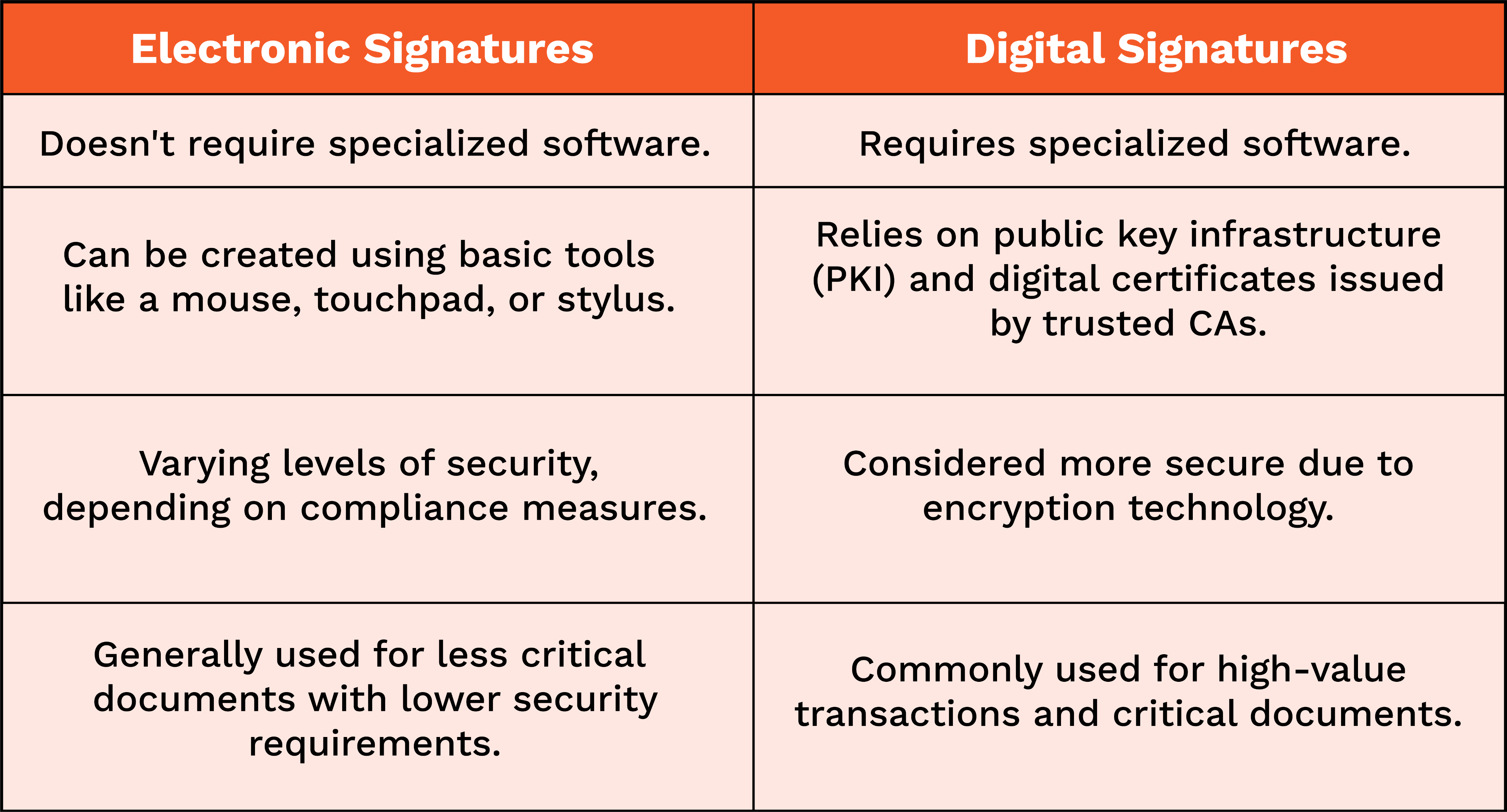
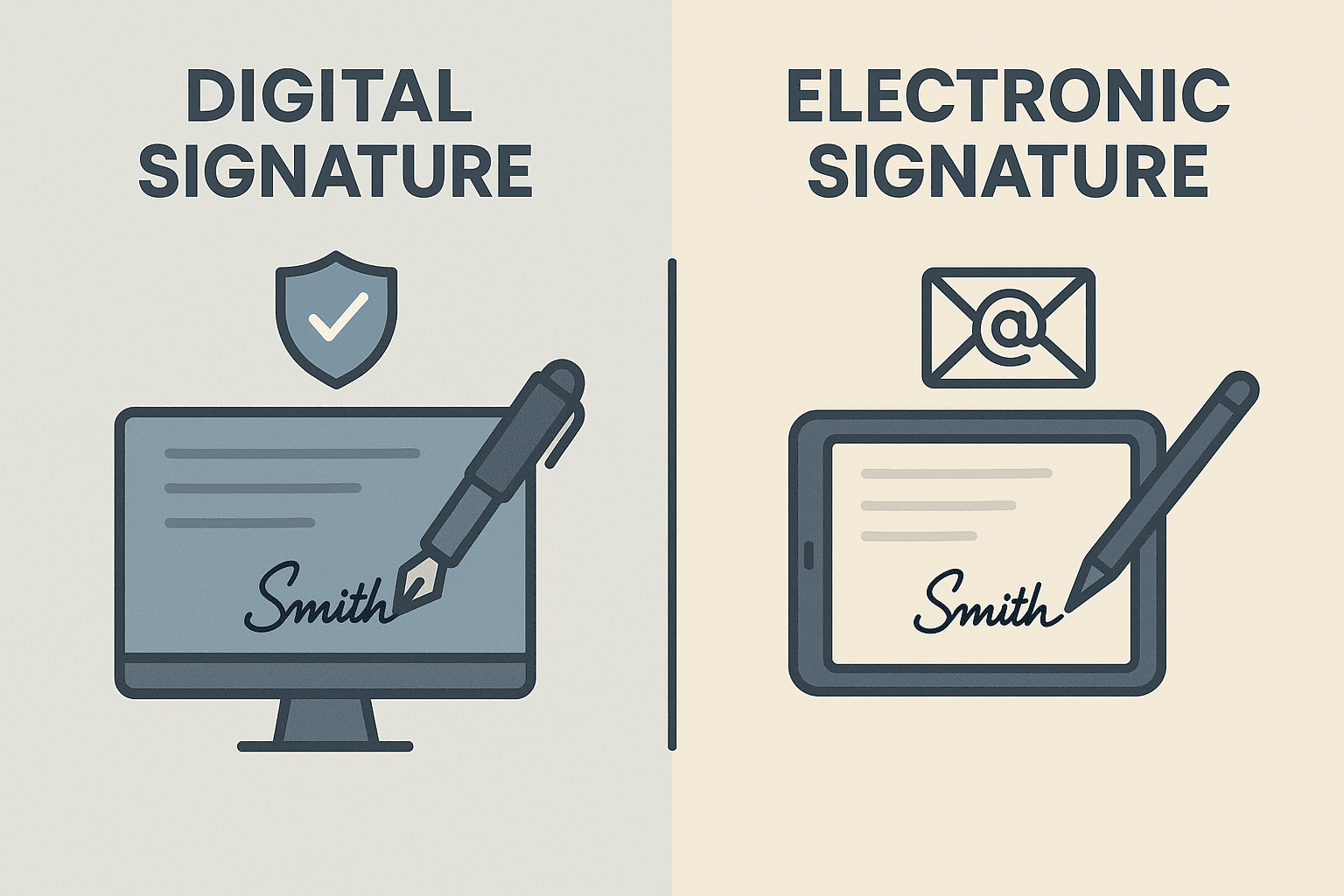
What is the difference between a "Digital Signature" and an "Electronic Signature"?
"Electronic signature" is the legal term for any electronic sound, symbol, or process associated with a record. "Digital signature" is a technical term referring to a specific type of e-signature that uses cryptographic technology (like PKI) to provide a higher level of security and verification. All digital signatures are e-signatures, but not all e-signatures are digital signatures.
Practical Recommendation for Ensuring Validity
To ensure your electronic signatures are indisputable in 2026, do not rely on simple email exchanges or scanned images. Instead, utilize a reputable e-signature service provider that adheres to SOC 2 Type II security standards and offers an automated, tamper-proof Audit Trail.
For high-value or international transactions, always opt for Advanced Electronic Signatures (AES) that include multi-factor authentication (MFA). If you are operating within the European Union or dealing with government agencies, verify whether a Qualified Electronic Signature (QES) is required. Finally, always ensure that a fully executed copy of the document—including the audit log—is stored in a secure, redundant cloud environment to satisfy record retention requirements.
Image Gallery
Select an image to open it in a new tab.



Zara El-Hashem
Sociocultural Dynamics and Academics Writer
