
Deamidation in proteins is a non-enzymatic chemical modification where an asparagine or glutamine side chain is converted into a carboxylic acid, typically resulting in a mixture of aspartic acid, isoaspartic acid, or glutamic acid. This transformation alters the protein's primary structure, introduces a negative charge, and often disrupts protein folding, stability, and physiological function, acting as a critical molecular clock for protein aging and degradation.
The Chemistry of Deamidation
At the fundamental level, deamidation is a hydrolytic reaction. It occurs primarily at asparagine (Asn) and, to a lesser extent, glutamine (Gln) residues. The reaction is driven by the susceptibility of the amide group in the side chain of these amino acids to nucleophilic attack.
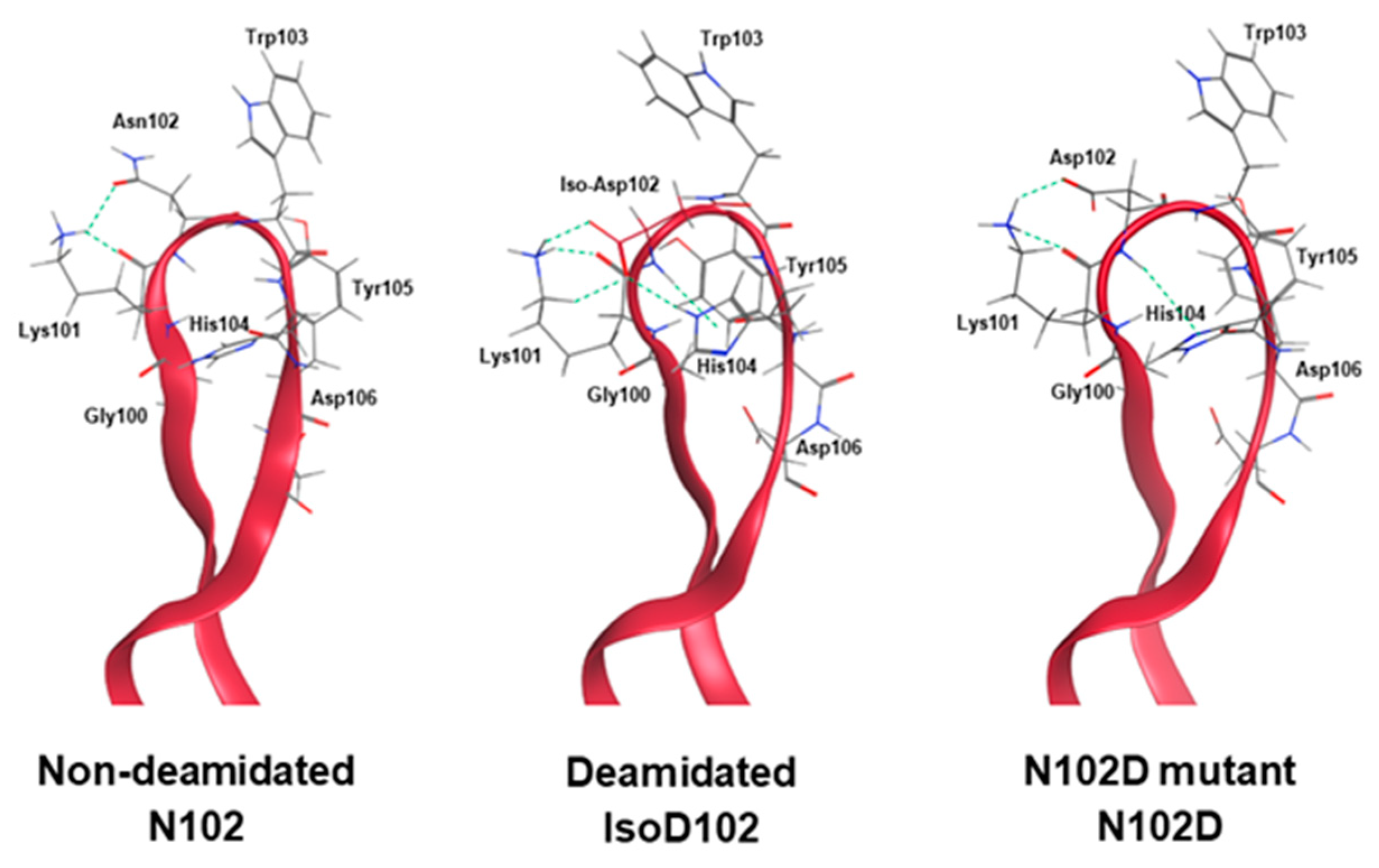
For asparagine, the reaction usually proceeds through a cyclic succinimide intermediate. The nitrogen atom of the adjacent peptide bond’s backbone amide attacks the side-chain carbonyl carbon, releasing ammonia and forming a five-membered succinimide ring. This intermediate is inherently unstable and rapidly undergoes hydrolysis. Because the attack can occur from either side of the ring, the hydrolysis of the succinimide intermediate typically results in a mixture of L-aspartic acid and L-isoaspartic acid (an isomer where the peptide backbone is attached to the side-chain carboxyl group).
The formation of isoaspartic acid is particularly significant because the additional methylene group in the peptide backbone effectively lengthens the chain, creating a "kink" that frequently destroys the local secondary structure, such as alpha-helices or beta-sheets. Glutamine deamidation proceeds more slowly and generally bypasses the cyclic intermediate, converting directly into glutamic acid, which retains the same peptide backbone structure but introduces a negative charge.
Factors Influencing the Deamidation Rate
Deamidation is not a random process; it is highly dependent on the local chemical environment. Understanding these factors is essential for both structural biologists and pharmaceutical scientists working on protein-based therapies.
Sequence Context
The primary amino acid sequence surrounding the Asn or Gln residue is the strongest determinant of deamidation speed. Residues with small side chains, such as glycine (Gly) or serine (Ser), allow for greater conformational flexibility, making it easier for the backbone amide to reach the transition state required for succinimide formation. Conversely, bulky or rigid residues tend to suppress the reaction by restricting local movement.
Environmental pH and Temperature
As a chemical hydrolysis reaction, deamidation is highly sensitive to the pH of the surrounding medium. Rates are generally higher in alkaline conditions where the concentration of hydroxide ions—a potent nucleophile—is elevated. However, the reaction can also be acid-catalyzed. Temperature acts as a multiplier; as thermal energy increases, the probability of reaching the activation energy threshold for the succinimide formation rises, significantly accelerating the rate of modification.
Protein Conformation
In a folded, native protein, many potential deamidation sites are sequestered in the hydrophobic core or constrained by tight secondary structures that prevent the side chain from orienting correctly for the reaction. If a protein partially unfolds or undergoes structural breathing, these sites become exposed to the solvent, leading to rapid, site-specific deamidation. This makes deamidation a reliable "clock" for measuring the residence time of proteins in the intracellular environment.

Biological Consequences and Quality Control
In vivo, deamidation is a major pathway for protein turnover. As proteins age, the gradual accumulation of isoaspartic acid can lead to the loss of functional efficacy. Cells have evolved specific mechanisms to mitigate these risks.
The Role of Protein Isoaspartyl Methyltransferase (PIMT)
One of the most vital cellular responses to isoaspartic acid formation is the action of the enzyme PIMT. This enzyme specifically recognizes L-isoaspartyl residues within proteins and catalyzes the transfer of a methyl group from S-adenosylmethionine to the alpha-carboxyl group of the isoaspartyl residue. This methylated intermediate is unstable and spontaneously reverts to a normal L-aspartyl residue, effectively "repairing" the damage. Failure of this repair mechanism is linked to various pathologies, including neurodegenerative diseases where damaged proteins accumulate as toxic aggregates.
Deamidation in Pharmaceutical Biotechnology
For the biopharmaceutical industry, deamidation represents a significant challenge in the development of therapeutic proteins and monoclonal antibodies. Because these products must remain stable during storage and delivery, controlling chemical degradation is a top priority for regulatory compliance and safety.
Analytical Challenges
Detecting deamidation is non-trivial because the mass difference between an amide (Asn/Gln) and an acid (Asp/Glu) is only 0.984 Daltons. This small mass shift requires high-resolution mass spectrometry (MS) for precise identification. Furthermore, distinguishing between aspartic acid and isoaspartic acid requires specialized chromatographic techniques, such as strong cation exchange (SCX) or hydrophobic interaction chromatography (HIC), often coupled with tandem MS/MS experiments.
Stability and Formulation Strategy
Pharmaceutical scientists utilize several strategies to minimize deamidation in drug products:
- Buffer Optimization: Formulating proteins at a slightly acidic pH (typically 5.0 to 6.5) can significantly suppress the rate of base-catalyzed deamidation.
- Excipients: The addition of stabilizing agents like sugars (e.g., trehalose or sucrose) or specific polyols can restrict protein dynamics, keeping residues in a "locked" conformation.
- Cold Chain Logistics: Since deamidation is thermally driven, maintaining a strictly controlled cold chain is the most effective operational strategy to extend the shelf life of biologics.
Comparison of Deamidation Impacts
| Feature | Asparagine (Asn) Deamidation | Glutamine (Gln) Deamidation |
|---|---|---|
| Intermediate | Succinimide (Cyclic) | None (Direct hydrolysis) |
| Primary Products | Aspartic acid, Isoaspartic acid | Glutamic acid |
| Structural Impact | High (Backbone alteration) | Moderate (Charge change) |
| Detection Ease | Difficult (Requires MS/Chromatography) | Moderate |
| Biological Role | Protein aging clock | Metabolic and signaling regulation |
Frequently Asked Questions
Is all deamidation harmful to a protein?
Not necessarily. While deamidation is often considered a degradation pathway that leads to loss of function, some biological systems use deamidation as a regulated process. In certain proteins, programmed deamidation serves as a timer to dictate the half-life of a protein or to trigger specific signaling events by altering binding affinity.
Can deamidation be reversed once it has occurred?
In a laboratory setting, the chemical modification is generally irreversible. However, the cell employs the PIMT repair enzyme to revert isoaspartic acid residues back to normal aspartic acid. This repair process does not work for glutamine conversion to glutamic acid or for aspartic acid residues that do not undergo the succinimide pathway.
How does deamidation affect monoclonal antibody efficacy?
Deamidation in the complementarity-determining regions (CDRs) of an antibody can dramatically reduce its binding affinity for its target antigen. If the deamidation occurs in the constant region (Fc), it may interfere with the antibody's ability to recruit immune effector cells, thereby impacting the drug's therapeutic potency and safety profile.
What is the most common method to detect deamidation?
Liquid chromatography-tandem mass spectrometry (LC-MS/MS) is the industry standard. Specifically, peptide mapping—where the protein is digested with enzymes like trypsin and the resulting peptides are analyzed—allows for the precise mapping of modified residues within the sequence.
Does temperature fluctuation affect deamidation during transit?
Yes. Every 10°C increase in temperature typically doubles or triples the rate of chemical degradation reactions like deamidation. Even brief excursions above the recommended storage temperature can lead to a significant, permanent increase in the percentage of deamidated species in a therapeutic protein batch.
Next Actions for Research and Development
For researchers analyzing deamidation, the immediate focus should be on the characterization of the local environment of susceptible sites. If you are developing a protein-based product, perform forced degradation studies under stress conditions (elevated temperature and high pH) to identify "hot spots" early in the development cycle. By identifying these sites through peptide mapping early, you can introduce point mutations—often replacing asparagine with serine or aspartic acid—to prevent the formation of isoaspartic acid, thereby creating a more stable, robust therapeutic protein.
Image Gallery
Select an image to open it in a new tab.

Celine Dubois
Contemporary Living and Global Arts Columnist
