The Relationship Between Passover and Easter: History, Theology, and the Calendar
The relationship between Passover and Easter is rooted in shared history, linguistic origins, and the narrative of the Exodus. While Passover commemorates the liberation of the Israelites from Egyptian slavery, Easter celebrates the resurrection of Jesus Christ, which occurred during the Passover season. These holidays remain linked through symbolic themes of sacrifice, redemption, and renewal.
To understand how these two major religious observances intersect, one must look beyond the surface level of the calendar. Their connection is a complex tapestry of 1st-century history, early Church politics, and profound theological shifts. In 2026, as both Jewish and Christian communities prepare for these spring observances, exploring their shared ancestry offers a clearer view of the foundations of Western religious tradition.
Historical Foundations: The Jewish Context of the First Easter
The events that form the core of Easter—the Last Supper, the Crucifixion, and the Resurrection—took place within the context of the Jewish Passover (Pesach). In the 1st century, Jerusalem was the epicenter of Jewish life, and the city would swell with hundreds of thousands of pilgrims arriving to offer the paschal lamb at the Second Temple.
According to the New Testament Gospels, Jesus of Nazareth and his disciples traveled to Jerusalem specifically to celebrate Passover. The "Last Supper" is widely interpreted by historians and theologians as a Passover Seder, or at least a meal heavily influenced by Seder traditions. During this meal, Jesus utilized the elements of the Passover table—the unleavened bread (matzah) and the wine—to establish what would become the Christian Eucharist or Communion.
The Synoptic vs. Johannine Chronologies
A notable point of discussion among scholars is the exact timing of these events. The Synoptic Gospels (Matthew, Mark, and Luke) suggest that the Last Supper was the Seder itself, occurring on the evening of the 15th of Nisan. Conversely, the Gospel of John suggests that Jesus was crucified at the same time the Passover lambs were being slaughtered in the Temple, on the 14th of Nisan. This creates a powerful symbolic link: Jesus is portrayed as the ultimate "Passover Lamb" whose sacrifice brings redemption, mirroring the blood of the lamb that protected the Israelites in Egypt.
Linguistic Links: Why Easter is Called "Pascha"
One of the most direct proofs of the relationship between Passover and Easter is found in linguistics. In the English-speaking world, the word "Easter" likely derives from Eostre, a Germanic goddess of spring. However, in almost every other language, the name for Easter is a direct derivative of the Hebrew word Pesach.
- Greek: Pascha
- Latin: Pascha
- Spanish: Pascua
- French: Pâques
- Italian: Pasqua
- Russian: Paskha
This linguistic continuity emphasizes that for the first several centuries of Christianity, the holiday was not seen as a separate entity but as the "Christian Passover." Even today, the theological term for the events of Easter is the Paschal Mystery, referring to the passion, death, and resurrection of Christ.
The Great Calendar Divergence: Why Dates Vary
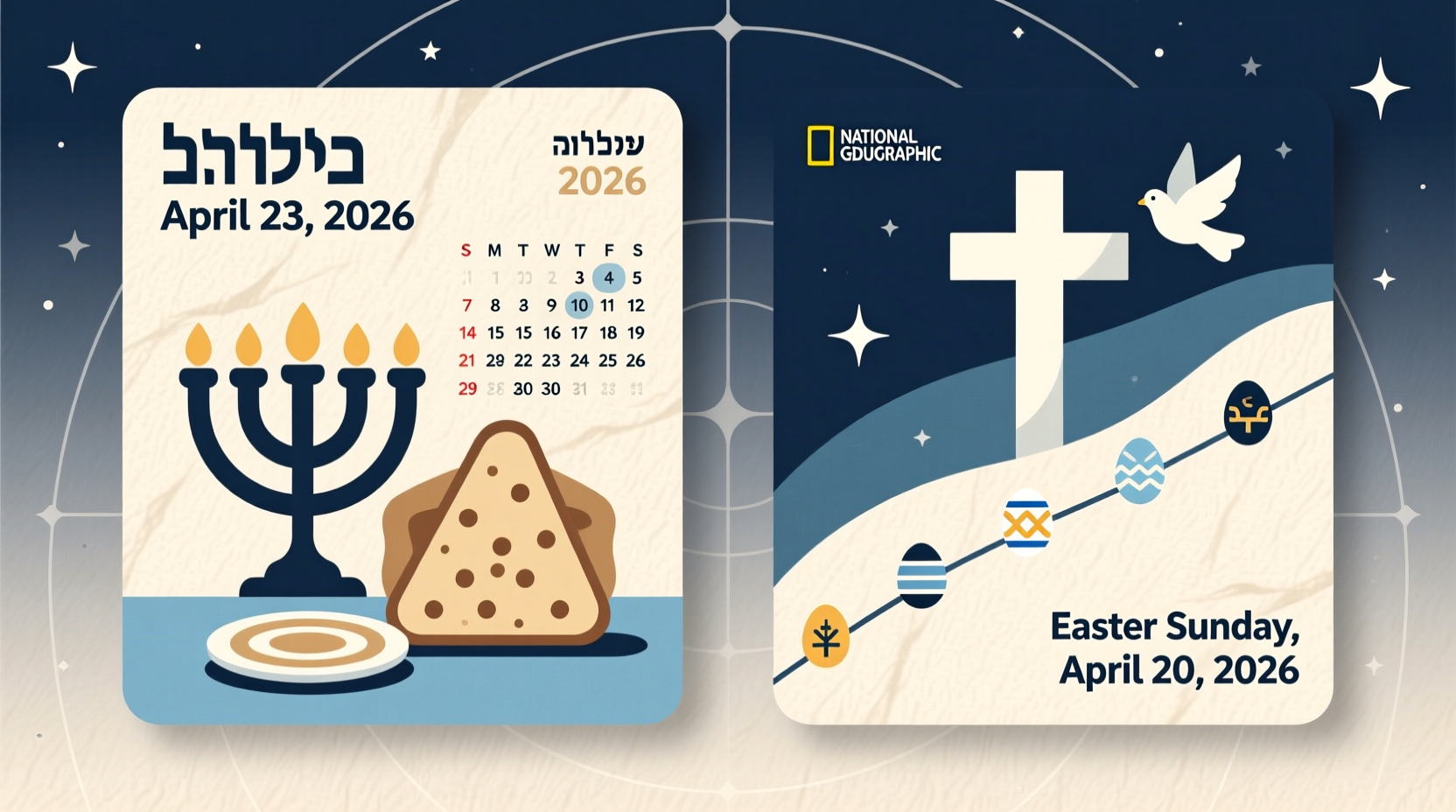
In 2026, many will notice that Passover and Easter do not fall on the same weekend. Passover begins at sundown on April 1, while Easter Sunday is observed on April 5. This divergence is the result of centuries of calendrical adjustments and the early Church's desire to distinguish itself from its Jewish roots.
The Jewish Calendar
The Jewish calendar is lunisolar, meaning it is based on the cycles of the moon but adjusted periodically with an extra month to stay in sync with the solar seasons. Passover always begins on the 15th day of the Hebrew month of Nisan, which coincides with the first full moon of spring.
The Council of Nicaea and the "Computus"
In the early years of the Church, many Christians (known as Quartodecimans) celebrated the death and resurrection of Jesus on the 14th of Nisan, the same day as the Jewish Passover sacrifice, regardless of which day of the week it fell on.
However, in 325 AD, the Council of Nicaea sought to standardize the celebration. The Council decided that Easter should always fall on a Sunday—the day of the Resurrection—and that it should not follow the Jewish calculation. They established the rule that Easter would be the first Sunday after the first full moon following the vernal equinox (March 21).
Because the Christian "ecclesiastical" moon and the actual astronomical moon can differ, and because the Jewish calendar uses a specific 19-year Metonic cycle to add leap months, the two holidays can be separated by as much as a month.
| Feature | Passover (Pesach) | Easter (Pascha) |
|---|---|---|
| Primary Theme | Liberation from slavery in Egypt | Resurrection of Jesus from the dead |
| Biblical Origin | Exodus 12 | The Four Gospels (New Testament) |
| Calendar Base | 15th of Nisan (Jewish Lunar Calendar) | First Sunday after the Paschal Full Moon |
| Duration | 7 or 8 days | 1 day (culmination of Holy Week) |
| Key Symbolism | Unleavened bread, bitter herbs, lamb | Empty tomb, lilies, lamb, eggs |
| Ritual Meal | The Seder | Easter Brunch/Dinner (Eucharist liturgically) |
Theological Parallels: Slavery, Sacrifice, and Freedom
The theological relationship between Passover and Easter is built on the concept of typology—the idea that events in the Old Testament "foreshadow" events in the New Testament.
From the Blood of the Lamb to the Lamb of God
In the Passover story, the Israelites were instructed to smear the blood of a spotless lamb on their doorposts so that the Angel of Death would "pass over" their homes. In Christian theology, Jesus is referred to as the "Lamb of God" (Agnus Dei). His death is viewed as the sacrificial blood that protects believers from spiritual death and the "slavery" of sin.
Deliverance and Resurrection
Passover celebrates a physical deliverance—the movement from the bondage of Egypt to the freedom of the Promised Land. Easter celebrates a spiritual deliverance—the movement from the bondage of death to the promise of eternal life. Both holidays emphasize that God intervenes in human history to bring his people out of "darkness" and into "light."
The Symbolism of Unleavened Bread
During Passover, Jews eat matzah, bread made without leaven (yeast), because the Israelites had no time to let their bread rise when fleeing Egypt. In the New Testament, leaven is often used as a metaphor for sin or corruption. By removing leaven, the Jewish household seeks ritual purity. Similarly, the Christian practice of using a thin, unleavened wafer for the Eucharist in many traditions (particularly the Roman Catholic and Anglican churches) maintains this physical link to the Passover matzah, symbolizing the "sinless" body of Christ.
Cultural and Ritual Overlaps
While the religious meanings have diverged, several cultural and ritual elements remain remarkably similar.
The Significance of the Lamb
The lamb remains a central symbol for both. In Judaism, while the physical sacrifice of the lamb ended with the destruction of the Temple in 70 AD, a roasted shank bone (zeroah) is still placed on the Seder plate as a reminder. In many European Christian cultures, roast lamb is the traditional centerpiece of the Easter meal, directly echoing the ancient Judean custom.
Eggs and New Life
The use of eggs is common to both traditions, though for slightly different reasons. On the Seder plate, a hard-boiled egg (beitzah) represents the festival sacrifice offered in the Temple and serves as a symbol of mourning for the Temple's destruction, as well as a symbol of life’s cycle. In Easter traditions, the egg represents the "empty tomb" of Jesus and the new life of the Resurrection.
Springtime and Renewal
Both holidays are inextricably linked to the spring season in the Northern Hemisphere. They occur during a time of agricultural rebirth. The Jewish holiday is also known as Chag HaAviv (the Holiday of Spring), while the timing of Easter was specifically tied to the equinox to ensure it coincided with the return of light and life to the world.
Contemporary Perspectives in 2026
In 2026, the dialogue between Jewish and Christian communities regarding these holidays continues to evolve. There is a growing movement of "Interfaith Seders" where Christians participate in a Seder meal to better understand the Jewish roots of their faith. However, many theologians advise caution, suggesting that while it is vital to acknowledge the historical link, it is equally important to respect the distinct integrity of each tradition.
For Jews, Passover is a self-contained celebration of national identity and divine covenant. For Christians, while Passover provides the necessary context, Easter is the fulfillment of a new covenant. Recognizing the relationship between the two helps practitioners of both faiths appreciate the deep historical continuity that has shaped religious thought for over two millennia.
Common Misconceptions
One common misconception is that Easter is a "pagan" holiday that replaced Passover. While the name "Easter" may have Germanic roots, the actual celebration and its timing were always tied to the Jewish Pesach. The early Church did not choose a random spring date; they chose the date of the Jewish festival because that was when the events of the Passion occurred.
Another misconception is that the Last Supper was exactly like a modern Seder. The modern Seder, as outlined in the Haggadah, was developed and codified by the Rabbis in the centuries following the destruction of the Temple (post-70 AD). While Jesus certainly celebrated a Passover meal, it likely looked more like a 1st-century festive banquet with specific blessings over wine and bread, rather than the highly structured 15-step ritual used by Jewish families today.
Practical Guidance for 2026 Observance
If you are navigating both holidays in a multi-faith household or community in 2026, keep the following schedule in mind:
- Preparation: Passover requires a deep cleaning of the home to remove "chametz" (leaven). For Christians, the weeks leading up to Easter (Lent) involve fasting and reflection.
- The Seder: The first Seder of 2026 will be held on the evening of Wednesday, April 1. This is the primary ritual of the Passover holiday.
- Holy Week: For Christians, the "Triduum" begins on Maundy Thursday (April 2, 2026), commemorating the Last Supper, followed by Good Friday (April 3) and Easter Sunday (April 5).
- Shared Respect: Acknowledge the "Paschal" theme of both. Whether referring to the Paschal lamb or the Paschal candle, the shared terminology can be a bridge for conversation.
Frequently Asked Questions
Is the Last Supper considered a Seder? Most historians agree the Last Supper was a Passover meal, though it lacked many of the specific Rabbinic structures found in the modern Seder. It took place on the night Passover began and involved the traditional elements of wine and unleavened bread, which Jesus used to symbolize his impending sacrifice.
Why does Easter move every year while Passover stays on the same Jewish date? Passover is fixed to the 15th of Nisan on the Hebrew calendar. However, because the Hebrew calendar is lunar and the Gregorian calendar (used by most of the world) is solar, the date appears to "jump" around in March and April. Easter moves because its calculation is based on the moon's phase following the spring equinox, specifically to ensure it falls on a Sunday.
Can a Christian celebrate Passover? Many Christians today participate in "Model Seders" or Christian Seders to connect with the Jewish roots of Jesus. However, it is important to distinguish between a traditional Jewish Seder and a Christian adaptation. Many Jewish communities appreciate the interest but emphasize that Passover is a specific covenantal observance for the Jewish people.
Why is the lamb a symbol for both holidays? The lamb originates from the Torah/Old Testament, where the blood of the Passover lamb saved the Israelites from the final plague in Egypt. Christians adopted this imagery, viewing Jesus as the "Lamb of God" whose sacrifice saves humanity from sin, thus making the lamb the central sacrificial symbol for both faiths.
Does Passover always come before Easter? Usually, but not always. Because of the way the two calendars are calculated, Easter can occasionally fall before Passover. This happens when the Christian calculation identifies a "Paschal Full Moon" that occurs before the Jewish 15th of Nisan, often due to how leap months are inserted into the Jewish calendar.
Next Actions for Readers
To further explore the relationship between these two holidays, consider reading the Exodus (Chapters 12-14) in the Old Testament and the Gospel of Luke (Chapters 22-24) in the New Testament. These texts provide the foundational narratives for Passover and Easter, respectively. If you are interested in the liturgical connection, many churches and synagogues hold joint educational events in the weeks leading up to April 2026 to discuss the shared heritage of the "Paschal season."
Image Gallery
Select an image to open it in a new tab.


Simon Caldwell
Enterprise Technology and Systems Editor
