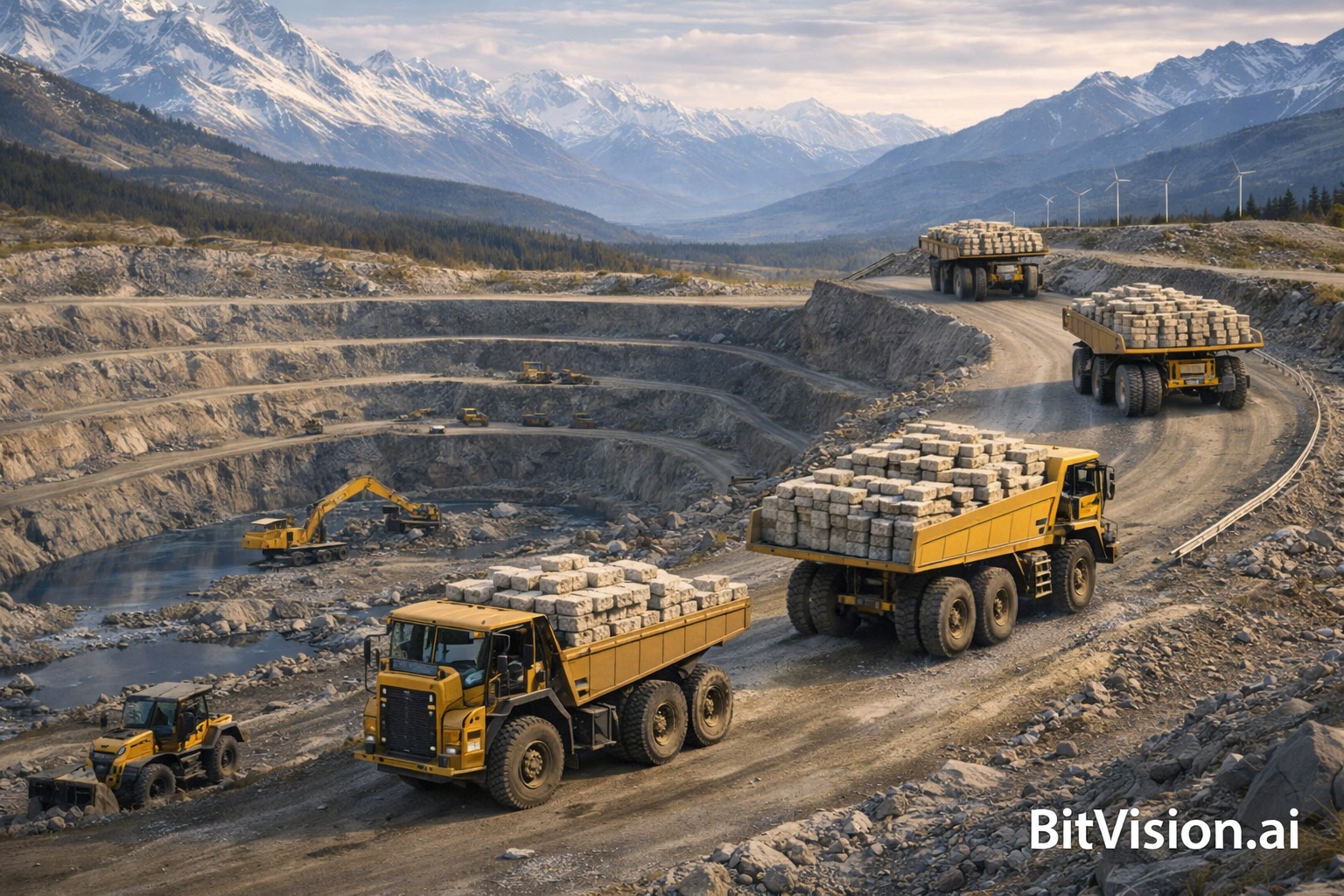
In 2026, modern silver extraction is a sophisticated multi-stage process that integrates mechanical engineering, chemical leaching, and advanced metallurgy. Most silver is recovered as a by-product of lead, zinc, copper, and gold mining, utilizing high-efficiency techniques such as froth flotation, cyanide leaching (specifically the Merrill-Crowe process), and electrolytic refining to achieve purity levels exceeding 99.9%.
The Geological Context: Silver Sources in 2026
Silver is rarely found in its "native" or pure metallic form. Instead, it is typically bound within complex mineral structures. Understanding how silver is extracted begins with identifying the type of ore being processed. As of 2026, roughly 70% of the world’s silver supply is a secondary product derived from mining other base metals.
The primary silver-bearing minerals include argentite ($Ag_2S$), proustite ($Ag_3AsS_3$), and pyrargyrite ($Ag_3SbS_3$). However, a significant portion of silver is also recovered from galena (lead ore) and chalcopyrite (copper ore). Because silver shares similar chemical affinities with these metals, it often "hides" within their crystal lattices.
Modern mining operations distinguish between two types of deposits:
- Primary Deposits: Where silver is the main economic driver of the mine.
- Polymetallic Deposits: Where silver is one of several valuable metals, often recovered alongside gold, lead, zinc, and copper.
The extraction method chosen depends entirely on the mineralogy. If the silver is "free-milling" (accessible to chemicals), leaching is preferred. If it is "refractory" (trapped inside other minerals), it requires intense mechanical or thermal pretreatment.
Exploration and Mine Development
Before a single gram of silver is extracted, extensive exploration defines the ore body. In 2026, mining companies use AI-driven geological modeling and hyperspectral satellite imaging to map sub-surface mineral concentrations with unprecedented accuracy.
Underground vs. Open Pit Mining
The physical extraction of ore usually follows one of two paths:
- Open Pit Mining: Utilized when silver-bearing ore is located near the surface. Large-scale excavations allow for the removal of massive tonnages, which is necessary when ore grades are low.
- Underground Mining: Preferred for high-grade silver veins that run deep into the earth. This method involves sinking shafts and driving tunnels (drifts) to reach the mineralized zones. Modern underground mines in 2026 are increasingly autonomous, utilizing remote-controlled drilling and hauling equipment to improve safety and efficiency.
Once the ore is blasted and hauled to the surface, the complex journey from "rock" to "bullion" begins.

Step 1: Comminution (Crushing and Grinding)
The first technical hurdle in silver extraction is liberating the microscopic silver minerals from the surrounding "gangue" (worthless rock). This is achieved through comminution.
Ore arrives at the processing plant as large boulders. It first passes through primary crushers (usually jaw or gyratory crushers), which reduce the material to the size of gravel. From there, it enters the grinding circuit.
In 2026, the industry standard involves Semi-Autogenous Grinding (SAG) mills followed by ball mills. These massive rotating drums use steel balls to grind the ore into a fine powder, often as fine as flour (typically 75 microns or less). This increases the surface area of the silver minerals, making them susceptible to the chemical reagents used in the following steps.
Step 2: Concentration via Froth Flotation
For polymetallic ores containing lead, zinc, or copper, froth flotation is the primary method of concentration. This process exploits the differences in the surface chemistry of minerals.
- Slurry Preparation: The ground ore is mixed with water to create a "pulp" or slurry.
- Chemical Conditioning: Specific reagents called "collectors" (such as xanthates) are added. These chemicals selectively coat the silver-bearing particles, making them hydrophobic (water-repellent).
- Aeration: The slurry is agitated in a flotation cell while air is pumped through the bottom.
- Collection: The hydrophobic silver particles attach to the rising air bubbles and float to the surface, forming a thick, metallic froth. The "gangue" stays at the bottom.
- Skimming: The froth is skimmed off, resulting in a "concentrate" that is significantly richer in silver than the original raw ore.
Step 3: Chemical Extraction (Cyanidation and Leaching)
When silver is the primary metal or is associated with gold, cyanide leaching is the most effective extraction route. This process relies on the fact that silver is soluble in a weak cyanide solution.
The Merrill-Crowe Process
While many gold mines use Carbon-in-Pulp (CIP), silver mines often prefer the Merrill-Crowe process because silver concentrations in the solution are typically much higher than gold, which can overwhelm carbon-based systems.
- Leaching: The ore is treated with a sodium cyanide solution ($NaCN$) in large tanks. The silver dissolves into the liquid, creating a "pregnant" solution.
- Clarification: The liquid is separated from the solid waste and filtered until it is crystal clear.
- De-aeration: Oxygen is removed from the solution using vacuum towers, as oxygen would interfere with the next step.
- Zinc Precipitation: Fine zinc dust is added to the solution. Silver has a higher affinity for electrons than zinc; consequently, the silver precipitates out of the solution as a solid metal powder, while the zinc dissolves.
Step 4: Pyrometallurgy and Smelting
The silver precipitate from the Merrill-Crowe process or the concentrates from flotation are not yet pure. They contain impurities like zinc, copper, and lead. These materials are sent to a smelter.
The concentrate is mixed with fluxes and heated to extreme temperatures (above 1,000°C). During smelting, the impurities oxidize and form a "slag" that floats on top, while the molten silver sinks. The result is a Doré bar—an alloy typically containing 70% to 90% silver, with the remainder being gold and other base metals.
The Parkes Process (for Lead-Silver Ore)
If the silver is being extracted from lead ore, the Parkes process is used. Zinc is added to molten lead containing silver. Silver is more soluble in zinc than in lead. As the mixture cools, a zinc-silver crust forms on the surface, which is then skimmed off and processed to recover the silver.
Step 5: Electrolytic Refining
To reach the "investment grade" purity of 99.9% or 99.99%, the Doré bars must undergo electrolytic refining.
In this stage, the Doré bar acts as the anode (positive electrode) in an electrolytic cell filled with a silver nitrate ($AgNO_3$) and nitric acid solution. A thin sheet of pure silver acts as the cathode (negative electrode).
When an electric current is applied:
- The silver in the anode dissolves into the solution.
- Pure silver ions migrate across the liquid and deposit themselves onto the cathode.
- Impurities (like gold or platinum) do not dissolve; they drop to the bottom of the tank as "anode slime," which is later collected and refined for its own value.
The resulting silver crystals are scraped off the cathode, melted, and cast into the familiar bars and coins found in global markets in 2026.
Comparative Overview of Extraction Methods
The following table summarizes the primary modern methods used depending on the ore type.
| Process | Ore Suitability | Primary Agent | Key Outcome |
|---|---|---|---|
| Froth Flotation | Lead, Zinc, Copper ores | Collectors & Frothers | High-grade metal concentrate |
| Cyanide Leaching | Primary Silver & Gold ore | Sodium Cyanide ($NaCN$) | Pregnant solution for precipitation |
| Merrill-Crowe | High-silver leaching | Zinc Dust | Solid silver precipitate |
| Parkes Process | Silver-bearing Lead ore | Molten Zinc | Silver-Zinc crust for further refining |
| Electrolytic Refining | Doré bars (all sources) | Silver Nitrate & Electricity | 99.9%+ Purity silver |
Modern Innovations and Sustainability in 2026
By 2026, the "how" of silver extraction is increasingly defined by environmental constraints. Silver is a critical component for the global energy transition—specifically for photovoltaic (solar) panels and electric vehicle (EV) electronics. This has led to three major shifts in extraction technology:
- Dry Stack Tailings: Traditional "wet" tailings dams are being replaced by dry stacking, where water is squeezed out of the waste rock and recycled back into the plant. This reduces the risk of dam failures and conserves water in arid mining regions.
- Thiosulfate Leaching: As an alternative to cyanide, some modern mines are experimenting with thiosulfate. It is less toxic than cyanide and can be more effective for certain types of "carbonaceous" ores that otherwise "steal" the silver during traditional leaching.
- Direct Electrowinning: Advances in cell design allow some mines to skip the zinc precipitation step and move straight from the pregnant solution to an electrolytic cell, reducing chemical consumption.
Frequently Asked Questions
Why is silver mostly a by-product of other metals?
Silver atoms are often trapped within the crystal structures of common base metal minerals like galena (lead) or chalcopyrite (copper). Because these base metals are mined in massive quantities, it is more economically viable to extract the silver during the refining of the lead or copper than to look for rare "pure" silver veins.
Is cyanide used in all silver mining?
No. Cyanide is primarily used for ores where the silver is "free" or associated with gold. If the silver is bound in a lead or copper concentrate, it is usually extracted through smelting and the Parkes process or electrolytic refining, which do not necessarily require cyanide.
How long does the extraction process take?
From the moment ore is blasted in the mine to the production of a refined silver bar, the process typically takes several weeks. This includes days for the crushing and grinding circuits, 24–48 hours for leaching, and several days for the electrolytic refining process to grow pure silver crystals.
What happens to the other metals found with silver?
In modern "polymetallic" mines, every metal is a revenue stream. Copper, lead, and zinc are sold as industrial concentrates. Gold and platinum-group metals collected during silver refining are processed separately. This "circular" recovery is what makes many silver mines profitable in 2026.
How much silver is recovered from a ton of ore?
Modern mines can profitably extract silver from ore containing as little as 50 to 100 grams per tonne. High-grade mines might see 300 to 500 grams per tonne. Efficiency is key; modern plants aim for "recovery rates" of 85% to 95% of the silver contained in the rock.
Practical Recommendation for 2026
For those monitoring the silver industry, it is essential to look beyond the "spot price" and evaluate the recovery efficiency of mining operations. As high-grade deposits become rarer, the profitability of a mine in 2026 depends on its ability to implement the advanced metallurgical techniques described above—specifically water-recycling flotation and automated electrolytic refining. Investors and researchers should prioritize companies that utilize dry-stack tailings and renewable-energy-powered smelting, as these are becoming the regulatory and economic standards for the modern era.
Image Gallery
Select an image to open it in a new tab.

Celine Dubois
Contemporary Living and Global Arts Columnist
