
Monty Python and the Holy Grail maintains its status as a pinnacle of comedy cinema because of its unique blend of low-budget ingenuity, meta-humor, and historical absurdity. By deconstructing the Arthurian legend through a lens of biting satire and surrealist gags, the film creates a timeless, repeatable experience that resonates across generations of comedy enthusiasts.
The Foundation of Surrealist British Satire
To understand why Monty Python and the Holy Grail (1975) continues to outperform its contemporaries, one must look at the troupe’s origin. The members—Graham Chapman, John Cleese, Terry Gilliam, Eric Idle, Terry Jones, and Michael Palin—brought their collective experience from the BBC’s Monty Python's Flying Circus to the big screen. Unlike traditional narrative comedies that rely on a linear progression of cause and effect, Holy Grail thrives on the "Python method": a rapid-fire sequence of sketches that defy narrative expectations.
The brilliance of the film lies in its refusal to adhere to the conventions of epic storytelling. While other historical comedies of the era attempted to mimic the grandeur of the period films they parodied, Holy Grail embraced its own limitations. The decision to use coconuts to simulate the sound of horse hooves is perhaps the most famous example of this "lo-fi" brilliance. By forcing the audience to acknowledge the artifice, the film establishes a rapport with the viewer that feels intimate and collaborative.
The Meta-Narrative as a Comedy Engine
Modern audiences are accustomed to "meta" humor, where characters acknowledge the screen or the script. In 1975, this was a radical departure from mainstream cinema. Holy Grail utilizes meta-narrative not just as a gimmick, but as a structural pillar. The film explicitly mentions its own production constraints, breaks the fourth wall to address the audience, and eventually ends with a police raid that shuts down the movie entirely.
This self-reflexive quality creates a "cult" atmosphere. Because the film does not take itself seriously, the viewer is invited to participate in the joke. This lack of pretension is why, half a century later, the humor does not feel dated. It is immune to the passage of time because it never claimed to be a realistic portrayal of history in the first place.
Budgetary Constraints as a Creative Catalyst
Many films have suffered from the "Curse of the Mid-Budget," where enough money exists to make things look professional, but not enough to achieve genuine spectacle. Monty Python and the Holy Grail bypassed this entirely. With a budget provided by rock bands like Led Zeppelin and Pink Floyd (who were fans of the troupe), the production was lean and occasionally chaotic.
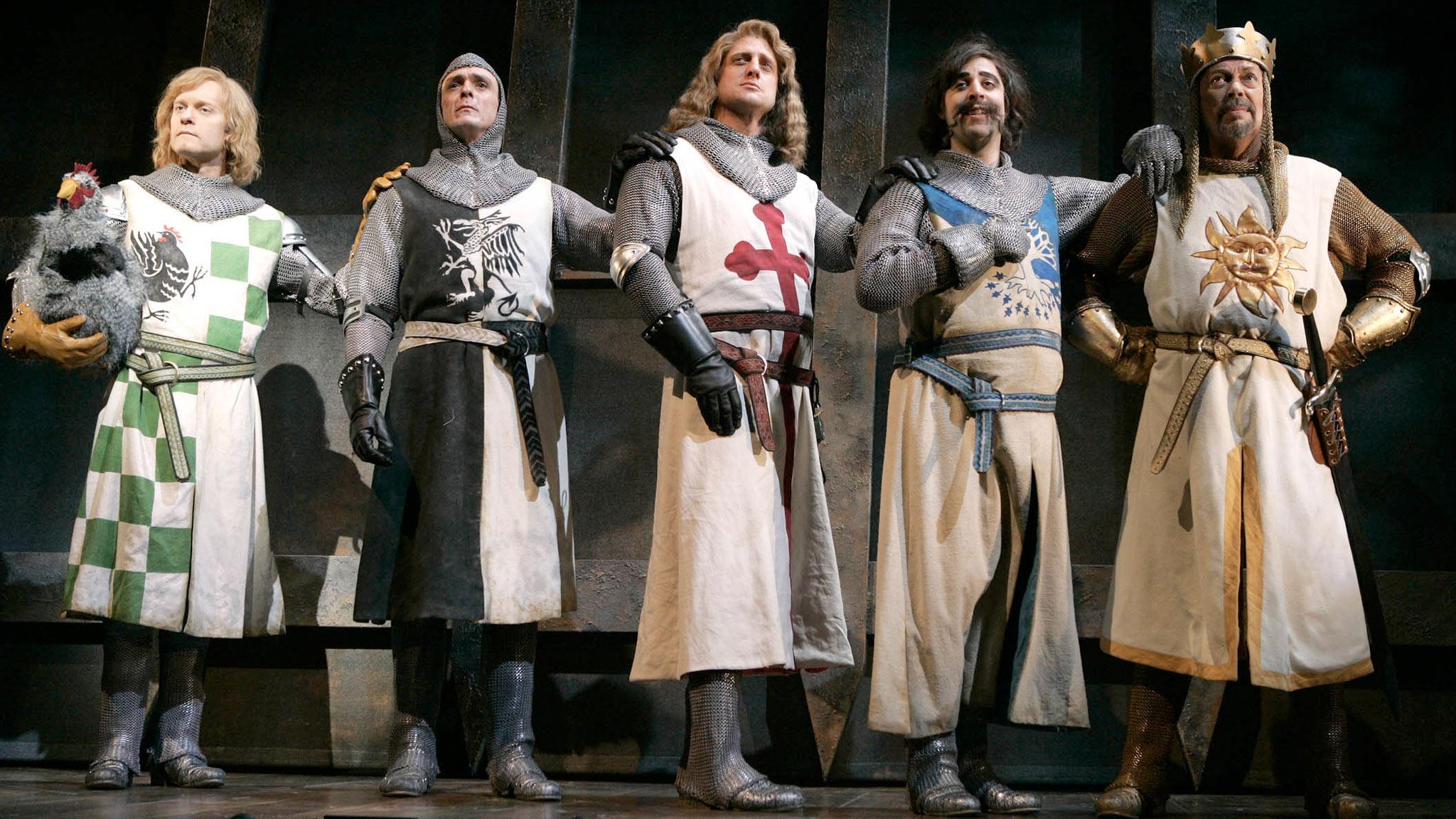
Because the team could not afford real horses or massive castles, they turned these deficits into the film’s defining stylistic choices. The "castle" interiors were often filmed in humble locations, and the "knights" were frequently seen running away from danger rather than fighting, subverting the heroic tropes of the Middle Ages. This frugality forced the writers to prioritize dialogue, character interaction, and visual slapstick over expensive CGI or set pieces, which remains a key reason the film holds up significantly better than blockbusters from the same era.
Comparison of Comedy Paradigms
The enduring nature of Holy Grail becomes even more evident when compared to other notable comedies of the 1970s. While films like Blazing Saddles (1974) offered biting social commentary, and Animal House (1978) codified the collegiate farce, Holy Grail operates on a plane of "intellectual absurdity."
| Feature | Monty Python and the Holy Grail | Typical 1970s Farce |
|---|---|---|
| Narrative Style | Fragmented/Sketch-based | Linear/Plot-driven |
| Humor Basis | Absurdist/Intellectual | Situational/Slapstick |
| Visual Identity | Lo-fi/Self-Aware | Studio-produced/Realist |
| Cultural Legacy | Infinite quotability | Context-dependent |
The table above illustrates that while other comedies relied on the cultural specificities of their time, Holy Grail utilized archetypes (knights, peasants, sorcerers) that are essentially universal. By grounding the absurdity in familiar historical tropes, the Pythons ensured their work would remain accessible to anyone with a basic understanding of Western folklore.
The Role of Quotability and Memetic Survival
In the context of 2026, the success of a film is often measured by its "meme-ability." Monty Python and the Holy Grail was a viral hit decades before the internet existed. The sheer density of iconic lines—"It’s just a flesh wound," "Bring out your dead," "What is your favorite color?"—has allowed the film to survive through constant repetition in pop culture.
This quotability functions as a social currency. Fans of the film recognize each other through these snippets of dialogue, creating a persistent community that spans generations. Because the humor is rooted in non-sequiturs, it functions effectively on social media platforms, allowing the film to remain relevant to younger audiences who might otherwise ignore a mid-70s production.
Obstacles to Modern Parody
Many directors have attempted to recapture the lightning-in-a-bottle success of Holy Grail, but most fail because they focus on the "what" rather than the "why." They try to replicate the sketches or the low-budget aesthetic without understanding the intellectual rigor behind the absurdity.
The Pythons were educated individuals—many were Oxford and Cambridge alumni—and their humor was designed to be dense. The "African or European Swallow" debate is a perfect example of this: it is a silly argument treated with extreme academic seriousness. Modern parodies often lack this layer of intellectual irony, opting instead for broad, shallow jokes. The depth of Holy Grail provides a level of engagement that rewards repeated viewings; audiences catch new details about the historical or linguistic satire every time they watch.
Frequently Asked Questions
Why is Monty Python and the Holy Grail considered "meta"? The film is considered meta because it continuously acknowledges its own existence as a film. Examples include the characters interacting with the filmmakers, the sudden intrusion of a police investigation in the final scene, and the characters complaining about the budget. It breaks the "fourth wall" to remind viewers that they are watching a constructed performance.
Did the budget really affect the humor? Yes, profoundly. The lack of funding forced the Pythons to rely on creative solutions like using coconut shells instead of horses. This became a recurring gag that defined the film's absurdist tone. If they had possessed a high budget, they would have used real horses, which would have removed one of the most iconic and hilarious elements of the movie.
Is the humor in the film still relevant in 2026? The humor remains relevant because it targets universal human behaviors: bureaucracy, class struggle, the pretension of heroism, and the absurdity of language. While the specific references to medieval tropes are old, the satirical targets are timeless. The surreal nature of the humor also prevents it from feeling "period-specific" in the way that political or social comedies from the 70s often do.
Why are the knights so cowardly in the film? The cowardice of the knights is a deliberate subversion of the chivalric romance tradition found in Arthurian legends. By making the protagonists cowardly, bickering, or incompetent, the Pythons emphasize the contrast between the romanticized view of history and the messy, often pathetic reality of human interaction.
How does the film's pacing compare to modern comedies? The film's pacing is erratic by design. It mirrors the frantic energy of the original television show. While modern films often prioritize a steady "three-act" structure, Holy Grail moves from scene to scene with little regard for standard plot progression. For modern viewers, this keeps the film feeling fresh, as it is difficult to predict where the next joke will come from.
Recommendations for the Viewer
To truly appreciate why Monty Python and the Holy Grail remains the gold standard, approach it not as a movie, but as a series of connected, highly disciplined comedic experiments. Watch for the subtle background details—the way the extras react to the knights, or the specific vocabulary used in the dialogue.
If you are a first-time viewer or returning after many years, consider watching with the "Production Commentary" if available, or simply pay close attention to the sound design. The film relies heavily on auditory humor, from the aforementioned coconuts to the specific, droning delivery of the "French Taunter." By focusing on these technical elements, you can see the precise construction of what appears to be chaotic madness.
The film is not merely a collection of sketches; it is a masterclass in comedic deconstruction. Its longevity is not an accident but the result of a perfectly executed vision that refused to compromise its absurdity, even when the budget—and sanity—of the production were on the line.

Image Gallery
Select an image to open it in a new tab.


Omar Farooq
EdTech Innovation and Virtual Pedagogy Journalist
