
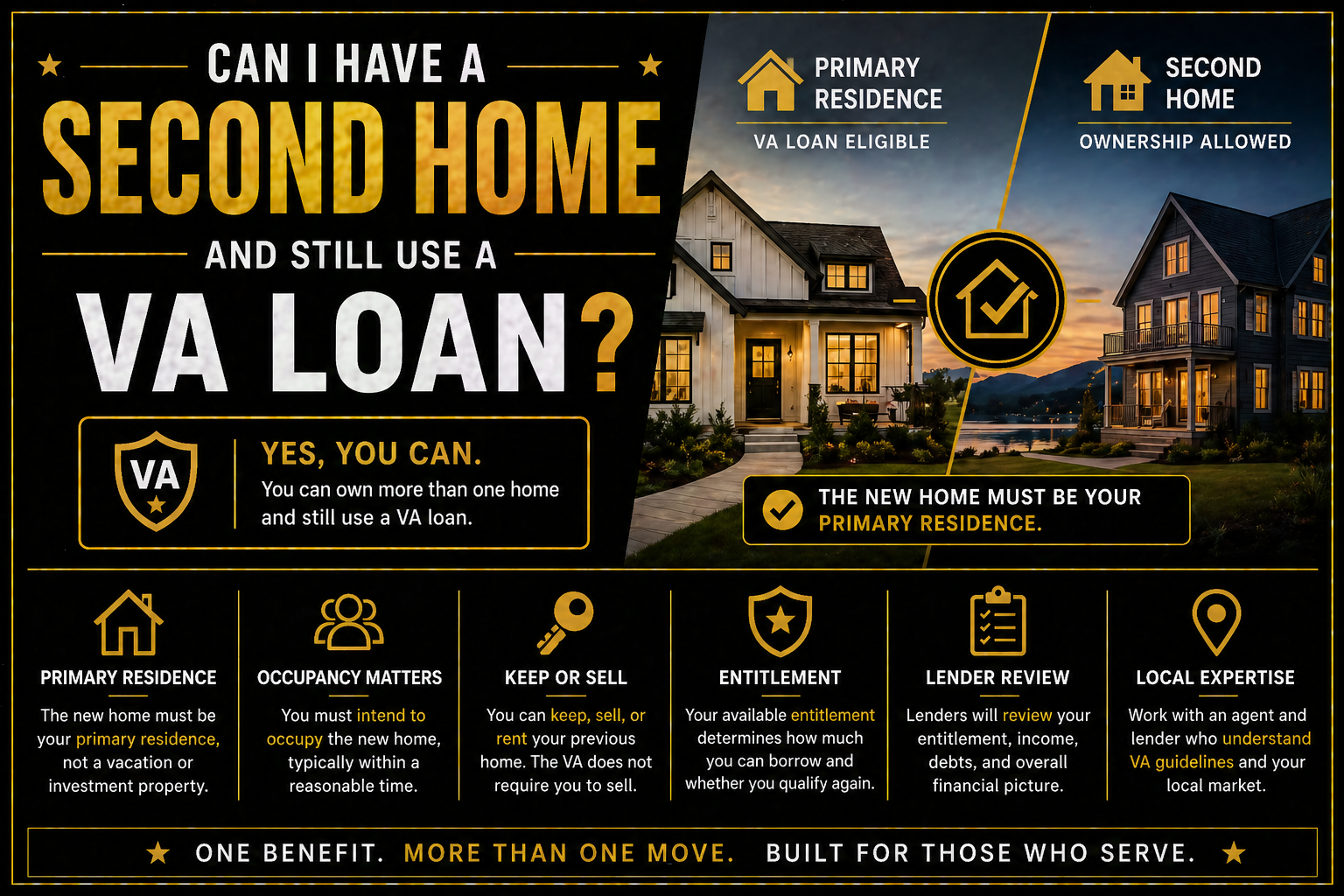
Obtaining a second VA home loan is a standard procedure for eligible veterans and service members who have remaining entitlement or have restored their entitlement after a previous VA loan. By leveraging the Department of Veterans Affairs (VA) home loan guaranty program, borrowers can purchase a new primary residence while retaining their existing VA-financed property, provided they meet specific occupancy and entitlement requirements.
Understanding VA Entitlement and Loan Eligibility
The foundation of the VA home loan program is "entitlement." This refers to the portion of a loan the VA guarantees to the lender. When you use your VA loan benefit to buy a home, you use a segment of this entitlement. For many veterans, the belief that they only get one loan is a common misconception. In reality, as long as you have "bonus entitlement" or have regained your full entitlement, you can secure a second VA-backed mortgage.
The VA’s entitlement structure consists of two parts: basic entitlement and bonus entitlement. Basic entitlement provides up to $36,000 in guaranty, which is sufficient for loans up to $144,000. However, in the modern housing market, loan limits often far exceed this amount. To bridge the gap, the VA provides bonus entitlement, which is tied to the Federal Housing Finance Agency’s conforming loan limits. As of 2026, these limits allow veterans in high-cost areas or those using their remaining entitlement to secure significant financing without a traditional down payment.
How to Qualify for a Second VA Loan
Qualifying for a second VA loan involves a two-pronged approach: assessing your remaining entitlement and meeting the lender’s standard financial underwriting criteria.
1. Checking Your Certificate of Eligibility (COE)
Your Certificate of Eligibility is the formal document that proves to a lender that you are eligible for the VA loan program. If you are applying for a second loan, your COE will show the amount of entitlement you have already used and what remains. You can request an updated COE through the VA’s online portal. If you have already paid off your first VA loan or sold the home, you can request a "restoration of entitlement," which resets your benefit to its full amount.
2. Meeting Financial Requirements
While the VA guarantees the loan, the actual mortgage is issued by a private lender. Therefore, you must meet that lender's requirements regarding:
- Credit Score: Most lenders look for a score of 620 or higher, though requirements vary.
- Debt-to-Income (DTI) Ratio: Lenders will evaluate your ability to manage both the new mortgage payment and any existing mortgage payments on your current home.
- Income Stability: You must provide documentation showing consistent income, such as W-2s, tax returns, and recent pay stubs.
Occupancy Requirements: The Crucial Distinction
The most critical rule regarding a second VA loan is that it must be intended for a primary residence. The VA program is designed to help veterans achieve homeownership for their personal living space, not for investment or vacation properties.
If you are buying a second home to live in—for example, because of a job relocation, a growing family, or a desire to downsize—the VA will generally permit you to obtain a second VA loan. However, you must move into the new home within 60 days of closing. The home you are currently living in can then be converted into a rental property, provided you meet the VA’s criteria regarding income offsets and your financial capacity to handle two mortgages simultaneously.
Table 1: Comparison of VA Loan Scenarios
| Scenario | Impact on Entitlement | Occupancy Rule |
|---|---|---|
| Full Restoration | Resets to 100% | Must occupy as primary residence |
| Remaining Entitlement | Uses available bonus amount | Must occupy as primary residence |
| Refinance (IRRRL) | None (uses original) | No occupancy required |
| Investment Property | Not permitted | Not permitted (must be primary) |
Strategies for Managing Two VA Loans
Navigating two simultaneous VA loans requires careful financial planning. If you keep your first house as a rental, the VA lender may allow you to use a portion of the projected rental income to qualify for the second loan. To do this, you generally need to provide a lease agreement and, in some cases, proof of a security deposit.
If you are selling your first home to buy the second, you must ensure the timing aligns. Many veterans use a "contingent offer" to ensure they do not end up owning two homes if the first one fails to sell. Alternatively, if you have sufficient equity in your first home, you might consider a bridge loan or a home equity line of credit (HELOC) to facilitate the transition, though these are independent of the VA loan program.
Common Misconceptions About Multiple VA Loans
One of the most frequent myths is that you must be "out of the military" to use the benefit, or that you can only have one VA loan at a time. Both are false. You can use your VA loan entitlement while on active duty, in the National Guard, or in the Reserves, provided you meet the length-of-service requirements.
Furthermore, some believe that taking out a second VA loan results in a higher interest rate. This is not inherently true. Interest rates are determined by market conditions, your credit profile, and the lender’s pricing. The VA itself does not set interest rates, and having an existing VA loan does not penalize your ability to secure a competitive rate on a second property.
Troubleshooting and Potential Roadblocks
When applying for a second VA loan, you may encounter specific hurdles:
- Residual Income Requirements: The VA requires that you have a certain amount of "residual income"—money left over after paying all major monthly expenses—to ensure you can afford the home. When you have two mortgages, this calculation becomes more stringent.
- Entitlement Limits: If you live in an area with extremely high property values, your remaining bonus entitlement might not be enough to cover the entire purchase price without a down payment. In this case, you will be required to pay a down payment equal to 25% of the difference between the loan amount and your available entitlement.
- Property Appraisal: The VA requires a specific appraisal process to ensure the property meets "Minimum Property Requirements" (MPRs). If your new home requires significant repairs, it may not qualify for a VA loan until those repairs are addressed.
How to Get Started: A Step-by-Step Approach
- Gather Documentation: Assemble your DD-214 (Certificate of Release or Discharge from Active Duty), recent bank statements, and current mortgage statements.
- Contact Your Lender: Speak with a loan officer who specializes in VA lending. They can run a preliminary check on your remaining entitlement and advise on whether you qualify for a second loan based on your current DTI ratio.
- Request a COE: Apply for an updated Certificate of Eligibility that reflects your current entitlement status.
- Pre-Approval: Obtain a formal pre-approval letter. This allows you to shop for homes with the confidence that your financing is structured correctly for a second VA loan.
- Property Search: When house hunting, prioritize homes that are move-in ready to avoid potential issues with the VA appraisal process.
- Underwriting and Closing: Once you are under contract, your lender will handle the VA underwriting. Be prepared to provide additional documentation regarding your plans for your current home (e.g., a lease agreement if you plan to rent it out).
Frequently Asked Questions
Can I have two VA loans at the same time? Yes, you can have more than one VA loan simultaneously. This is possible if you have sufficient bonus entitlement remaining after your first loan was originated. You must intend to occupy the second home as your primary residence.
Do I need a down payment for a second VA loan? If you have sufficient full or bonus entitlement, you generally do not need a down payment. However, if your remaining entitlement is limited and the loan amount exceeds that limit, you may be required to pay a down payment on the portion that is not guaranteed by the VA.
What happens if I sell my first house? If you sell your first home and pay off the VA loan, you can apply to have your entitlement restored. This "one-time" restoration allows you to regain your full benefit, which can then be used for a future home purchase without the restrictions of partial entitlement.
Can I use a second VA loan for an investment property? No. The VA loan program is strictly for primary residences. You cannot use the VA guaranty to purchase a property with the intent of using it solely as a rental or vacation home.
How is rental income from my first home handled? If you plan to rent your current home, lenders may allow you to count a percentage of the projected rental income toward your qualifying income. You typically need a signed lease agreement and proof of a security deposit to satisfy lender requirements.
Final Next Action
If you are considering a second VA home loan, your first action should be to log into the VA's official benefits portal to download your current Certificate of Eligibility. Once you have this document in hand, contact a reputable mortgage lender with specific expertise in VA loans to conduct a "soft pull" of your credit and a review of your remaining entitlement. Understanding exactly how much of your benefit remains is the single most important step in mapping out your path to your next home.
Image Gallery
Select an image to open it in a new tab.

Simon Caldwell
Enterprise Technology and Systems Editor
