
The song "Landslide" by Fleetwood Mac is a poignant meditation on the fear of change, the inevitability of aging, and the courage required to navigate life's transitions. Written by Stevie Nicks, the track uses the metaphor of a mountain and a shifting landscape to represent the fragility of relationships and the uncertainty of a career at a crossroads.
Stevie Nicks wrote "Landslide" in late 1974 while staying in Aspen, Colorado. At the time, she and her musical and romantic partner, Lindsey Buckingham, were at a professional low point. Their debut album, Buckingham Nicks, had failed to gain traction, and they had been dropped by their record label. While Buckingham was on the road with Don Everly, Nicks stayed in the mountains, contemplating whether she should continue pursuing music or return to school. This sense of being overwhelmed by the scale of her decisions—and the literal scale of the Rocky Mountains—breathed life into one of the most enduring songs in the rock canon.
The Biographical Context: Aspen and the Buckingham Nicks Era
To understand the meaning of "Landslide," one must look at the specific circumstances of Stevie Nicks’ life in 1974. She was working as a waitress and a cleaning lady to support her and Buckingham while he practiced guitar. The duo was living in a state of financial and emotional precariousness. Nicks has frequently recounted looking out at the snow-covered mountains of Aspen and feeling like her life was a "landslide" waiting to happen.
The song was written approximately three months before Mick Fleetwood invited Nicks and Buckingham to join Fleetwood Mac. Consequently, "Landslide" captures a moment of pure, unadorned vulnerability before the whirlwind of international superstardom. It is the sound of a young woman realizing that she cannot control the passage of time or the shifts in her personal relationships, yet deciding to move forward anyway.
Deciphering the Lyrics: A Journey Through Time and Change
The lyrics of "Landslide" are deceptively simple, yet they possess a universal resonance that has allowed the song to remain relevant for over half a century. As we look at the track from the vantage point of 2026, its themes of resilience and reflection are perhaps more poignant than ever.
The Mountain and the Snow
The opening lines, "I took my love, I took it down / Climbed a mountain and I turned around," establish the central metaphor. The "mountain" represents the height of her ambitions and the complexity of her relationship with Buckingham. By "turning around," Nicks is looking back at her journey and assessing whether the struggle has been worth the cost.
The "snow-covered hills" symbolize a state of temporary beauty that is also inherently unstable. Just as snow can trigger a landslide, Nicks felt that her current life—her relationship, her career, her sense of self—was on the verge of a massive, uncontrollable shift.
The Mirror in the Sky
One of the most famous lines, "I saw my reflection in the snow-covered hills / 'Til the landslide brought me down," suggests a loss of identity. When we see ourselves in a shifting landscape, our self-perception becomes tied to external circumstances. When those circumstances collapse (the "landslide"), we are forced to find a new version of ourselves.
The "mirror in the sky" is often interpreted as a reference to destiny or a higher power. Nicks is asking the universe for guidance, wondering if she can "sail through the changing ocean tides" or if she will be swept away by the "seasons of my life."
The Question of Aging
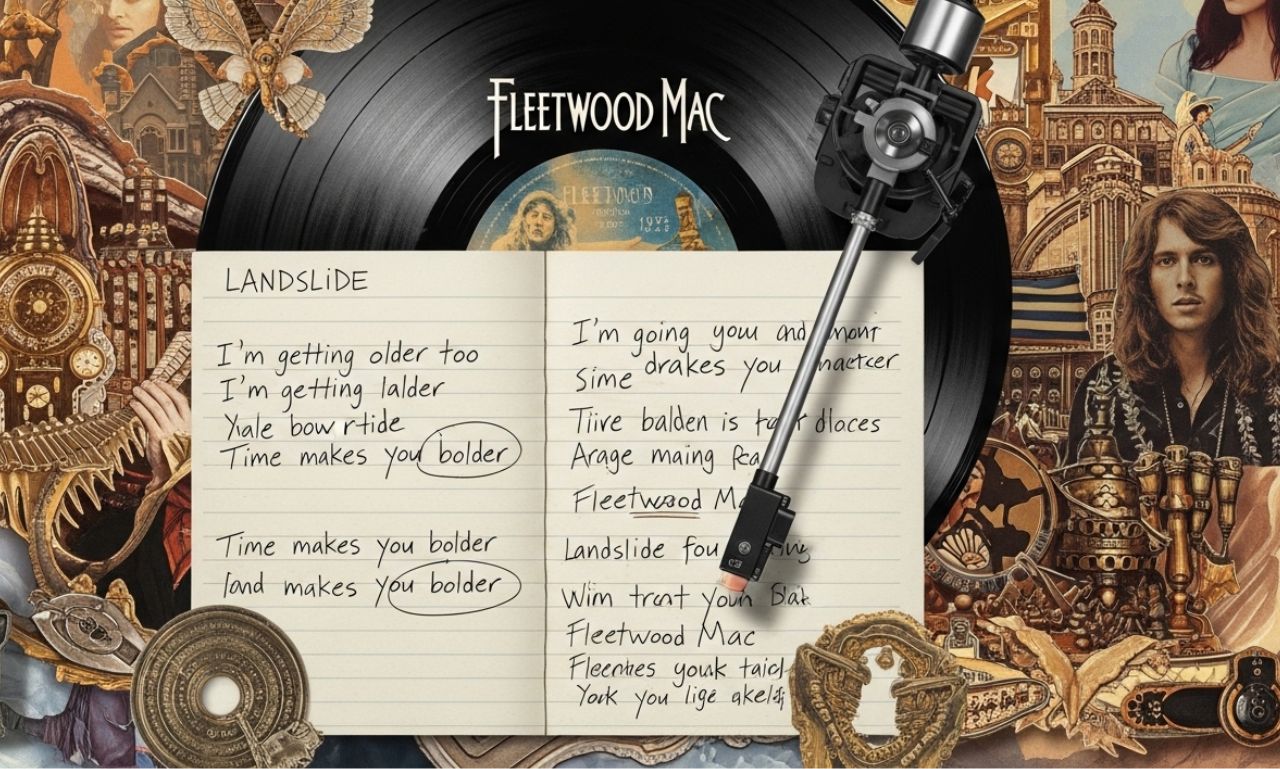
Nicks was only in her mid-20s when she wrote, "Well, I've been afraid of changing / 'Cause I've built my life around you / But time makes you bolder / Even children get older / And I'm getting older, too." This is the emotional core of the song. It acknowledges the fear of losing a partner who has become the foundation of one's world. However, it also offers a glimmer of hope: "time makes you bolder." This suggests that while aging involves loss, it also brings a necessary hardening of the spirit and a newfound independence.

The Metaphor of the Landslide
The choice of a "landslide" as the primary metaphor is significant. Unlike a fire or a flood, a landslide is a gravitational collapse. It is the result of internal instability reaching a breaking point. For Nicks, the landslide represented the potential end of her relationship with Buckingham and the end of her dreams of musical success.
In a broader psychological sense, the landslide represents the moments in life where the ground falls out from beneath us. This could be a career change, a bereavement, or the end of a long-term partnership. By naming the song "Landslide," Nicks acknowledges that these collapses are natural, inevitable, and often necessary for new growth to occur.
Musical Composition and Emotional Delivery
The power of "Landslide" is amplified by its minimalist arrangement. On the original 1975 Fleetwood Mac (the "White Album"), the track features only Nicks’ vocals and Lindsey Buckingham’s intricate acoustic guitar work.
Buckingham’s Fingerpicking
Lindsey Buckingham’s guitar style on "Landslide" is a masterclass in folk-influenced Travis picking. The steady, rolling rhythm of the guitar provides a stabilizing force against the lyrical themes of instability. There is a profound irony in the music: the man she is singing about losing is the one providing the musical foundation for her to express that fear.
Vocal Evolution
Nicks’ vocal performance has evolved significantly over the decades. In the 1975 studio version, her voice is high, clear, and carries a hint of youthful trepidation. By the time of the 1997 live version on The Dance, her voice had deepened, adding a layer of lived experience and "boldness" that perfectly matched the lyrics. In 2026, as fans listen to remastered versions or archival live recordings, the song continues to benefit from this "aging" process, as Nicks herself has become the wise elder she was imagining in her youth.
The Relationship Between Stevie Nicks and Lindsey Buckingham
It is impossible to separate the meaning of "Landslide" from the volatile relationship between Nicks and Buckingham. The song was written at a time when their romantic bond was fraying under the pressure of poverty and creative frustration.
When they eventually joined Fleetwood Mac, their relationship became the subject of intense public scrutiny, particularly during the recording of the Rumours album. "Landslide" served as a precursor to the emotional honesty that would define the band’s most famous work. It was Nicks’ way of preparing herself for a life without Buckingham, even as they continued to work together for decades. The fact that they performed this song together for 40 years added a layer of performative tension that fans found captivating.
Historical Milestones of "Landslide"
Since its release in 1975, "Landslide" has moved from a hidden gem on an album to one of the most covered and culturally significant songs in American music history.
| Year | Event | Significance |
|---|---|---|
| 1975 | Release on Fleetwood Mac | Introduced the song to the public; initially not a single. |
| 1997 | The Dance Live Version | Re-popularized the song for a new generation; became a hit single. |
| 1998 | Fleetwood Mac Hall of Fame Induction | Cemented the song's status as a rock classic. |
| 2002 | Dixie Chicks (The Chicks) Cover | Reached #1 on Adult Contemporary charts; introduced the song to country audiences. |
| 2011 | Glee Performance | Introduced the song to a younger Gen Z and Millennial demographic. |
| 2026 | 51st Anniversary of the Album | The song remains a staple of radio and streaming, symbolizing timeless resilience. |
Cultural Legacy and Covers
"Landslide" has been covered by a diverse array of artists, each bringing a different perspective to its themes.
- The Smashing Pumpkins: Billy Corgan’s 1994 acoustic cover highlighted the song’s inherent melancholy and its appeal to the "Alternative" generation.
- The Chicks (formerly Dixie Chicks): Their 2002 version is perhaps the most famous cover, adding a country-pop sensibility that emphasized the "coming-of-age" aspect of the lyrics. Stevie Nicks has expressed great fondness for this version, noting that it gave the song a "third life."
- Harry Styles: Styles has frequently performed the song, often with Nicks herself, bridging the gap between classic rock and modern pop.
The song’s use in television and film—from South Park to This Is Us—has solidified its role as the go-to anthem for moments of bittersweet reflection and life-changing decisions.
Stevie Nicks’ Perspective in 2026
Now that the song has existed for over half a century, Stevie Nicks’ own relationship with "Landslide" has come full circle. She has often said that she wrote it for her father, Jess Nicks, who had encouraged her to pursue her dreams but also cautioned her about the hardships of the music industry.
In recent years, Nicks has dedicated live performances of the song to fallen friends, family members, and even her younger self. For Nicks, the song is no longer just about a relationship with a man; it is about her relationship with time itself. It is a testament to her survival in an industry that often discards women as they age.
The Psychological Impact: Why We Still Listen
"Landslide" remains a staple of therapeutic playlists and funeral services alike because it validates the feeling of being "stuck" or "afraid." It doesn't offer a simple solution; it doesn't say that everything will be okay. Instead, it suggests that the act of acknowledging our fear—looking at the "mirror in the sky"—is the first step toward bravery.
The song resonates across generations because the "seasons of life" are a universal experience. Whether a listener is 15 and graduating from school, 40 and facing a mid-life career shift, or 80 and looking back at a long life, the lyrics provide a framework for understanding the transition from one phase to the next.
Frequently Asked Questions
Was "Landslide" written about a specific person?
While the song is primarily about Stevie Nicks’ own internal struggle and her relationship with Lindsey Buckingham, she has also dedicated it to her father. It is less about one specific person and more about the fear of losing the people who make up the "foundation" of your life.
Why is the song so popular for graduations and weddings?
The lyrics "children get older, and I'm getting older too" perfectly capture the bittersweet nature of life milestones. At a graduation, it represents moving from childhood to adulthood. At a wedding, it can represent the shift from being a daughter or son to a partner, acknowledging that change is necessary for growth.
Did "Landslide" chart when it was first released?
Surprisingly, no. "Landslide" was not released as a single from the 1975 Fleetwood Mac album. It became a radio staple over time and finally hit the charts in 1997 when a live version from the reunion special The Dance was released as a single.
Is the song about Stevie Nicks quitting music?
In part, yes. When she wrote it in Aspen, she was seriously considering leaving the music business to return to school because she and Buckingham were struggling so much financially. The "landslide" she feared was the failure of her career.
How does the Dixie Chicks version differ in meaning?
The meaning remains the same, but the delivery emphasizes the "boldness" Nicks mentions in the lyrics. Their version brought the song to a country audience and proved that the track's emotional core is not limited to the rock genre.
Final Recommendations for Listeners
To truly appreciate the depth of "Landslide," listeners should experience the song in chronological order of its performance. Start with the 1975 studio version on the Fleetwood Mac album to hear the raw, youthful uncertainty of Stevie Nicks. Then, move to the 1997 version from The Dance to hear the power of a woman who has "sailed through the changing ocean tides" and come out the other side. Finally, seek out a recent live performance from the 2020s to hear the song as a masterful piece of American folk-rock history, delivered by an artist who has truly become "bolder" with time.
Whether you are facing a major life change or simply reflecting on the years behind you, "Landslide" offers a rare moment of clarity: change is coming, it might bring you down, but you have the strength to survive it.
Image Gallery
Select an image to open it in a new tab.

Simon Caldwell
Enterprise Technology and Systems Editor
