Joe Namath NFL Stats: A Comprehensive Career Breakdown and Historical Context

Joe Namath concluded his professional career with 27,663 passing yards, 173 touchdowns, and 220 interceptions across 13 seasons in the AFL and NFL. His most iconic statistical achievement occurred in 1967, when he became the first professional quarterback to surpass 4,000 passing yards in a single season—a record that stood for 12 years.
To understand Joe Namath's NFL stats, one must look beyond the raw numbers and examine the era in which he played. "Broadway Joe" was the primary engine of a New York Jets offense that prioritized the long ball at a time when professional football was dominated by "three yards and a cloud of dust" rushing attacks. While his career interception total often draws scrutiny from modern analysts, his volume passing and vertical efficiency made him the most feared aerial threat of the late 1960s.
The Landmark 4,000-Yard Season (1967)
In 1967, Joe Namath achieved a feat that many experts at the time thought was impossible within the constraints of a 14-game schedule. He threw for 4,007 yards, averaging 286.2 yards per game. To put this in perspective, no other quarterback reached the 4,000-yard plateau until Dan Fouts did so in 1979, and Fouts required a 16-game season to accomplish it.
Namath's 1967 season was a masterclass in aggressive vertical passing. He led the AFL in attempts (491), completions (258), and yards, while also throwing 26 touchdowns. The technical depth of this achievement lies in the league's rules at the time. Defensive backs were permitted to "chuck" receivers all the way down the field, and there were no "defenseless receiver" protections. Passing for 4,000 yards in 1967 is statistically equivalent to passing for over 5,500 yards in the 2026 NFL environment.
Comprehensive Career Statistics Breakdown
Namath’s career is divided into two distinct halves: his dominant, pre-injury peak in the American Football League (AFL) and his often injury-plagued later years in the post-merger NFL. The following table provides a year-by-year breakdown of his primary passing metrics.
| Year | Team | League | Games | Comp | Att | Yards | TD | INT | Rate |
|---|---|---|---|---|---|---|---|---|---|
| 1965 | NYJ | AFL | 13 | 171 | 340 | 2,220 | 18 | 15 | 71.5 |
| 1966 | NYJ | AFL | 14 | 232 | 471 | 3,379 | 19 | 27 | 62.6 |
| 1967 | NYJ | AFL | 14 | 258 | 491 | 4,007 | 26 | 28 | 73.8 |
| 1968 | NYJ | AFL | 14 | 187 | 380 | 3,147 | 15 | 17 | 72.1 |
| 1969 | NYJ | AFL | 14 | 185 | 361 | 2,734 | 19 | 17 | 74.3 |
| 1970 | NYJ | NFL | 5 | 72 | 150 | 1,253 | 5 | 12 | 54.7 |
| 1971 | NYJ | NFL | 3 | 28 | 59 | 537 | 5 | 6 | 68.2 |
| 1972 | NYJ | NFL | 13 | 162 | 324 | 2,816 | 19 | 21 | 72.5 |
| 1973 | NYJ | NFL | 6 | 68 | 133 | 1,149 | 5 | 10 | 59.4 |
| 1974 | NYJ | NFL | 14 | 191 | 361 | 2,616 | 20 | 22 | 69.4 |
| 1975 | NYJ | NFL | 13 | 157 | 326 | 2,286 | 15 | 28 | 51.0 |
| 1976 | NYJ | NFL | 11 | 114 | 230 | 1,090 | 4 | 16 | 39.9 |
| 1977 | LAR | NFL | 4 | 50 | 107 | 601 | 3 | 1 | 54.5 |
| Total | 140 | 1,886 | 3,762 | 27,663 | 173 | 220 | 65.5 |
Note: Statistics represent regular season play only. Data sourced from Pro-Football-Reference.

Analyzing the Interception Ratio
One of the most frequent criticisms of Joe Namath’s Hall of Fame credentials is his touchdown-to-interception ratio (173 TDs to 220 INTs). By modern 2026 standards, an interception rate of 5.8% would be grounds for immediate benching. However, a technical analysis of the era reveals that Namath’s efficiency was much closer to his peers than it appears.
During the 1960s and 70s, the "bump and run" coverage was legal for the entirety of the route. Passing windows were significantly tighter, and quarterbacks were expected to take high-risk shots to stretch the field. Namath was known for his extremely quick release—perhaps the fastest in NFL history—which allowed him to wait until the last possible millisecond before firing. While this resulted in massive yardage totals, it also led to "tipped" balls and interceptions that wouldn't occur under modern rules that protect receivers.
Furthermore, Namath played much of his career with chronic knee injuries that limited his ability to drive off his back foot. This lack of mobility meant he couldn't scramble to avoid pressure, forcing him to throw the ball away or attempt dangerous passes to avoid sacks.
The 1972 Comeback and Late Career Peaks
While many fans focus on the 1968 Super Bowl season, Namath’s 1972 season is often cited by film scouts as his most impressive individual performance. After missing most of the 1970 and 1971 seasons due to injury, Namath returned to lead the NFL in passing yards (2,816) and passing touchdowns (19).
He earned the NFL Comeback Player of the Year award and proved that, when healthy, he was still the premier passer in the league. His 1972 stats are particularly remarkable because he achieved them while playing behind a declining offensive line and with a mobility level that was effectively zero. This season serves as the strongest evidence that Namath’s "stats" were a product of elite talent overcoming physical limitations.
Postseason Success and Super Bowl III
Namath’s regular-season stats are legendary, but his legacy is cemented by his performance in the 1968 AFL Championship and Super Bowl III. In the AFL Championship win over the Oakland Raiders, Namath threw for 266 yards and 3 touchdowns in freezing winds at Shea Stadium.
In Super Bowl III, the game that changed the trajectory of the NFL, Namath’s stats were:
- Completions/Attempts: 17/28
- Passing Yards: 206
- Touchdowns: 0
- Interceptions: 0
While he didn't throw a touchdown, his efficiency was the key. Facing a Baltimore Colts defense that was considered one of the greatest in history, Namath dismantled their "zone" coverage with surgical precision. He did not throw a single pass in the fourth quarter, as the Jets relied on the running game to milk the clock—a strategic decision that suppressed his final yardage but secured the championship.
Why the Stats Led to the Hall of Fame
Joe Namath was inducted into the Pro Football Hall of Fame in 1985. Some "stat-only" analysts argue that his numbers don't compare to modern greats, but the Hall of Fame selection committee focuses on several key factors derived from his stats:
- Leading the League: Namath led his league (AFL or NFL) in passing yards three times (1966, 1967, 1972).
- The 4,000-Yard Barrier: Being the first to reach a milestone is a primary criterion for "greatness."
- Efficiency in Context: In 1967, Namath averaged 8.2 yards per attempt. To find a similar average in 2026, a quarterback would typically need to be an All-Pro or MVP candidate.
- Impact on the Game: Namath’s stats proved that a "pass-first" offense could win championships, leading to the high-flying NFL we see today.
Comparison with Contemporaries
To truly value Namath's NFL stats, they must be compared to other legends who played during the same window.
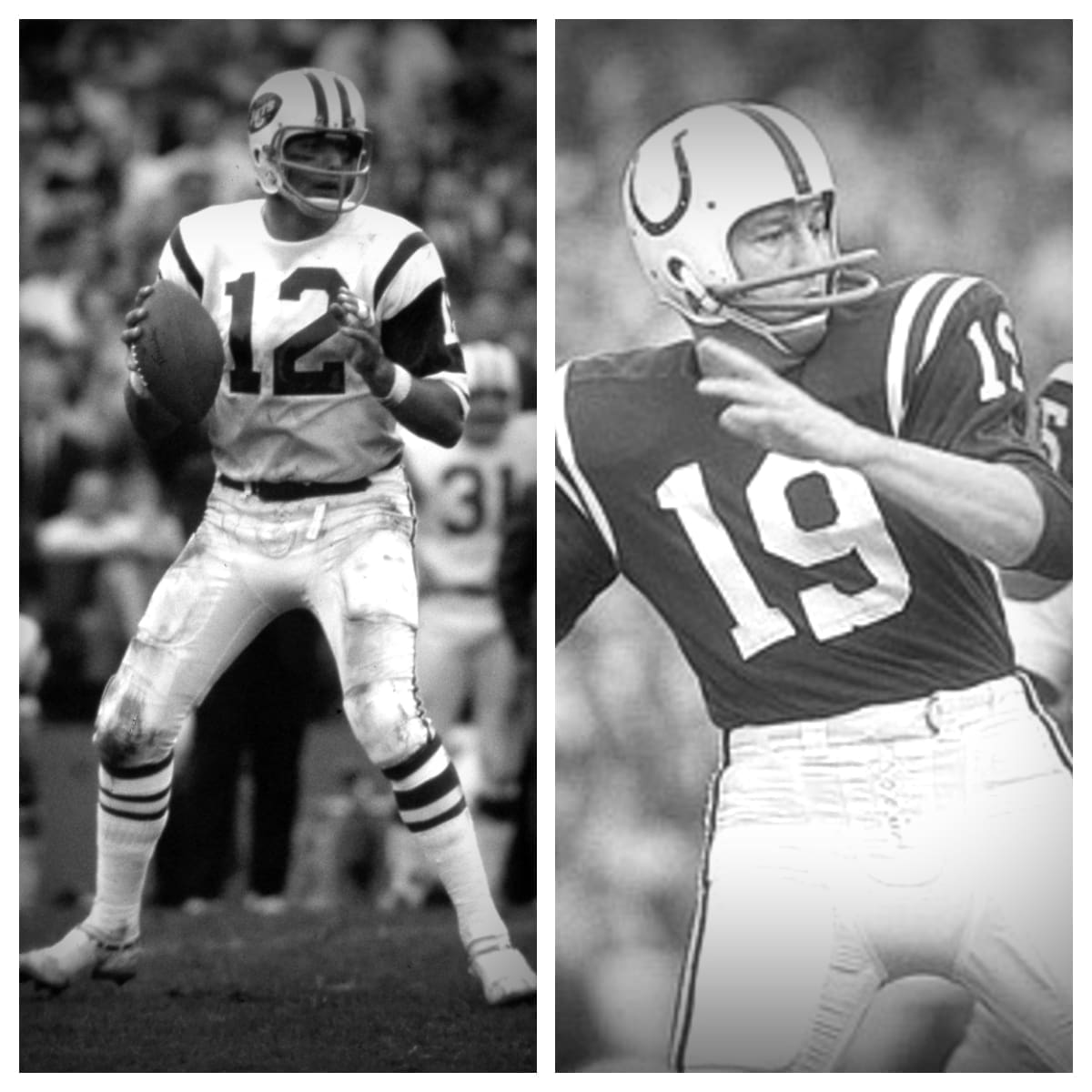
- Johnny Unitas: While Unitas had more career yards, he played 5 additional seasons. In their overlapping peak (1965–1970), Namath often outpaced Unitas in yards per game and total yardage.
- Fran Tarkenton: Tarkenton holds the era's records for yards and touchdowns, but he was a "scrambling" quarterback who played 18 seasons and rarely suffered the debilitating knee injuries that shortened Namath’s prime.
- Len Dawson: Dawson was more efficient (higher completion percentage), but he played in a conservative "ball control" offense that didn't ask him to carry the team's entire scoring load the way Namath did for the Jets.
The Physical Toll: How Injuries Suppressed His Totals
It is widely accepted that if Namath had played with modern surgical techniques and turf conditions, his stats would have been significantly higher. He underwent multiple knee surgeries at a time when such procedures were primitive. By 1974, he was essentially playing without cartilage in either knee.
Despite this, he started every game in 1974 and led the Jets to a six-game winning streak to end the season, including a famous victory over the cross-town rival Giants. His ability to produce 2,616 yards and 20 touchdowns in 1974 with "wooden legs" is regarded by historians as one of the gutsiest statistical seasons in NFL history.
FAQ: Frequently Asked Questions About Joe Namath’s Stats
How many 4,000-yard seasons did Joe Namath have?
Joe Namath had exactly one 4,000-yard season, which occurred in 1967 (4,007 yards). While this seems low by 2026 standards, it was the only 4,000-yard season in professional football history for 12 years. Most quarterbacks of that era struggled to reach 3,000 yards.
What was Joe Namath's career-high in touchdowns for a single season?
His career-high was 26 passing touchdowns in 1967. He also threw 20 or more touchdowns in 1974. These numbers were elite for the 14-game era, where leading the league often required only 22 to 25 touchdowns.
Did Joe Namath ever win an NFL MVP award?
While he didn't win the "NFL" MVP (which was often dominated by players from the established NFL), he was named the AFL Most Valuable Player twice, in 1968 and 1969. He was also the Super Bowl III MVP.
Why are Joe Namath's interceptions so high?
Namath’s 220 interceptions were a result of the Jets' vertical offensive scheme, the lack of illegal contact rules for defenders, and his own aggressive playing style. He preferred to "force" a ball into a tight window for a big gain rather than take a sack or check down to a running back.
What were Joe Namath's stats in his final season with the Rams?
In his final season (1977) with the Los Angeles Rams, Namath appeared in 4 games, completing 50 of 107 passes for 601 yards, 3 touchdowns, and 1 interception. His knees had failed him by this point, and he retired shortly after the season concluded.
How many Pro Bowls did Joe Namath make?
Namath was selected to five AFL All-Star games (1965, 1967, 1968, 1969) and one NFL Pro Bowl (1972) after the merger. His selections were a direct reflection of his standing as the top statistical passer in the game during those years.
Final Recommendation for Researchers
For those looking to analyze Joe Namath's NFL stats further, it is recommended to utilize "Era Adjusted" metrics found on advanced statistical databases. Comparing his 1967 raw data to a 2026 quarterback's data is misleading; instead, look at ANY/A (Adjusted Net Yards per Pass Attempt), which accounts for sacks, touchdowns, and interceptions relative to the league average of the time. You will find that during his peak (1967–1972), Namath consistently ranked in the top 5% of all professional passers, validating his status as a legendary figure in football history.
Image Gallery
Select an image to open it in a new tab.



Celine Dubois
Contemporary Living and Global Arts Columnist
