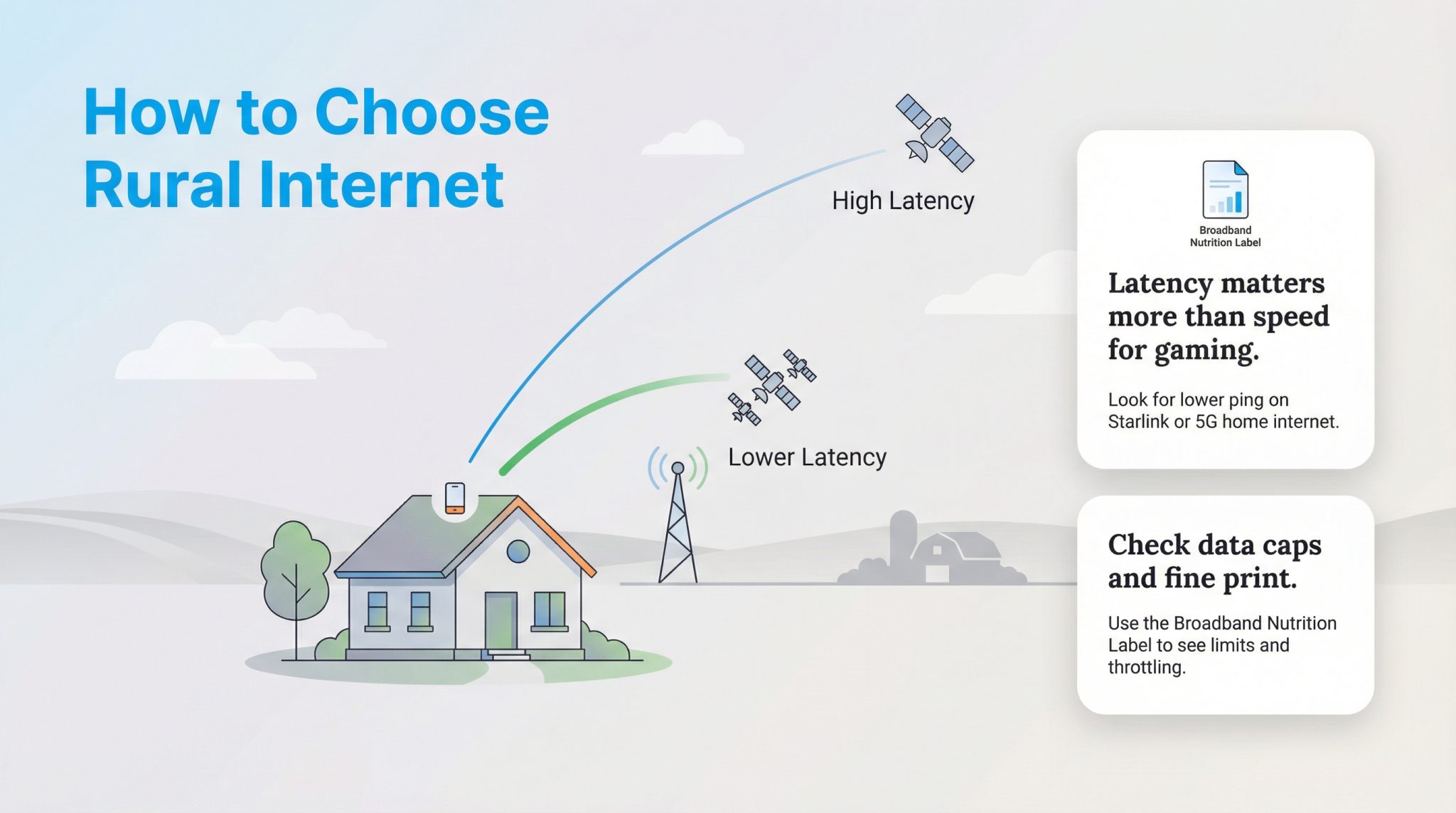
High-speed internet for rural areas is increasingly achievable through a combination of evolving low-Earth orbit satellite constellations, expanded fiber-optic infrastructure funded by federal and state grants, and fixed wireless access technologies. While geographic isolation once posed an insurmountable barrier, modern connectivity solutions now provide multi-megabit speeds that support remote work, telehealth, and education in historically underserved regions.
Understanding the Rural Connectivity Landscape
For decades, rural residents faced a "digital divide" characterized by dial-up speeds, expensive and capped satellite plans, or a complete absence of service. The challenge is primarily economic: the high cost of trenching fiber-optic cables or erecting cell towers across sparsely populated terrain often discouraged private providers. By 2026, however, the landscape has shifted significantly due to technological breakthroughs and a sustained focus on universal broadband access.
The feasibility of obtaining high-speed internet now depends on the intersection of three factors: your specific physical location, the available transmission technology, and your performance requirements. Achieving high speed is no longer a question of "if," but rather a determination of "which solution fits the local environment."
Evaluating Connectivity Technologies
Not all high-speed options are equal, and the suitability of each depends on the topography and infrastructure density of your area.
Low-Earth Orbit (LEO) Satellite
LEO satellite constellations have revolutionized rural connectivity by moving the transmission hardware from geostationary orbit—thousands of miles away—to a few hundred miles above the Earth. This proximity significantly reduces latency, the "ping" time that previously made satellite internet unusable for video calls or gaming. Providers utilize thousands of small satellites that work in tandem to provide near-continuous coverage, even in mountainous or heavily forested regions.
Fixed Wireless Access (FWA)
Fixed wireless involves mounting an antenna on your home that communicates with a nearby base station or tower. Unlike mobile hotspots that rely on the same signal as your smartphone, FWA is engineered to provide high-bandwidth, dedicated connections to fixed locations. This is an excellent solution in rural plains or rolling hills where line-of-sight to a tower is possible.
Fiber-Optic Broadband
While fiber is the gold standard for speed and stability, it remains the most difficult to deploy in rural areas. However, as of 2026, many regional cooperatives and municipal broadband projects have successfully utilized state and federal funding to bring fiber to residential properties. Even if a major national ISP does not serve your area, a small, locally-owned fiber cooperative might.
Comparative Overview of Rural Internet Solutions
| Technology | Latency | Weather Sensitivity | Primary Use Case |
|---|---|---|---|
| LEO Satellite | Low (20–50ms) | Moderate | Global/Remote coverage |
| Fixed Wireless | Moderate | Low | Rural plains/Line-of-sight |
| Fiber-Optic | Very Low | None | High-bandwidth heavy users |
| DSL/Copper | Moderate | None | Legacy areas (low speed) |
Prerequisites for Rural Installation
Before selecting a provider, you must assess your property's specific physical requirements. The first step is verifying your "line-of-sight." For satellite and fixed wireless providers, the antenna must have an unobstructed view of the sky or the tower. Obstructions like dense tree cover, hills, or large structures can significantly degrade or entirely block service.
You should also review your internal home network infrastructure. Even if you bring high-speed data to the exterior of your home, an outdated router or low-quality Ethernet cabling inside the house will create a bottleneck, making the connection appear slower than it actually is. By 2026, a Wi-Fi 6 or 7 router is the recommended standard for distributing modern high-speed signals throughout a residence.
The Role of Funding and Legislative Progress
In recent years, the government has prioritized bridging the gap between urban and rural connectivity. Programs like the Broadband Equity, Access, and Deployment (BEAD) program continue to allocate significant funding to states to build out "last-mile" infrastructure.
If you are struggling to find a provider, visit the Federal Communications Commission (FCC) National Broadband Map. This resource allows you to input your exact address to see which providers are reported to serve your location. Note that these maps are periodically updated based on new filings; if the map says you have service but you do not, you can file a challenge directly through the portal. This is a critical step in ensuring that accurate data reaches the regulators, which in turn influences future infrastructure investment in your region.
Overcoming Challenges and Troubleshooting
Achieving high-speed internet often involves proactive management. If your connection remains slow, consider these steps:
- Verify Your Data Cap: Many satellite and some wireless providers impose "soft caps" or data thresholds. If you exceed these, your speeds may be throttled to a lower tier for the remainder of the billing cycle.
- Optimize Antenna Placement: If using FWA or satellite, consult with the installer to ensure the antenna is in the most stable, unobstructed location. Even a slight shift caused by high winds can impact signal quality.
- Upgrade Hardware: Ensure your modem or satellite dish is the latest model provided by the manufacturer. Technologies evolve, and older equipment may not be capable of utilizing new network upgrades implemented by the provider.
- Local ISP Scouting: Look for smaller, independent Wireless Internet Service Providers (WISPs). These companies are often more agile than national corporations and may have towers positioned specifically to cover localized valleys or rural clusters that larger companies ignore.
Frequently Asked Questions
Is satellite internet finally fast enough for gaming and streaming? Yes, with the advent of LEO satellite technology, latency has dropped from 600+ milliseconds to under 50 milliseconds. This is generally sufficient for most modern online gaming and high-definition video streaming. However, heavy cloud-based computing tasks or professional-grade video editing may still encounter occasional stutters during periods of extreme atmospheric interference.
Why does my speed test show different results than what I pay for? Internet plans are typically marketed as "up to" a certain speed. Environmental factors like distance from a tower, signal interference, network congestion during peak evening hours, and internal hardware limitations can result in real-world speeds being lower than the advertised maximum.
Are there free government programs to help with the cost of rural internet? While federal assistance programs fluctuate in availability, many states offer localized subsidies for rural residents to cover the cost of installation or hardware. Check with your state’s department of commerce or agricultural extension office to see if there are active initiatives to offset the capital expenditure of setting up a connection.
What is the best way to determine which ISP is actually available at my home? The most reliable method is to check your address on the official FCC National Broadband Map. Additionally, contact your local utility cooperative. Many rural electric co-ops have begun offering fiber-to-the-home services to their members as a utility, similar to electricity or water.
What happens if I live in a "dead zone" where no service is available? If satellite, wireless, and fiber are all unavailable, you may need to look into community-led initiatives. In some regions, neighbors have formed "broadband cooperatives" to pool resources and contract with a local WISP to bring a central point of service to an area, which is then distributed locally via point-to-point wireless links.
Conclusion and Next Actions
High-speed internet in rural areas is no longer a luxury; it is a fundamental requirement for modern life. The most effective next step for any rural resident is to conduct a site-specific assessment of their property. Begin by using the FCC’s mapping tools to identify authorized providers and reach out to local electric cooperatives, as they are often the hidden heroes of rural infrastructure. If major providers show no availability, research local Wireless Internet Service Providers (WISPs) that may have proprietary towers in your vicinity. By auditing your home’s hardware and verifying your specific geographic limitations, you can make an informed decision on which technology will provide the reliable connection you need.
Image Gallery
Select an image to open it in a new tab.

Simon Caldwell
Enterprise Technology and Systems Editor
