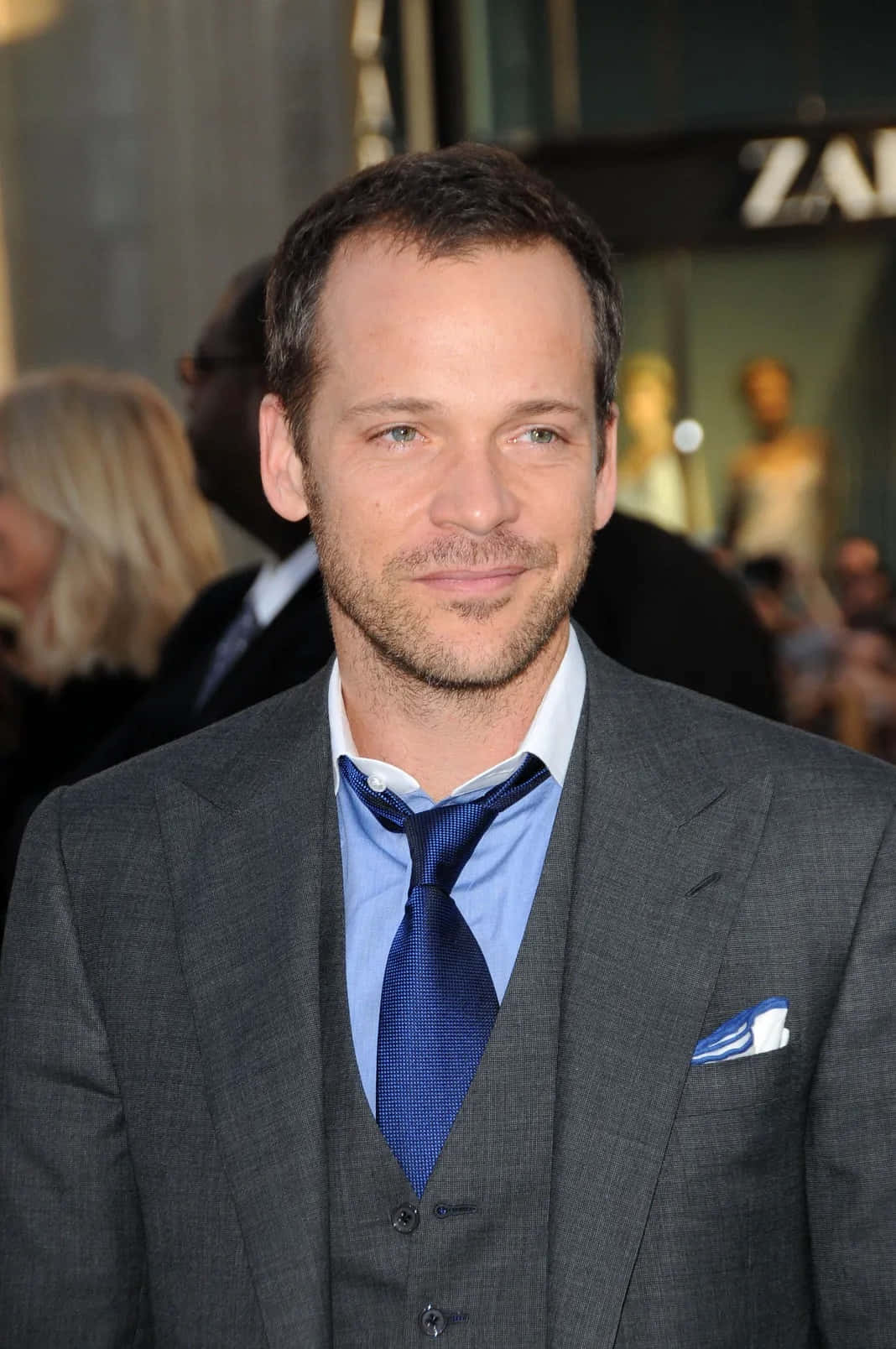
Peter Sarsgaard is a critically acclaimed American actor recognized for his intellectual depth and chameleonic ability to portray complex, often morally ambiguous characters. Since his 1995 film debut, he has transitioned seamlessly between independent cinema, high-stakes television, and major blockbusters, earning a Volpi Cup and widespread industry respect for his transformative performances.
The Foundation of a Thinking Person’s Actor
Born John Peter Sarsgaard on March 7, 1971, at Scott Air Force Base in Illinois, his early life was defined by the frequent relocations typical of a military family. This transient upbringing often fosters a keen sense of observation—a trait that would later become a hallmark of his acting style. Sarsgaard did not initially set out to be an actor; his early interests were focused on soccer and academics. However, after a series of concussions ended his athletic pursuits, he pivoted toward the arts while attending Washington University in St. Louis.
At Washington University, Sarsgaard co-founded a comedy improv troupe called "Mama’s Pot Roast" and began appearing in theatrical productions. His dedication to the craft led him to the Actors Studio in New York, where he refined his technique under the tutelage of seasoned professionals. This classical training, combined with the grit of the New York theater scene in the early 1990s, prepared him for a career defined by internal complexity rather than mere physical presence.
His off-Broadway debut in Horton Foote’s Laura Dennis (1995) signaled the arrival of a performer who could hold the stage with a quiet, simmering intensity. Sarsgaard’s early stage work, including performances in productions like Kingdom of Earth, established his reputation as a "serious" actor, a label that would follow him as he moved into film and television.
Breaking Through: Boys Don’t Cry and the Villain Archetype
While Sarsgaard’s film debut occurred in the 1995 drama Dead Man Walking, it was his chilling performance in the 1999 film Boys Don’t Cry that brought him national attention. In the film, he portrayed John Lotter, a volatile and violent man whose actions drive the tragic conclusion of the story.
The role was a double-edged sword. While it showcased Sarsgaard’s ability to inhabit deeply unsympathetic characters with terrifying realism, it also threatened to pigeonhole him as a perennial villain. However, Sarsgaard avoided the trap of typecasting by choosing subsequent roles that highlighted his range. He didn't just play "bad" men; he played men with internal contradictions, men who were wounded, and men who were intellectually superior yet ethically compromised.
By the turn of the millennium, Sarsgaard had established himself as a staple of the American independent film movement. His presence in a cast became a shorthand for quality, signaling to audiences that the film would likely prioritize character development and psychological realism over superficial spectacle.

The Intellectual Masterclass: Shattered Glass and Kinsey
If Boys Don’t Cry put him on the map, the 2003 film Shattered Glass solidified his status as one of the finest actors of his generation. Playing Charles "Chuck" Lane, the editor of The New Republic who uncovers the journalistic fraud of Stephen Glass (played by Hayden Christensen), Sarsgaard delivered a performance of remarkable restraint.
Unlike Christensen’s flamboyant, needy portrayal of Glass, Sarsgaard’s Lane was the moral anchor of the film—stiff, seemingly humorless, but ultimately guided by a relentless pursuit of the truth. His performance earned him a Golden Globe nomination for Best Supporting Actor and awards from the National Society of Film Critics and the New York Film Critics Circle. Critics noted that Sarsgaard managed to make the mundane act of editing and fact-checking feel like a high-stakes thriller.
Following this success, Sarsgaard continued to explore the lives of intellectuals and professionals. In Kinsey (2004), he played Clyde Martin, an assistant to the famed sexologist Alfred Kinsey. The role required a delicate balance of academic rigor and personal vulnerability, particularly in the scenes exploring the fluid boundaries of human sexuality. These performances established the "Sarsgaard archetype": the man who thinks more than he speaks, and whose internal world is far more chaotic than his outward appearance suggests.
Navigating the Hollywood Blockbuster Landscape
Despite his roots in independent cinema, Sarsgaard has never been afraid to engage with large-scale Hollywood productions. However, even in "popcorn" movies, he often brings an eccentric energy that elevates the material.
In the 2011 superhero film Green Lantern, he played the antagonist Hector Hammond. While the film itself received mixed reviews, Sarsgaard’s performance was frequently cited as a highlight. He fully embraced the physical transformations and the psychological breakdown of the character, treating the role with the same seriousness he would a Chekhov play.
More recently, his role as District Attorney Gil Colson in Matt Reeves’ The Batman (2022) demonstrated his ability to function within a stylized, noir-inspired universe. As a corrupt official facing a terrifying moral dilemma, Sarsgaard provided a grounded, visceral sense of fear that helped anchor the film’s high-concept world. His ability to work within the confines of a massive franchise while maintaining his artistic integrity is a testament to his versatility.
The Sarsgaard-Gyllenhaal Artistic Partnership
A significant aspect of Peter Sarsgaard’s career and personal life is his partnership with actor and director Maggie Gyllenhaal. Married since 2009, the two have become one of the most respected power couples in the industry, often collaborating on projects that push artistic boundaries.
Sarsgaard appeared in The Lost Daughter (2021), Gyllenhaal’s directorial debut based on the novel by Elena Ferrante. His performance as Professor Hardy—a charismatic intellectual who becomes an object of fascination for the protagonist—was a masterclass in subtle magnetism.
As of 2026, their collaboration continues with highly anticipated projects like The Bride!, a reimagining of the Frankenstein mythos. Sarsgaard has often spoken about how Gyllenhaal’s vision as a director challenges him to find new layers in his performances. This partnership has not only produced exceptional art but has also allowed Sarsgaard to explore the dynamics of creative influence and mutual support within the high-pressure environment of Hollywood.
Key Performances and Career Milestones
The following table highlights some of the most significant roles in Peter Sarsgaard’s career, demonstrating the breadth of his work across different genres and formats.
| Year | Title | Role | Category/Notes |
|---|---|---|---|
| 1999 | Boys Don't Cry | John Lotter | Breakthrough performance; Independent film |
| 2003 | Shattered Glass | Chuck Lane | Golden Globe Nominee; Critical acclaim |
| 2004 | Garden State | Mark | Cult classic; Indie dramedy |
| 2004 | Kinsey | Clyde Martin | Biographical drama; Exploratory role |
| 2005 | Jarhead | Alan Troy | Military drama; Physical performance |
| 2009 | An Education | David | Period drama; International recognition |
| 2013 | The Killing | Ray Seward | Television; Highly acclaimed character arc |
| 2021 | Dopesick | Rick Mountcastle | Emmy Nominee; Socially relevant drama |
| 2022 | The Batman | Gil Colson | Blockbuster; DC Comics universe |
| 2023 | Memory | Saul | Volpi Cup Winner (Best Actor) |
| 2024 | Presumed Innocent | Tommy Molto | Television; Legal thriller |
The 2023 Volpi Cup and "Memory"
One of the most significant achievements of Sarsgaard’s career occurred at the 80th Venice International Film Festival in 2023. He was awarded the Volpi Cup for Best Actor for his role in Michel Franco’s Memory.
In the film, Sarsgaard portrays Saul, a man suffering from early-onset dementia who forms an unlikely connection with a woman from his past (played by Jessica Chastain). The role required a profound level of empathy and a rejection of traditional acting tropes associated with illness. Sarsgaard’s portrayal was praised for its dignity and its focus on the "presentness" of the character rather than the tragedy of his condition.
This award served as a formal acknowledgment of what many in the industry had known for decades: Sarsgaard is a world-class talent capable of leading a film with immense emotional weight. The win reinvigorated his career, leading to a new wave of leading-man offers and a renewed interest in his earlier body of work.
Technical Mastery: The "Actor's Actor"
What makes Peter Sarsgaard a "versatile American actor"? It often comes down to his technical approach to the work. Unlike actors who rely on a consistent persona, Sarsgaard is known for his "vocal gymnastics" and physical specificity. He often alters his speech patterns, pitch, and cadence to suit a character’s background and psychological state.
- Stillness and Subtext: Sarsgaard is a master of the "unsaid." He understands that on film, the camera can capture thought. Many of his most powerful moments involve him simply listening or reacting, with the audience able to see the gears turning behind his eyes.
- Empathy for the "Unlovable": He approaches villains and antagonists without judgment. Whether playing a murderer in The Killing or a corrupt lawyer in Presumed Innocent, he looks for the character’s internal logic—the reasons why they believe they are doing the right thing.
- Theatrical Discipline: Even in his film work, Sarsgaard maintains the discipline of a stage actor. He is known for thorough preparation, often diving deep into the research associated with his characters' professions or conditions.
Television and the Golden Age of Streaming
As the landscape of entertainment shifted toward high-quality television, Sarsgaard found a new outlet for his talents. His work in the third season of The Killing (2013) as death row inmate Ray Seward is often cited as one of the greatest single-season performances in television history. He brought a harrowing, claustrophobic intensity to the role that was almost difficult to watch, yet impossible to look away from.
In 2021, he starred in the Hulu miniseries Dopesick, which chronicled the opioid crisis in America. Playing Assistant U.S. Attorney Rick Mountcastle, Sarsgaard channeled the same righteous indignation he displayed in Shattered Glass, but with the added weight of a decade's worth of experience. The role earned him an Emmy nomination and reminded audiences that he is just as effective on the small screen as he is on the large one.
By 2026, Sarsgaard has become a sought-after lead for prestigious limited series, where the expanded runtime allows him to explore the "slow-burn" character development at which he excels.
Frequently Asked Questions
What is Peter Sarsgaard's most famous role?
While he is known for many roles, his performance as Chuck Lane in Shattered Glass (2003) is often cited as his definitive work. However, younger audiences may recognize him best as District Attorney Gil Colson from The Batman (2022) or from his acclaimed role in the series Dopesick.
Has Peter Sarsgaard won an Oscar?
As of 2026, Peter Sarsgaard has not won an Academy Award, though he has been the subject of significant Oscar buzz throughout his career, particularly for Shattered Glass and Memory. He has won the prestigious Volpi Cup for Best Actor at the Venice Film Festival and has been nominated for a Golden Globe and an Emmy.
Is Peter Sarsgaard related to the Skarsgård family?
No, Peter Sarsgaard is not related to the Swedish acting family that includes Stellan, Alexander, Bill, and Gustaf Skarsgård. The spellings of their last names are different (Sarsgaard vs. Skarsgård), and Peter is American, born in Illinois.
What kind of characters does Peter Sarsgaard usually play?
Sarsgaard is known for playing "intellectual" characters who often have a dark, complicated, or morally ambiguous side. He excels at playing people who are highly competent but may be hiding a secret or struggling with an internal moral conflict.
Who is Peter Sarsgaard married to?
Peter Sarsgaard has been married to fellow actor and director Maggie Gyllenhaal since May 2009. They have two daughters together and have collaborated on several professional projects, including the film The Lost Daughter.
Recommendation for Further Exploration
To truly appreciate the versatility of Peter Sarsgaard, it is recommended to watch his work in a specific sequence that highlights his range. Start with Shattered Glass to see his mastery of moral authority and restraint. Follow this with The Killing (Season 3) to witness his ability to portray raw, desperate vulnerability. Finally, watch Memory (2023) to see his award-winning portrayal of a man navigating the complexities of the human mind and heart. These three performances provide a comprehensive overview of why he remains one of the most respected figures in modern American cinema as of 2026.
Image Gallery
Select an image to open it in a new tab.
Simon Caldwell
Enterprise Technology and Systems Editor
