Navigating a Visitation Schedule in Texas: Understanding Possession and Access Orders

A visitation schedule in Texas, formally referred to in the Texas Family Code as a "possession and access" order, dictates how divorced or separated parents share time with their children. Texas courts default to a Standard Possession Order, which gives the non-custodial parent specific weekends, holidays, and extended summer periods, though parents may also negotiate custom schedules tailored to their family's needs.
Establishing and navigating a visitation schedule in the Texas family law system can feel overwhelming for parents facing custody decisions. Whether going through an amicable divorce, negotiating terms through mediation, or preparing for a contested court battle, understanding how Texas law views child custody, visitation, and parenting time is essential. The state legal framework prioritizes the best interests of the child while establishing structured guidelines to ensure both parents maintain meaningful involvement in their children's lives.
The Legal Framework of Child Custody and Visitation in Texas
Texas family law avoids terms like "custody" and "visitation" in its statutory text, opting instead for Conservatorship and Possession and Access. Understanding these legal distinctions is the first step toward navigating any visitation schedule in Texas.
Conservatorship vs. Possession and Access
In Texas, parental rights and duties are split into two major categories:
- Conservatorship: This governs legal rights and duties, such as making decisions about the child's education, medical care, and religious upbringing. Most parents are appointed as Joint Managing Conservators (JMCs), meaning they share these rights, though one parent usually holds the exclusive right to determine the child’s primary residence.
- Possession and Access: This is the schedule that dictates physical custody—specifically, when each parent has physical possession of the child and the right to access the child.
The Best Interest of the Child Standard
Under Section 153.002 of the Texas Family Code, the primary consideration in any case involving a visitation schedule is always the best interest of the child. Courts evaluate a multitude of factors, known widely through legal precedent as the Holley factors. These include the emotional and physical needs of the child now and in the future, any history of domestic violence or substance abuse, the stability of the home environments proposed by each parent, and, depending on the child's age, the reasonable preference of the child.
The Texas Standard Possession Order (SPO)
For decades, the default framework for parenting time in Texas has been the Standard Possession Order (SPO). Designed primarily for parents who live 100 miles or less apart from each other, the traditional SPO provides a predictable, highly structured calendar.
The 100-Mile Rule and Standard Schedule
Under a standard SPO where parents reside 100 miles or less apart, the non-custodial parent typically receives possession of the child under the following framework:
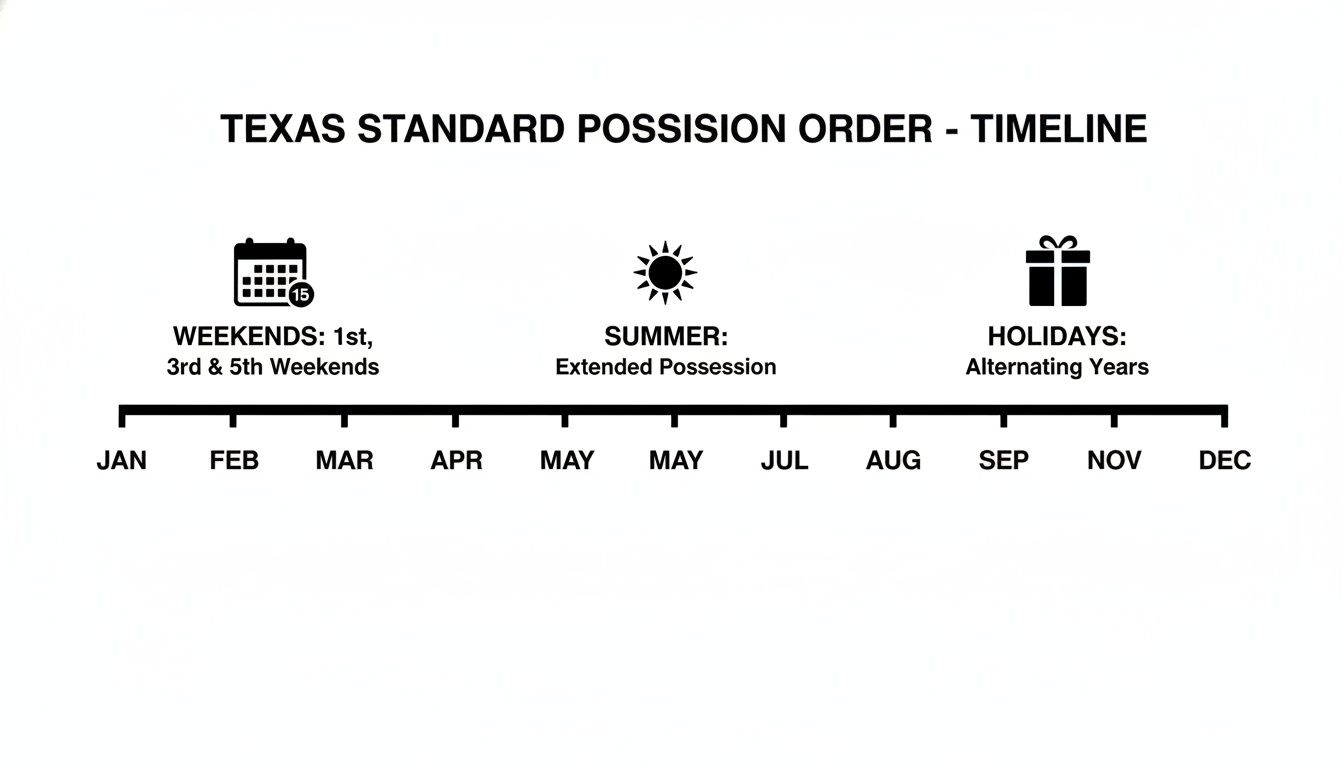
- Weekends: The 1st, 3rd, and 5th weekends of every month. Possession usually begins when school lets out on Friday and ends when school resumes on Monday morning.
- Thursdays: Every Thursday evening during the school year, from after school until the school day resumes on Friday (or overnight, depending on the specific court order).
- Holidays: Holidays are alternated on an odd-even year basis. For instance, one parent has Thanksgiving in even-numbered years (e.g., 2026, 2028), while the other has Thanksgiving in odd-numbered years (e.g., 2025, 2027). The same rotation applies to Christmas, Spring Break, and major holiday weekends like Easter, Memorial Day, and Labor Day.
- Summer: The non-custodial parent is entitled to 30 days of extended summer possession, which can typically be taken in one continuous block or split into two separate 14-day periods, provided written notice is given to the other parent by May 1.
The Expanded Standard Possession Order
Texas law presumes that an Expanded Standard Possession Order is in the best interest of the child, unless a parent can prove otherwise. The expanded SPO modifies the standard weekend and Thursday times to maximize contact. Instead of waiting until Friday after school, the non-custodial parent often picks the child up directly from school on Friday (or at the end of the school day) and keeps the child through the return to school on Monday morning. Similarly, Thursday possession extends overnight, running from the end of school on Thursday until school resumes on Friday morning.
| Schedule Type | Weekend Frequency | School-Year Weekdays | Summer Possession | Geographic Limitation |
|---|---|---|---|---|
| Standard Possession Order (SPO) | 1st, 3rd, and 5th weekends | Thursday evenings (or overnight) | 30 days (can be split) | 100 miles or less between residences |
| Expanded SPO | 1st, 3rd, and 5th weekends (extended pickup/dropoff) | Thursday overnight to Friday morning | 30 days (can be split) | 100 miles or less between residences |
| Over 100 Miles SPO | 1st, 3rd, and 5th weekends (or 1 weekend per month with notice) | None | 42 days during summer | Greater than 100 miles apart |
Visitation Schedules When Parents Live Far Apart
When parents live more than 100 miles apart, the logistical realities of mid-week visits become impractical. Consequently, the Texas Family Code provides an alternative schedule designed to accommodate long-distance parenting.
The Over-100-Miles Rule
If the parents reside more than 100 miles apart, the non-custodial parent generally loses the Thursday evening visits, but gains more flexibility and time during school breaks and summer vacation:
- Weekends: The non-custodial parent may still choose the 1st, 3rd, and 5th weekends of the month, or they may elect to have just one weekend per month, provided they give the other parent 14 days' written notice.
- Spring Break: The non-custodial parent typically has the right to possession of the child during every Spring Break.
- Summer Vacation: The extended summer possession period increases from 30 days to 42 days. If the parents live more than 200 miles apart, that summer period can expand even further to 50 days upon proper request.
Creating a Customized or Modified Visitation Schedule
While the Standard Possession Order is the statutory baseline in Texas, parents are not legally forced to use it. Texas family courts strongly encourage parents to craft agreements that suit their unique circumstances, work schedules, and children's developmental needs.
Custom and Alternative Schedules
Parents frequently negotiate alternative schedules, particularly when children are very young or when parents maintain non-traditional work hours (such as healthcare workers, first responders, or shift workers). Common alternatives include:
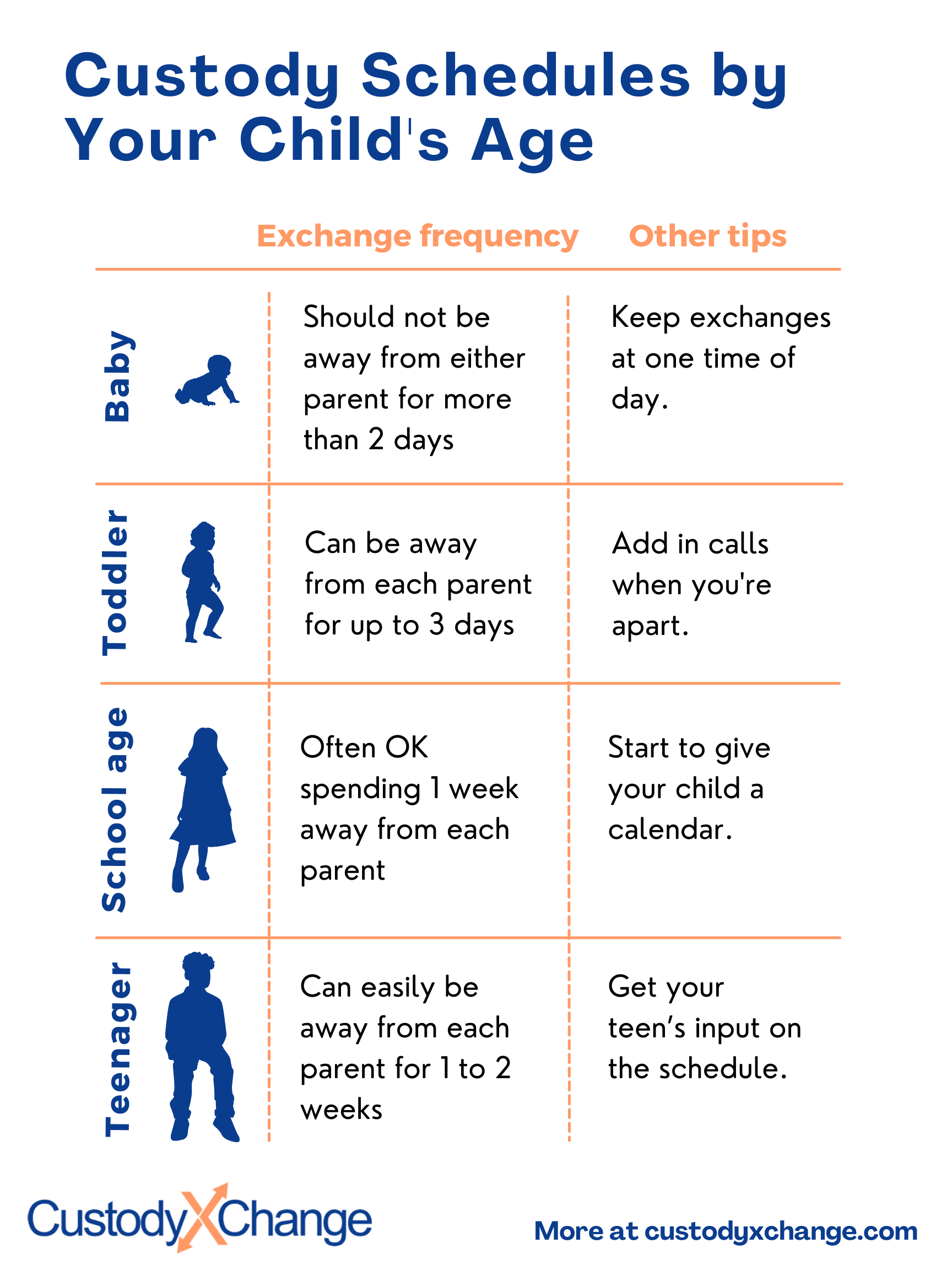
- 2-2-3 Schedule: The child spends two days with Parent A, two days with Parent B, and then alternates weekends (Friday through Sunday) with each parent. This ensures a young child is never away from either parent for more than a few days.
- Alternating Week (Week-on, Week-off): Often used for older children and cooperative co-parents, where exchanges occur on a specific day (such as Friday after school) every seven days.
- Modified Split Schedules: Tailored arrangements that account for extracurricular activities, tutoring, and specific holiday traditions.
Modification of Existing Orders
Once a visitation schedule is finalized and signed by a judge as a court order, it is legally binding. To change an existing schedule, a parent must file a Suit for Modification of the Parent-Child Relationship. To succeed, the petitioning parent must prove two legal elements:
- That the circumstances of the child, a conservator, or another affected party have materially and substantially changed since the rendition of the existing order; and
- That the proposed modification is in the best interest of the child.
Examples of material and substantial changes include a parent relocating for work, a significant shift in a parent's work schedule, changing educational or medical needs of the child, or evidence of a home environment that poses risks to the child's safety.
Enforcement of Visitation Orders and Troubleshooting
Disputes frequently arise regarding compliance with visitation schedules. Because a court order carries the full weight of the law, unilateral withholding of visitation or chronic tardiness during exchanges can lead to severe legal consequences.
Legal Remedies for Non-Compliance
If a parent consistently violates the visitation schedule—such as refusing to return the child on time or denying scheduled phone calls—the aggrieved parent can file a Motion for Enforcement or a Motion for Contempt in the court that issued the order. Remedies available to a Texas family court judge include:
- Ordering makeup visitation to compensate for missed time.
- Placing the violating parent on community supervision (probation).
- Assessing attorney’s fees and court costs against the non-compliant parent.
- In severe or repeat cases of willful contempt, imposing fines or jail time.
Resolving Minor Disputes Outside Court
Before filing motions for enforcement, parents are often required by local court rules or their specific decree to attempt alternative dispute resolution, such as mediation. Utilizing co-parenting communication applications (like OurFamilyWizard or TalkingParents) can also help track exchange times, expenses, and visitation logs, providing clear documentation if court intervention ultimately becomes necessary.
Frequently Asked Questions About Texas Visitation Schedules
What is the default visitation schedule in Texas?
The default schedule in Texas is the Standard Possession Order (SPO), which typically gives the non-custodial parent possession on the first, third, and fifth weekends of a month, Thursday evenings during the school year, alternating holidays, and 30 days during the summer.
Can grandparents get visitation rights in Texas?
Yes, grandparents can request court-ordered visitation under Section 153.433 of the Texas Family Code, but they face a high legal hurdle. They must prove that denial of access would significantly impair the child’s physical health or emotional well-being, and they must meet specific statutory criteria regarding their relationship with the child and the status of the parents.
Does Texas require child support to be paid for visitation to occur?
No. Under Texas law, child support and visitation are legally independent obligations. A custodial parent cannot legally withhold visitation because child support is late or unpaid, and a non-custodial parent cannot stop paying child support because visitation was denied. Violating either obligation independently risks court sanctions.
Can a child choose which parent to live with in Texas?
There is no "magic age" in Texas where a child can unilaterally decide their visitation schedule. However, once a child turns 12 years old, either parent can request that the judge interview the child in chambers regarding their preference. While the child's preference is considered by the court, it is only one factor among many and is never automatically controlling.
What happens if one parent wants to move away with the child?
Most Texas custody orders contain a geographic restriction (often limited to the county where the divorce was granted and contiguous counties, or a specific metropolitan area). If the parent with the right to designate the primary residence wants to move outside that geographic area, they must obtain written agreement from the other parent or file a court modification to lift or alter the restriction.
Next Steps and Professional Guidance
Navigating a visitation schedule in Texas requires careful attention to statutory rules, local court standing orders, and the unique logistics of your family dynamic. Because family law is highly fact-specific and subject to change based on judicial discretion in different counties (such as Harris, Dallas, Travis, or Bexar), individuals facing complex custody matters should consult with a qualified family law attorney licensed in Texas. Ensure that any agreements reached are formally submitted to the court and signed by a judge to guarantee legal enforceability and protect your parental rights.
Image Gallery
Select an image to open it in a new tab.


Akira Tanaka
International Academic Trends Correspondent
