Are Self Publishing Companies Worth It? A Comprehensive Guide for Authors in 2026

Determining if a self-publishing company is worth the investment depends on your budget, technical skills, and publishing goals. While these companies offer convenience by handling editing, design, and distribution, many authors find higher profit margins and greater creative control by hiring individual freelancers or managing the process themselves through platforms like Amazon KDP.
Understanding the Landscape: Self-Publishing Companies vs. DIY Platforms
As we move through 2026, the distinction between a "self-publishing platform" and a "self-publishing company" has become a critical pivot point for authors. A platform, such as Amazon Kindle Direct Publishing (KDP), IngramSpark, or Draft2Digital, is a toolset. These platforms provide the infrastructure to upload a finished file and make it available for sale, but they do not perform the labor of creating that file.
In contrast, a self-publishing company (often referred to as an "assisted publishing service" or "author services provider") is a business that you pay to handle the production aspects of your book. This may include professional developmental editing, cover design, interior formatting, and marketing strategy. The "worth" of these companies is often measured by the time an author saves versus the significant capital outlay required.
In the current market, "hybrid publishing" has also matured. Hybrid publishers occupy a middle ground, functioning like traditional publishers in terms of selectivity and editorial oversight, but requiring the author to subsidize the initial production costs. Understanding where a company sits on this spectrum—from a pure service provider like BookBaby to a selective hybrid like She Writes Press—is the first step in determining value.
The Financial Reality of Self-Publishing Companies in 2026
The cost of hiring a full-service self-publishing company in 2026 typically ranges from $2,000 to $15,000, depending on the level of editorial intervention and marketing support. To determine if this is worth it, an author must perform a "Break-Even Analysis."
If a package costs $5,000 and your net profit per book (after printing costs and retailer cuts) is $5.00, you must sell 1,000 copies just to recoup your initial investment. For many first-time authors, particularly in niche non-fiction or debut fiction, selling 1,000 copies is a significant hurdle.
However, the financial "worth" isn't always calculated in book sales alone. For professional speakers, consultants, and business leaders, a book serves as a high-end business card. In these cases, the $10,000 spent on a high-quality self-publishing company is justified if it leads to a single $15,000 speaking engagement or a new corporate contract. The company’s value lies in ensuring the product meets a professional standard that reflects well on the author’s primary brand.
Types of Self-Publishing Companies and Their Value Propositions
To evaluate worth, you must categorize the company you are considering. The industry is broadly divided into four segments:
1. Service Marketplaces (The Modular Approach)
Platforms like Reedsy or Upwork aren't "companies" that publish your book, but rather marketplaces where you hire vetted professionals. This is often considered the most "worth it" path for experienced authors because you pay for exactly what you need. You might hire a world-class cover designer but handle the formatting yourself using AI-assisted tools that have become standard by 2026.
2. Full-Service Assisted Publishers
Companies like BookBaby or Lulu offer "all-in-one" packages. They provide a streamlined, hands-off experience. This is worth it for the "technologically averse" author or the busy professional who lacks the time to manage multiple freelancers. The trade-off is often a higher price tag than hiring freelancers individually.
3. Hybrid Publishers
A true hybrid publisher is selective. They reject manuscripts that don't meet their quality standards. Their value proposition includes the "prestige" of their imprint and potentially better access to traditional distribution channels (like getting your book into physical bookstores). If a company accepts every manuscript regardless of quality, they are likely a vanity press, not a hybrid publisher.
4. Vanity Presses (The "Red Flag" Zone)
Vanity presses often disguise themselves as traditional or hybrid publishers. They make their money from authors, not from selling books to readers. They frequently charge exorbitant fees for low-quality services and may attempt to take a percentage of your royalties or ownership of your rights. In 2026, these are almost never "worth it."
Pros and Cons of Using a Self-Publishing Company
The Advantages (Pros)
- Professionalism and Quality: A reputable company ensures your book doesn't "look" self-published. This includes proper "widow and orphan" management in typography and industry-standard cover ratios.
- Time Efficiency: Managing an editor, a cover designer, a formatter, and a proofreader is essentially a project management role. A company removes this burden.
- Distribution Expertise: Navigating the "Expanded Distribution" options on IngramSpark or managing library distribution through OverDrive can be complex. Companies handle the metadata and technical requirements.
- Consolidated Billing: Instead of paying five different freelancers across different platforms, you have one invoice and one point of contact.
The Disadvantages (Cons)
- Lower Profit Margins: The high upfront cost significantly delays the point of profitability.
- Loss of Granular Control: You may be forced to choose from a limited set of templates or a specific roster of designers who might not perfectly capture your vision.
- Variable Quality: Large "package" companies often outsource work to the lowest bidder, meaning the quality of your $3,000 package might vary wildly depending on which freelancer is assigned your project.
- Marketing Misconceptions: Many authors believe a "publishing company" will sell the book for them. In reality, even with a company's help, the primary burden of marketing remains with the author.
Comparative Value: DIY vs. Assisted vs. Hybrid
The following table compares the typical experience of an author in 2026 across the three primary paths.
| Feature | DIY (Freelance Managed) | Assisted Company (Package) | Hybrid Publisher |
|---|---|---|---|
| Typical Upfront Cost | $1,000 – $3,500 | $2,000 – $7,000 | $5,000 – $15,000+ |
| Time Investment | Very High (Project Manager role) | Low (Reviewer role) | Moderate (Collaborative) |
| Creative Control | Absolute | Limited by package terms | Shared with the publisher |
| Royalty Retention | 100% (after retailer cut) | 100% (usually) | 50% – 80% (shared) |
| Prestige/Vetting | None (Self-branded) | None (Service-branded) | Moderate to High |
| Best For | Career Indie Authors | Busy Professionals/Hobbyists | High-End Non-Fiction/Literary |
The "Red Flags" of Predatory Publishing Companies
To ensure your investment is worth it, you must avoid predatory entities. The Alliance of Independent Authors (ALLi) maintains a "Watchdog Desk" that is essential reading for any author. In 2026, watch for these specific warning signs:
- The "Rights Grab": If a company asks for a percentage of your royalties or your subsidiary rights (film, foreign translation) while also charging you thousands of dollars for production, walk away.
- Aggressive Sales Tactics: High-pressure phone calls claiming your book has "best-seller potential" are a hallmark of vanity presses.
- Mandatory "Marketing" Packages: Many companies sell "press release" or "book trailer" packages for $1,000+. In 2026, these are largely ineffective for book sales and serve only to inflate the company's profit.
- Hidden Fees: Check if you are charged for every minor correction or if there are annual "hosting fees" to keep your book in their catalog.
Evaluating the "Worth" Based on Your Goals
The answer to "is it worth it" changes based on what you want to achieve.
Goal: Maximum Profit for Fiction Series
If you are writing a 10-book sci-fi series, self-publishing companies are generally not worth it. The cumulative cost of 10 packages would be astronomical. In this scenario, learning to manage the process yourself (DIY) and building a "lean" production pipeline is the only way to ensure long-term sustainability.
Goal: High-Quality Memoir for Family and Friends
If you want to produce a beautiful hardcover memoir for a limited audience, a company like Lulu or Blurb is highly worth it. They provide the tools to create a professional-grade physical object without requiring you to become a publishing expert.
Goal: Thought Leadership and Authority
For a CEO or consultant, a self-publishing company is worth it because the "opportunity cost" of their time is higher than the service fee. Paying $10,000 to ensure a book is polished, launched on time, and distributed globally allows the professional to stay focused on their core business.
The Role of AI and Technology in 2026 Publishing Services
By 2026, the value of self-publishing companies has been challenged by advanced AI tools. Automated formatting software (like the evolution of Vellum or Atticus) can now handle complex layouts in seconds. AI-driven proofreading tools have also become more nuanced, identifying tone and style inconsistencies.
When evaluating a company, ask how they integrate these technologies. If a company is charging you $1,000 for "formatting" that is clearly done via an automated AI script without human oversight, the value is not there. A "worth it" company in 2026 should be providing human expertise that transcends what an author can do with basic AI tools—specifically in areas like developmental editing and nuanced cover design that targets specific genre tropes.
Rights, Royalties, and Long-Term Ownership
The most significant factor in the "worth it" equation is the contract. A legitimate service provider should act as a "work-for-hire" entity. This means you pay them a fee, they perform a service, and you retain 100% of the copyright and 100% of the net royalties.
If a company offers a "discounted" package in exchange for a 15% royalty stake, you must calculate the long-term cost. If your book becomes a surprise success, that 15% "discount" could eventually cost you tens of thousands of dollars. Generally, it is better to pay the full price upfront and keep your rights. Ensure you have the right to terminate the agreement and take your files (the "source files") elsewhere at any time.
FAQ
Do self-publishing companies help get books into bookstores?
Most assisted publishing companies offer "distribution" through Ingram, which makes your book available for bookstores to order. However, they rarely actively "pitch" your book to buyers. Getting a book onto a physical shelf usually requires "returnability" (where you agree to pay for any unsold copies), a feature some companies facilitate but that carries financial risk for the author.
Is it cheaper to hire an editor and designer separately?
Almost always, yes. By hiring freelancers directly, you eliminate the "middleman markup" that self-publishing companies charge to manage the project. However, you must spend time vetting these freelancers and coordinating their schedules.
Can I change my mind after my book is published by a company?
This depends entirely on your contract. Reputable companies allow you to take your ISBN and files and move to another platform. Predatory companies may "lock" your ISBN or formatting files, forcing you to pay a "reversion fee" or re-do the entire production process from scratch if you want to leave.
Does "Assisted Publishing" count as being "traditionally published"?
No. In the eyes of literary agents, traditional publishers, and major awards (like the Pulitzer or Booker), assisted or hybrid publishing is still categorized as self-publishing because the author provided the funding.
Will a self-publishing company handle my taxes and royalties?
Most companies that offer "full distribution" will collect royalties from retailers, take any agreed-upon cut, and then issue you a payment and a tax form (like a 1099 in the U.S.). If you use the DIY approach through Amazon KDP, the retailer pays you directly.
Final Recommendation: How to Decide
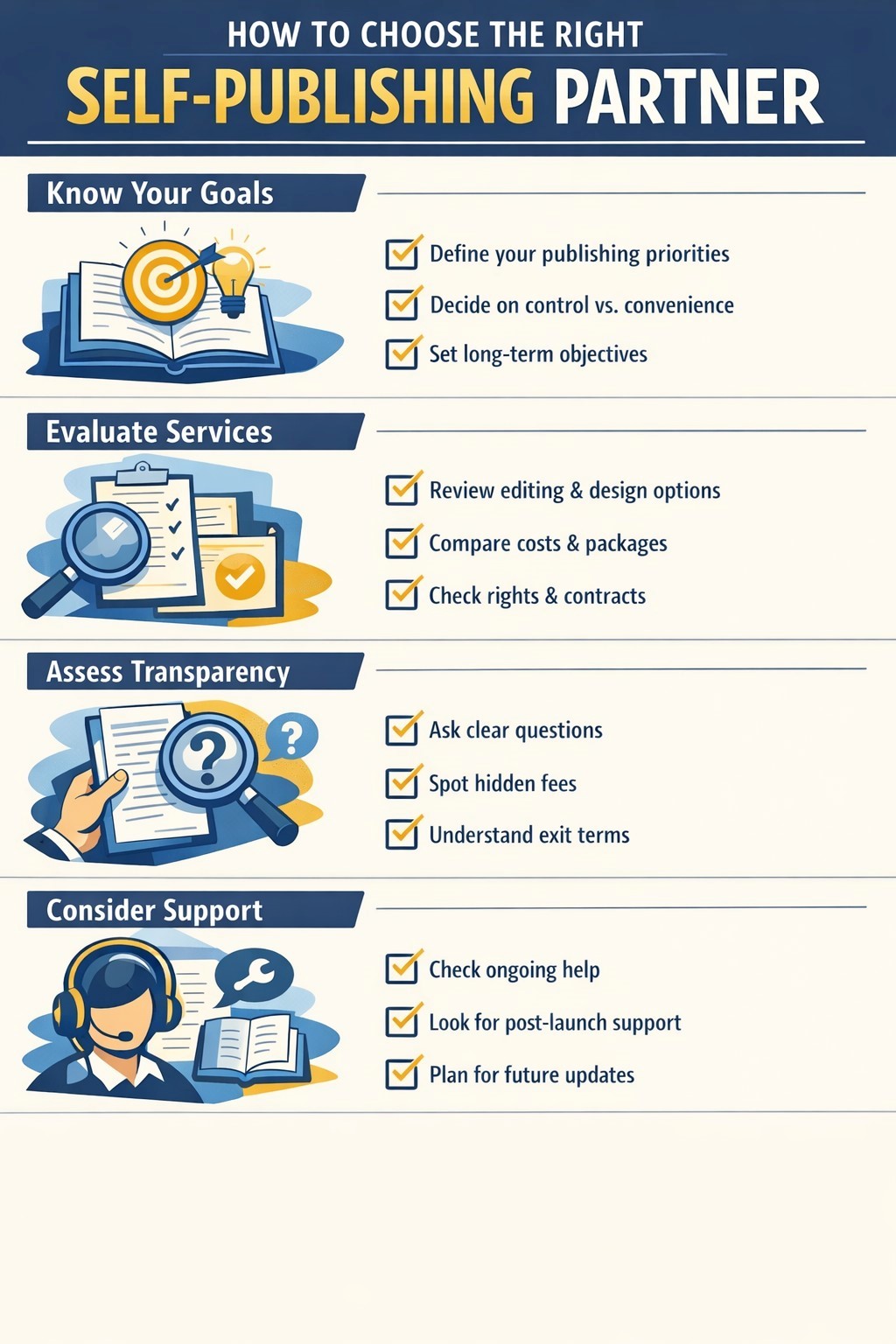
Before signing a contract with a self-publishing company in 2026, take the "Three-Step Audit":
- Define Your Success: Is it "Number of copies sold" or "Professionalism of the finished product"?
- Check the "All-In" Price: Compare the company's package price against the cost of hiring a freelancer for each service on a site like Reedsy. If the company is more than 30% more expensive, you are paying a significant "convenience tax."
- Read the Fine Print: Ensure you keep 100% of your rights and can walk away with your production files.
If you value time and professional polish over maximum profit-per-copy, a reputable self-publishing company is a worthwhile investment. If you are building a career as an independent author, learning the "DIY" mechanics is the superior long-term strategy.
Image Gallery
Select an image to open it in a new tab.

Simon Caldwell
Enterprise Technology and Systems Editor
