The Geological Synthesis: How Rocks and Minerals Interact Within the Earth’s Crust

Rocks and minerals interact through a continuous cycle of chemical weathering, physical transformation, and tectonic recycling. Minerals—the distinct chemical building blocks—dictate the structural integrity of rocks, while environmental stressors like pressure, temperature, and fluid movement trigger reactions that dismantle existing crystalline lattices to reform them into new geological materials.
The Fundamental Distinction Between Rocks and Minerals
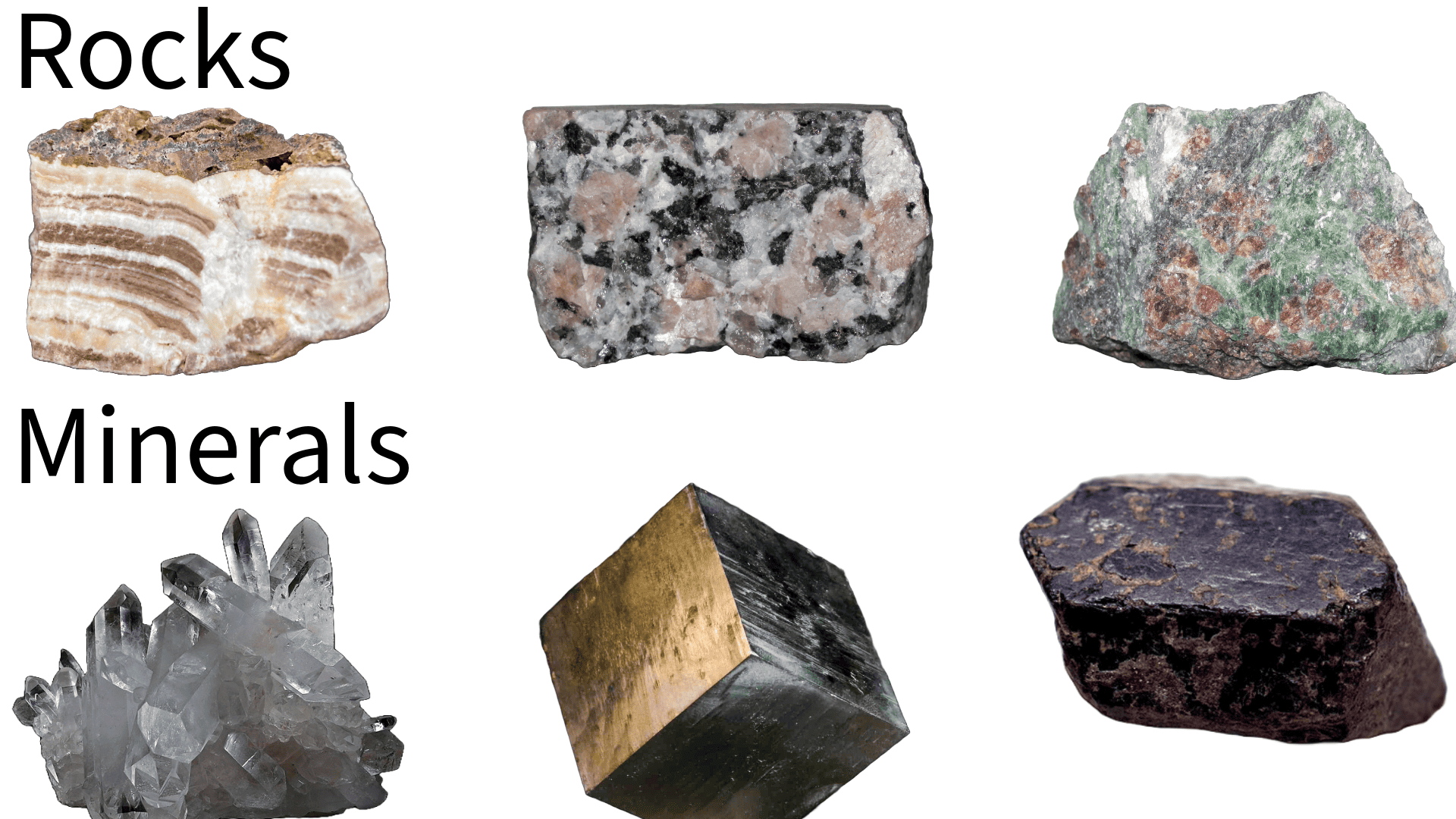
To understand how these entities interact, one must first distinguish between the two. A mineral is a naturally occurring, inorganic solid with a definite chemical composition and an ordered internal crystalline structure. Examples include quartz, feldspar, and calcite. Rocks, conversely, are solid aggregates of one or more minerals. A piece of granite, for instance, is a rock composed of an interlocking mosaic of quartz, mica, and feldspar crystals.
The interaction begins at the microscopic level. The physical properties of a rock—such as its hardness, porosity, and permeability—are direct consequences of the minerals that compose it. When a rock is subjected to external forces, it is the individual mineral grains and the bonds between them that yield or resist.
Chemical Weathering: The Interface of Atmosphere and Lithosphere
The interaction between minerals and the environment is most visible during chemical weathering. When rocks are exposed at the Earth's surface, minerals that were once stable under high-temperature and high-pressure conditions (such as those in igneous or metamorphic rocks) become thermodynamically unstable.
Water, combined with atmospheric carbon dioxide, creates a weak carbonic acid. This fluid permeates the pore spaces of rocks, reacting with silicate minerals. For example, the process of hydrolysis transforms feldspar—a common component of granite—into clay minerals like kaolinite. This is a transformative interaction: the hard, rigid feldspar structure is broken down into softer, sheet-like clay structures. This change fundamentally alters the rock’s cohesion, eventually leading to its disintegration into regolith or soil.
Metamorphism: Solid-State Transformation
Unlike weathering, which occurs at the surface, metamorphism involves deep-seated interactions between minerals under extreme pressure and temperature. When rocks are buried through tectonic processes, the minerals within them may become unstable without actually melting.
Under these conditions, atoms migrate through the crystal lattices, and new minerals grow at the expense of old ones—a process known as recrystallization. Garnet, for example, often forms during the regional metamorphism of shale. The minerals that once constituted the mud-based rock reorganize their atomic structures to accommodate the increased density and pressure. This interaction is a "solid-state" phenomenon, meaning the rock remains a solid throughout the change, though its mineralogical "recipe" is rewritten.
The Role of Fluids in Mineral Mobility
Fluids—primarily water, but also supercritical carbon dioxide and dissolved salts—act as catalysts for mineral interactions. In the Earth's crust, these fluids move through fractures and grain boundaries. When a fluid encounters a mineral, it can dissolve certain elements while transporting others to different sites.
This process is critical in the formation of ore deposits. Hydrothermal fluids circulating through a cooling igneous intrusion can leach metallic ions from surrounding rocks and precipitate them as sulfide minerals (like chalcopyrite or galena) in cooler zones. Here, the mineral and the fluid interact to move matter from one location to another, fundamentally altering the chemistry of the host rock.
Mechanical Interactions and Physical Weathering
Physical or mechanical weathering interacts with mineral stability by increasing the surface area available for chemical reactions. When thermal expansion and contraction (due to temperature fluctuations) or ice wedging occurs, a rock breaks into smaller fragments.
As the surface area increases, more mineral surfaces are exposed to the atmosphere. This acceleration of surface-level interactions is a feedback loop: physical breakdown exposes fresh mineral faces, which are then more susceptible to chemical hydrolysis, which in turn weakens the rock further, making it easier to break physically.
Comparative Mechanisms of Geological Interaction
| Process | Primary Driver | Nature of Change | Primary Result |
|---|---|---|---|
| Chemical Weathering | Water & Atmospheric Gases | Ion exchange/dissolution | Breakdown to clay/ions |
| Metamorphism | Heat & Pressure | Recrystallization | New mineral assemblages |
| Hydrothermal Alteration | Hot aqueous fluids | Leaching/precipitation | Ore formation/mineral veins |
| Physical Weathering | Mechanical stress | Fracturing/disaggregation | Increased surface area |
The Rock Cycle as a Framework for Interaction
The concept of the rock cycle provides the macro-level view of how these interactions occur over geological time. Igneous rocks, formed from cooling magma, interact with the surface and become sedimentary rocks through weathering and lithification. These sedimentary rocks may then be pushed deep into the crust to interact with high-pressure environments, becoming metamorphic rocks. Eventually, if they reach sufficient depths, they melt, returning to an igneous state.
Every stage of this cycle relies on the capacity for minerals to transition between states. These transitions are governed by the Gibbs free energy, which dictates that minerals will always seek to exist in the configuration that is most stable for their current environment.
Common Misconceptions Regarding Rock Stability
A frequent error in understanding this interaction is the assumption that rocks are static, inert objects. In reality, a rock is a dynamic system of minerals constantly adjusting to their surroundings. Even a "stable" granite headstone in a cemetery is undergoing slow, constant mineralogical changes.
Another misconception involves the speed of these interactions. While some processes, such as earthquake-induced fracturing, are instantaneous, most mineral-rock interactions—like the formation of metamorphic minerals or the hydrolysis of silicates—occur over thousands or even millions of years. Understanding these timescales is crucial for geologists studying landscape evolution or economic ore deposits.
Frequently Asked Questions
How do minerals determine the strength of a rock? The strength of a rock is determined by its mineral composition and the cementing agents holding those minerals together. Minerals with high Mohs hardness, such as quartz, provide high compressive strength. However, the orientation of minerals, particularly in foliated rocks like schist, creates planes of weakness that can dictate how the rock breaks under stress.
What is the role of temperature in mineral reactions? Temperature acts as an energy source for atomic movement. As temperature increases, the kinetic energy of the atoms within a crystal lattice increases, making it easier for bonds to break and for elements to swap positions. This allows for the metamorphic conversion of minerals into new, stable forms.
Can rocks interact with each other without a liquid medium? Yes, rocks interact through direct physical contact during tectonic stress. This can cause deformation, grain-size reduction, and fracturing. However, chemical interactions—the changing of one mineral into another—almost always require a fluid phase (even if it is just a thin film of water) to act as a transport medium for ions.
How does porosity affect mineral interaction? Porosity defines the volume of space between mineral grains. Higher porosity allows more fluid and gas to penetrate the interior of the rock. This accelerates chemical weathering and hydrothermal alteration, as the reagents can reach the surface of every internal mineral grain rather than just those on the outer surface of the rock.
Do all minerals change at the same rate? No. This is described by the Goldich Dissolution Series, which is the inverse of the Bowen’s Reaction Series. Minerals that crystallize first from magma at the highest temperatures (like olivine) are the least stable at the Earth's surface and weather the fastest. Minerals that crystallize last (like quartz) are the most stable and resistant to chemical interaction.
Next Steps for Further Study
To gain a deeper understanding of these interactions, begin by examining local geological outcrops. Identify the primary minerals within a specimen and assess how the rock has weathered compared to others in the vicinity. For those seeking technical data, refer to the mineral stability diagrams provided by your regional geological survey or academic resources on petrology. Observing these interactions in the field is the most effective way to grasp the slow, constant dance of chemical change that shapes the Earth’s crust.

Image Gallery
Select an image to open it in a new tab.




Akira Tanaka
International Academic Trends Correspondent
