
A Legionella consultant is a specialized risk management professional who identifies, assesses, and manages the risk of Legionnaires' disease within man-made water systems. They provide expert guidance on regulatory compliance, design and implement written control schemes, oversee remedial engineering works, and conduct independent audits to ensure building owners meet their legal duty of care.
The Strategic Role of a Legionella Consultant
While many associate Legionella management solely with taking water samples, the role of a consultant in 2026 is significantly more complex and strategic. A consultant acts as a bridge between high-level health and safety legislation and the practical, day-to-day engineering requirements of a facility. Their primary objective is to prevent the growth and aerosolization of Legionella bacteria, which can cause a severe and potentially fatal form of pneumonia.
The modern consultant does not just look at pipes; they look at management structures. They evaluate whether a business has a clearly defined "Responsible Person," whether staff are adequately trained, and whether the record-keeping systems—increasingly digital and automated—are robust enough to withstand legal scrutiny during an audit or, in the worst-case scenario, a health and safety investigation following an outbreak.
Conducting the Legionella Risk Assessment (LRA)
The cornerstone of any consultant’s work is the Legionella Risk Assessment. This is a comprehensive physical and administrative survey of a building’s water infrastructure. In 2026, these assessments have become highly detailed, often utilizing Building Information Modeling (BIM) data to map out hidden risks.
Physical Asset Survey
The consultant begins by identifying every asset that uses or stores water. This includes cold water storage tanks, calorifiers (water heaters), cooling towers, decorative fountains, and complex pipework networks. They look for specific "at-risk" conditions, such as:
- Stagnation: Areas where water does not flow regularly, known as "dead legs" or "dead ends," which provide a breeding ground for biofilm.
- Temperature Ranges: Legionella thrives between 20°C and 45°C. The consultant measures temperatures throughout the system to ensure cold water remains below 20°C and hot water is stored at 60°C and distributed at 50°C (or 55°C in healthcare settings).
- Nutrients: The presence of scale, rust, sludge, or organic matter that provides food for the bacteria.
- Aerosol Generation: Any point where water is turned into a fine mist—such as showers, spray taps, or cooling tower plumes—is a potential point of infection for humans.
Administrative and Management Audit
The "consultant" aspect of the role shines during the audit of the management system. They examine the training records of maintenance staff to ensure competence. They check the logbooks to see if weekly flushing of infrequently used outlets is actually occurring. If a building is using remote IoT (Internet of Things) sensors for temperature monitoring, the consultant verifies the calibration and the response protocols for when an alert is triggered.
Developing and Overseeing the Written Scheme of Control
Once the risks are identified, the consultant must provide a solution. This is documented in the Written Scheme of Control. This is not a generic template but a bespoke operational manual for a specific building.
The consultant defines exactly what needs to happen, how often, and by whom. This includes:
- Monitoring Regimes: Specifying the frequency of temperature checks and inspection of tanks and heaters.
- Disinfection Procedures: Outlining when and how chemical or thermal disinfections should be carried out (e.g., following a positive sample or a system stagnation period).
- Corrective Actions: Establishing "trigger levels" where specific actions must be taken if a parameter (like temperature or biocide levels) falls outside of the required range.
- Operational Responsibilities: Explicitly naming the individuals responsible for each task, ensuring there are no gaps in the chain of command.
By 2026, these schemes are often integrated into Computer-Aided Facilities Management (CAFM) systems, and the consultant’s role includes ensuring these digital workflows align with the latest health and safety Executive (HSE) ACoP L8 guidelines or international standards like ASHRAE Standard 188.
Microbiological Sampling and Interpretation
One of the most misunderstood parts of a consultant's job is water sampling. A consultant is not a laboratory technician, but they are responsible for the sampling strategy. They determine where samples should be taken to get a representative view of the system's health, typically focusing on the "sentinel" outlets (the nearest and furthest from the water source).
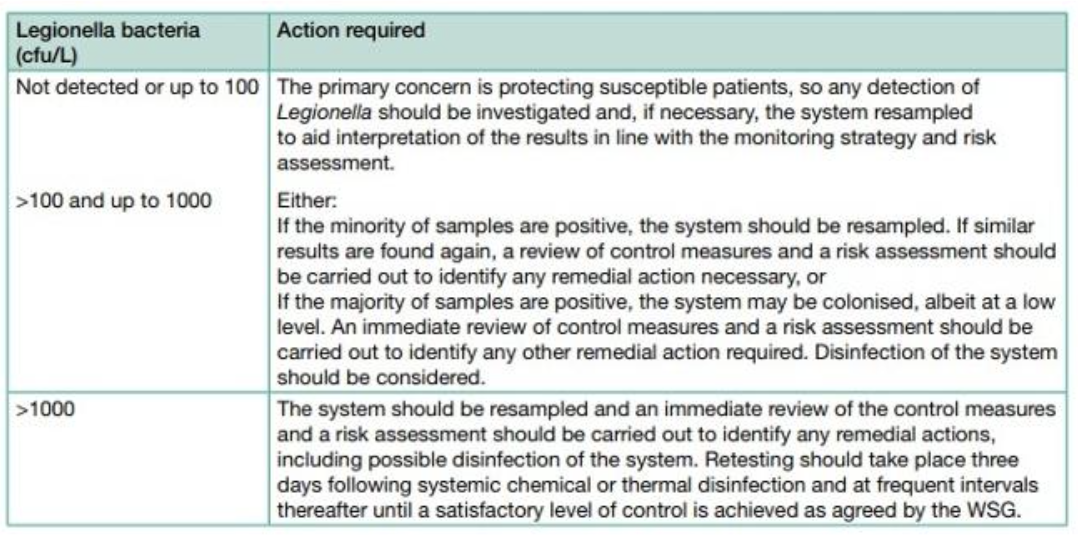
When results come back from a UKAS-accredited laboratory (or equivalent international body), the consultant provides the interpretation. A "positive" result of 1,000 CFU/L (Colony Forming Units per litre) of Legionella requires a very different response than 100 CFU/L. The consultant advises on whether to isolate the supply, perform a shock pasteurization, or increase biocide dosages. They provide the expert weight behind the decision to shut down a building’s water supply, balancing safety with operational continuity.
Remedial Engineering and System Design Guidance
Legionella consultants often function as specialized engineers. If an LRA identifies a redundant section of pipework (a dead leg), the consultant doesn't just say "fix it"; they specify the exact point of disconnection to ensure no further stagnation occurs.
Their expertise is critical during the design and commissioning phase of new buildings. Many Legionella issues are "built-in" by architects and plumbers who prioritize aesthetics or energy efficiency over water hygiene. A consultant reviews designs to ensure:
- Pipe runs are as short as possible.
- Cold and hot water pipes are sufficiently insulated to prevent heat transfer (which would push cold water into the 20°C–45°C "danger zone").
- Materials used are compliant with water regulations and do not support bacterial growth.
- Expansion vessels are installed correctly to prevent water from sitting stagnant within them.
Training and Competence Building
Under various global health and safety laws, such as the UK’s Health and Safety at Work etc. Act 1974, the duty holder must be "competent" or have access to competent advice. A major part of what a consultant really does is transferring knowledge.
They provide bespoke training sessions for:
- The Responsible Person (RP): To understand their legal liabilities and management duties.
- Maintenance Teams: To learn the correct way to clean showerheads, flush outlets, and take accurate temperature readings.
- General Staff: To raise awareness of the risks and the importance of reporting issues like lukewarm water or leaking pipes.
Comparing the Consultant to Other Water Professionals
It is common for building owners to confuse consultants with water treatment contractors or plumbers. While there is overlap, the consultant’s primary value is their independence and expertise.
| Feature | Legionella Consultant | Water Treatment Contractor | Maintenance Plumber |
|---|---|---|---|
| Primary Goal | Independent risk assessment & compliance. | Execution of chemical/physical cleaning. | General repairs and installations. |
| Independence | High (Usually doesn't sell the chemicals they recommend). | Low (Often profit from chemical sales/remediation). | Neutral (Focuses on functionality, not microbiology). |
| Key Output | Risk Assessment & Written Scheme. | Service reports & dosage logs. | Repair invoices. |
| Regulatory Knowledge | High (Specialized in Health & Safety law). | Moderate (Focused on application standards). | Variable (Focused on Building Regs). |
| Sampling Authority | Interprets results and sets strategy. | Collects samples as part of a contract. | Rarely involved in sampling. |
Crisis Management and Outbreak Response
In the unfortunate event of an outbreak or a cluster of Legionnaires' disease cases linked to a property, the consultant’s role shifts into high-stakes crisis management. They act as the technical liaison between the building owner and public health authorities, such as the Centers for Disease Control and Prevention (CDC) or the UK Health Security Agency (UKHSA).
During an investigation, the consultant will:
- Audit all recent records to prove "due diligence."
- Identify the likely source of the bacteria within the system.
- Supervise emergency disinfection procedures.
- Advise on communication strategies for tenants, employees, or the public to prevent panic while ensuring transparency.
The Cost and Value of a Legionella Consultant in 2026
By 2026, the cost of hiring a consultant varies based on the complexity of the site. A small dental practice might pay a few hundred pounds/dollars for an assessment, while a large hospital campus or a multi-site industrial facility may enter into five-figure annual consultancy contracts.
However, the value is found in the mitigation of risk. The fines for non-compliance, even in the absence of an actual outbreak, can be astronomical. In the UK, the Sentencing Guidelines for health and safety offenses often link fines to company turnover, meaning a failure in Legionella management can cost a large firm millions. A consultant provides the legal "shield" by ensuring that if a case does occur, the business can prove it did everything "reasonably practicable" to prevent it.
Common FAQs About Legionella Consultants
How often do I need a Legionella consultant to visit?
While the LRA should be reviewed whenever there is a "significant change" to the water system or its use, it is standard practice to have a consultant conduct a full review every two years. However, in high-risk environments like hospitals or care homes, annual or even quarterly consulting audits are common to ensure strict compliance.
Can a regular plumber do the work of a Legionella consultant?
Technically, anyone can perform a risk assessment if they are "competent." However, most general plumbers lack the specific training in microbiology, risk modeling, and health and safety law required to produce a legally defensible Legionella Risk Assessment. Using a non-specialist often leads to missed risks, such as aerosol sources in air handling units or complex thermostatic mixing valve (TMV) failures.
Do consultants provide the chemicals and cleaning services too?
Some companies are "full-service," providing both consultancy and water treatment. However, there is an inherent conflict of interest in this model. An independent consultant identifies only the work that is necessary, whereas a contractor may be incentivized to recommend more frequent cleaning or chemical dosing than is strictly required. Many property managers prefer "consultancy-only" firms for this reason.
What qualifications should a Legionella consultant have in 2026?
You should look for consultants who are members of recognized industry bodies such as the Legionella Control Association (LCA) in the UK or who hold certifications like the ASSE 12080 (Legionella Water Safety and Management Specialist) in the United States. They should also hold professional indemnity insurance specifically covering Legionella-related advice.
Does a consultant look at "low risk" buildings?
Yes. Even "simple" buildings like small offices or retail units have water systems. While the risk is lower, the legal duty of care remains. A consultant can often perform a "simplified" assessment for these sites, providing a low-cost way for the business owner to achieve compliance and peace of mind.
Expert Recommendation: Choosing the Right Path
If you are a building owner or manager, do not treat Legionella management as a "check-box" exercise for your insurance. A consultant's real value lies in their ability to simplify complex systems and provide a clear, actionable roadmap for safety.
Next Action: Review your current Legionella Risk Assessment. If it is more than two years old, or if it was written by a general maintenance contractor rather than a specialist, your first step should be to commission an independent audit from a certified Legionella consultant. Ensure that their scope includes a review of your "Written Scheme" and a gap analysis of your current staff training and record-keeping.
Image Gallery
Select an image to open it in a new tab.
Ingrid Bjornson
Global Cyber Policy and Regulation Analyst
