Canadian corporate tax rates depend on business structure, corporation type, income classification, and the province or territory of operation. For Canadian-Controlled Private Corporations (CCPCs) claiming the small business deduction, the net federal tax rate is 9% on active business income up to $500,000, while the general federal corporate rate sits at 15%. Combined federal and provincial rates range from 9% to 31%.
Corporate taxation in Canada follows a dual-tier structure administered primarily by the Canada Revenue Agency (CRA), alongside independent provincial revenue agencies in Quebec and Alberta. Correctly navigating these brackets requires evaluating active versus passive income, provincial allocation formulas, and integration mechanics to prevent unexpected tax liabilities.
The Dual-Tier Structure of Corporate Income Tax in Canada
Corporate tax liability in Canada is shared between the federal government and individual provincial or territorial governments. Corporations operating through a permanent establishment in any province or territory must calculate both federal and sub-national corporate taxes on their taxable income.
Total Corporate Tax Rate = Net Federal Tax Rate + Provincial/Territorial Tax Rate
Basic Federal Corporate Tax Calculation
Every corporation operating in Canada begins its federal income tax calculation with a gross statutory rate of 38% under the federal Income Tax Act. This base rate is systematically reduced through standard statutory credits and abatements:
- Gross Federal Tax Rate: 38.0%
- Federal Tax Abatement: -10.0%The federal government grants a 10% abatement on taxable income earned in a Canadian province or territory, effectively delegating that tax room to the provincial jurisdiction. If income is earned outside any province (such as in an international permanent establishment without a tax treaty allocation), this abatement does not apply.
- Base Federal Rate: 28.0%
- General Rate Reduction: -13.0%To keep corporate entities competitive internationally, Canada applies a 13% general rate reduction to active business income that does not qualify for preferential regimes like the small business deduction or manufacturing and processing deductions.
- Net Federal General Corporate Rate: 15.0%
Corporations that do not qualify as Canadian-Controlled Private Corporations—such as public companies, foreign-controlled subsidiaries, and non-resident entities operating branch offices—pay this net federal rate of 15% on their Canadian taxable business income, plus the applicable provincial corporate rate.
Canadian-Controlled Private Corporations and the Small Business Deduction
The cornerstone of Canadian small enterprise policy is the Small Business Deduction (SBD), enacted under Section 125 of the Income Tax Act. The SBD provides a substantial rate reduction to eligible Canadian-Controlled Private Corporations (CCPCs).
Definition of a CCPC
To qualify as a CCPC throughout a taxation year, a corporation must meet strict statutory criteria:
- It must be a private corporation resident in Canada.
- It cannot be controlled directly or indirectly, in any manner, by one or more non-resident persons.
- It cannot be controlled directly or indirectly by one or more public corporations.
- It cannot be controlled by any combination of non-residents and public corporations.
- None of its shares can be listed on a designated stock exchange.
The Small Business Deduction Rate
For qualifying CCPCs, the federal government offers an additional Small Business Deduction of 19% against the base 28% federal rate (post-abatement). This lowers the net federal corporate tax rate to 9% on eligible active business income up to the federal business limit.
The federal business limit is capped at $500,000 annually for an individual corporation or an associated group of corporations. Any active business income earned above this threshold is taxed at the general federal rate of 15%.
Limits and Phase-Out Rules for the Small Business Deduction
The $500,000 small business limit is not universal; it phases out under two anti-avoidance measures:
1. Taxable Capital Employed in Canada
The federal business limit is reduced on a straight-line basis when the combined taxable capital employed in Canada of the corporation and its associated corporate group exceeds $10 million. Under expanded statutory thresholds, the deduction is eliminated entirely once taxable capital reaches $50 million.
$$\text{Capital Reduction Factor} = \frac{\text{Taxable Capital} - $10,000,000}{$40,000,000}$$
2. Passive Investment Income Rule (AAII)
To discourage business owners from using active business corporations as personal tax-sheltered investment vaults, the federal rules reduce the small business limit based on Adjusted Aggregate Investment Income (AAII):
- For every $1 of AAII earned by an associated group in excess of $50,000, the small business limit is reduced by $5.
- Once a corporate group generates $150,000 of net passive investment income in a given tax year, its entitlement to the 9% small business tax rate drops to zero.
When both the taxable capital phase-out and the passive investment income phase-out apply, the corporation’s business limit is reduced by the greater of the two calculations.

Provincial and Territorial Corporate Tax Rates
Each province and territory establishes its own corporate income tax rates. Most jurisdictions mimic the federal framework by offering a lower "small business rate" aligned with the federal SBD threshold, alongside a higher "general corporate rate" for income above that threshold or earned by non-CCPC entities.
While the Canada Revenue Agency collects corporate taxes on behalf of most provinces, Alberta (via the Alberta Treasury Board and Finance, Tax and Revenue Administration) and Quebec (via Revenu Québec) administer their corporate income tax systems independently, requiring separate corporate tax returns.
Combined Federal and Provincial Corporate Tax Rates
The following table provides the statutory corporate tax rates for active business income across all Canadian jurisdictions:
| Province / Territory | Small Business Rate (Provincial) | General Corporate Rate (Provincial) | Combined Small Business Rate | Combined General Corporate Rate | Provincial Small Business Threshold |
|---|---|---|---|---|---|
| Federal Base | 9.0% | 15.0% | — | — | $500,000 |
| Alberta | 2.0% | 8.0% | 11.0% | 23.0% | $500,000 |
| British Columbia | 2.0% | 12.0% | 11.0% | 27.0% | $500,000 |
| Manitoba | 0.0% | 12.0% | 9.0% | 27.0% | $500,000 |
| New Brunswick | 2.5% | 14.0% | 11.5% | 29.0% | $500,000 |
| Newfoundland & Labrador | 3.0% | 15.0% | 12.0% | 30.0% | $500,000 |
| Northwest Territories | 2.0% | 11.5% | 11.0% | 26.5% | $500,000 |
| Nova Scotia | 2.5% | 14.0% | 11.5% | 29.0% | $500,000 |
| Nunavut | 3.0% | 12.0% | 12.0% | 27.0% | $500,000 |
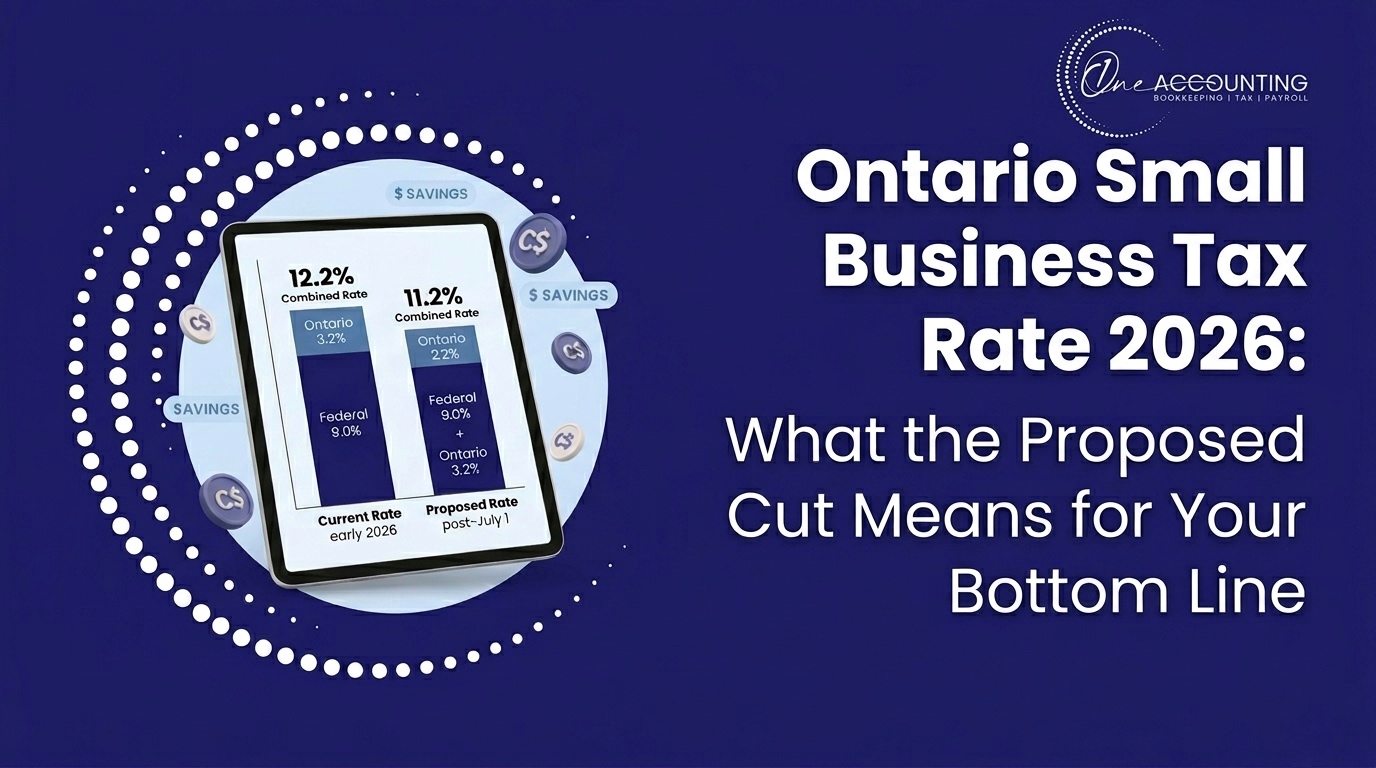
| Ontario | 3.2% | 11.5% | 12.2% | 26.5% | $500,000 |
| Prince Edward Island | 1.0% | 16.0% | 10.0% | 31.0% | $500,000 |
| Quebec | 3.2% | 11.5% | 12.2% | 26.5% | $500,000* |
| Saskatchewan | 1.0% | 12.0% | 10.0% | 27.0% | $600,000 |
| Yukon | 0.0% | 12.0% | 9.0% | 27.0% | $500,000 |
*Note on Quebec: To access Quebec’s small business rate (3.2%), a CCPC must meet the "remuneration hours" test. The corporation's employees must have worked at least 5,500 paid hours during the fiscal year, or the company must operate primarily in the primary or manufacturing sectors. If a corporation fails this test, its provincial rate defaults to the general 11.5%, even if it qualifies for the federal small business rate.
Taxation of Corporate Investment Income
Corporate passive income earned by private corporations is deliberately taxed at punitive upfront rates to eliminate tax deferral advantages over individuals earning direct investment income. The statutory mechanism governing this is called integration.
When a CCPC earns passive income—such as interest, rental income, foreign dividends, and non-active portfolio gains—it is disqualified from both the Small Business Deduction and the General Rate Reduction.
Breakdown of Upfront Investment Tax Rates
The upfront federal tax rate on aggregate investment income is structured as follows:
- Basic Federal Tax: 38.0%
- Federal Abatement: -10.0%
- Additional Refundable Tax (ART): +10.67%
- Net Federal Investment Tax Rate: 38.67%
When combined with provincial corporate investment tax rates (which average between 8% and 16%), the effective initial corporate tax rate on passive income is 50% to 54.67%.
The Refundable Dividend Tax on Hand (RDTOH)
To prevent double taxation when this income is distributed to shareholders, a portion of the tax paid upfront by the corporation is directed into nominal tracking accounts: Eligible RDTOH and Non-Eligible RDTOH.
- Refundable Portion: The federal system treats 30.67% of investment income as a refundable tax.
- Dividend Refund: When the corporation pays taxable dividends to human shareholders, it triggers a dividend refund from its RDTOH account at a rate of $38.33 for every $100 of taxable dividends paid.
This design ensures that investment income held inside a corporation bears approximately the same total lifetime tax burden as if the underlying shareholder had earned the investment income directly at the top personal marginal tax bracket.
Initial Corporate Tax (~50-54%) - RDTOH Refund (30.67%) + Personal Dividend Tax = Marginal Personal Rate
Treatment of Capital Gains
When a corporation realizes a capital gain, only the taxable portion is subject to income tax:
- Taxable Capital Gain: 50% of the net capital gain is included in corporate income and taxed at the passive investment rate (approximately 50% to 54.67% combined).
- Non-Taxable Capital Gain: The remaining 50% is added to the corporation's Capital Dividend Account (CDA).
- CDA Distribution: Balances in the CDA can be distributed to Canadian-resident shareholders as a tax-free Capital Dividend, provided the corporation files form T2054 before or on the distribution date.
Specialized Corporate Deductions and Sector Incentives
Outside of general active business income and the small business regime, specific tax codes offer targeted relief for distinct business activities:
Manufacturing and Processing (M&P) Profits Deduction
Corporations generating taxable income from manufacturing or processing goods in Canada that do not qualify for the small business deduction may qualify for the Manufacturing and Processing Profits Deduction under Section 125.1 of the Income Tax Act. This mechanism reduces the general federal tax rate down to match or approximate competitive industrial production benchmarks. Several provinces (such as Saskatchewan and Yukon) offer mirrored provincial rate cuts for certified manufacturing activities.
Zero-Emission Technology Manufacturing
The federal government maintains reduced tax rates for eligible zero-emission technology manufacturers. Qualifying income from activities like manufacturing solar panels, wind turbines, electric vehicles, and battery storage systems is taxed at:
- 4.5% for income that would otherwise be taxed at the small business rate.
- 7.5% for income otherwise subject to the general corporate rate.
Scientific Research and Experimental Development (SR&ED)
CCPCs performing qualifying research and development in Canada are entitled to an enhanced refundable investment tax credit (ITC) of 35% on up to $3 million of eligible current expenditures. This credit provides non-dilutive liquidity, as it can be refunded in cash even if the corporation operates at a net tax loss. Non-CCPC corporations receive a non-refundable 15% credit on qualifying SR&ED spending.
Corporate Tax Compliance, Filing Deadlines, and Installment Rules
Proper management of Canadian corporate tax extends beyond understanding headline rates to executing filing duties and statutory remittance schedules correctly.
Return Filing Obligations: The T2 Corporate Return
Every corporation resident in Canada—including non-active businesses, holding companies, and foreign corporations with a Canadian permanent establishment—must file a T2 Corporation Income Tax Return within six months following the conclusion of its fiscal year-end.
- Example: A corporation whose fiscal year concludes on December 31 must submit its T2 return no later than June 30 of the following year.
- Unlike personal tax deadlines, which align with the calendar year, a corporation selects a dedicated fiscal year-end upon its initial incorporation.
Tax Payment Deadlines
A frequent trap for new business owners is confusing the filing deadline with the balance-due day:
- Balance Due for CCPCs: Tax balances are due within three months of fiscal year-end if the corporation claimed the small business deduction in the current or preceding year, and its taxable income for the preceding year did not exceed the business limit.
- Balance Due for General Corporations: All other corporations, including public entities, foreign-controlled firms, and CCPCs exceeding statutory income ceilings, must pay outstanding taxes within two months after the fiscal year-end.
Failure to remit taxes by the balance-due date incurs compound daily arrears interest assessed at the prescribed CRA interest rate, even if the formal T2 return is filed within its 6-month statutory window.
Quarterly and Monthly Tax Installments
Most profitable corporations cannot wait until year-end to pay their annual tax liabilities. If a corporation's total tax payable for either the current year or the immediately preceding year exceeds $3,000, it must remit tax installments throughout the taxation year.
- CCPC Installments: Eligible small CCPCs can make quarterly installments if they have maintained a pristine compliance record over the preceding 12 months, possessed taxable income below $500,000, and maintained taxable capital below $10 million.
- General Installments: Large corporations and standard entities must calculate and remit their corporate tax installments monthly.
Installment schedules can be determined based on:
- Current-year estimated tax liability.
- Prior-year actual tax liability.
- A combination of the second-prior year and prior year calculations.
Underpaying required installments results in statutory installment interest charges that cannot be deducted as business expenses.
Common Corporate Tax Planning Mistakes
Operating under the Canadian corporate tax umbrella exposes corporate managers and founders to several technical traps:
1. Treating Personal Services Businesses (PSBs) as Standard CCPCs
If an incorporated contractor provides services that bear the legal hallmarks of an employer-employee relationship, the CRA may reclassify the enterprise as a Personal Services Business.
The consequences of PSB classification are punitive:
- The corporation loses both the Small Business Deduction and the 13% General Rate Reduction.
- An additional 5% penalty tax is assessed, bringing the federal corporate rate to 33%.
- Expense deductions are strictly curtailed to the equivalent salary and benefits that would be allowable to an incorporated employee under the Act.
2. Misallocating Income Across Associated Corporations
Small business owners often establish multiple operating companies or real estate entities to segment risk. However, Section 256 contains broad associated corporation rules evaluating direct ownership, cross-ownership, sibling ownership, and discretionary trust controls.
If multiple corporations are determined to be associated:
- They must legally share a single $500,000 federal small business limit.
- Their taxable capital must be aggregated for the purpose of the $10 million to $50 million SBD phase-out.
- Splitting active business income among distinct corporations solely to claim the small business deduction multiple times will trigger severe general anti-avoidance assessments.
3. Misclassifying Passive Income as Active Income
Rental properties, mortgage interest, and standard portfolio returns earned inside a holding company or operating entity are categorized as passive investment income. Attempting to claim the 9% small business rate on rental property income without employing more than five full-time employees throughout the taxation year violates the statutory definition of an active business under Section 125, resulting in retroactive reassessments at passive income rates exceeding 50%.
Frequently Asked Questions
What is the corporate tax rate for an LLC in Canada?
Canada does not recognize Limited Liability Companies (LLCs) as native domestic corporate structures. If a United States LLC operates or carries on business in Canada, the Canada Revenue Agency classifies it as a foreign non-resident corporation. As a result, it does not qualify for the 9% small business deduction and is taxed at the net federal general rate of 15% plus provincial allocations, alongside potential branch tax obligations under Section 219 of the Income Tax Act.
What is the difference between active business income and passive income?
Active business income is earned through ongoing commercial, manufacturing, retail, or service operations that carry commercial risk and involve active operations. It qualifies for either the 9% small business rate (up to $500,000 for CCPCs) or the 15% general federal rate. Passive income consists of returns derived from property or capital without active operations, including interest, royalties, portfolio dividends, and real estate rents (unless the business employs more than five full-time employees). Passive income is taxed upfront at higher rates (approximately 50% to 54.67% combined) to deter personal tax deferral.
How do Canadian corporate tax rates affect dividend distributions to owners?
Canada resolves the double-taxation issue between corporations and their owners through the dividend tax credit system. Income that was taxed at the lower small business rate (9% federal) generates non-eligible dividends, which carry a lower dividend tax credit and face higher personal marginal taxes when paid to the owner. Income taxed at the general corporate rate (15% federal) or public company dividends generates eligible dividends, which confer an enhanced dividend tax credit to offset the higher corporate tax already paid.
How do I allocate corporate income if my business operates in multiple provinces?
If a corporation maintains a permanent establishment (such as an office, warehouse, factory, or substantial agency) in more than one province or territory, it cannot assign all its income to its home jurisdiction. Under Part IV of the federal Income Tax Regulations, the company must allocate its taxable income across jurisdictions using a two-factor formula: the proportion of gross revenue earned in each province and the proportion of total salaries and wages paid in each province.
When should an incorporated business choose a non-calendar fiscal year-end?
A Canadian corporation can choose any fiscal year-end date within 53 weeks of its date of incorporation. Selecting an off-calendar fiscal year-end (such as January 31, March 31, or September 30) is advantageous for businesses with seasonal revenue peaks, as it allows year-end accounting to occur during slow operating cycles. It also facilitates strategic tax deferrals by permitting management bonuses to be declared within the corporate year and paid out in the subsequent personal tax calendar year within the statutory 180-day limitation.
Strategic Next Steps for Business Owners
Navigating corporate taxation in Canada requires active management throughout the fiscal year rather than passive review at filing time. Business leaders, controllers, and founders should implement the following operational safeguards:
- Audit Passive Asset Accumulation: Review total Adjusted Aggregate Investment Income (AAII) across all associated holding and operating companies annually. If aggregate passive returns approach $50,000, consider corporate-owned life insurance, individual pension plans (IPPs), or operational reinvestment to prevent losing access to the small business rate on active earnings.
- Review Multi-Jurisdictional Exposure: If team members operate remotely across different provinces, evaluate whether those remote setups constitute permanent establishments under provincial regulations, which triggers inter-provincial income allocation schedules on Schedule 5 of the T2 return.
- Formalize Shareholder Loan Balances: Reconcile all shareholder drawings and advances before fiscal year-end. Any debt owed by a shareholder to the corporation that remains unpaid for more than one year from the end of the taxation year in which the loan was made will be added directly to the shareholder’s personal taxable income under Section 15(2).
- Engage Professional Tax Representation: Corporate tax codes are subject to legislative adjustments, judicial interpretations, and administrative changes by the Canada Revenue Agency and provincial ministries. Retain a qualified Chartered Professional Accountant (CPA) to review corporate structures, intercompany allocations, and planned capital distributions.
Disclaimer: This guide provides objective informational coverage of the Canadian corporate tax system and does not constitute formal legal, accounting, or professional tax advice. Consult a licensed Canadian tax professional to evaluate specific corporate structures, filings, and jurisdictional requirements.
Image Gallery
Select an image to open it in a new tab.




Ingrid Bjornson
Global Cyber Policy and Regulation Analyst
