
The seven pay test is a regulatory calculation used by the Internal Revenue Service to determine whether a life insurance contract has been overfunded, which would reclassify it as a Modified Endowment Contract and alter its favorable tax-free growth and distribution features.
Introduction to the Seven Pay Test
Life insurance has long served as a versatile financial instrument, offering a death benefit to protect beneficiaries while building cash value through permanent policies like whole life, universal life, or variable life insurance. While the primary function of these products is risk protection, their cash value components grow on a tax-deferred basis, and policyholders can typically access these funds via tax-free withdrawals and policy loans.
Historically, these tax advantages made permanent life insurance an attractive alternative to traditional investment vehicles. However, high-net-worth individuals and aggressive financial planners occasionally utilized permanent policies primarily as tax shelters, funneling massive sums of money into contracts immediately to leverage the tax-free accumulation and withdrawal rules.
To curb this practice and ensure that life insurance products function primarily as insurance protection rather than investment accounts, the United States Congress enacted the Technical and Miscellaneous Revenue Act (TAMRA) of 1988. This legislation introduced the seven pay test. Under Internal Revenue Code Section 7702A, any permanent life insurance contract that fails this mathematical test loses its pure life insurance tax status and becomes classified as a Modified Endowment Contract (MEC). Understanding how this test works is essential for policyholders, estate planners, and financial advisors who want to maximize a policy's cash value growth without inadvertently triggering a severe tax penalty.
What is a Modified Endowment Contract (MEC)?
Before diving into the mechanics of the calculation, it is crucial to understand what happens when a policy fails the seven pay test. A Modified Endowment Contract is not a different type of insurance policy; rather, it is a tax classification assigned by the IRS. Once a contract becomes a MEC, that status is permanent for the life of the policy. Even if the policyholder stops overfunding or removes excess funds, the MEC designation cannot be undone.
The primary consequence of MEC status involves how withdrawals and loans are taxed. For a standard, non-MEC permanent life insurance policy, withdrawals follow a First-In, First-Out (FIFO) accounting method. This means that any money withdrawn is considered a return of the policyholder's cost basis (the premiums paid) first, which is completely tax-free, before touching the accumulated earnings. Furthermore, policy loans can be taken tax-free as long as the policy remains active.
Once a policy becomes a MEC, the tax rules flip to a Last-In, First-Out (LIFO) basis. Under LIFO, any withdrawals, loans, or pledges of the policy's cash value are considered to come from the accumulated earnings first, rather than the principal investment. These gains are treated as ordinary income and are fully taxable up to the amount of the gain.
In addition to LIFO taxation, if a policyholder takes a loan or makes a withdrawal from a MEC before reaching age 59½, the IRS imposes a 10% penalty tax on the taxable portion of the distribution, much like early withdrawals from a traditional Individual Retirement Account (IRA) or 401(k). Importantly, the death benefit paid to beneficiaries upon the insured's death remains income tax-free whether the policy is a MEC or not.
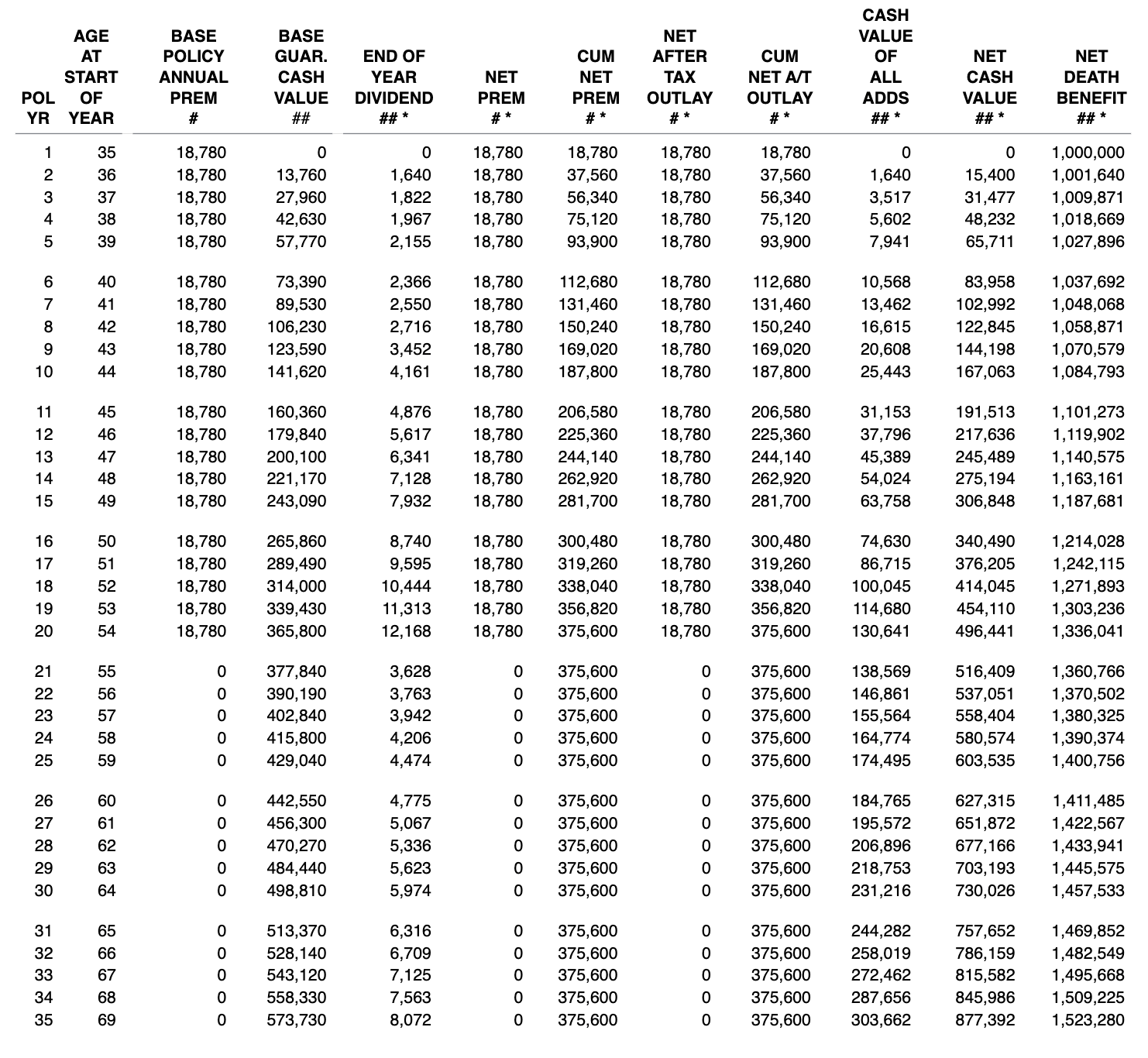
How the Seven Pay Test Works
The seven pay test is designed to measure whether the cumulative premiums paid into a life insurance contract during the first seven years exceed the sum of the net level premiums needed to fund the contract's future death benefit and maturity.
The core rule of the test is straightforward: the total amount of premiums paid into a life insurance policy at any time during the first seven years of the contract cannot exceed the cumulative sum of the "seven-pay premiums" for that same period.
The Seven-Pay Premium Defined
The seven-pay premium is not a static dollar amount set by the insurance carrier's whim. Instead, it is a calculated actuarial limit. It represents the level annual amount of premiums required to fully pay up the life insurance policy—meaning no further premium payments would be necessary to keep the policy in force—using reasonable mortality charges, standard interest rates, and other prescribed actuarial assumptions defined by the Internal Revenue Code.
For example, suppose an insurance carrier calculates that a specific whole life policy requires an annual payment of $5,000 for seven years to become fully paid up under the contract's guarantees. In this scenario, the seven-pay limit for each of the first seven years is $5,000.
Cumulative Limits Over Seven Years
The test is evaluated cumulatively rather than strictly year by year, though each year introduces a new threshold. The maximum allowable cumulative premium at any given point during the seven-year testing period is determined by multiplying the annual seven-pay premium by the number of elapsed years in the contract.
- End of Year 1: Maximum cumulative premiums paid cannot exceed 1 × Seven-Pay Premium ($5,000).
- End of Year 2: Maximum cumulative premiums paid cannot exceed 2 × Seven-Pay Premium ($10,000).
- End of Year 3: Maximum cumulative premiums paid cannot exceed 3 × Seven-Pay Premium ($15,000).
- End of Year 4: Maximum cumulative premiums paid cannot exceed 4 × Seven-Pay Premium ($20,000).
- End of Year 5: Maximum cumulative premiums paid cannot exceed 5 × Seven-Pay Premium ($25,000).
- End of Year 6: Maximum cumulative premiums paid cannot exceed 6 × Seven-Pay Premium ($30,000).
- End of Year 7: Maximum cumulative premiums paid cannot exceed 7 × Seven-Pay Premium ($35,000).
If a policyholder pays exactly the maximum amount each year for seven years, the policy is fully paid up, and the seven-year testing period concludes. After year seven, the policy generally cannot trigger a MEC status simply through premium payments, provided no material changes are made to the contract.
The Reset Rule: Material Changes and Face Amount Adjustments
Many policyholders assume that once a policy passes the initial seven-year window, they can pump unlimited funds into the contract without consequence. While this is generally true for unadjusted policies, certain modifications can trigger a brand-new seven-year testing period. These events are known as "material changes."
A material change can occur due to several policy adjustments, including:
- An increase in the policy's death benefit (other than certain automatic increases built into the contract, such as cost-of-living adjustments or certain cash-value-scaling features).
- A change in the policy's riders or benefits that alters the future cash value or death benefit trajectory.
- Certain exchanges or conversions of the policy.
When a material change occurs, the IRS resets the clock, launching a brand-new seven-year testing period. Crucially, the insurance carrier must recalculate a new set of seven-pay limits based on the policy's current cash value, the insured's attained age at the time of the change, and the updated death benefit. This ensures that policyholders cannot use a death benefit increase late in the life of a policy as a backdoor method to inject a large lump sum of cash into a tax-advantaged vehicle.
Practical Management and Safe Harbor Provisions
Life insurance companies build sophisticated tracking software into their policy administration systems to prevent clients from accidentally failing the seven pay test. When a policyholder or their financial advisor submits a premium payment, the carrier evaluates the transaction against the current cumulative seven-pay limit.
| Policy Year | Cumulative Seven-Pay Limit Example ($5,000 Annual Limit) | Maximum Cumulative Premiums Allowed | Action Required If Exceeded |
|---|---|---|---|
| Year 1 | 1 × $5,000 | $5,000 | None (Within limit) |
| Year 2 | 2 × $5,000 | $10,000 | None (Within limit) |
| Year 3 | 3 × $5,000 | $15,000 | None (Within limit) |
| Year 4 | 4 × $5,000 | $20,000 | None (Within limit) |
| Year 5 | 5 × $5,000 | $25,000 | None (Within limit) |
| Year 6 | 6 × $5,000 | $30,000 | None (Within limit) |
| Year 7 | 7 × $5,000 | $35,000 | None (Within limit) |
If an overfunding payment would cause the policy to breach the seven-pay limit, the insurance company will typically reject the excess payment, place the extra funds in a suspense account, or alert the policyholder. However, mistakes can happen, particularly when dealing with complex universal life policies where flexible premium payments vary throughout the year.
The 60-Day Correction Window
Fortunately, the Internal Revenue Code provides a safety valve for accidental overfunding. Under IRC Section 7702A(e)(2), if an insurance company or policyholder discovers that a contract has failed the seven pay test, the error can be corrected by refunding the excess premiums along with the interest earned on those excess funds.
This correction must be completed within 60 days after the end of the contract year in which the excess contribution occurred. If the carrier successfully returns the excess premium and earnings to the policyholder within this window, the policy is treated as though it never failed the test, successfully averting permanent MEC classification. If the 60-day window passes without corrective action, the MEC status becomes permanent and irreversible.
Frequently Asked Questions
What happens if my life insurance policy becomes a MEC?
If your policy becomes a Modified Endowment Contract, it does not lose its death benefit protection, and the death benefit remains income tax-free to your beneficiaries. However, any lifetime distributions—such as withdrawals, policy loans, or pledging the policy as collateral—are taxed on a Last-In, First-Out (LIFO) basis. Furthermore, any taxable gains withdrawn or borrowed before age 59½ are subject to an additional 10% IRS penalty tax.
Can a life insurance policy ever lose its MEC status once it is classified?
No. According to IRS regulations, MEC status is permanent. Once a contract is classified as a Modified Endowment Contract, it remains a MEC for the entire life of the contract. Even if you withdraw the excess funds or stop paying premiums entirely, the MEC designation cannot be removed.
Does the seven pay test apply to term life insurance?
No. The seven pay test applies exclusively to permanent life insurance contracts that build cash value, such as whole life, universal life, and variable life insurance. Term life insurance does not feature a cash value accumulation component or tax-sheltered investment growth, making the seven pay test irrelevant to term products.
How do I know my policy's specific seven-pay limit?
Your life insurance carrier calculates your specific seven-pay limit based on your age, health rating, face amount, and policy design when the contract is issued. This information is typically detailed in the policy illustration provided by your insurance agent or carrier at the time of purchase. You can also request a current in-force illustration or a cash-value projection directly from your insurance provider's customer service department.
Can I intentionally fund a policy as a MEC?
Yes. Some financial planners deliberately structure permanent life insurance policies to become MECs. This strategy is typically used by individuals who do not intend to make lifetime withdrawals or policy loans before age 59½ and are primarily interested in maximizing the tax-deferred growth of the cash value inside the policy, bypassing some of the lower limits imposed on non-MEC permanent contracts.
Conclusion and Next Actions
Navigating permanent life insurance requires a careful balance between maximizing cash value growth and maintaining compliance with IRS regulations. The seven pay test acts as a vital guardrail, ensuring that your policy retains its tax-advantaged status for withdrawals and loans.
If you plan to fund a permanent policy with large lump sums, a 1035 exchange, or accelerated premium payments, consult with your insurance agent, financial advisor, or a qualified tax professional before submitting payments. Always request a formal in-force illustration from your carrier to verify your exact cumulative seven-pay limits, and monitor any planned policy changes or death benefit increases that could inadvertently reset your seven-year testing clock.
Image Gallery
Select an image to open it in a new tab.
Mateo Castillo
Decentralized Finance and E-Payments Strategist
