The Tiger's Unique Characteristics: Physical Adaptations, Behavior, and Evolutionary Traits

Tigers (Panthera tigris) possess a unique combination of biological traits, including coat stripe patterns as distinct as human fingerprints, massive muscle density, specialized night vision, and an unusual affinity for water. As solitary apex predators, their physical anatomy—from retractable claws to raspy, keratinized tongues—represents evolutionary engineering optimized for silent stalking and ecological dominance.
- Tiger Anatomy & Adaptations:
- Panthera tigris
- Physical Traits:
- Muscular frame
- 1,000 PSI bite
- Retractable protractile claws
- Sensory Systems:
- Tapetum lucidum
- Low-frequency infrasound
- Sensitive whiskers (vibrissae)
- Behavioral Traits:
- Solitary hunters
- Strong swimmers
- Vast home ranges (up to 1,000 km²)
- Ambush strategy
- Skin & Coat:
- Dermal stripes
- Disruptive camouflage
- White ocelli ("false eyes")
- Physical Traits:
- Panthera tigris
Distinctive Physical Anatomy and Morphological Traits
The tiger is the largest of all wild felid species, characterized by heavy bone structure and powerful muscular forelimbs. Unlike endurance-based predators such as wolves or hyenas, tigers are built for explosive power, short bursts of speed, and overwhelming physical force.
- Typical Tiger Skull & Dental Structure:
- Dominant Forehead
- Shortened Snout (Higher Mechanical Advantage)
- Eye Socket
- Nasal Cavity
- Upper Canine (up to 10 cm / 4 in)
- Lower Canine
- Carnassial Shearing Teeth
Unique Stripe Patterns and Dermal Pigmentation
One of the tiger’s most famous traits is its dark vertical stripes set against reddish-orange fur. This coloration pattern serves as disruptive camouflage, breaking up the animal's outline in dappled light and tall vegetation.
- Epidermal Etching: A common misconception is that the stripes exist only within the fur. The dark pigmentation is actually rooted directly in the skin’s epidermal layer. If a tiger were completely shaved, its dark stripe pattern would remain clearly visible on its bare skin.
- Individual Uniqueness: No two tigers share the same stripe configuration. The pattern on each side of a single tiger’s body is asymmetrical. Wildlife biologists rely on these unique markings—much like human fingerprints—to identify individual animals in camera trap surveys.
- Subspecies Density: Stripe density, width, and background coloration vary substantially across regions. The endangered Sumatran tiger exhibits dark, closely spaced stripes to blend into dense tropical rainforests, whereas the Siberian (Amur) tiger features lighter, broader stripes suited to snowy boreal landscapes.
Cranial Structure and Bite Force
The tiger’s skull is shortened and rounded compared to non-feline carnivores. This broad, compact cranial architecture shortens the lever arm between the jaw joint and the temporalis muscles, generating immense mechanical force at the tip of the jaws.
Bite Force Quotients: A fully grown tiger can exert a bite force of approximately 1,000 pounds per square inch (PSI) at the canine tip—nearly double that of a lion relative to body size.
Specialized Dentition: Tigers possess 30 specialized teeth. Their canines can reach lengths of 7.5 to 10 centimeters (3 to 4 inches), making them the longest among living felids. These canines are densely embedded with pressure-sensitive nerve endings, allowing the predator to sense where to strike between its prey's vertebrae to sever the spinal cord or crush the trachea.
Carnassial Shearing: Behind the canines are modified molars and premolars called carnassials. These scissor-like teeth operate in a lateral shearing motion to slice through tough hides, tendons, and muscle tissue.
Retractable Claw Mechanism:
- Extended / Protracted:
- Flexor Tendon Pulled
- Claw Exposed
- Pad
- Ground Level
- Retracted / Resting:
- Elastic Ligament Pulled
- Claw Retracted
- Pad
- Ground Level
- Extended / Protracted:
Muscular Skeleton and Paw Mechanics
A tiger's skeleton is designed for immense strength rather than long-distance chasing. Deep pectoral muscles connect the forelimbs directly to a flexible chest wall, while the collarbone (clavicle) is reduced and detached from the sternum. This structural adaptation allows the shoulders to move independently, extending stride length and absorbing landing impact.
Tigers possess protractile, retractable claws housed within protective skin sheaths. Elastic ligaments hold the claws retracted while walking, preserving their sharpness by preventing contact with the ground. When hunting or climbing, the flexor tendons pull the distal phalanges forward, exposing curved talons capable of anchoring heavy prey. Soft, broad paw pads muffle footprints, enabling dead-silent stalks through forest foliage.
Sensory Perception and Communication Systems
Tigers rely on high-definition sensory systems tailored for twilight and nighttime hunting, known as crepuscular and nocturnal hunting strategies.
- Incoming Light (Night/Dusk)
- Retina (Rod Photons) - Light captured on first pass
- Tapetum Lucidum (Mirror Layer) - Reflective layer behind retina
- Bounces Back To Retinal Rods - Light captured on second pass (Amplifies vision up to 6x)
Ocular Adaptations and Night Vision
The tiger’s eyes feature a high ratio of rod cells (which detect movement and light intensity) to cone cells (which process color). This composition gives tigers night vision estimated to be six times more sensitive than human sight.
Tapetum Lucidum: Situated directly behind the retina is a specialized reflective tissue layer called the tapetum lucidum. This structure acts like a mirror, reflecting ambient light back through the photoreceptors a second time. This doubling effect allows tigers to hunt effectively in conditions approaching total darkness.
Eye Color and Pupils: Most adult tigers have golden-yellow irises paired with circular pupils that dilate wide in low light. White tigers typically display blue eyes due to the same genetic mutation affecting coat pigmentation.
Ocelli ("False Eyes"): On the back of each ear, tigers display a prominent white spot bordered by black fur, known as an ocellus. Biologists hypothesize two primary functions for these spots: they act as visual "follow-me" markers for cubs navigating dense bush behind their mother, and they function as intimidation displays when the ears are rotated backward during territorial conflicts.
Tiger Ear Markings (Ocelli):
- Left Ear and Right Ear
- Distinct White Spot ("False Eye")
- Dark Surrounding Border Disrupts Predators / Rivals
Auditory and Infrasonic Communication
A tiger’s ears can rotate independently up to 180 degrees to locate subtle sound sources. Tigers can process frequencies ranging from high-pitched rustles to deep, low-frequency sounds below 20 Hertz, known as infrasound.
Infrasound travels through dense forest vegetation and across vast distances without dispersing as quickly as higher frequencies. These low-pitched vocalizations can penetrate physical barriers, allowing tigers to establish territorial boundaries and communicate with potential mates over several kilometers.
| Vocalization Type | Acoustic Profile | Functional Context |
|---|---|---|
| Roar | Low-frequency, deep reverberation (up to 114 dB) | Long-range territorial assertion, intimidation of rivals |
| Chuffing (Prusten) | Soft, non-threatening nasal snort | Friendly greeting between mother and cubs or courting adults |
| Growl / Snarl | Mid-to-low pitch guttural resonance | Short-range defensive warning or immediate aggression display |
| Pooking / Calling | High-pitched whistle or deep moan | Location signal used by mothers calling cubs or adults finding mates |
Keratinized Tongue Papillae
A tiger's tongue is covered with backward-pointing, rigid spines called filiform papillae. Made of keratin—the same tough protein that forms human fingernails and tiger claws—these papillae give the tongue a rough texture similar to coarse sandpaper.
- Keratinized Tongue Papillae:
- Direction of Swallows
- Curved Keratin Spines (Filiform Papillae)
- Tongue Surface
This rasping surface allows tigers to perform two vital functions:
- Feeding Efficiency: They can scrape meat, feathers, and fur directly off the bones of their prey, ensuring maximum calorie intake from every kill.
- Grooming and Hygiene: The rigid spines comb through their dense double coat, removing dirt, parasites, and loose hair while spreading scent gland secretions across their fur.
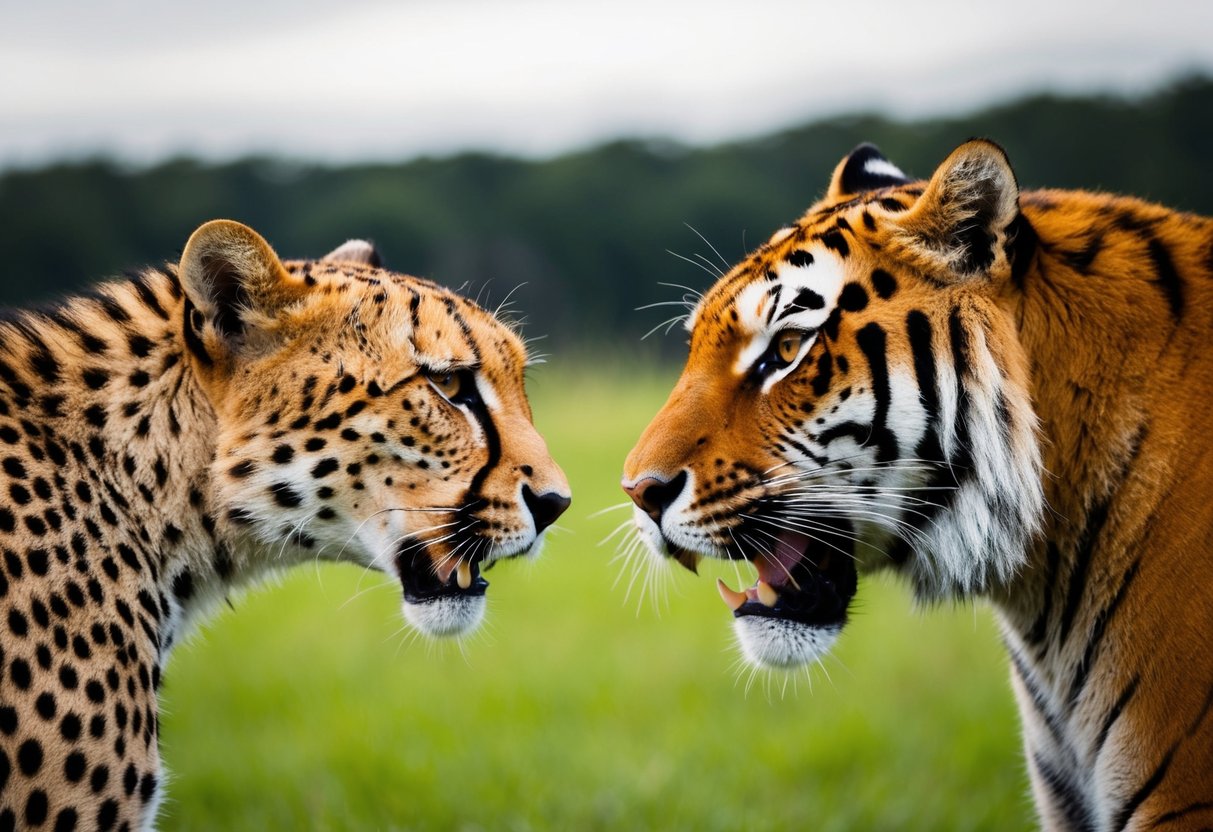
Behavioral Adaptations: Water Affinity and Hunting Mechanics
Unlike most domestic cats and many wild felids, tigers actively seek out water. They possess specialized physical features and hunting techniques that take full advantage of aquatic environments.
- Scenting / Tracking Phase: Uses vomeronasal organ & olfactory pads
- Silent Stalking Phase: Retracted claws, padded footpads, low center of gravity through high cover
- Ambush Burst Phase: Explosive acceleration (up to 60 km/h), Distance covered: Under 20 meters
- Subduing Strike: Forelimb grapple + throat clamp or cervical spine puncture with 10cm teeth
Aquatic Mastery and Thermoregulation
Tigers are exceptional swimmers, capable of crossing rivers up to 29 kilometers (18 miles) wide and navigating coastal mangroves.
- Physical Propulsion: Partial webbing between their toes broadens their surface area in water, while powerful shoulder muscles provide strong forward thrust.
- Cooling Mechanics: Because tigers have few sweat glands (located primarily between their toe pads), they submerge themselves in lakes, rivers, and mud pools during peak daytime heat to prevent thermal stress.
- Aquatic Hunting: Tigers routinely drive prey into deep water, where heavy ungulates like deer or wild boar lose their footing, giving the buoyant tiger a decisive physical advantage.
Solitary Territoriality and Ambush Execution
Tigers are solitary predators that rely on element-of-surprise attacks rather than group hunting strategies. Because maintaining a high body mass requires substantial calories, tigers maintain large home ranges to secure enough food.
- Territory Size: Home ranges vary based on local prey density. In prey-rich habitats like India’s Kaziranga National Park, a female tiger may hold a territory of 20 square kilometers (8 square miles). In the Russian Far East, where prey is sparse, home ranges can exceed 1,000 square kilometers (386 square miles).
- Ambush Dynamics: Due to their heavy builds, tigers cannot run down prey over long distances. They use dense cover to creep within 10 to 20 meters (30 to 65 feet) of a target before launching an explosive ambush sprint. They can reach top speeds of 50 to 60 km/h (31 to 37 mph), but only for short distances.
Comparative Analysis: Tiger vs. Other Big Cats
The table below outlines key morphological, physical, and behavioral differences between the tiger (Panthera tigris) and other members of the Panthera genus according to data from wild cat research authorities like Panthera.org.
| Characteristic | Tiger (Panthera tigris) | Lion (Panthera leo) | Jaguar (Panthera onca) | Leopard (Panthera pardus) |
|---|---|---|---|---|
| Average Adult Weight | 100–300 kg (220–660 lbs) | 120–250 kg (265–550 lbs) | 56–100 kg (123–220 lbs) | 30–90 kg (66–198 lbs) |
| Coat Marking Pattern | Vertical stripes (Etched in skin) | Uniform tawny coat (Adults) | Rosettes with internal spots | Rosettes without internal spots |
| Social Structure | Strictly Solitary | Social (Prides) | Strictly Solitary | Strictly Solitary |
| Swimming Affinity | Very High (Active swimmer) | Low to Moderate | High (Active swimmer) | Low to Moderate |
| Primary Hunting Style | Ground-based ambush | Group stalking / Drives | Ground ambush / Aquatic strike | Tree-stalking / Arboreal ambush |
| Bite Force (Canine Tip) | ~1,000 PSI | ~650 PSI | ~1,010 PSI | ~470 PSI |
| Skin Pigmentation | Patterns visible on bare skin | Unpatterned pale skin | Patterned skin | Patterned skin |
Subspecies Variations and Regional Adaptations
The International Union for Conservation of Nature (IUCN Red List) officially recognizes two primary tiger subspecies: Panthera tigris tigris (mainland Asian tiger) and Panthera tigris sondaica (Sundas island tiger). However, conservation biologists frequently categorize them into distinct regional populations based on unique local traits.
- Panthera tigris
- Mainland Asian Tiger (P. t. tigris)
- Amur / Siberian Population
- Bengal Population
- Indochinese Population
- Malayan Population
- South China Population (Critically Endangered)
- Caspian Population (Extinct)
- Sundas Island Tiger (P. t. sondaica)
- Sumatran Tiger (Extant)
- Javan Tiger (Extinct)
- Bali Tiger (Extinct)
- Mainland Asian Tiger (P. t. tigris)
Amur (Siberian) Tiger
Inhabiting the Russian Far East and Northeast China, the Amur tiger (P. t. altaica) is adapted for severe winter environments.
- Coat Density: It grows a thick winter coat with hair density reaching up to 3,000 hairs per square centimeter, along with an abdominal layer of fat up to 5 cm thick.
- Coloration: Its fur is noticeably paler orange with dark brown stripes rather than deep black, helping it blend into snowy forests.
Bengal Tiger
Representing more than half of all wild tigers, the Bengal tiger (P. t. tigris) lives across India, Nepal, Bhutan, and Bangladesh.
- Physical Profile: Known for classic bright orange coats with crisp black stripes.
- Leucism (White Mutation): The Bengal tiger population carries a rare double-recessive gene mutation that causes leucism. White tigers are not albino; they possess dark stripes, blue eyes, and pale skin due to a lack of pheomelanin pigment.
Sumatran Tiger
The last remaining island subspecies, the Sumatran tiger (P. t. sumatrae), lives in the dense rainforests of Sumatra, Indonesia.
Compact Body: Weighing between 75 and 140 kg (165 to 308 lbs), it is significantly smaller than mainland tigers, allowing it to move easily through thick jungle foliage.
Distinct Features: Features extremely narrow, closely packed stripes and a prominent facial beard or neck ruff.
Regional Size Comparison:
- Amur Tiger: 300 kg (660 lbs)
- Bengal Tiger: 230 kg (500 lbs)
- Sumatran Tiger: 120 kg (265 lbs)
Ecological Significance: The Apex Regulator
Tigers act as an apex predator and umbrella species across Asian ecosystems. By preying primarily on large ungulates like sambar deer, chital, gaur, and wild boar, they keep herbivore populations in check.
- Apex Predator (Tigers): Keeps populations in check
- Large Herbivores (Deer, Boar, Gaur): Prevents overgrazing
- Primary Producers (Forests, Plants)
Without apex carnivores, herbivore populations can grow unchecked, leading to overgrazing that strips forest understories. This habitat degradation destabilizes topsoil, speeds up riverbank erosion, and drives out smaller mammal and bird species. Protecting a single tiger’s territory indirectly preserves hundreds of square miles of forest habitat, safeguarding countless co-existing plants and animals.
Frequently Asked Questions
Do tigers have stripes on their skin or just their fur?
Tigers have stripes etched directly into their skin. The dark pigmentation originates in the dermal hair follicles and stains the surrounding epidermal skin layers. Even if shaved, a tiger's unique stripe pattern remains clearly visible on its bare hide.
Why are tigers bright orange if their natural habitat is green?
Tigers appear bright orange to humans because we possess trichromatic vision (seeing red, green, and blue light). However, most prey animals—such as deer and wild pigs—have dichromatic vision, making them blind to red frequencies. To a deer, a tiger's orange coat blends seamlessly into green foliage as a muted, greyish-tan shade.
How do white tigers occur, and are they a separate species?
White tigers are not a distinct subspecies or albinos. They are Bengal tigers born with a rare recessive genetic mutation that blocks the production of reddish-orange pigments while preserving dark stripes. White tigers rarely survive in the wild because they lack the natural camouflage needed to stalk prey effectively.
Why do tigers enjoy water when domestic cats usually avoid it?
Tigers evolved in warm climates and heavy jungle environments where overheating is a serious biological risk. They possess few sweat glands, so soaking in cool water helps regulate their body temperature. Water also provides a distinct hunting advantage by allowing tigers to corner terrestrial prey that struggle to move efficiently through deep rivers and lakes.
How powerful is a tiger's bite compared to other predators?
A tiger can bite with approximately 1,000 PSI at canine tips, giving it one of the strongest bites relative to body size in the cat family. While larger species like Nile crocodiles and hippos exert higher absolute bite forces, a tiger's jaw design generates enough pressure to crush bones and puncture dense skulls instantly.
Practical Conservation Actions
Preserving the tiger’s unique biological characteristics requires protecting large, uninterrupted forest landscapes. Historical habitat loss, illegal poaching, and human-wildlife conflict have reduced wild tiger populations to roughly 5% of their historic range. Organizations like the World Wildlife Fund (WWF) lead global initiatives focused on habitat restoration and anti-poaching patrols.
- Global Tiger Population Trajectory:
- 100,000 (Year 1900)
- 5,500 (Current Estimate)
To support tiger conservation directly:
- Support Verified Habitat Corridors: Choose programs that rebuild ecological corridors connecting fragmented forest reserves, allowing isolated tiger populations to interbreed naturally.
- Buy Certified Sustainable Goods: Purchase wood, paper, and agricultural products certified by organizations like the Forest Stewardship Council (FSC) to reduce tropical deforestation in critical tiger habitats.
- Report Wildlife Trafficking: Avoid buying wildlife products, skins, or traditional medicines derived from big cat parts, and support enforcement teams fighting illegal trade networks.
Image Gallery
Select an image to open it in a new tab.
Declan O'Connor
Higher Education and Campus Culture Reporter
