
A charitable life insurance program allows individuals to leverage a life insurance policy to make a substantial philanthropic donation, creating a lasting legacy for a non-profit organization while potentially securing significant income or estate tax benefits for the donor.
Philanthropic planning requires balancing personal financial security with charitable goals. For individuals seeking to maximize their giving potential beyond what current liquid assets allow, life insurance offers an efficient mechanism. By integrating an insurance policy into an estate or financial plan, donors can transform modest, incremental premium payments into a substantial future gift.
Understanding the mechanics, structuring options, tax implications, and administrative requirements of these programs is essential for anyone considering this form of legacy giving. Because charitable life insurance intersects with complex tax codes and insurance underwriting, navigating the process requires a clear understanding of legal ownership rules and financial commitments.
The Core Concept of Charitable Life Insurance
At its fundamental level, a charitable life insurance program involves designating a tax-exempt organization as the beneficiary or the owner of a life insurance policy. When the insured individual passes away, the insurance company pays the death benefit directly to the charity. This straightforward transaction bypasses the probate process, ensuring that 100% of the intended funds reach the non-profit organization quickly and privately.
The power of this strategy lies in the leverage it provides. For a fraction of the ultimate payout's cost, a donor can fund a major endowment, building project, or ongoing operational fund that might otherwise be impossible through direct annual cash donations.
However, charitable life insurance is not a one-size-fits-all product. The structure of the program depends heavily on whether the donor purchases a new policy specifically for the charity or transfers an existing, paid-up policy. Furthermore, the tax advantages realized by the donor vary significantly depending on how the policy is owned and who controls the beneficiary designations.
Primary Methods of Structuring a Program
Donors and non-profit organizations typically utilize one of two primary structures when establishing a charitable life insurance program: direct ownership transfer or beneficiary designation. Each method carries distinct legal responsibilities, tax consequences, and control mechanisms.
1. Absolute Assignment (Ownership Transfer)
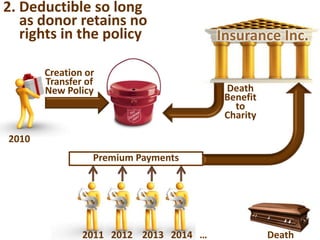
In this arrangement, the donor purchases a life insurance policy and completely transfers ownership of the policy to the charitable organization. The charity becomes both the owner and the irrevocable beneficiary of the contract.
- Donor Responsibilities: While the charity owns the policy, the donor typically continues to make annual cash contributions to the organization specifically earmarked to cover the ongoing premium payments.
- Tax Treatment: Because the transfer is irrevocable, the donor may be entitled to an income tax charitable deduction for the present value of the policy (if it is a cash-value policy) or the replacement cost. Furthermore, any subsequent cash gifts made to the charity to pay premiums are generally tax-deductible as charitable contributions.
- Control: The donor completely relinquishes control over the policy. They cannot change the beneficiary, borrow against the cash value, or surrender the policy without the charity's consent.
2. Beneficiary Designation
In this arrangement, the donor retains complete ownership and control of the life insurance policy throughout their lifetime, but names the charitable organization as the primary or contingent beneficiary for all or a specific percentage of the death benefit.
- Donor Responsibilities: The donor retains full responsibility for paying all premiums and managing the policy's performance.
- Tax Treatment: Naming a charity as a beneficiary does not provide an immediate income tax deduction during the donor’s lifetime. Because the donor retains the right to change the beneficiary at any time, the gift is considered incomplete for income tax purposes. However, the death benefit is excluded from the donor's gross estate for federal estate tax purposes, and the estate receives a charitable estate tax deduction for the payout.
- Control: Maximum flexibility. The donor can alter the beneficiary designation if personal financial circumstances change.
| Structuring Method | Ownership | Immediate Tax Deduction | Donor Control | Estate Tax Benefit |
|---|---|---|---|---|
| Absolute Assignment | Transferred to Charity | Yes (Present value / Premiums) | None | Excluded from estate |
| Beneficiary Designation | Retained by Donor | No | Full control | Charitable estate deduction |

Exploring the Role of Policy Types
Not all life insurance policies are equally suited for charitable programs. The choice between term life insurance and permanent life insurance dictates how the program operates, how long it lasts, and what financial resources are required.
Term Life Insurance
Term life insurance provides coverage for a specified period, such as 10, 20, or 30 years. It pays a death benefit only if the insured passes away during that term.
- Suitability: Term insurance is generally used for temporary philanthropic campaigns or when a donor wants to make a large legacy gift with minimal initial outlay.
- Limitations: Because term policies eventually expire or experience prohibitive premium increases at advanced ages, they carry a high risk that the policy will lapse before the insured passes away, resulting in no gift for the charity.
Permanent Life Insurance (Whole Life and Universal Life)
Permanent insurance provides lifetime coverage and includes a cash-value component that grows on a tax-deferred basis.
- Suitability: Whole life and universal life policies are the gold standard for charitable life insurance programs. They guarantee that a death benefit will eventually be paid, provided premiums are maintained.
- Cash-Value Utilization: Over time, the cash value can accumulate significantly. In some advanced planning scenarios, a donor can use the accumulated cash value to fund other philanthropic endeavors or allow the charity to surrender the policy for its cash value if the organization faces an urgent financial need.
Tax Implications and Financial Considerations
The financial architecture of a charitable life insurance program is governed strictly by the Internal Revenue Service (IRS) code and relevant state insurance regulations. Donors must evaluate these tax dynamics carefully, preferably in consultation with a certified public accountant (CPA) or estate planning attorney.
Income Tax Deductions for Premium Payments
When a donor irrevocably assigns a policy to a charity and makes cash gifts to cover the premiums, those cash gifts qualify as charitable deductions, subject to standard IRS adjusted gross income (AGI) limitations (typically up to 60% of AGI for cash gifts to public charities). If the donor transfers an existing policy, the deduction for the initial transfer is generally limited to the policy's cost basis or its fair market value, whichever is less.
Estate Tax Reduction
For high-net-worth individuals facing potential estate tax liabilities, removing the life insurance proceeds from the taxable estate is a powerful tool. When a charity is named as the irrevocable owner and beneficiary, the death benefit bypasses the estate entirely, reducing the overall taxable estate value and potentially eliminating estate tax burdens for heirs.
Avoiding Unrelated Business Income Tax (UBIT) and Safeguards
Non-profit organizations must evaluate incoming policies carefully to ensure compliance with state insurable interest laws. A charity cannot purchase a policy on the life of an individual in whom it has no insurable interest, nor can it participate in speculative secondary market transactions that violate public policy. Furthermore, charities must ensure that accepting certain types of leveraged policies does not trigger Unrelated Business Income Tax (UBIT).
Step-by-Step Process to Establish a Program
Establishing a charitable life insurance program involves a methodical process shared between the donor, the financial advisor, and the recipient institution.
- Define Philanthropic Goals: Determine the exact financial magnitude of the intended legacy and select a verified 501(c)(3) organization or qualified public charity.
- Consult Professionals: Engage an insurance agent, financial planner, and legal counsel to review existing assets and determine whether to purchase a new policy or utilize an existing one.
- Underwriting and Issuance: If purchasing a new policy, undergo medical underwriting to determine premium rates. The health classification directly dictates the cost of funding the program.
- Execute Legal Documentation: Complete the formal assignment forms or beneficiary designation paperwork provided by the insurance carrier and vetted by the charity's legal department.
- Establish Funding Mechanism: Set up recurring payment schedules, automatic bank transfers, or direct contributions to ensure premiums are paid reliably on time, preventing inadvertent policy lapses.
- Annual Review: Periodically review the policy's performance, dividend rates (for whole life policies), and universal life interest crediting rates to ensure the policy remains on track to fulfill its intended purpose.
Common Mistakes to Avoid
Mismanaging a charitable life insurance program can lead to unintended financial liabilities, administrative burdens for the charity, or the complete collapse of the gift.
- Allowing the Policy to Lapse: The most common failure in life insurance philanthropy is missing premium payments. If a donor stops making contributions and the policy lacks sufficient cash value to sustain itself, the policy lapses, destroying the planned legacy.
- Failing to Verify Charity Acceptance Policies: Not all non-profit organizations have the administrative capacity or willingness to accept ownership of life insurance policies. Some organizations have strict policies against accepting encumbered policies or managing ongoing premium obligations. Donors must coordinate with the charity's development office beforehand.
- Overlooking State Insurable Interest Laws: Attempting to set up a policy without a legitimate insurable interest can render the contract void or illegal under state law.
- Ignoring Tax Law Changes: Tax codes governing charitable deductions and estate exemptions evolve. Failing to review the program periodically against current tax laws can diminish anticipated financial benefits.
Frequently Asked Questions
Can I donate an existing life insurance policy that I no longer need?
Yes. Many individuals donate older policies—such as whole life policies purchased years ago to protect growing children who are now financially independent. By irrevocably assigning the policy to a charity, you can receive an immediate income tax deduction roughly equal to the policy's cash surrender value and remove the asset from your taxable estate.
What happens if I stop paying the premiums on a policy owned by a charity?
If you transfer ownership of the policy to the charity and stop making the corresponding cash gifts for premiums, the charity faces a choice. The organization may use the policy's accumulated cash value to pay the premiums, pay the premiums out of its own operating budget, or surrender the policy for its cash value. Open communication with the charity is vital if financial circumstances force a change in your giving capacity.
Are all charities legally permitted to accept life insurance policies?
Legally, most tax-exempt 501(c)(3) organizations can accept life insurance policies, but practically, smaller non-profits may lack the administrative infrastructure to manage them. Organizations must evaluate whether accepting a policy aligns with their internal gift acceptance policies and whether they are prepared to handle ongoing premium notices and ultimate claim filings.
Does a charitable life insurance program replace the need for a will or trust?
No. Life insurance passes via contract law directly to the named beneficiary, bypassing the probate process entirely. However, it is a specialized tool that should be integrated into a comprehensive estate plan, working alongside your last will and testament and any living trusts to ensure your overall asset distribution aligns with your wishes.
Next Steps for Prospective Donors
If you are interested in establishing a charitable life insurance program, your first step is to contact the development or planned giving office of your chosen non-profit organization to confirm their gift acceptance guidelines. Following that discussion, consult with an independent financial advisor or estate planning attorney to evaluate your current insurance portfolio, assess your tax situation, and draft the necessary legal assignments to secure your philanthropic legacy safely and efficiently.
Image Gallery
Select an image to open it in a new tab.
Simon Caldwell
Enterprise Technology and Systems Editor
