Understanding the Ionic Formula: A Comprehensive Guide to Writing and Predicting Chemical Compounds

An ionic formula is a chemical expression representing the simplest whole-number ratio of cations to anions in an ionic compound. It describes how metal and non-metal atoms bond through the transfer of electrons to achieve electrical neutrality. Unlike molecular formulas, ionic formulas represent a repeating crystal lattice rather than individual, discrete molecules.
The Fundamentals of Ionic Bonding and Formula Construction
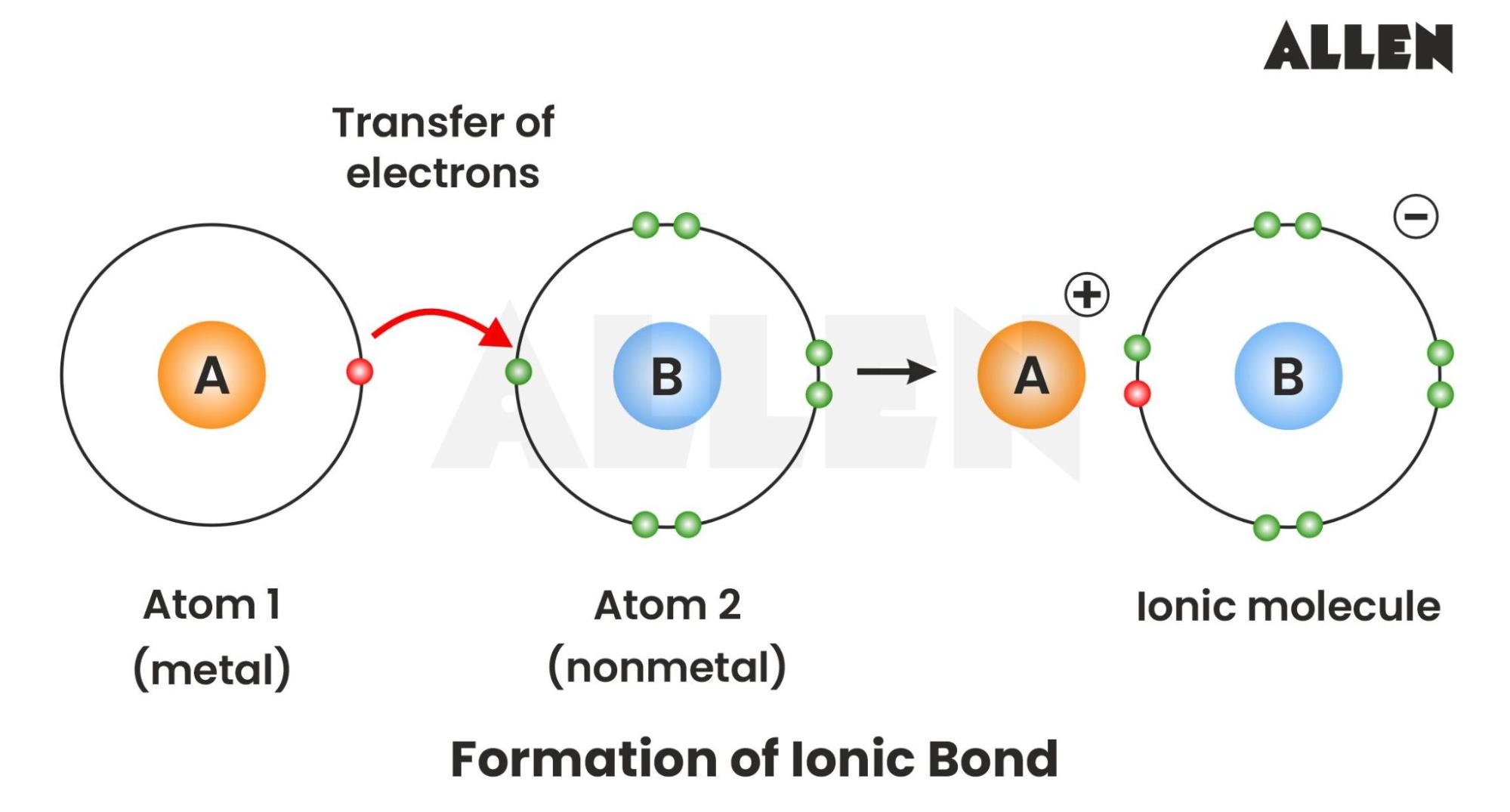
To understand what an ionic formula is, one must first grasp the nature of the ionic bond. In the field of chemistry, as observed in current 2026 educational standards, an ionic bond is defined by the electrostatic attraction between oppositely charged ions. This typically occurs when a metal atom, which has a low ionization energy, transfers one or more of its valence electrons to a non-metal atom, which possesses a high electron affinity. This transfer results in the formation of a positive ion, known as a cation, and a negative ion, known as an anion.
The resulting ionic formula is not just a random collection of symbols; it is a precise mathematical representation of the compound's composition. For instance, in the formula for table salt, NaCl, the absence of subscripts indicates a 1:1 ratio between sodium ions ($Na^+$) and chloride ions ($Cl^-$). The formula reflects the "formula unit," which is the lowest whole-number ratio of ions that yields a net charge of zero. This distinction is vital because ionic compounds do not exist as independent pairs of atoms but as vast, three-dimensional networks called crystal lattices.
The stability of an ionic formula is driven by the octet rule. Most atoms seek to have eight electrons in their outermost shell to mimic the electron configuration of a noble gas. Metals achieve this by losing electrons to empty their outer shell, while non-metals achieve it by gaining electrons to fill their outer shell. The ionic formula serves as the blueprint for this exchange, ensuring that the total number of electrons lost by the metal atoms equals the total number of electrons gained by the non-metal atoms.
The Principle of Electroneutrality
The most critical rule in determining an ionic formula is the principle of electroneutrality. In nature, bulk matter is electrically neutral. Therefore, any stable ionic compound must have a total positive charge that exactly cancels out the total negative charge. When writing an ionic formula, the chemist's primary task is to balance these charges by adjusting the number of ions involved.
Consider the compound formed between magnesium and nitrogen. Magnesium, a Group 2 element, typically forms a $Mg^{2+}$ ion. Nitrogen, a Group 15 element, forms a $N^{3-}$ ion. To reach a neutral state, the charges must find a common multiple. In this case, the lowest common multiple of 2 and 3 is 6. To achieve a total positive charge of +6, three magnesium ions are required ($3 \times +2 = +6$). To achieve a total negative charge of -6, two nitrogen ions are required ($2 \times -3 = -6$). Consequently, the ionic formula is written as $Mg_3N_2$.
This balance is why subscripts are used in ionic formulas. A subscript is the small number written to the lower right of an element's symbol. It indicates how many of that specific ion are present in the formula unit. If a subscript is not written, it is understood to be one. The mathematical precision of these ratios is what allows chemists to predict the yields of reactions and the properties of materials with such accuracy in modern laboratory settings.

Step-by-Step Guide to Writing an Ionic Formula
Writing an ionic formula requires a systematic approach to ensure accuracy. By following these established steps, students and professionals can derive the correct formula for any binary or ternary ionic compound.
Step 1: Identify the Ions and Their Charges
The first step is to identify the symbol and the ionic charge of both the cation and the anion. The cation (usually a metal) is always written first, followed by the anion (usually a non-metal). One can determine the charge of representative elements by their position on the periodic table. For example, Group 1 elements form +1 ions, Group 2 elements form +2 ions, and Group 17 elements form -1 ions.
Step 2: The Criss-Cross Method
A common and effective technique used in 2026 chemistry curricula is the "criss-cross" method. In this technique, the numerical value of the cation's charge becomes the subscript for the anion, and the numerical value of the anion's charge becomes the subscript for the cation. For example, when bonding Aluminum ($Al^{3+}$) with Oxygen ($O^{2-}$), the 3 from the aluminum charge moves to the oxygen's subscript, and the 2 from the oxygen charge moves to the aluminum's subscript. This results in $Al_2O_3$.
Step 3: Simplify the Ratios
Since an ionic formula must represent the empirical formula (the simplest ratio), any subscripts that share a common factor must be simplified. If the criss-cross method yields a formula like $Ti_2O_4$, it must be reduced to $TiO_2$. This reflects the reality that the lattice structure is built on the simplest repeating unit. Failure to simplify is a frequent error in introductory chemistry but is easily avoided by checking the greatest common divisor of the subscripts.
Step 4: Verify the Net Charge
As a final check, multiply the subscript of each ion by its charge and sum them up. For $Al_2O_3$, the calculation would be $(2 \times +3) + (3 \times -2) = 6 - 6 = 0$. If the sum is zero, the formula is correct and represents a stable, neutral compound.
Understanding Polyatomic Ions in Formulas
Not all ions are composed of a single atom. Polyatomic ions are groups of atoms covalently bonded together that carry an overall net charge. Examples include the sulfate ion ($SO_4^{2-}$), the nitrate ion ($NO_3^-$), and the ammonium ion ($NH_4^+$). When these ions are part of an ionic formula, they are treated as a single discrete unit.
The use of parentheses is mandatory when more than one polyatomic ion is needed to balance the charge. For example, if you are writing the formula for Calcium Nitrate, you have $Ca^{2+}$ and $NO_3^-$. To balance the +2 charge of calcium, you need two nitrate ions. The formula is written as $Ca(NO_3)_2$. The parentheses indicate that the subscript '2' applies to the entire nitrate unit, not just the oxygen. If the formula were written as $CaNO_{32}$, it would incorrectly suggest thirty-two oxygen atoms, which is chemically impossible in this context.
It is important to note that if only one polyatomic ion is required, parentheses are not used. Sodium nitrate, composed of $Na^+$ and $NO_3^-$, is simply written as $NaNO_3$. Mastery of these polyatomic ions is essential because they are prevalent in biological systems, industrial fertilizers, and geological formations.
Transition Metals and Variable Oxidation States
Transition metals (found in Groups 3 through 12 of the periodic table) present a unique challenge because many of them can form more than one type of ion. For example, Iron can form $Fe^{2+}$ or $Fe^{3+}$. In chemical nomenclature, these different charges are indicated by Roman numerals in the name, such as Iron(II) chloride or Iron(III) chloride.
To write the ionic formula for these compounds, you must look at the Roman numeral to determine the cation's charge.
- Iron(II) chloride: $Fe^{2+}$ and $Cl^-$. Using the criss-cross method, the formula is $FeCl_2$.
- Iron(III) chloride: $Fe^{3+}$ and $Cl^-$. Using the criss-cross method, the formula is $FeCl_3$.
In the absence of a Roman numeral, the charge must often be deduced from the anions present in the formula. If you are given the formula $CuO$, and you know that Oxygen always has a -2 charge, you can deduce that the Copper ion in this specific compound must have a +2 charge to maintain neutrality. This deductive reasoning is a core skill for interpreting chemical data in analytical chemistry.
Comparison of Common Ions and Their Formulas
The following table provides a reference for several common ions and the resulting formulas they create when combined. This illustrates the diversity of ratios required to achieve electroneutrality.
| Cation Name | Cation Symbol | Anion Name | Anion Symbol | Resulting Ionic Formula |
|---|---|---|---|---|
| Sodium | $Na^+$ | Chloride | $Cl^-$ | $NaCl$ |
| Magnesium | $Mg^{2+}$ | Bromide | $Br^-$ | $MgBr_2$ |
| Aluminum | $Al^{3+}$ | Oxide | $O^{2-}$ | $Al_2O_3$ |
| Calcium | $Ca^{2+}$ | Phosphate | $PO_4^{3-}$ | $Ca_3(PO_4)_2$ |
| Potassium | $K^+$ | Sulfate | $SO_4^{2-}$ | $K_2SO_4$ |
| Ammonium | $NH_4^+$ | Nitrate | $NO_3^-$ | $NH_4NO_3$ |
| Lithium | $Li^+$ | Nitride | $N^{3-}$ | $Li_3N$ |
| Zinc | $Zn^{2+}$ | Carbonate | $CO_3^{2-}$ | $ZnCO_3$ |
Physical and Chemical Properties Dictated by the Formula
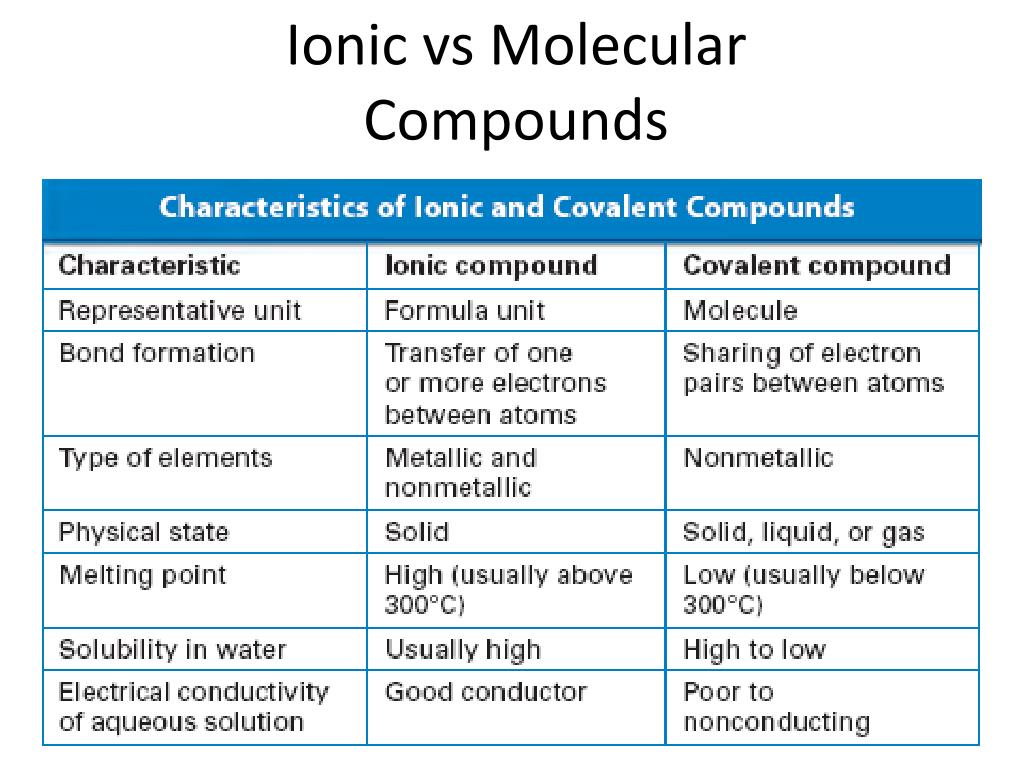
The ionic formula is not merely a label; it dictates the physical characteristics of the substance. Because the formula represents a lattice of alternating charges, ionic compounds possess specific properties that distinguish them from molecular substances like water or sugar.
- High Melting and Boiling Points: The electrostatic forces (Coulombic forces) holding the ions together in the ratio defined by the formula are extremely strong. Breaking these bonds to melt or boil the substance requires significant thermal energy.
- Brittleness: In an ionic lattice, ions are arranged so that opposite charges are adjacent. If a force shifts the lattice, ions of like charges may align and repel each other, causing the crystal to shatter.
- Electrical Conductivity: While solid ionic compounds do not conduct electricity because the ions are fixed in place, they become excellent conductors when melted (molten) or dissolved in water (aqueous). In these states, the ions are free to move and carry an electric current.
- Solubility: Many ionic formulas describe substances that are highly soluble in polar solvents like water. The polar water molecules surround the individual ions, overcoming the lattice energy and pulling them into solution—a process known as hydration or dissociation.
Common Mistakes and Troubleshooting
Even experienced students can make errors when deriving an ionic formula. Identifying these pitfalls early can prevent significant misunderstandings in stoichiometry and laboratory work.
- Confusing Charge with Subscript: A common error is writing the charge as part of the final formula. For example, writing $Na^{+1}Cl^{-1}$ instead of $NaCl$. The charges are tools used to find the ratio; they should not appear in the final neutral formula.
- Incorrect Subscript Placement for Polyatomic Ions: Students often forget parentheses. Writing $MgOH_2$ instead of $Mg(OH)_2$ is a major error, as the first version implies one magnesium, one oxygen, and two hydrogens, rather than two hydroxide units.
- Failure to Reduce: As mentioned previously, always check if the subscripts can be divided by a common factor. Ionic formulas must always be in their most reduced form.
- Mixing up Cation and Anion Order: The cation must always come first. Writing $ClNa$ is non-standard and violates IUPAC naming and formula conventions.
For more technical details on chemical nomenclature and formula standards, the International Union of Pure and Applied Chemistry (IUPAC) provides the definitive guidelines used globally in 2026.
Frequently Asked Questions
What is the difference between an ionic formula and a molecular formula?
An ionic formula represents the simplest ratio of ions in a crystal lattice (a formula unit), whereas a molecular formula represents the actual number of atoms in a single, discrete molecule. For example, $C_6H_{12}O_6$ is a molecular formula for glucose, showing exactly 24 atoms in one molecule. Conversely, $NaCl$ represents a repeating pattern where there is one sodium for every one chlorine, with no single "molecule" of salt existing independently.
Can two non-metals form an ionic bond and an ionic formula?
Generally, no. Two non-metals typically share electrons, forming a covalent bond and a molecular formula. Ionic bonds and formulas almost always involve a metal and a non-metal, or a polyatomic ion like ammonium ($NH_4^+$) which acts as a metal cation despite being made of non-metals. The difference in electronegativity between the two components must be high (typically greater than 1.7) for the bond to be considered ionic.
How do I find the charge of an element if I don't have a chart?
You can use the periodic table to find the valence electrons. Elements in Group 1 have one valence electron and will lose it to become +1. Elements in Group 17 have seven valence electrons and will gain one to become -1. For any representative element, the charge is often determined by how many electrons must be gained or lost to reach a full set of eight (the octet rule).
Why are Roman numerals sometimes used in the names of ionic compounds but not the formulas?
Roman numerals are used in the name (e.g., Copper(II) Oxide) to specify which ion a transition metal has formed. However, the formula ($CuO$) does not include the Roman numeral because the charge is already implied by the ratio of atoms needed to create a neutral compound. The formula relies on subscripts to communicate the ratio, which inherently reveals the charges of the constituent ions to those who know how to read them.
What is a "Formula Unit" exactly?
A formula unit is the smallest collection of atoms from which an ionic compound's formula can be established. Since ionic compounds exist as continuous 3D structures, we cannot point to a single "molecule" of salt. Instead, the formula unit is the mathematical "tile" that repeats over and over again to build the entire crystal.
Final Recommendation for Students and Educators
When working with ionic formulas in 2026, it is highly recommended to use a high-quality periodic table that includes common oxidation states for transition metals. Practice the criss-cross method with a variety of polyatomic ions, as these are the most common sources of error in chemical equations. For those looking to verify their work, the PubChem database remains an authoritative source for checking the established formulas and properties of millions of compounds. Always remember: the goal of an ionic formula is balance. If the charges do not sum to zero, the formula is not yet complete.
Image Gallery
Select an image to open it in a new tab.

Lars Thomsen
Global Labor Markets and Economic Strategy Editor
