
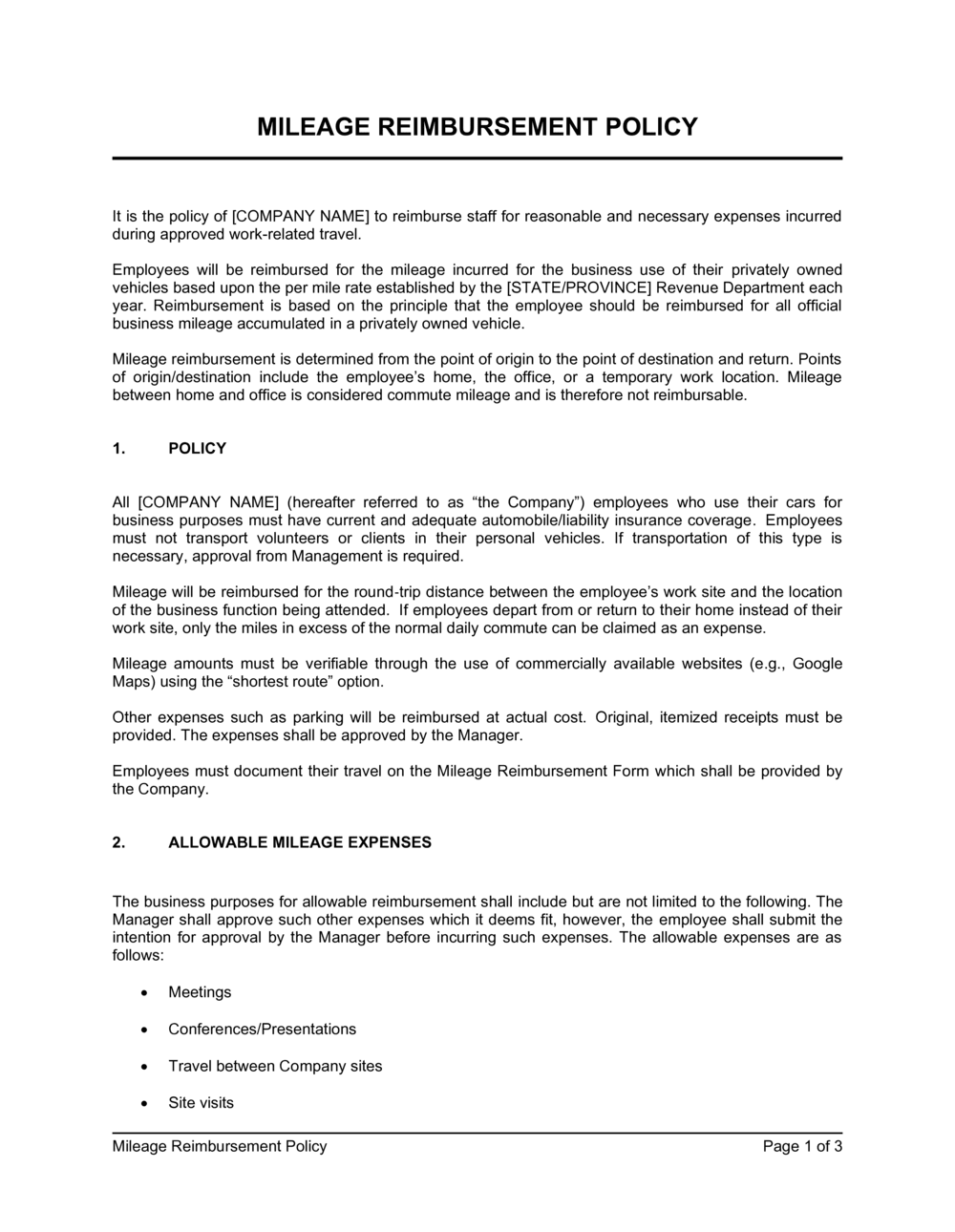
An employee mileage reimbursement policy outlines how a company compensates staff for using personal vehicles for business-related travel. In 2026, most organizations align their policies with the IRS standard mileage rate to ensure payments are tax-deductible for the employer and non-taxable for the employee. A well-defined policy ensures legal compliance, maintains financial transparency, and establishes clear expectations for documentation and eligibility.
The Importance of a Formal Mileage Policy
A formal mileage reimbursement policy is more than just a financial guideline; it is a critical document for risk management and operational efficiency. Without a written policy, businesses face inconsistent expense reporting, potential tax penalties, and disgruntled employees who may feel unfairly compensated for the wear and tear on their personal assets.
In 2026, the cost of vehicle ownership—including insurance, maintenance, and fuel—continues to fluctuate. A policy provides a stable framework that adjusts to these economic shifts. By establishing an Accountable Plan, as defined by the IRS, companies can ensure that reimbursements are not treated as taxable income. To qualify as an accountable plan, the policy must require employees to have a business connection for the expenses, provide substantiation (proof of travel), and return any excess reimbursement within a reasonable timeframe.
Beyond tax benefits, a clear policy helps in budgeting. When the rules for what constitutes "business travel" are clearly defined, management can more accurately forecast travel-related expenses and identify departments where travel costs may be exceeding expectations.
The 2026 IRS Standard Mileage Rate and Its Role
The Internal Revenue Service (IRS) typically adjusts the standard mileage rate annually to reflect the average costs of operating a vehicle. For 2026, the rate serves as the primary benchmark for most American businesses. This rate covers both variable costs, such as gasoline and oil, and fixed costs, such as insurance, registration, and depreciation.
Using the IRS rate is the most straightforward method for reimbursement. If an employer pays the exact IRS rate, the reimbursement is generally tax-free. If an employer pays more than the IRS rate, the excess amount is considered wages and is subject to income tax withholding. Conversely, if an employer pays less, employees in certain states may have the right to demand the full cost of their expenses under local labor laws.
It is important to note that the standard mileage rate cannot be used for vehicles used for hire (like taxis) or if the employee has previously claimed accelerated depreciation on that specific vehicle. For most office-based or field-sales employees using standard passenger cars, SUVs, or light trucks, the IRS rate remains the gold standard for simplicity and compliance.

Legal Requirements and Jurisdictional Variations
While federal law through the Fair Labor Standards Act (FLSA) does not strictly require mileage reimbursement, it does mandate that an employee's expenses cannot reduce their net pay below the federal minimum wage. However, several states have much stricter requirements that make mileage reimbursement a legal necessity.
California Labor Code Section 2802
California remains the most stringent jurisdiction regarding employee expenses. Section 2802 requires employers to indemnify employees for all "necessary expenditures or losses incurred by the employee in direct consequence of the discharge of his or her duties." In practice, this means California employers must reimburse for mileage, and most courts accept the IRS rate as a "presumptively reasonable" way to satisfy this requirement.
Illinois and Massachusetts
Similar to California, Illinois (under the Illinois Wage Payment and Collection Act) and Massachusetts have laws requiring the reimbursement of necessary business expenses. In these states, a failure to provide a mileage reimbursement policy can lead to class-action lawsuits and significant statutory penalties.
Remote and Hybrid Work Considerations
In the 2026 labor market, the definition of the "tax home" is vital. With many employees working from home, the distinction between commuting (not reimbursable) and business travel (reimbursable) has blurred. Generally, travel from a home office to a client site is reimbursable, while travel from home to a primary company office is often classified as commuting. Your policy must explicitly define these boundaries to prevent confusion and overpayment.
Types of Reimbursement Programs
Not every company uses the standard cents-per-mile model. Depending on the size of the fleet and the frequency of travel, other methods may be more cost-effective.
1. Cents-per-Mile (Standard)
This is the most common approach. The employee tracks their business miles and is paid a flat rate per mile.
- Pros: Easy to calculate; mirrors IRS guidelines.
- Cons: Does not account for geographic differences in gas prices or insurance.
2. Fixed and Variable Rate (FAVR)
FAVR is a more sophisticated method often used for employees who drive more than 5,000 miles per year. It separates reimbursement into a fixed monthly payment (for insurance and depreciation) and a variable rate (for fuel and maintenance).
- Pros: Highly accurate; adjusts for localized costs (e.g., driving in New York City vs. rural Ohio).
- Cons: Complex to administer; requires strict adherence to IRS "FAVR" rules to remain tax-free.
3. Flat Monthly Allowance
Some companies provide a set "car allowance" each month regardless of mileage.
- Pros: Predictable for the company budget.
- Cons: Almost always treated as taxable income unless the employee keeps a detailed log to prove the allowance was used for business miles.
| Feature | Cents-per-Mile | FAVR | Flat Allowance |
|---|---|---|---|
| Tax Status | Tax-free (up to IRS limit) | Tax-free (if IRS rules met) | Usually Taxable |
| Administrative Effort | Moderate | High | Low |
| Accuracy | Good | Excellent | Low |
| Best For | Occasional business travel | High-mileage field staff | Executive perks |
| Documentation Req. | Mileage logs | Detailed cost analysis | Minimal (but taxed) |
Essential Components of a 2026 Mileage Policy
To be effective, your policy should be detailed and easily accessible via the company handbook or HR portal. A comprehensive 2026 policy should include the following sections:
1. Eligibility and Vehicle Standards
Clearly define which employees are eligible for reimbursement. Does the policy apply to all full-time staff, or only those in sales and field service? Additionally, specify vehicle requirements. Many modern policies require vehicles to be no more than 10 years old and maintain specific insurance coverage limits (e.g., $100,000/$300,000 liability) to protect the company in the event of an accident.
2. Definition of Reimbursable Miles
The policy must distinguish between personal use, commuting, and business travel.
- Reimbursable: Travel between work sites, travel to meet clients, travel to the airport for a business trip, and errands for supplies.
- Non-Reimbursable: The daily commute from home to the primary office, personal errands during the workday, and travel to social events unless explicitly required by management.
3. Documentation and Submission Process
In 2026, manual paper logs are largely considered obsolete due to the high margin for error and potential for fraud. Policies should mandate the use of GPS-enabled mileage tracking applications. The IRS requires the following data points for every trip:
- The date of the trip.
- The total mileage.
- The destination (city/state or specific address).
- The specific business purpose of the trip.
4. Submission Deadlines
To remain an "accountable plan," expenses must be submitted within a "reasonable period." Most companies define this as 30 to 60 days. Timely submission ensures that the company’s financial records are up to date and that employees are reimbursed promptly.
Best Practices for Tracking and Verification
The shift toward digital transformation has made mileage tracking significantly more accurate. Organizations should leverage specialized software that integrates with their accounting systems (such as SAP, Oracle, or QuickBooks).
Automated GPS Tracking: Modern apps can automatically detect when a drive starts and ends. Employees can then "swipe" to categorize a trip as business or personal. This reduces "mileage padding," where employees might round up their distances.
Verification Protocols: Managers should perform periodic audits of mileage logs. If an employee claims 50 miles for a trip that Google Maps indicates is 35 miles, the policy should have a mechanism for addressing the discrepancy. Using a "point-to-point" calculation based on map software, rather than just odometer readings, is a common 2026 standard for verification.
Safety and Compliance: Your policy should explicitly state that reimbursement is contingent upon the employee following traffic laws. Companies may refuse to reimburse for miles driven while an employee's license is suspended or if they were involved in an accident where they were under the influence.
Common Pitfalls to Avoid
Even with a policy in place, certain mistakes can lead to tax issues or employee dissatisfaction.
- Failing to Update Rates: The IRS occasionally issues mid-year adjustments to the mileage rate if gas prices spike or drop significantly (as seen in previous years). Ensure your payroll or accounting software is updated to reflect the current 2026 rates immediately upon their announcement.
- Ignoring Local Laws: As mentioned, if you have remote employees in California or Illinois, you cannot simply opt-out of reimbursement. Ensure your policy is compliant with the laws of the state where the employee is located, not just where the company is headquartered.
- Inconsistent Enforcement: If one manager allows "commuting miles" to be reimbursed while another doesn't, it creates a risk of discrimination claims or morale issues. Centralize the approval process through HR or a dedicated travel department.
- Neglecting Insurance Verification: If an employee has an accident while driving for business and they do not have adequate insurance, the company may be held liable under the doctrine of respondeat superior. Verify insurance certificates annually.
Implementing the Policy: Step-by-Step
- Draft the Document: Use the components listed above to create a draft tailored to your industry and workforce.
- Legal Review: Have your legal counsel review the policy, specifically checking for compliance with the U.S. Department of Labor and relevant state labor boards.
- Select a Tracking Tool: Choose a mileage tracking app or software that fits your budget and technical needs.
- Employee Training: Hold a brief webinar or distribute a video explaining how to use the tracking tool and what counts as a "reimbursable mile."
- Obtain Signatures: Ensure every employee signs an acknowledgment form stating they have read and understood the policy.
- Regular Audits: Schedule quarterly reviews of mileage expenses to ensure the policy is being followed and costs are within budget.
FAQs
What is the 2026 IRS standard mileage rate?
The IRS standard mileage rate is the amount per mile that the IRS allows businesses to deduct for the costs of operating a vehicle for business purposes. In 2026, this rate is determined by the IRS based on an annual study of fixed and variable costs. Organizations should refer to the official IRS website for the current year's exact figure.
Is mileage reimbursement taxable for employees?
If the reimbursement is paid under an "Accountable Plan" and does not exceed the IRS standard mileage rate, it is generally not taxable. However, if an employer provides a flat allowance without requiring mileage logs, or pays a rate higher than the IRS standard, the amount (or the excess) is considered taxable income.
Can an employee claim a tax deduction for mileage in 2026?
Under current tax laws, most W-2 employees cannot claim a federal tax deduction for unreimbursed business expenses, including mileage. This makes a company-sponsored reimbursement policy vital for employee retention, as they cannot otherwise recover these costs on their personal tax returns.
Does the policy cover tolls and parking?
Most mileage reimbursement policies treat tolls and parking as separate expenses. While the cents-per-mile rate covers the operation of the vehicle, tolls and parking fees incurred during business travel are usually reimbursed at 100% of their actual cost, provided the employee provides receipts.
What happens if an employee uses a company car?
If an employee uses a company-provided vehicle, they are not eligible for mileage reimbursement. In fact, if they use the company car for personal purposes, the value of that personal use must be calculated and added to their taxable income as a fringe benefit.
Strategic Recommendation
For most mid-sized businesses in 2026, the most effective strategy is to implement a Cents-per-Mile program using the IRS standard rate, supported by a GPS-based tracking application. This combination provides the best balance of tax efficiency, ease of use for employees, and audit protection for the company. If your workforce includes high-mileage drivers (over 10,000 miles annually) in high-cost-of-living areas, consider conducting a cost-benefit analysis of a FAVR program to potentially reduce overall expenditure while ensuring fair compensation.
Image Gallery
Select an image to open it in a new tab.

Omar Farooq
EdTech Innovation and Virtual Pedagogy Journalist
