Understanding the Roosevelt Corollary Political Cartoon: Visual Rhetoric and Imperial History
A Roosevelt Corollary political cartoon is an editorial illustration from the early 20th century that visually interprets President Theodore Roosevelt’s 1904 extension of the Monroe Doctrine. These historical artworks typically depict the United States as an aggressive international police officer in Latin America, employing metaphors like a big stick, a broom, or a constable to critique or defend American imperial ambitions.
Historical Context and Origins of the Roosevelt Corollary
To fully understand why editorial cartoonists drew what they did, one must examine the geopolitical environment of the Western Hemisphere at the turn of the 20th century. President Theodore Roosevelt issued the Roosevelt Corollary as an addition to the Monroe Doctrine of 1823. While the original doctrine warned European powers against establishing new colonies or interfering in the Americas, Roosevelt’s 1904 corollary went a crucial step further. It asserted that the United States had the right to exercise "international police power" to intervene in the internal affairs of Latin American and Caribbean nations guilty of "chronic wrongdoing" or fiscal insolvency.
This policy emerged largely out of the Venezuelan Crisis of 1902–1903. European powers, notably Great Britain, Germany, and Italy, blockaded Venezuelan ports to collect overdue sovereign debts. Concerned that these military interventions would lead to permanent European territorial footprints in the Caribbean—threatening the projected Panama Canal—Roosevelt formulated his corollary. Essentially, Washington declared that if any nation in the region required military intervention to maintain order or pay debts, the United States would act as the hemisphere's policeman, preempting European aggression.
This dramatic shift in foreign policy transformed the United States from a regional defensive actor into an active, interventionist power in the Caribbean basin. It set the stage for frequent military incursions into countries like the Dominican Republic, Cuba, Nicaragua, and Haiti over the subsequent three decades. Because this policy represented a radical departure from traditional American isolationism and smacked of outright imperialism, it instantly became a lightning rod for debate in the domestic and international press. Editorial cartoonists found themselves uniquely equipped to translate these complex financial doctrines and power dynamics into punchy, highly visual critiques or celebrations.
Key Themes and Visual Metaphors in Roosevelt Corollary Cartoons
Editorial cartoonists during the Progressive Era relied on a shared visual language to communicate the implications of the Roosevelt Corollary to a general readership. Because literacy rates varied and visual media had immense cultural traction in newspapers like Puck, Judge, and the Washington Post, these drawings shaped public opinion as profoundly as presidential speeches.
The Big Stick and Police Metaphors
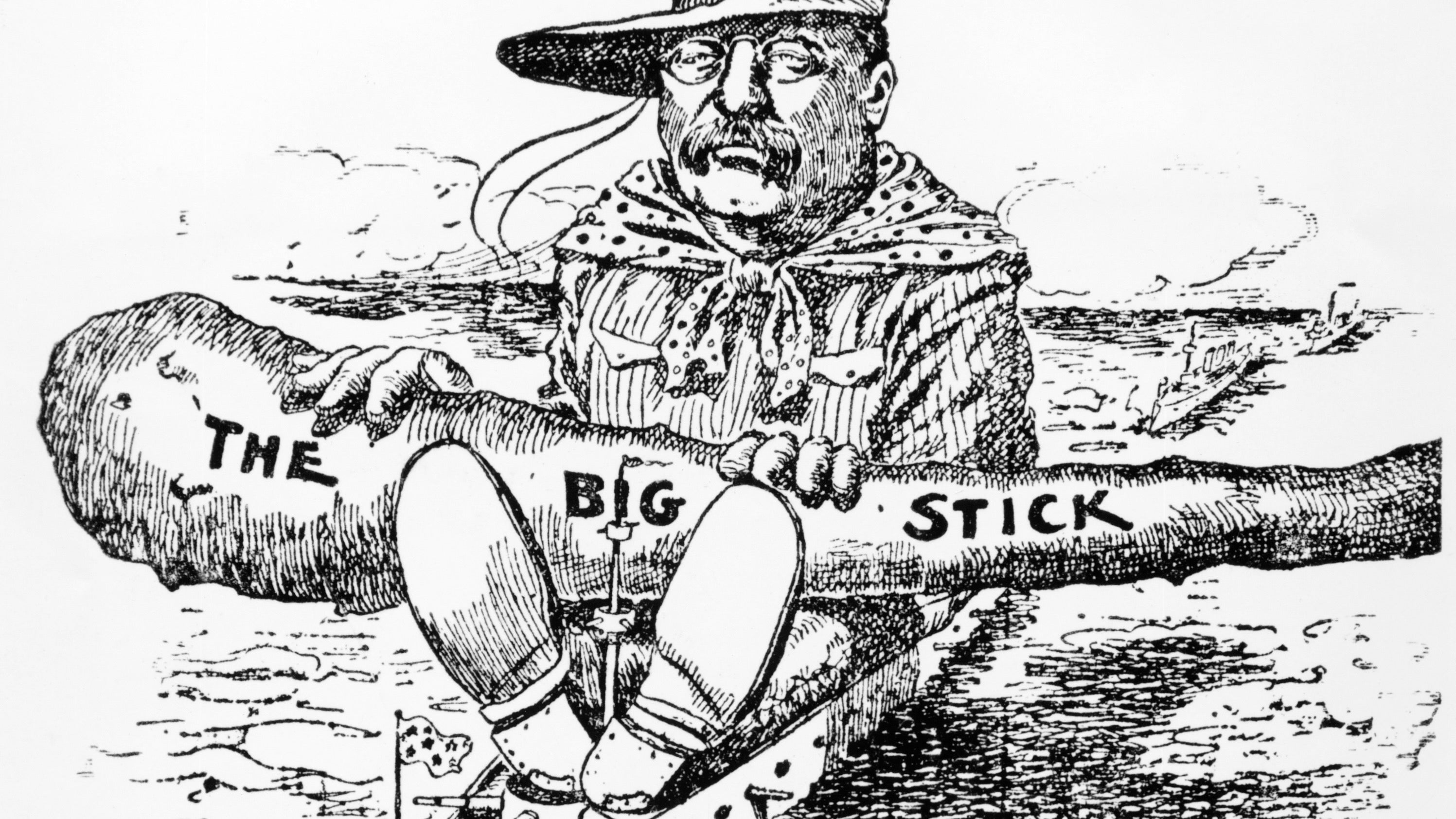
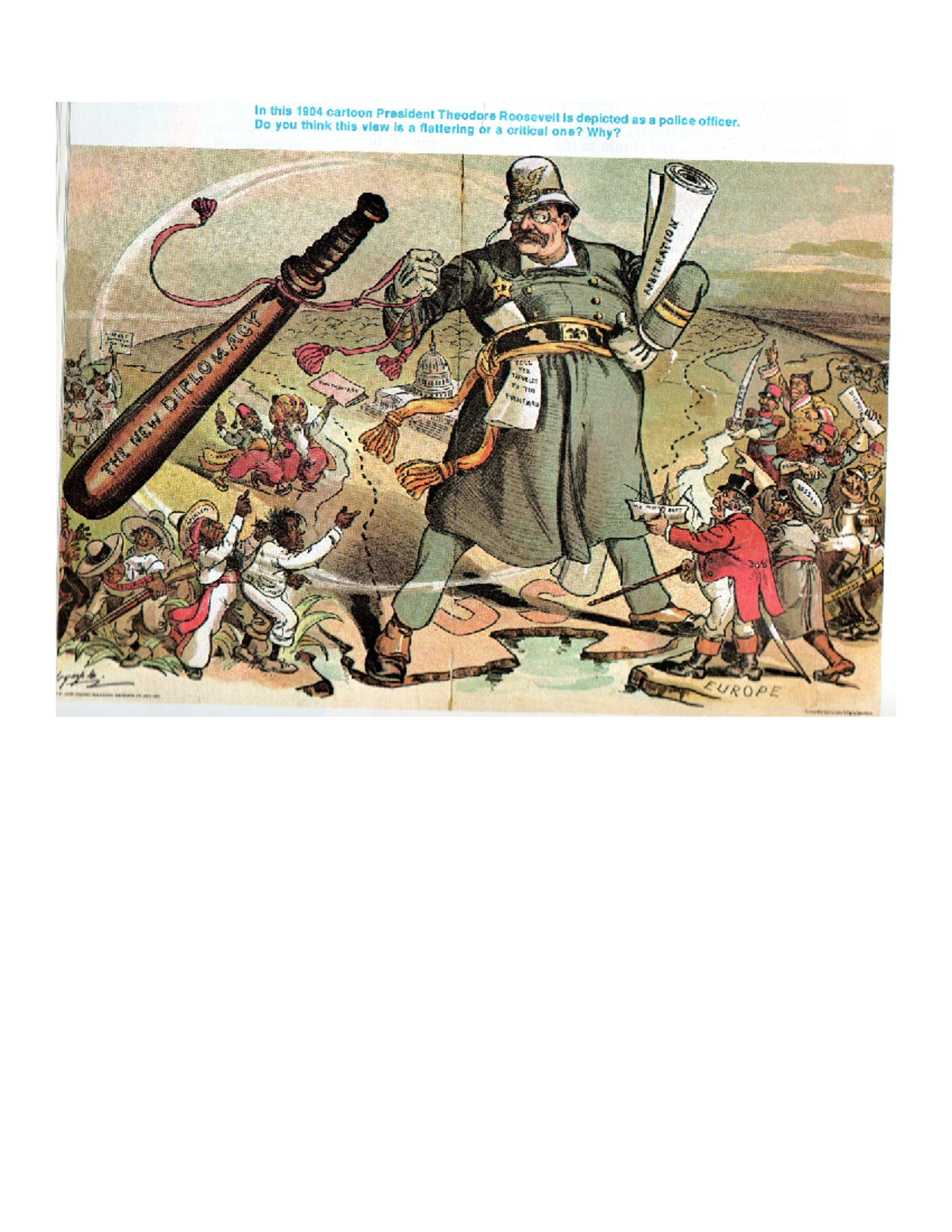
The most famous visual motif associated with Theodore Roosevelt—and by extension his foreign policy—was the "big stick," derived from his famous West African proverb, "Speak softly and carry a big stick, you will go far." In political cartoons, Roosevelt was frequently portrayed as a giant park policeman, a sheriff, or a schoolmaster wielding an enormous club.
In these illustrations, Latin American nations were typically depicted as small, helpless children or stereotyped caricatures cowering before the American enforcer. The visual rhetoric aimed to highlight the extreme asymmetry of power between the United States and its southern neighbors. Cartoonists used the police metaphor both to mock the pretension of acting as a global moral authority and to applaud American strength, depending on the political stance of the publication.
Financial Collectors and Debt Sweepers
Because the Roosevelt Corollary was ostensibly designed to prevent European debt-collection invasions, many cartoons focused heavily on money, ledgers, and brooms. A prime example features Roosevelt sweeping the Caribbean clean of European creditors or brandishing a massive pistol while collecting tariffs at customs houses—most notably in the Dominican Republic, where the U.S. took over financial administration in 1905.
These illustrations emphasized the financial entanglement of the policy. They frequently showed European powers watching jealously from across the Atlantic Ocean while Uncle Sam aggressively balanced the checkbooks of sovereign Latin American republics at gunpoint.
Famous Examples of Early 20th-Century Editorial Art
Several specific cartoons became touchstones for understanding the era, widely anthologized in history textbooks and studied by political scientists.
| Cartoon Title / Description | Primary Publication / Creator | Core Visual Metaphor | Underlying Message |
|---|---|---|---|
| The World's Constable | Judge or Puck (circa 1904-1905) | Theodore Roosevelt walking through the Caribbean with a massive club labeled "The New Diplomacy." | Satirizes the arrogant assumption of the U.S. acting as global judge and jury over smaller nations. |
| The Big Stick in the Caribbean | New York Herald or similar daily | Roosevelt as a naval officer brandishing a club, patrolling waters filled with small, frightened toy boats representing Latin states. | Highlights gunboat diplomacy and the direct military enforcement of financial compliance. |
| Uncle Sam's Imperialism | Anti-Imperialist League publications | Uncle Sam wearing a crown or military uniform, stepping over Monroe Doctrine boundaries. | Critiques the hypocrisy of a formerly anti-colonial nation adopting European-style imperial conquest. |
Analyzing these historical artifacts requires looking beyond surface humor. Illustrators like W.A. Rogers, Louis Dalrymple, and Clifford Berryman used exaggerated body proportions, recognizable national personifications (like Uncle Sam and John Bull), and recognizable geographical props to guide the viewer toward a specific ideological conclusion.
Comparing Pro-Imperialist vs. Anti-Imperialist Artistic Perspectives
Political cartoons addressing the Roosevelt Corollary were deeply polarized, reflecting a fractured American society at the dawn of the American Century.
Pro-imperialist publications championed the corollary as a necessary civilizing mission and a pragmatic defense of the Monroe Doctrine. Their cartoons depicted Roosevelt as a heroic, dynamic figure protecting vulnerable republics from predatory European monarchies. In these frames, American intervention was cast as benevolent protection, bringing financial stability, modern sanitation, and orderly governance to chaotic regions. The underlying worldview assumed that Anglo-Saxon institutions were uniquely suited to manage the affairs of developing nations.
Conversely, anti-imperialist cartoonists—often aligned with the Democratic Party or progressive labor movements—condemned the policy as a betrayal of American democratic ideals. Their artwork focused on the hypocrisy of fighting for liberty at home while subjugating neighbors abroad. These illustrations frequently featured Uncle Sam shedding his traditional rustic garb for the robes of a European emperor or tyrant. They warned that maintaining a standing colonial empire would militarize American society, drain the federal treasury, and entangle the nation in endless foreign quagmires.
Evolution of Interpretation and Educational Value Today
In modern educational settings, analyzing a Roosevelt Corollary political cartoon serves as a foundational exercise in visual literacy and primary source evaluation. Historians do not view these cartoons as objective records of events, but rather as windows into the ideological battles of 2004’s historical centenary and the early 1900s.
When evaluating these images today, students and researchers must ask several critical questions:
- Who is the intended audience of the publication?
- What specific political agenda or financial interests did the newspaper or magazine represent?
- Which cultural stereotypes are being deployed to justify or condemn foreign intervention?
- How does the visual exaggeration alter the historical reality of the diplomatic event?
By dissecting the symbolism—such as the size of Roosevelt relative to foreign leaders, the presence of military hardware versus diplomatic documents, and the expressions on the faces of colonized populations—observers can reconstruct the complex anxieties of an era when the United States first projected its economic and military might onto the global stage.
Frequently Asked Questions
What was the main purpose of a Roosevelt Corollary political cartoon?
These cartoons aimed to simplify, satirize, or champion Theodore Roosevelt’s foreign policy extension. By turning complex diplomatic doctrine and international debt management into relatable visual metaphors—like a policeman with a big stick—cartoonists influenced public debate and shaped how citizens viewed American interventionism.
How did cartoonists typically depict Theodore Roosevelt in these illustrations?
Cartoonists most frequently portrayed Roosevelt as an assertive, hyper-masculine figure, often dressed as a police officer, a park constable, a cowboy, or a naval commander. He was almost always shown wielding physical power, such as a large club, a broom, or a firearm, to emphasize his aggressive approach to international relations.
Were these political cartoons supportive of American imperialism?
It depended entirely on the political leaning of the newspaper or magazine. Pro-expansionist publications praised Roosevelt’s actions as protective and necessary, while anti-imperialist outlets used biting satire to condemn the policy as hypocritical bullying that violated American democratic principles.
What symbols were commonly used to represent Latin American nations?
Latin American countries were frequently depicted as small, helpless children, frightened villagers, or passive observers standing beside dilapidated buildings. Editorial artists utilized these paternalistic and often ethnocentric tropes to justify American intervention by framing local governments as incapable of self-rule.
Why is the "Big Stick" imagery so prevalent in these cartoons?
The imagery stems directly from Theodore Roosevelt’s favorite proverb about walking softly and carrying a big stick. Cartoonists literalized this phrase into giant clubs to visually anchor the concept of gunboat diplomacy, making the threat of military force immediately apparent to readers.
Conclusion and Next Actions
Examining a Roosevelt Corollary political cartoon provides a vivid portal into the ideological struggles of American foreign policy during the early 20th century. To deepen your understanding of this era, examine archived digital collections from historical periodicals like Puck or Judge, cross-reference the cartoons with primary presidential documents from the Theodore Roosevelt Papers at the Library of Congress, and analyze how visual propaganda continues to shape geopolitical debates today.
Image Gallery
Select an image to open it in a new tab.




Simon Caldwell
Enterprise Technology and Systems Editor
