Winnipeg is the capital city of Manitoba because it served as the established administrative, economic, and social heart of the Red River Colony during the mid-19th century. Its strategic location at the confluence of the Red and Assiniboine Rivers made it the natural site for the provisional government that negotiated Manitoba’s entry into Canadian Confederation in 1870.
Determining why a specific city holds capital status requires looking beyond modern logistics to the deep historical, geographical, and political currents that shaped the region. As of 2026, Winnipeg has served as the provincial capital for over 155 years, a role solidified by its origins as a fur trade hub and its later transformation into the "Gateway to the West." To understand why Winnipeg holds this title, one must examine the intersection of Indigenous history, the fur trade rivalry, and the political upheaval of the late 1860s.
The Geographical Imperative: The Confluence of Two Rivers
Long before the concept of a "Manitoba" existed, the site of modern-day Winnipeg was a focal point for human activity. Known as The Forks, the meeting point of the Red and Assiniboine Rivers has been a gathering place for Indigenous peoples—including the Anishinaabe, Cree, Dakota, and Métis—for at least 6,000 years.
Geography dictated that this location would become an administrative center. In a wilderness where rivers were the primary "highways," the confluence was the ultimate crossroads. Any entity that controlled The Forks effectively controlled the flow of trade, communication, and people across the eastern prairies. When European fur traders arrived, they recognized this strategic advantage immediately.
The North West Company established Fort Gibraltar in 1809, while the Hudson’s Bay Company (HBC) eventually countered with Fort Garry. The dominance of these forts meant that by the time the Red River Colony was established by Lord Selkirk in 1812, the area was already the de facto seat of power for the region then known as Rupert’s Land.
The Red River Resistance and the Provisional Government
The most direct political reason Winnipeg is the capital stems from the Red River Resistance of 1869–1870. When the Hudson’s Bay Company prepared to sell Rupert’s Land to the newly formed Dominion of Canada, they did so without consulting the residents of the Red River Settlement, many of whom were Métis.
Under the leadership of Louis Riel, the Métis and other local residents formed a provisional government to protect their land rights, language, and religion. This government was headquartered at Upper Fort Garry, located in the heart of what is now downtown Winnipeg. Because the negotiations for Manitoba’s entry into Confederation were conducted by a government based at this site, it was a foregone conclusion that the resulting province would be governed from the same location.
When the Manitoba Act was passed by the Parliament of Canada in 1870, creating the "postage stamp province," Winnipeg was the only logical choice for the capital. It possessed the only significant concentration of permanent buildings, a rudimentary administrative structure, and the highest population density in the region.

The Manitoba Act of 1870: Legalizing the Capital
The Manitoba Act received Royal Assent on May 12, 1870, and officially came into force on July 15, 1870. This legislation did more than just create a province; it formalized the existing power structures. While the Act itself did not explicitly state "Winnipeg shall be the capital" in the way modern constitutions might, it established the framework for a provincial legislature and a Lieutenant Governor.
The first Lieutenant Governor, Adams George Archibald, arrived in the settlement and took up residence at Upper Fort Garry. The first legislative assembly met in 1871 at the home of A.G.B. Bannatyne, which was also located within the burgeoning townsite of Winnipeg. The legal consolidation of power occurred here because the infrastructure—limited as it was—existed nowhere else in the newly defined provincial boundaries.
Economic Dominance and the "Chicago of the North"
In the decades following Confederation, Winnipeg’s status as capital was reinforced by an unprecedented economic boom. In the late 19th and early 20th centuries, Winnipeg became known as the "Chicago of the North." The city’s growth was driven by its selection as the primary hub for the Canadian Pacific Railway (CPR).
There was a brief period where the town of Selkirk, located further north along the Red River, was considered as a potential main crossing for the transcontinental railway because it was less prone to flooding. However, intense lobbying by Winnipeg businessmen and politicians ensured the CPR crossed at Winnipeg. This decision was a turning point; it guaranteed that Winnipeg would not only remain the political capital but also become the undisputed economic engine of Western Canada.
Between 1881 and 1911, Winnipeg’s population exploded from roughly 8,000 to over 136,000. This growth provided the tax base and the political influence necessary to build the grand public institutions that define a capital city, such as the Manitoba Legislative Building.
Comparison of Early Manitoba Settlements (1870-1885)
The following table illustrates why Winnipeg faced little competition for the role of capital during the province's formative years.
| Settlement | Primary Function | Advantage | Outcome |
|---|---|---|---|
| Winnipeg | Administrative/Trade | Centralized location at The Forks; home to Upper Fort Garry. | Established as the Provincial Capital in 1870. |
| Selkirk | River Port | Higher elevation; originally favored for the CPR crossing. | Remained a secondary regional hub after losing the railway bid. |
| St. Boniface | Religious/Cultural | Heart of the Francophone and Catholic community. | Incorporated into the City of Winnipeg in 1972. |
| Portage la Prairie | Agricultural Trade | Fertile land; gateway to the western plains. | Developed as a major regional city but lacked administrative infrastructure. |
| Brandon | Railway Hub | Strategic location on the CPR line (after 1881). | Became Manitoba's second city; developed too late to be the capital. |
The Symbolic Center: The Manitoba Legislative Building
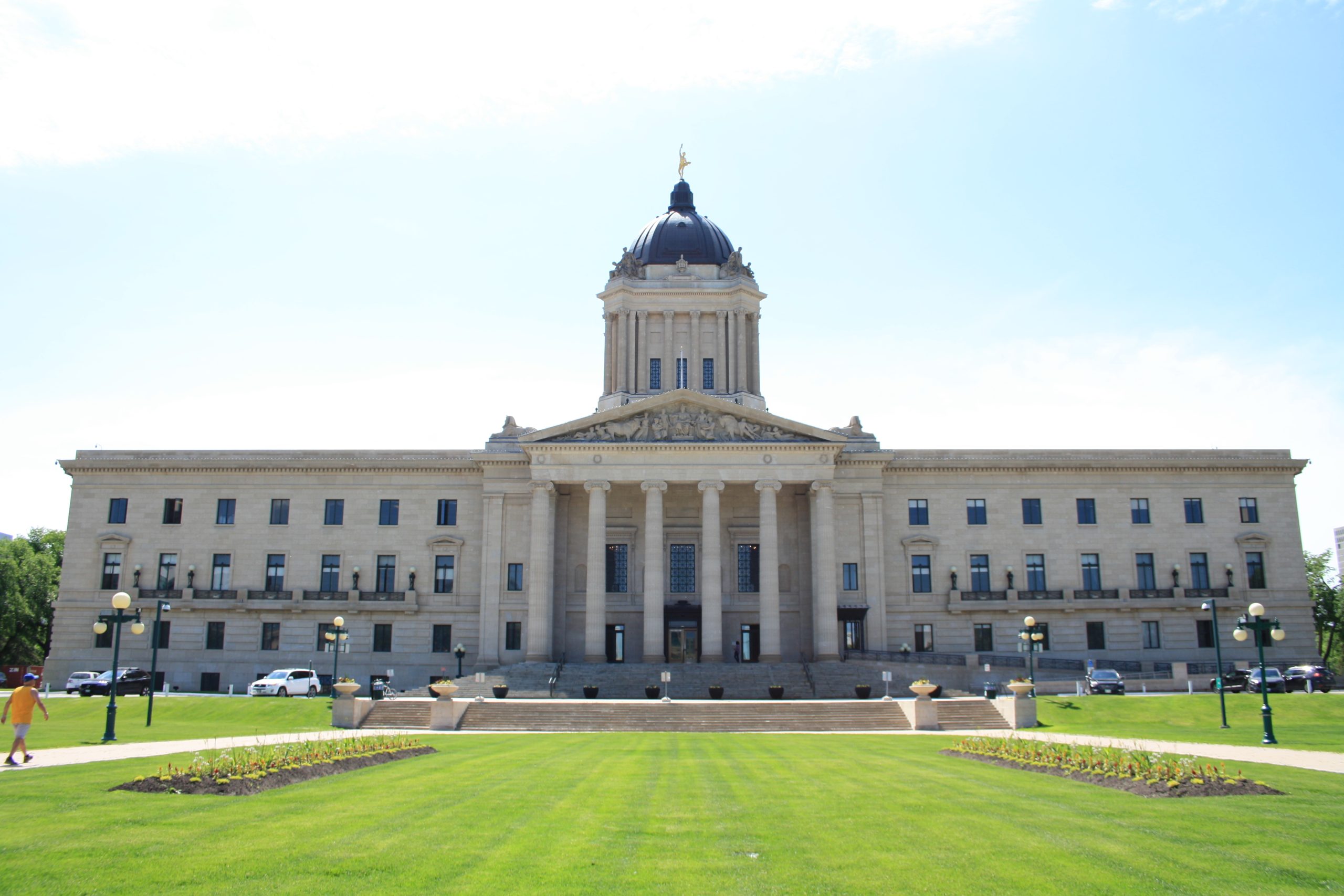
The physical manifestation of Winnipeg’s role as the capital is the Manitoba Legislative Building, completed in 1920. Designed in the Neoclassical style, it was intended to signal that Manitoba was a mature, wealthy, and permanent province.
The building is famous for the Golden Boy, a bronze statue perched atop the dome, facing north. The statue symbolizes Manitoba’s focus on the development of its northern resources and its future potential. The sheer scale of the building—constructed from local Tyndall stone—serves as a permanent anchor for the provincial government. By investing such massive resources into a single site, the provincial government made the cost of ever moving the capital to another city (such as Brandon) prohibitively expensive and politically unpalatable.
Administrative Centralization in the 20th Century
Throughout the 20th century, the centralization of the provincial civil service further cemented Winnipeg’s status. As the role of government expanded to include health care, education, and social services, the provincial bureaucracy grew. Because these departments were headquartered in Winnipeg, the city became the primary employer for thousands of government workers.
The 1972 unification of twelve municipalities into the "Unicity" of Winnipeg also played a role. This merger made Winnipeg one of the most dominant capital cities in Canada in terms of its share of the total provincial population. Today, roughly 60% of all Manitobans live within the Winnipeg Metropolitan Region. This demographic weight makes it impossible to separate the political identity of the province from its capital city.
Historical Challenges to Winnipeg's Dominance
While Winnipeg's status as the capital seems inevitable today, it faced several historical "threats" or alternative paths:
- The Capital of Assiniboia: Before 1870, the region was governed by the Council of Assiniboia. Had the Red River Resistance failed or had Canada annexed the territory differently, the administrative center might have been moved closer to the U.S. border or kept further east at the Lake of the Woods.
- The Selkirk Railway Bid: As mentioned, if the CPR had crossed at Selkirk, the economic heart of the province would have shifted 35 kilometers north. Historically, political capitals often follow economic power; had Selkirk become the metropolis, there likely would have been a movement to relocate the legislature.
- Regionalism: Periodic complaints from western Manitoba (centered in Brandon) regarding "Winnipeg-centric" policies have occasionally sparked theoretical debates about decentralizing government. However, no serious legislative attempt to move the capital has ever gained traction.
Why Winnipeg Remains the Capital in 2026
As of 2026, Winnipeg remains the capital because it successfully transitioned from a fur-trade post to a modern logistical and cultural hub. It serves as the primary link between Eastern Canada and the West, and its diverse economy—spanning aerospace, manufacturing, and financial services—provides the stability required of a provincial seat of power.
The city also hosts the Manitoba Court of Appeal, the University of Manitoba, and the headquarters of major provincial Crown corporations like Manitoba Hydro. This concentration of legal, educational, and corporate power ensures that all paths of provincial governance continue to lead to Winnipeg.
FAQ
Was there ever another capital of Manitoba?
No. Since Manitoba was officially established as a province in 1870, Winnipeg has been its only capital. Before 1870, the region was part of Rupert's Land, which was managed by the Hudson's Bay Company, often from Fort Garry (now Winnipeg).
Who decided that Winnipeg would be the capital?
The decision was effectively made by the residents of the Red River Settlement and the provisional government led by Louis Riel. By negotiating the Manitoba Act from their base at Upper Fort Garry, they established the site as the center of provincial power. The federal government of Canada accepted this by establishing the first provincial institutions there.
Does the Manitoba capital have any unique features?
Yes. The Manitoba Legislative Building is considered one of the finest examples of Neoclassical architecture in North America. It is also famous for its Masonic symbolism and the "Hermetic Code" hidden in its architecture, as well as the Golden Boy statue on its dome.
Why wasn't Brandon chosen as the capital?
Brandon was not established until 1881, more than a decade after Manitoba became a province. By the time Brandon grew into a significant city, Winnipeg already had a fully functioning legislature, court system, and government infrastructure.
Is the capital city also the largest city in Manitoba?
Yes, Winnipeg is significantly larger than any other city in the province. As of 2026, it contains the majority of Manitoba's population, which further solidifies its role as the political and economic center.
Next Actions for Interested Readers
To truly understand why Winnipeg is the capital, a physical or virtual visit to the historical sites is recommended.
- Visit The Forks National Historic Site: Stand at the confluence of the Red and Assiniboine Rivers to see the geographic reason for the city's existence.
- Tour the Manitoba Legislative Building: Available for public tours, this building showcases the political grandeur that cemented Winnipeg’s status in the early 20th century.
- Explore Upper Fort Garry Heritage Provincial Park: This park preserves the remains of the gate of the fort where the provisional government met in 1870.
- Research the Manitoba Act of 1870: Reviewing the original text of the negotiations provides insight into the constitutional birth of the province.
Image Gallery
Select an image to open it in a new tab.

Omar Farooq
EdTech Innovation and Virtual Pedagogy Journalist
