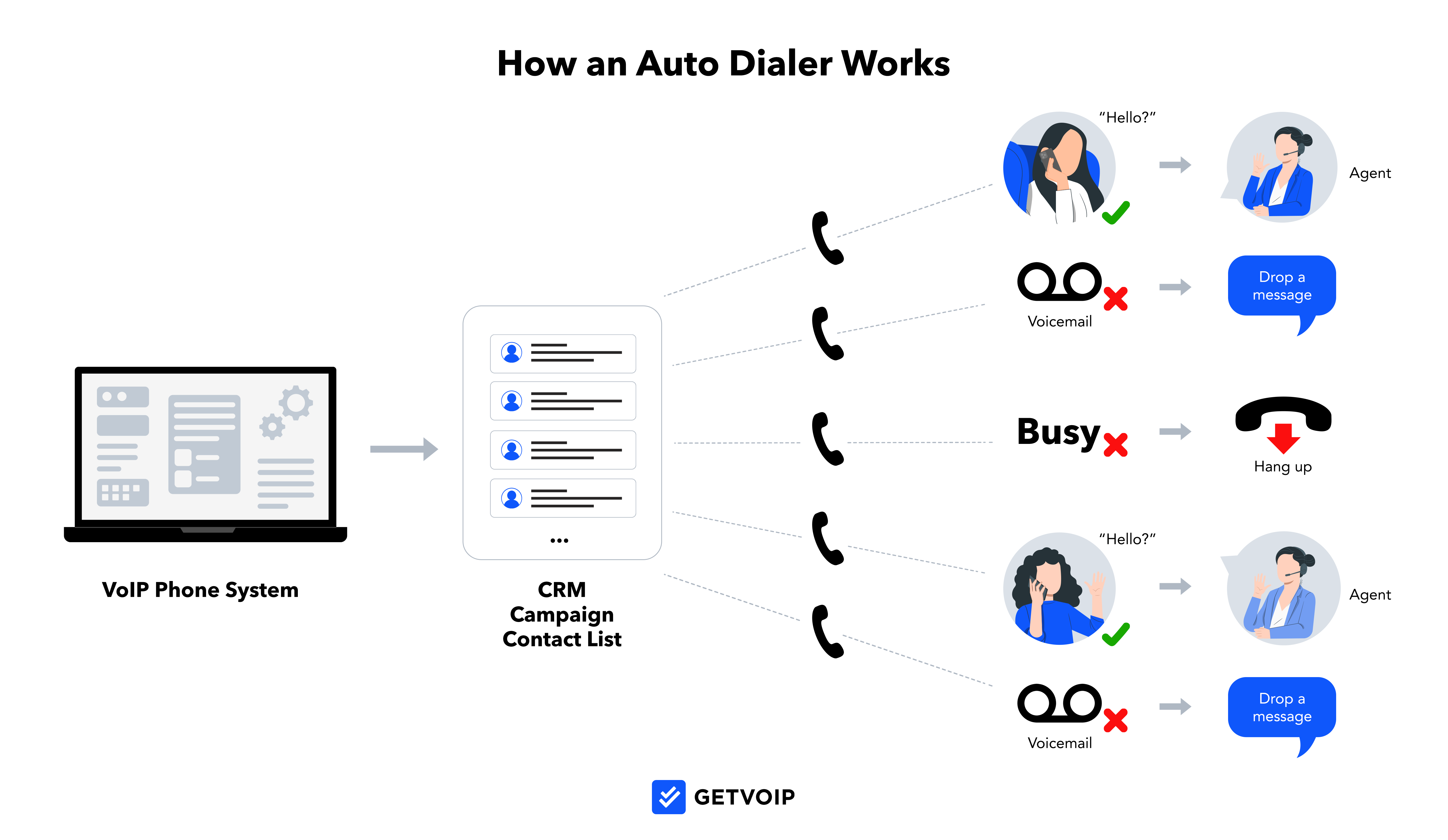
Progressive dialing is an automated outbound calling method where the system dials the next contact on a list only when an agent becomes available to take a call. By maintaining a strict one-to-one ratio between available agents and active calls, it eliminates the risk of "abandoned" or "silent" calls common in more aggressive dialing modes.
Outbound call centers face a constant struggle: maximizing agent productivity without sacrificing the customer experience or violating telemarketing regulations. As we navigate the operational landscape of 2026, the shift toward more personalized, compliant communication has positioned progressive dialing as a vital middle ground between slow manual dialing and high-risk predictive dialing.
This guide provides a comprehensive analysis of progressive dialing mechanics, its strategic advantages, and how it fits into the modern contact center ecosystem.
The Mechanics of Progressive Dialing: How It Works
In a progressive dialing environment, the software acts as an automated gatekeeper. The process begins when an agent finishes their current interaction and completes any necessary "after-call work" (ACW). Once the agent signals their availability through the interface—often referred to as moving into a "Ready" state—the system automatically pulls the next record from the designated lead list and initiates the call.
Unlike predictive dialing, which uses mathematical algorithms to guess when an agent might be free and dials multiple lines simultaneously, a progressive dialer waits for a definitive signal of availability. This 1:1 pacing ensures that if a person answers the phone, there is a live agent immediately ready to speak with them.
The Technical Workflow
- Agent Ready Signal: The agent logs into the system or finishes a call and completes wrap-up notes. The CRM or dialer software detects the "Available" status.
- Record Retrieval: The system retrieves the next prioritized lead based on campaign settings (e.g., time zone, lead score, or previous touchpoints).
- Automatic Initiation: The dialer places the call via SIP (Session Initiation Protocol) or the organization’s telephony infrastructure.
- Live Detection and Connection: The software may use Answering Machine Detection (AMD). If a human answers, the call is instantly connected to the agent. If a machine is detected, the dialer may hang up or leave a pre-recorded message, depending on campaign configuration.
- Data Synchronization: During the call, the dialer pushes the contact's information to the agent's screen (screen pop), allowing for a seamless transition into the conversation.
Progressive Dialing vs. Other Dialing Modes
To understand the value of progressive dialing, it is essential to compare it against the other common automated dialing strategies used in call centers today. Each mode serves a specific purpose depending on lead quality, volume, and compliance requirements.
| Feature | Manual Dialing | Preview Dialing | Progressive Dialing | Predictive Dialing |
|---|---|---|---|---|
| Pacing Control | Entirely Agent-led | Agent reviews before dialing | System dials when agent is free | System dials based on algorithms |
| Calls per Agent | 1:1 (Slow) | 1:1 (Moderate) | 1:1 (Efficient) | Multiple:1 (Aggressive) |
| Abandonment Risk | Zero | Zero | Near Zero | High |
| Primary Benefit | High Personalization | Informed Outreach | Compliance & Efficiency | Maximum Volume |
| Best Use Case | Highly complex B2B | Deep-research sales | Mid-tier leads & CX | Mass market / Low-value leads |
The "Silent Call" Problem
The primary differentiator for progressive dialing is the elimination of the "silent call." In predictive dialing, the system often dials more numbers than there are available agents, betting on the fact that most people won't answer. When more people answer than predicted, the system must drop the call, leading to a period of silence for the recipient before the line goes dead. Progressive dialing removes this variable entirely, protecting the brand's reputation and ensuring compliance with strict "dropped call" percentage limits.

Strategic Benefits of Progressive Dialing in 2026
By 2026, consumer expectations for brand interactions have reached an all-time high. People are increasingly wary of automated spam, and the patience for "dead air" when answering the phone is non-existent. Progressive dialing addresses these challenges directly.
1. Guaranteed Connection and Improved CX
Because an agent is already "on the line" (waiting for the connection), there is no delay between the customer saying "Hello" and the agent responding. This immediate engagement is critical for establishing trust, especially in outbound sales or high-touch customer service. It prevents the recipient from feeling like just another number in a mass-marketing machine.
2. Enhanced Agent Morale and Focus
Predictive dialing can be grueling for agents. It often forces them into a relentless "back-to-back" cycle where calls are pushed to them the millisecond they are free, sometimes even before they have mentally transitioned from the last case. Progressive dialing provides a more controlled rhythm. While it keeps agents busy, it reduces the stress of "waiting for the drop," allowing agents to be more prepared and present during each interaction.
3. Regulatory Compliance (TCPA and Beyond)
Telemarketing regulations, such as the Telephone Consumer Protection Act (TCPA) in the United States and similar laws in the UK (Ofcom) and EU (GDPR), have strict thresholds for abandoned call rates (often capped at 3%). Predictive dialers require constant monitoring and tuning to stay within these limits. Progressive dialers are "compliant by design" because they do not dial unless an agent is ready, virtually guaranteeing an abandonment rate of 0%.
4. Integration with Lead Scoring
In the current era of data-driven marketing, not all leads are equal. Progressive dialing is the preferred choice for "warm" leads or high-priority accounts. When a lead has been nurtured through marketing automation or has a high propensity to buy, the cost of losing that connection due to a predictive dialer error is too high. Progressive dialing ensures that every high-value connection is handled by a live human.
Limitations and Operational Considerations
While progressive dialing offers a balanced approach, it is not without its drawbacks. Organizations must weigh these limitations against their specific campaign goals.
- Agent Idle Time: If a call list has many dead numbers, wrong numbers, or unanswered calls, the agent must sit and wait while the system cycles through these attempts. Unlike predictive dialing, which would dial multiple lines to "hide" this idle time, the progressive dialer keeps the agent occupied with the process of the single dial attempt.
- Lower Overall Volume: For mass-market campaigns where the lead quality is low and the goal is simply to reach as many people as possible, progressive dialing will result in significantly fewer "talk minutes" per hour compared to a predictive dialer.
- Dependency on List Quality: Progressive dialing's efficiency is directly tied to the health of the contact list. If the list is outdated or poorly sourced, agents will spend a significant portion of their day watching the system dial numbers that never answer.
Implementing Progressive Dialing: Best Practices
To successfully deploy progressive dialing in a call center, managers should focus on technical configuration and strategic lead management.
Data Hygiene and List Management
Since progressive dialing is sensitive to unanswered calls, maintaining high data quality is paramount. Use tools to verify phone numbers before they enter the dialer queue. Implementing AI-driven lead scoring can ensure that agents are spending their "one-to-one" time on the prospects most likely to answer and engage.
Integrating with CRM
A progressive dialer should never exist as a silo. It must be deeply integrated with your Customer Relationship Management (CRM) system. When the dialer initiates a call, the CRM should automatically display the contact’s history, previous purchases, and any notes from other departments. This "screen pop" functionality ensures that the time saved by automated dialing is not lost to manual data searching.
Workflow Optimization
Configure your "After-Call Work" (ACW) settings carefully. If agents are given too much time for notes, the dialer remains idle. If they are given too little, note quality suffers. Modern systems allow for "disposition codes"—quick buttons that agents click to categorize the call (e.g., "Interested," "Not Interested," "Wrong Number")—which can automatically trigger the next dial attempt while simultaneously updating the CRM.
Answering Machine Detection (AMD) in 2026
A critical component of progressive dialing efficiency is how the system handles non-human answers. In 2026, AI-powered Answering Machine Detection has become highly sophisticated, distinguishing between a live "Hello" and an automated greeting within milliseconds.
When the dialer detects a machine, it can be programmed to:
- Hang up immediately and move to the next record to save agent time.
- Leave a "human-sounding" voicemail using pre-recorded audio snippets (where legal).
- Bridge the agent only if a live person is confirmed, though this is more common in "Power" dialing variations.
In a pure progressive setup, the agent often hears the ringing and the machine themselves, which provides more context but consumes more time. Finding the right balance for your specific campaign is key to maximizing ROI.
Frequently Asked Questions
Is progressive dialing the same as power dialing?
While the terms are often used interchangeably, there is a subtle difference. A Power Dialer typically dials a pre-set number of lines per available agent (e.g., two lines for one agent) to account for non-answers, whereas a Progressive Dialer strictly maintains a 1:1 ratio. However, in many modern software suites, "Progressive" is simply the setting used to describe a 1:1 automated pacing.
When should I switch from predictive to progressive dialing?
You should consider switching if your abandoned call rate is approaching legal limits (3%), if you are seeing a decline in customer satisfaction scores (CSAT) due to "silent calls," or if you are moving from high-volume "cold" calling to a "warm" lead follow-up model.
Does progressive dialing require specialized hardware?
In 2026, most progressive dialing is handled through Cloud-based Contact Center as a Service (CCaaS) platforms. You generally only need a stable internet connection, a computer, and a high-quality headset. The "dialing" happens on the provider's servers.
Can progressive dialing be used for inbound calls?
Progressive dialing is specifically an outbound technology. However, most modern call centers use "Blended" environments. In a blended setup, the system can automatically pause progressive dialing for an agent if inbound call volume spikes, ensuring that existing customers calling in are prioritized over outbound prospecting.
How does progressive dialing handle "Do Not Call" (DNC) lists?
Top-tier progressive dialing software integrates real-time DNC scrubbing. Before a record is even placed in the "Ready" queue, the system checks it against national and internal DNC registries to ensure compliance, preventing the dialer from ever initiating an illegal call.
Conclusion and Next Steps
Progressive dialing represents a strategic choice for call centers that prioritize quality and compliance over raw, unrefined volume. By automating the dialing process while maintaining a 1:1 agent-to-call ratio, organizations can achieve significant productivity gains over manual dialing without the reputational risks associated with predictive algorithms.
To move forward with progressive dialing:
- Audit your current lead lists: Determine if your contact data is accurate enough to support 1:1 dialing.
- Evaluate your CCaaS provider: Ensure your software supports seamless CRM integration and advanced Answering Machine Detection.
- Monitor Abandonment Rates: Even with progressive dialing, keep a close watch on your analytics to ensure the transition from dial-to-connection is as near-instant as possible.
- Train your agents: Help them understand the rhythm of automated dialing so they can maximize their "Ready" time and utilize screen-pop data effectively.
Image Gallery
Select an image to open it in a new tab.
Ingrid Bjornson
Global Cyber Policy and Regulation Analyst
