
Determining what your net worth should be by age depends on your income, lifestyle, and long-term financial goals. A common 2026 benchmark suggests aiming for a net worth equal to your annual salary by age 30, three times your salary by age 40, and approximately ten times your salary by age 67.
Net worth is the most comprehensive metric for measuring financial health. Unlike income, which only tracks the money flowing in, net worth accounts for what you actually keep and grow. As we navigate the economic landscape of 2026, understanding where you stand relative to your peers and your own retirement needs is essential for long-term security. Whether you are just starting your career or approaching the transition to retirement, these benchmarks provide a roadmap for measuring progress and adjusting your strategy.
Understanding and Calculating Your Net Worth in 2026
Before comparing yourself to averages or medians, you must accurately calculate your current standing. Net worth is a simple equation: Total Assets minus Total Liabilities. However, the nuance lies in how you value those components in today’s market.
Identifying Your Assets
Assets are anything of value that you own. In 2026, these are generally categorized into liquid and non-liquid assets:
- Cash and Equivalents: Savings accounts, checking accounts, and certificates of deposit (CDs).
- Investments: Brokerage accounts, stocks, bonds, and mutual funds.
- Retirement Accounts: 401(k)s, 403(b)s, IRAs, and Roth IRAs.
- Real Estate: The current market value of your primary residence and any investment properties.
- Personal Property: Resale value of vehicles, jewelry, and high-value collectibles.
Identifying Your Liabilities
Liabilities are your financial obligations or debts. To get an accurate net worth, you must include:
- Mortgages: The remaining principal on your home or property loans.
- Student Loans: Federal and private educational debt.
- Consumer Debt: Credit card balances and personal loans.
- Auto Loans: The outstanding balance on vehicle financing.
By subtracting your total liabilities from your total assets, you arrive at your net worth. It is common for young professionals in 2026 to have a negative net worth due to high student loan balances and early-career housing costs; this is often a temporary stage rather than a permanent financial failure.
Factors Influencing Net Worth Benchmarks in 2026
Several macroeconomic factors unique to the mid-2020s influence these benchmarks. Following the inflationary pressures of the early 2020s, the cost of living and asset valuations have shifted.
- Housing Market Trends: For many, the primary residence remains the largest component of net worth. With the stabilization of mortgage rates in 2026, home equity has become a more predictable, albeit slower-growing, asset compared to the volatility of the previous five years.
- Tax Policy Shifts: Following the expiration of many provisions in the Tax Cuts and Jobs Act (TCJA) at the end of 2025, individual tax rates and standard deductions have seen significant changes. This impacts "after-tax" net worth and how people prioritize tax-advantaged retirement accounts.
- The Rise of Side Gains: In 2026, a significant portion of the workforce engages in the gig economy or "solopreneurship." This has changed how net worth is built, with many individuals holding more diversified, business-related assets than previous generations.
- Education Costs: While student loan forgiveness programs have evolved, the "cost of entry" for high-earning careers remains a primary driver for the initial lag in net worth for those under 35.
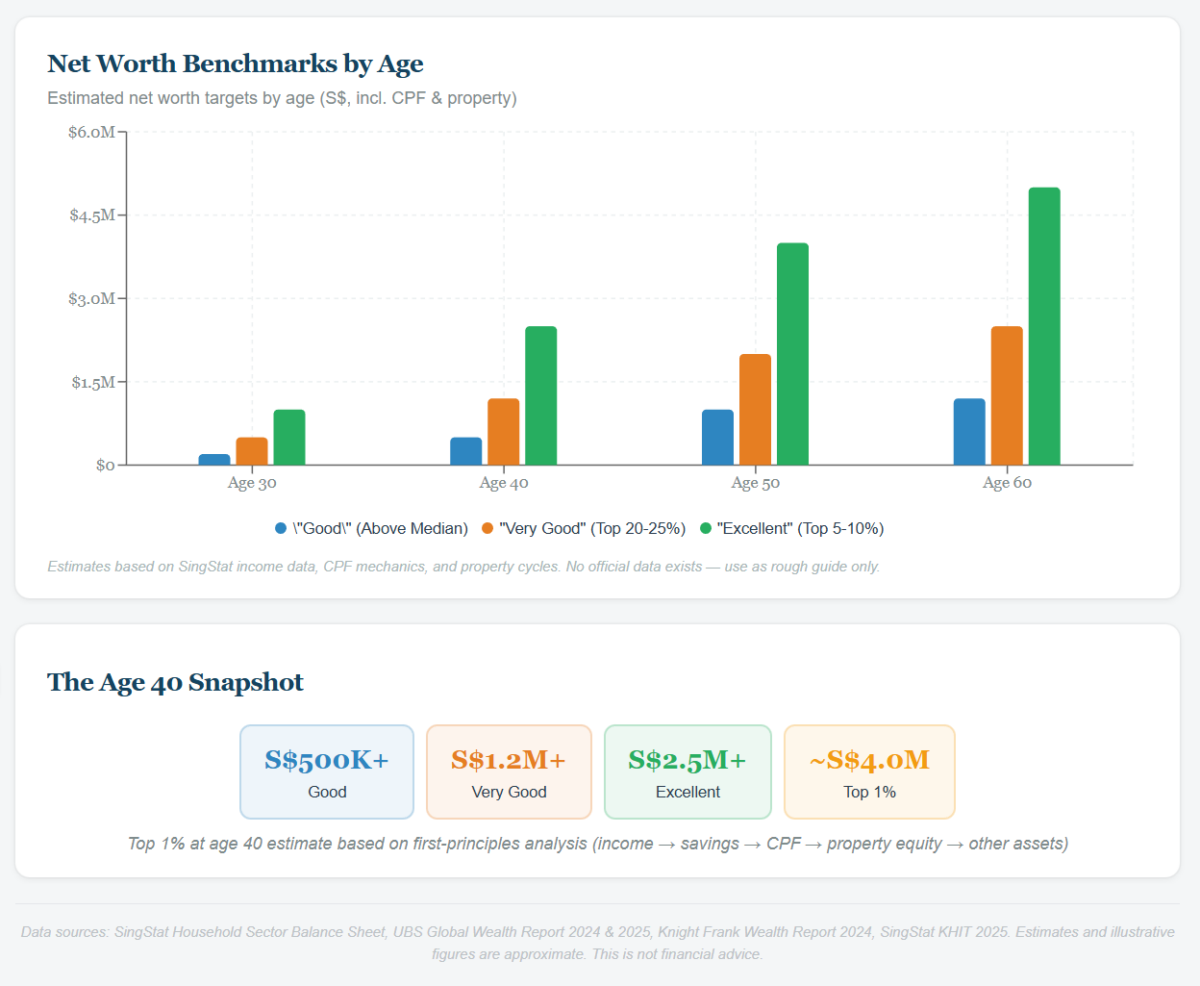
Net Worth Benchmarks by Decade
While individual circumstances vary, the following benchmarks represent a blend of the "Millionaire Next Door" formula and modern retirement planning standards.
The 20s: Establishing the Foundation
In your 20s, the primary goal is often to reach a net worth of zero. This sounds counterintuitive, but for those graduating with debt, "getting back to even" is a major milestone.
- Benchmark: Aim to have at least 25% of your annual salary in total assets by age 25.
- Focus: Establishing an emergency fund (3–6 months of expenses) and contributing enough to a 401(k) to capture any employer match.
- 2026 Context: Many 20-somethings are prioritizing "liquid net worth" to maintain flexibility in a shifting job market.
The 30s: The Accumulation Phase
This is typically the decade of the "one-times-salary" goal. By age 30, having a net worth equal to your annual income is a standard indicator that you are on track for a comfortable retirement.
- Benchmark: 1x your annual salary by 30; 2x by 35.
- Focus: Aggressive debt reduction and increasing retirement contributions. This is often the time when people purchase their first home, shifting some liquid cash into home equity.
- Challenge: The "lifestyle creep" that often accompanies mid-career raises can hinder net worth growth if expenses rise as fast as income.
The 40s: The Peak Earning Years
By 40, the power of compound interest should begin to show its full effect. Your investments should start doing more of the "heavy lifting" than your manual contributions.
- Benchmark: 3x to 4x your annual salary.
- Focus: Diversification. At this stage, ensure your net worth isn't entirely tied up in your home. Stock market exposure through low-cost index funds is critical.
- 2026 Context: Many in their 40s are currently navigating the "sandwich generation" years—supporting children and aging parents—which can slow net worth accumulation.
The 50s: The Pre-Retirement Stretch
In your 50s, the focus shifts toward securing the "finish line." The IRS allows for "catch-up contributions" to retirement accounts, which is vital for those who feel they are behind.
- Benchmark: 6x to 8x your annual salary.
- Focus: Eliminating high-interest debt and potentially paying off the mortgage. This is also the time to estimate your "retirement number" based on projected expenses.
- Technical Tip: Use the Rule of 72 to estimate how long it will take for your current assets to double, helping you project your net worth at age 65.
The 60s and Beyond: Preservation and Distribution
By the time you reach traditional retirement age, your net worth should be sufficient to support a withdrawal rate of roughly 4% annually.
- Benchmark: 10x to 12x your final annual salary.
- Focus: Shifting from growth to preservation. This involves moving a portion of assets into less volatile vehicles like bonds or high-yield fixed-income products.
- Verification: Ensure you are accounting for the "net" in net worth—meaning you've factored in the taxes you will owe when withdrawing from traditional IRAs or 401(k)s.
2026 Net Worth Targets by Age and Income Level
The following table outlines realistic net worth targets for 2026, considering different career stages and the 40th to 50th percentile of American households.
| Age Bracket | Recommended Multiple of Salary | Median Net Worth Target (Est. 2026) | "High Achiever" Target (Top 10%) |
|---|---|---|---|
| 25–29 | 0.25x – 0.5x | $15,000 – $35,000 | $150,000+ |
| 30–34 | 1x | $65,000 – $90,000 | $450,000+ |
| 35–39 | 2x | $120,000 – $160,000 | $800,000+ |
| 40–44 | 3x | $190,000 – $250,000 | $1,200,000+ |
| 45–49 | 4x | $280,000 – $380,000 | $1,800,000+ |
| 50–54 | 6x | $450,000 – $600,000 | $2,500,000+ |
| 55–59 | 8x | $650,000 – $850,000 | $3,800,000+ |
| 60–64 | 10x | $900,000 – $1,200,000 | $5,000,000+ |
Note: These figures include home equity. Liquid net worth (cash and stocks) is typically 40-60% of these totals for most households.
The Thomas J. Stanley Formula (The "Millionaire Next Door" Rule)
A classic method to determine if you are an "Under Accumulator of Wealth" (UAW) or a "Prodigious Accumulator of Wealth" (PAW) is the Stanley formula. While developed years ago, it remains a high-bar benchmark in 2026 for those focused on significant wealth.
The Formula: (Your Age x Your Pre-Tax Annual Household Income from all sources) / 10
- Example: If you are 40 years old and earn $100,000, your target net worth by this formula is $400,000.
- Limitation: This formula is often criticized for being too aggressive for young people (who haven't had time for income to compound) and too lenient for older high-earners.
- 2026 Adjustment: Many financial advisors now suggest using
(Age - 25)for the first part of the equation to account for the time spent in education and early-career debt repayment.
Practical Strategies to Increase Your Net Worth
If you find that your current net worth is below the 2026 benchmarks, several levers can be pulled to accelerate your progress.
1. Optimize Your Asset Allocation
In 2026, holding too much cash can be a risk due to the long-term effects of inflation on purchasing power. Ensure your portfolio is aligned with your risk tolerance. For those under 45, a heavy tilt toward equities remains the historically most effective way to grow net worth. Diversifying into international markets and real estate investment trusts (REITs) can provide stability when domestic markets fluctuate.
2. Radical Debt Management
Not all debt is created equal. In the 2026 interest rate environment, carrying credit card debt (often at 20%+) is a "net worth killer." Prioritize the Debt Avalanche method: pay off the highest interest rate loans first while maintaining minimums on others. Conversely, "good debt," such as a mortgage at a rate lower than the average stock market return, can actually help grow net worth by allowing you to invest your extra cash elsewhere.
3. Automate Your Savings
The most successful wealth builders in 2026 do not save what is left over after spending; they spend what is left over after saving. Use automated transfers to move money into brokerage accounts or high-yield savings the day your paycheck hits. Increasing your savings rate by even 1% each year can have a massive impact over a 20-year horizon.
4. Review Your "Big Three" Expenses
Net worth growth is often limited by the "Big Three": Housing, Transportation, and Food.
- Housing: If your mortgage or rent exceeds 30% of your take-home pay, it becomes difficult to fund investment accounts.
- Transportation: The rapid depreciation of new vehicles is one of the quickest ways to lower your net worth. Buying used or keeping vehicles for 10+ years is a hallmark of high-net-worth individuals.
- Food: With food inflation remaining a factor in 2026, dining out excessively can drain the "seed money" needed for investments.
Common Pitfalls and Misconceptions
Including "Lifestyle Assets"
Many people mistakenly include the purchase price of their cars, furniture, and electronics in their net worth. In reality, these are depreciating assets. For an accurate financial picture, only include assets that are likely to appreciate or can be liquidated for a significant amount (like a primary residence or a rare collection).
Ignoring Inflation
A million-dollar net worth in 2026 does not have the same purchasing power as it did in 2016. When setting your goals, it is crucial to think in terms of "real" value—what that money will actually buy you in the future. Adjust your targets upward periodically to account for the rising cost of goods and services.
Comparing Yourself to the "Top 1%"
Social media often skews our perception of what a "normal" net worth looks like. The median net worth in the United States is significantly lower than the average, as the average is pulled upward by a small number of extremely wealthy individuals. Focus on the median for your age group to get a realistic sense of how you compare to the typical household.
FAQ: Frequently Asked Questions about Net Worth
Should I include my home equity in my net worth?
Yes, your home is a major asset. However, for retirement planning, many advisors suggest calculating your liquid net worth separately. Liquid net worth (cash, stocks, bonds) is what will actually pay your bills in retirement, whereas home equity is "locked away" unless you sell the home or take out a loan against it.
What if I have a negative net worth in my late 20s?
This is increasingly common in 2026 due to the rising costs of professional degrees. A negative net worth is not a permanent state if your "human capital" (earning potential) is high. As long as you have a plan to pay down high-interest debt and are starting to contribute to retirement, your net worth will eventually trend upward as you enter your 30s.
Is the "4% Rule" still valid for net worth planning in 2026?
The 4% rule suggests you can safely withdraw 4% of your portfolio's value in the first year of retirement and adjust for inflation thereafter. While there is debate about whether this should be 3.3% or 4% in the mid-2020s, it remains a solid "back-of-the-envelope" calculation to determine if your net worth is high enough to support your lifestyle without a paycheck.
How often should I calculate my net worth?
Calculating your net worth once or twice a year is sufficient. Monthly tracking can lead to unnecessary stress over market volatility. Annual checks allow you to see the big picture, account for tax season changes, and adjust your budget for the following year.
Does my car count toward my net worth?
Technically, yes, if you use the resale value (not the price you paid). However, because cars lose value so quickly, many conservative financial planners suggest leaving them out of your net worth calculation entirely, or only including them if they are high-value collector items.
Strategic Next Actions
To take control of your financial trajectory, your first step should be to create a comprehensive balance sheet using the categories mentioned above. Once you have your 2026 net worth figure, compare it to the benchmark for your age and income.
If you are ahead of the curve, consider if you can shift your focus toward "tax-location" strategies—putting the right assets in the right accounts (Roth vs. Traditional) to minimize your future tax burden. If you are behind, do not panic. Focus on the two most powerful tools at your disposal: increasing your income through skill acquisition and decreasing your high-interest liabilities. Small, consistent adjustments to your savings rate today will yield exponential results in the years to come.
Image Gallery
Select an image to open it in a new tab.
Ingrid Bjornson
Global Cyber Policy and Regulation Analyst
