What Courses in Supply Chain Management Provide: A Comprehensive Guide to 2026 Curricula
Supply chain management courses provide a comprehensive understanding of the lifecycle of goods, from raw material extraction to final delivery. They equip students with technical skills in logistics, procurement, and data analytics, alongside strategic frameworks for risk mitigation, sustainability, and global network optimization within the complex and digital-first 2026 economic landscape.
The Core Pillars of Supply Chain Education
Modern supply chain management (SCM) courses are designed to transform students into architects of efficiency. In 2026, the curriculum has evolved beyond simple transportation and warehousing to encompass a holistic view of the global value chain. Students are no longer just learning how to move boxes; they are learning how to manage information, finances, and relationships across international borders.
Strategic Procurement and Sourcing
One of the primary components of any SCM course is procurement. This module teaches students how to identify, evaluate, and manage suppliers. However, in the current landscape, this has shifted from "lowest cost" sourcing to "strategic value" sourcing. Courses provide frameworks for assessing supplier risk, understanding geopolitical impacts on lead times, and managing the total cost of ownership (TCO). Students learn how to draft service-level agreements (SLAs) that are resilient to market volatility and how to foster collaborative partnerships rather than adversarial buyer-supplier relationships.
Logistics and Physical Distribution
Logistics remains the backbone of SCM education. This area provides deep dives into transportation modes—sea, air, rail, and road—and the regulatory environments governing them. Education in this sector covers freight forwarding, customs brokerage, and the intricacies of "last-mile" delivery, which has become a critical competitive advantage for e-commerce entities. Courses provide technical knowledge of Warehouse Management Systems (WMS) and the physics of slotting and layout optimization to maximize throughput and minimize labor costs.
Operations and Production Management
Courses provide a foundational understanding of how products are actually made. This includes Lean manufacturing principles, Six Sigma methodologies, and Total Quality Management (TQM). By understanding production scheduling and capacity planning, students learn how to synchronize manufacturing with market demand. This minimizes the "bullwhip effect," where small fluctuations in consumer demand cause massive, costly swings in production and inventory further up the chain.
Technical Proficiencies and Digital Integration
By 2026, the digital divide in supply chain management has closed, and courses now provide intensive training on the technological ecosystem that powers global trade. Proficiency in digital tools is no longer an elective; it is a core requirement of the curriculum.
Enterprise Resource Planning (ERP) Systems
Most accredited SCM programs provide hands-on experience with major ERP platforms such as SAP S/4HANA or Oracle Cloud SCM. These systems are the central nervous system of a corporation. Students learn how to integrate data across finance, sales, and operations, ensuring that a single source of truth exists for the entire organization. Training includes data entry, report generation, and the interpretation of real-time dashboards to make informed operational decisions.
Data Analytics and Predictive Modeling
The ability to interpret "Big Data" is a significant takeaway from modern courses. SCM education provides students with the mathematical and statistical tools needed for demand forecasting and inventory optimization. This often involves learning software like Tableau, Power BI, or specialized Python libraries for supply chain analytics. By mastering these tools, students can move from descriptive analytics (what happened) to predictive analytics (what will happen) and prescriptive analytics (how to make it happen).
Artificial Intelligence and Automation
In 2026, courses provide specific modules on AI-driven supply chain control towers. These modules explain how machine learning algorithms can predict weather disruptions, port strikes, or sudden spikes in consumer interest. Furthermore, students are introduced to the hardware of automation, including Autonomous Mobile Robots (AMRs) used in distribution centers and the software required to orchestrate them. Understanding the ROI and implementation challenges of these technologies is a key learning objective.

Financial Literacy in the Supply Chain
A common misconception is that SCM is purely operational. On the contrary, advanced courses provide significant financial training. The supply chain is essentially a series of financial transactions, and managing it requires a deep understanding of the balance sheet.
Working Capital and Cash-to-Cash Cycle
Courses teach students how inventory levels directly impact a company’s liquidity. By understanding the "Cash-to-Cash" cycle—the time it takes for a dollar spent on raw materials to return as revenue—students learn how to optimize inventory to free up capital for other investments. This financial perspective is crucial for those aspiring to executive roles like Chief Supply Chain Officer (CSCO).
Cost Accounting and Budgeting
Students are taught how to allocate overheads, manage departmental budgets, and perform cost-benefit analyses for major capital expenditures, such as building a new fulfillment center. SCM education provides the skills to present these financial arguments to stakeholders, bridging the gap between the warehouse floor and the boardroom.
Comparison of SCM Educational Paths
Choosing the right course depends on career stage and specific professional goals. The table below outlines the primary types of SCM education available in 2026.
| Course/Credential Type | Primary Focus | Duration | Ideal Candidate |
|---|---|---|---|
| Bachelor’s Degree | Foundational SCM & General Business | 3–4 Years | Entry-level students seeking a broad start. |
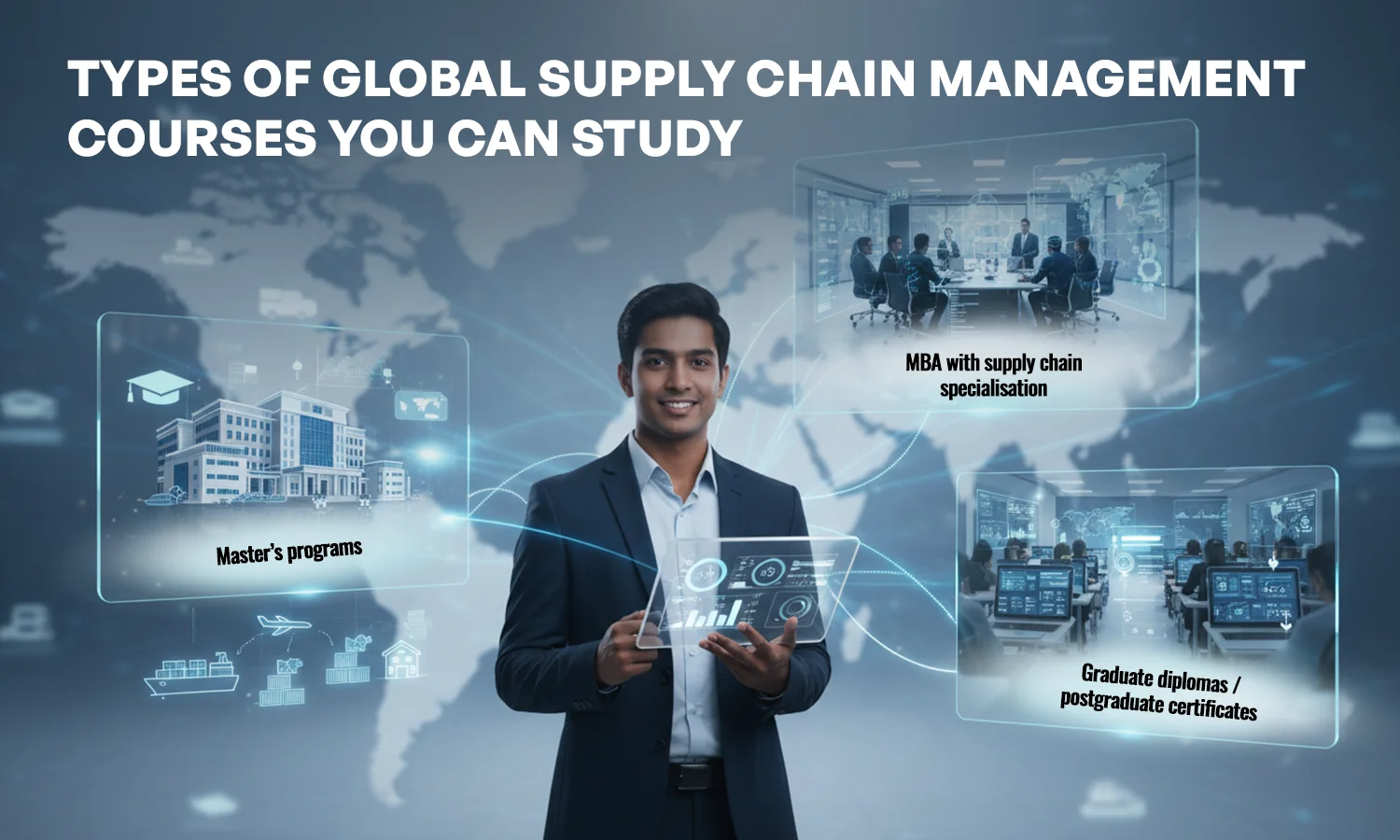
| Master’s (MS or MBA) | Strategy, Leadership, & Global Macro-economics | 1–2 Years | Mid-career professionals moving into management. |
| CSCP (ASCM) | End-to-end global supply chain operations | 6–12 Months | Experienced practitioners seeking certification. |
| CPIM (ASCM) | Internal operations, inventory, & production | 6–12 Months | Production planners and warehouse managers. |
| SCM Micro-credentials | Niche skills like ESG, AI, or Blockchain | 2–4 Months | Professionals needing to upskill in a specific tech. |
Strategic Mindset and Global Risk Management
Supply chains in 2026 operate in a world of "permacrisis." Consequently, SCM courses provide the strategic frameworks necessary to manage volatility and build resilience.
Risk Mitigation and Resilience
Courses now dedicate significant time to Business Continuity Planning (BCP). Students learn how to conduct "stress tests" on supply chains, identifying single points of failure. They are taught strategies such as "multi-sourcing" (having more than one supplier for a critical component) and "near-shoring" (moving production closer to the end consumer) to reduce the impact of global disruptions.
Sustainability and the Circular Economy
The focus on Environmental, Social, and Governance (ESG) criteria has become a cornerstone of SCM education. Courses provide the knowledge required to measure and reduce Scope 3 emissions—the carbon footprint generated by a company’s suppliers and logistics providers. Students learn about the circular economy, where products are designed to be refurbished or recycled, creating a closed-loop system that reduces waste and complies with increasingly stringent global environmental regulations.
Ethics and Human Rights
Global supply chains often touch regions with varying labor standards. SCM courses provide training on ethical sourcing and corporate social responsibility (CSR). This includes learning how to conduct social audits to ensure that no forced labor or unethical practices are present in the lower tiers of the supply chain. This knowledge is essential for protecting a brand’s reputation and ensuring compliance with international laws like the UN Guiding Principles on Business and Human Rights.
Soft Skills and Leadership Development
Technical knowledge is only half of the equation. Supply chain management is a "people business" that requires intense collaboration between different departments and external partners.
- Negotiation Skills: Courses provide simulated environments where students practice negotiating contracts, balancing price, quality, and lead times.
- Conflict Resolution: Managing a supply chain often involves mediating between conflicting interests—for example, sales wanting high inventory for customer service while finance wants low inventory for cash flow.
- Project Management: Implementing a new software system or opening a new facility requires robust project management skills. Courses often provide training in Agile or PMP methodologies.
- Cross-Functional Leadership: Students learn how to speak the languages of marketing, finance, and engineering, allowing them to lead integrated business planning (IBP) processes.
Career Outcomes and Market Value
Completing a course in supply chain management provides a clear path to a variety of high-demand roles. In 2026, the demand for SCM professionals continues to outstrip supply, leading to competitive salaries and rapid career progression.
Graduates often start as Supply Chain Analysts or Logistics Coordinators, focusing on data and day-to-day operations. With experience and the strategic skills provided by advanced courses, they can move into roles such as Procurement Manager, Operations Director, or Sustainability Lead.
According to the Association for Supply Chain Management (ASCM), professionals with at least one certification earn significantly more than their non-certified peers. The specialized knowledge provided by these courses serves as a "trust signal" to employers that the individual understands the complexities of 2026 commerce.
Frequently Asked Questions
Do I need a background in math for a supply chain management course?
While you don't need to be a mathematician, a comfortable grasp of basic statistics and algebra is highly beneficial. SCM courses provide the specific mathematical frameworks used in the industry—such as probability for demand forecasting and optimization models for logistics—and they often include tutorials on how to use software to perform these calculations.
Is an SCM certification better than a full degree?
It depends on your career stage. A Bachelor’s or Master’s degree provides a broad business foundation and is often required for entry-level corporate roles or upper-tier management. Certifications like the Certified Supply Chain Professional (CSCP) are highly valued for mid-career professionals looking to validate their expertise and specialize in end-to-end global operations.
How much focus is there on coding and IT in these courses?
In 2026, there is a significant focus on "digital literacy." While most courses won't require you to be a software developer, they do provide training in data manipulation (often using SQL or Python) and advanced Excel. Understanding how software systems integrate is a core learning objective.
Can I specialize in a specific industry, like pharmaceuticals or fashion?
Yes. Many advanced SCM courses provide "electives" or specialized tracks. For example, a pharmaceutical track would focus on "cold chain" logistics and stringent regulatory compliance, while a fashion track might focus on rapid product lifecycles and ethical sourcing in the garment industry.
What is the most difficult part of an SCM course?
Most students find the integration of disparate concepts the most challenging. You must learn to see how a small change in a supplier's contract in Asia can ripple through to the delivery experience of a customer in London. Mastering this "systems thinking" is the primary goal of the education.
Final Recommendation for Prospective Students
If you are looking to enter or advance in the field of supply chain management in 2026, prioritize courses that offer a balanced mix of strategic theory and technical application. Look for programs that provide hands-on experience with ERP software and emphasize data analytics. For those already in the workforce, a specialized certification from a recognized body like the Institute for Supply Management (ISM) or ASCM can provide an immediate boost in both knowledge and earning potential. The most successful professionals are those who commit to "lifelong learning," as the technologies and global dynamics of the supply chain continue to evolve at a rapid pace.
Image Gallery
Select an image to open it in a new tab.
Declan O'Connor
Higher Education and Campus Culture Reporter
