Understanding Life Insurance Taxed as Imputed Income: Rules, Calculations, and Employer-Provided Policies

When an employer provides group-term life insurance exceeding $50,000 in coverage, the Internal Revenue Service (IRS) considers the cost of the excess coverage as taxable compensation, which is reported and taxed as imputed income. This value is added to an employee's gross income, meaning the employee must pay income and payroll taxes on a benefit they receive rather than direct cash wages.
What is Group-Term Life Insurance and Imputed Income?
Group-term life insurance is a common employee benefit offered by corporations, non-profits, and government agencies. It provides a death benefit to designated beneficiaries if an employee passes away while actively employed. Under Section 79 of the Internal Revenue Code, employers can provide up to $50,000 of group-term life insurance coverage to employees on a tax-free basis. This means the premiums paid by the employer for the first $50,000 of coverage do not generate any tax liability for the worker.
However, when an employer provides a policy with a death benefit greater than $50,000, the tax laws shift. The IRS treats the economic value of the coverage above that $50,000 threshold as a form of non-cash compensation. This non-cash benefit is known as imputed income. Because the employee receives an economic benefit—namely, peace of mind and financial security for their beneficiaries without paying out-of-pocket premiums—the government requires that value to be treated as if it were paid to the employee in cash and subsequently taxed.
Imputed income does not apply to all forms of life insurance. It specifically targets employer-provided group-term policies. Individually owned term or permanent life insurance policies purchased directly by an employee using their own after-tax dollars do not trigger imputed income, regardless of the face value. Similarly, if an employee pays the entire premium for group-term life insurance out of after-tax salary deductions, no imputed income arises because the employee is absorbing the full cost.
IRS Section 79 and the $50,000 Exclusion Threshold
Internal Revenue Code Section 79 governs the tax treatment of group-term life insurance. The statute was designed to encourage employers to offer basic life insurance protection to their workforce while ensuring that highly compensated individuals do not receive excessive tax-free fringe benefits.
The $50,000 exclusion limit has remained a fixed statutory benchmark for decades. It applies per employee, not per policy. If an employee is covered under multiple group-term life insurance plans sponsored by the same employer or related employers, the face values must be aggregated to determine whether the total exceeds $50,000.
Treatment of Spouses and Dependents
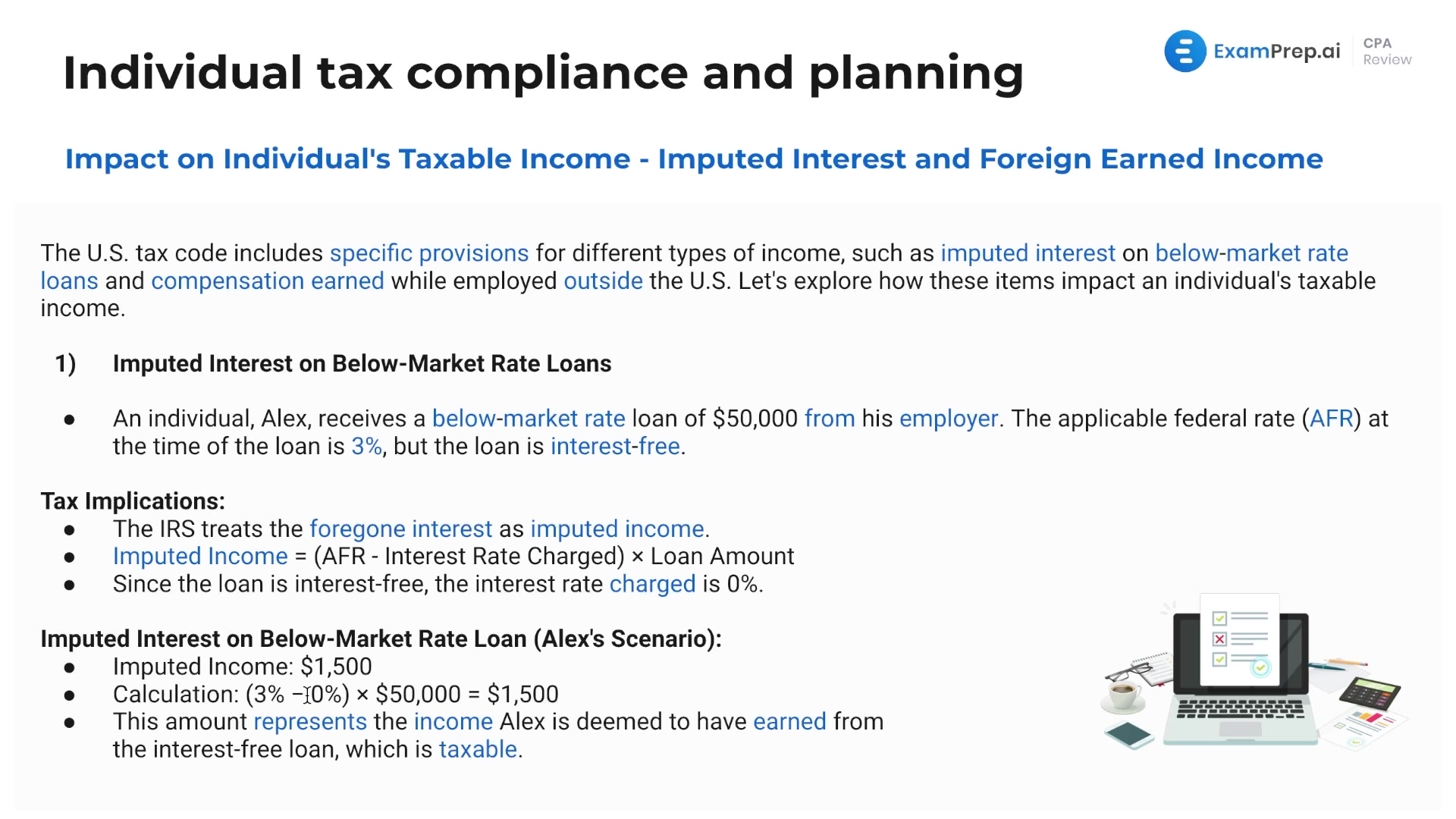
Many group life insurance plans allow employees to purchase optional coverage for spouses and children. Under IRS rules, if an employer provides group-term life insurance on the life of an employee’s spouse or dependent, and the face amount of that coverage does not exceed $2,000, it is considered a "de minimis" fringe benefit and is excluded from income.
However, if an employer-provided policy gives a spouse or dependent coverage exceeding $2,000, the entire cost of that dependent coverage is generally treated as imputed income to the employee, without the benefit of a $50,000 threshold. This is a crucial distinction that often catches employees off guard during tax season.
How Table 1 Rates Determine the Cost of Excess Coverage
To calculate the imputed income for coverage exceeding $50,000, employers cannot simply use the actual premium paid to the insurance carrier. Instead, the IRS mandates the use of a uniform cost table known as Table 1, found in Treasury Regulation Section 1.79-3(d)(2). Table 1 establishes monthly cost rates per $1,000 of protection based on the employee's age at the end of the tax year.
The Table 1 rates increase progressively as an employee ages, reflecting the higher statistical cost of mortality.
| Age Group | Cost per $1,000 of Protection (Per Month) |
|---|---|
| Under 25 | $0.05 |
| 25 to 29 | $0.06 |
| 30 to 34 | $0.08 |
| 35 to 39 | $0.09 |
| 40 to 44 | $0.10 |
| 45 to 49 | $0.15 |
| 50 to 54 | $0.23 |
| 55 to 59 | $0.43 |
| 60 to 64 | $0.66 |
| 65 to 69 | $1.27 |
| 70 and older | $2.06 |
These rates represent the monthly cost for each $1,000 of group-term life insurance that exceeds the $50,000 statutory limit. It is important to note that if an employee turns a specific age during the calendar year, their Table 1 rate for the entire year is determined by their age on the last day of that tax year.
Step-by-Step Calculation of Imputed Income
Calculating life insurance imputed income requires a straightforward mathematical formula. Employers typically automate this calculation through payroll software, but understanding the underlying math helps employees verify their W-2 forms and anticipate tax liabilities.
Step 1: Determine Total Coverage and Excess Amount
Subtract $50,000 from the total face value of the employer-provided group-term life insurance policy. $$\text{Excess Coverage} = \text{Total Policy Value} - $50,000$$
Step 2: Calculate the Number of Thousands
Divide the excess coverage amount by 1,000. $$\text{Thousands of Excess Coverage} = \frac{\text{Excess Coverage}}{1,000}$$
Step 3: Apply the Table 1 Rate
Multiply the number of thousands by the appropriate monthly Table 1 rate corresponding to the employee's age. $$\text{Monthly Imputed Income} = \text{Thousands of Excess Coverage} \times \text{Table 1 Rate}$$
Step 4: Annualize the Figure
Multiply the monthly figure by 12 (or the number of months the coverage was active during the year) to find the annual imputed income amount. $$\text{Annual Imputed Income} = \text{Monthly Imputed Income} \times 12$$
Step 5: Subtract Employee Contributions
If the employee pays any portion of the premium for the excess coverage using after-tax dollars, that amount can be subtracted from the calculated imputed income. Premiums paid with pre-tax dollars (such as through a Section 125 cafeteria plan) cannot be deducted from this calculation.
Practical Example of Imputed Income Calculation
Consider a scenario where an employee is 48 years old and receives a group-term life insurance policy from their employer worth $150,000. The employer pays the entire premium, and the employee makes no out-of-pocket contributions.
Calculate Excess Coverage: $$$150,000 - $50,000 = $100,000 \text{ in excess coverage.}$$
Calculate Thousands: $$\frac{$100,000}{1,000} = 100 \text{ units of coverage.}$$
Identify Table 1 Rate: For an age of 48, the monthly Table 1 rate is $0.15 per $1,000.
Calculate Monthly Imputed Income: $$100 \text{ units} \times $0.15 = $15.00 \text{ per month.}$$
Calculate Annual Imputed Income: $$$15.00 \times 12 \text{ months} = $180.00 \text{ per year.}$$
In this example, $180.00 will be added to the employee's taxable gross income for the year. This amount is reported on the employee's Form W-2, typically in Box 1 (as taxable wages) and designated with code "C" in Box 12 for informational purposes.
Tax Implications and Payroll Withholding
Even though imputed income does not represent cash paid directly to the worker, it is subject to standard payroll withholding requirements.
Federal Income and Payroll Taxes
The imputed income amount is added to the employee’s gross wages on each pay period or reconciled annually. Consequently, it is subject to:
- Federal income tax withholding based on the employee’s Form W-4 elections.
- Social Security tax (6.2% up to the annual wage base limit).
- Medicare tax (1.45%, plus any applicable Additional Medicare Tax for high earners).
State and Local Taxes
In most jurisdictions, state and local income tax authorities follow federal guidelines regarding group-term life insurance. Therefore, imputed income is typically added to state taxable wages as well, resulting in state income tax withholding.
Impact on Paychecks
Because imputed income increases taxable wages without increasing the cash distributed to the employee, it can slightly reduce the net take-home pay on the affected paychecks. Employers manage this by adjusting withholdings across regular cash wages to cover the tax liability generated by the non-cash benefit.
Exceptions and Special Rules
Certain situations alter how group-term life insurance and imputed income are handled under tax law:
- Disabled Employees: If an employee has terminated employment due to a medically determined disability, they are entirely exempt from imputed income on employer-provided group-term life insurance, regardless of the policy amount.
- Charitable Beneficiaries: If the employer or a designated tax-exempt charity is the sole beneficiary of the group-term life insurance policy for the entire period of the tax year, imputed income does not apply.
- Qualified Retirement Plans: Group life insurance provided through qualified pension, profit-sharing, or stock bonus plans follows separate taxation rules under Section 72 rather than Section 79.
- Key Employee Discrimination Rules: If a group-term life insurance plan discriminates in favor of key employees regarding eligibility or benefits, the key employees lose the benefit of the $50,000 exclusion. Instead, they must include in income the actual cost of the insurance or the Table 1 cost, whichever is greater.
Frequently Asked Questions
Does imputed income mean I have to pay taxes twice on my life insurance?
No. Imputed income taxes the economic value of the employer-paid coverage while you are alive. When the death benefit is eventually paid out to your beneficiaries upon your passing, life insurance death benefits are generally received income tax-free under Internal Revenue Code Section 101(a).
Can I decline employer-provided life insurance to avoid imputed income?
In many standard benefit plans, employers provide a baseline coverage level (e.g., one or two times salary) automatically as a mandatory condition of employment. If the resulting coverage exceeds $50,000 and cannot be waived, the imputed income cannot be avoided. If elective supplemental coverage pushes you over the limit, you can often reduce your election during open enrollment.
Where do I find life insurance imputed income on my W-2 form?
Imputed income for group-term life insurance exceeding $50,000 is included in Box 1 (Wages, tips, other compensation), Box 3 (Social Security wages), and Box 5 (Medicare wages). It is also reported separately in Box 12 using Code C for tracking and informational purposes.
Are domestic partners subject to the same rules as spouses for group life insurance?
Federal tax law historically limited the tax-free exclusion for spousal coverage to legally recognized spouses. If an employer provides coverage for a domestic partner, the entire cost of that coverage is typically treated as imputed income to the employee, as domestic partners do not automatically qualify for the same federal tax exemptions as legal spouses unless they meet specific IRS dependency tests.
Next Steps and Professional Guidance
If you notice an unfamiliar wage adjustment on your paystub or see Code C on your Form W-2, review your employer’s group-term life insurance policy limits. Verify whether your total coverage exceeds the $50,000 threshold and check whether you are paying any premiums with pre-tax versus after-tax dollars. Because tax laws regarding fringe benefits and payroll withholding involve intricate statutory thresholds, consult a qualified certified public accountant (CPA) or tax professional for personalized advice tailored to your specific financial situation.
Image Gallery
Select an image to open it in a new tab.


Celine Dubois
Contemporary Living and Global Arts Columnist
