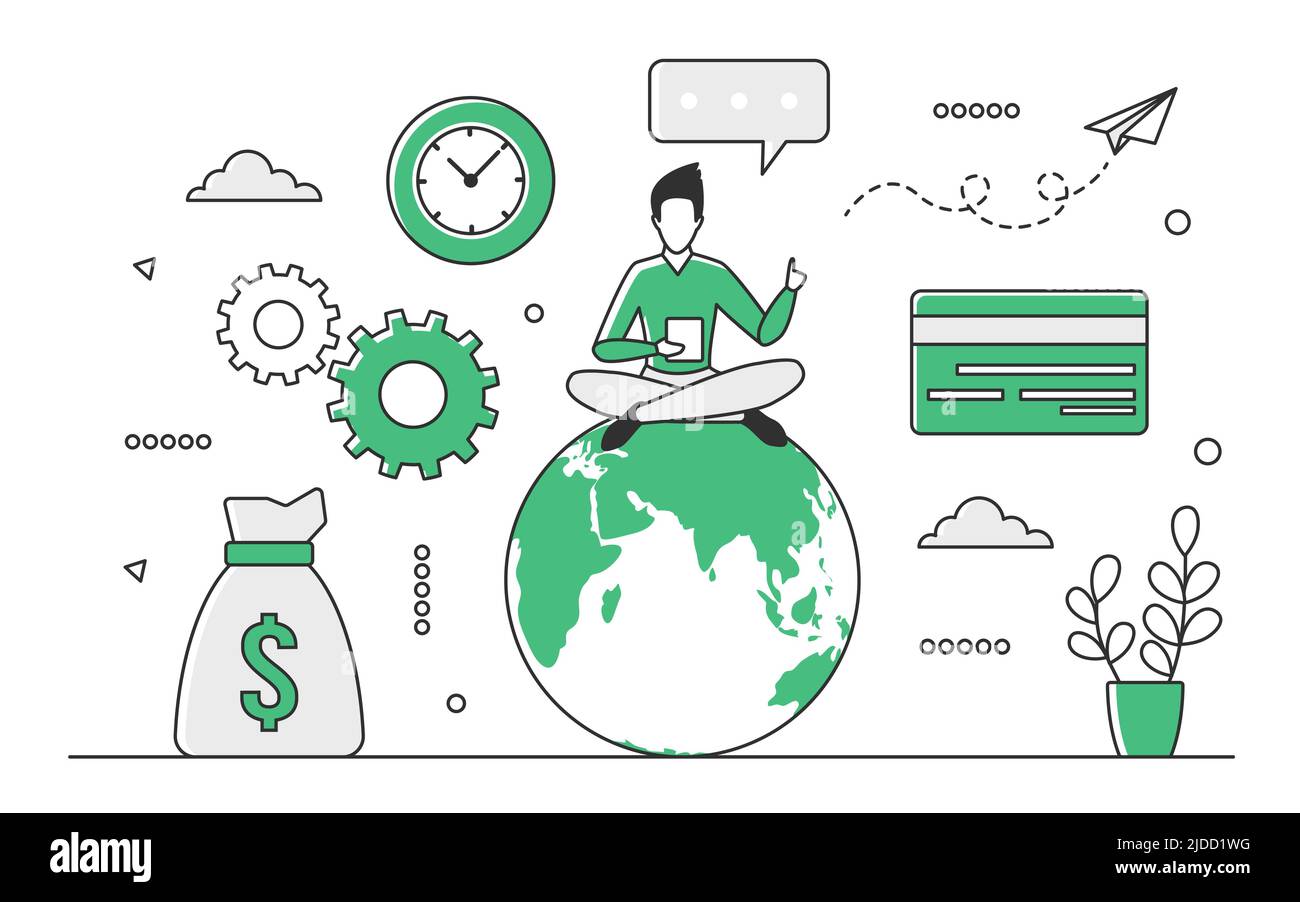
The circulation of money in the economy refers to the continuous movement of currency and credit between households, businesses, financial institutions, and the government. This process, often visualized through the Circular Flow of Income model, dictates how production generates income, which in turn fuels consumption and further investment, sustaining overall economic growth.
Understanding how money moves through an economy is more than an academic exercise; it is the foundation of financial literacy and macroeconomic policy. In 2026, as the global economy navigates a landscape defined by digital currencies, shifting supply chains, and evolving fiscal mandates, the "speed" and "direction" of money flow have become primary indicators of national health. Whether you are an investor, a business owner, or a policymaker, grasping the mechanics of monetary circulation allows you to anticipate inflationary trends, interest rate shifts, and market cycles.
The Core Model: The Circular Flow of Income
At its most basic level, the economy functions as a closed loop consisting of two primary actors: households and firms. This relationship is mediated through two distinct markets: the resource (factor) market and the product market.
Households and Firms
Households are the owners of the factors of production—labor, land, capital, and entrepreneurship. They provide these factors to firms through the resource market. In exchange, firms pay households income in the forms of wages, rent, interest, and profit.
Firms take these resources and transform them into goods and services. These products are then sold back to households in the product market. The money that households received as income flows back to the firms as consumption expenditure. This simple loop demonstrates that, in a perfect vacuum, the value of production equals the value of income, which equals the value of spending.
Product and Factor Markets
The Product Market is where finished goods and services are exchanged. When you buy a laptop or a meal, you are participating in the product market. The Factor Market (or Resource Market) is where the "ingredients" of production are traded. When you go to work, you are selling your labor in the factor market. The circulation of money is essentially the "blood" that carries value between these two markets, ensuring that resources are allocated where they are most demanded.
Expanding the Circle: Injections and Leakages
In a real-world economy, the circular flow is rarely a perfect, closed loop. Money often "leaks" out of the primary flow between households and firms, and it is frequently "injected" back in from external sources. The balance between these leakages and injections determines whether an economy is expanding or contracting.
Understanding Leakages
Leakages are uses of income that do not immediately flow back to domestic firms through the purchase of goods and services. There are three primary leakages:
- Savings (S): When households set aside money in banks or under mattresses, that money is removed from immediate consumption.
- Taxes (T): Payments made to the government reduce the disposable income available for households to spend.
- Imports (M): When consumers buy goods produced in other countries, the money leaves the domestic circular flow and enters the economy of another nation.
Understanding Injections
Injections are additions to the circular flow that do not originate from household consumption. There are three primary injections:
- Investment (I): When businesses buy capital goods (like machinery or software) or when the financial sector lends saved money back to firms, it injects capital into the system.
- Government Spending (G): Public expenditure on infrastructure, defense, and social services pumps money back into the hands of firms and households.
- Exports (X): When foreign entities buy domestically produced goods, "new" money enters the domestic circular flow from abroad.
The equilibrium of an economy is often expressed by the formula: S + T + M = I + G + X. If injections exceed leakages, the economy grows; if leakages exceed injections, the economy shrinks.

The Role of the Financial Sector as an Intermediary
Financial institutions—banks, credit unions, and investment firms—act as the "pumps" in the circulatory system. They do not merely hold money; they facilitate its movement from those who have an excess (savers) to those who have a need for capital (borrowers).
Maturity Transformation and Liquidity
Banks perform a vital function known as maturity transformation. They take short-term deposits (money you can withdraw at any time) and turn them into long-term loans (like 30-year mortgages or 5-year business loans). This process ensures that "idle" money is put to work, funding the expansion of businesses and the purchase of homes, which stimulates the product market.
The Fractional Reserve System
In 2026, the fractional reserve banking system remains the primary driver of money creation. Banks are required to keep only a small fraction of their deposits in reserve and can lend out the rest. This creates a money multiplier effect. When a bank lends money, that loan typically ends up as a deposit in another bank, which then lends out a portion of that deposit. This cycle effectively increases the total money supply in circulation, providing the liquidity necessary for a growing economy.
The Velocity of Money: Why Speed Matters
The "circulation" of money isn't just about the volume of currency; it is also about the frequency with which it changes hands. This is known as the Velocity of Money.
The velocity of money (V) is calculated by dividing the Gross Domestic Product (GDP) by the money supply (M). The formula MV = PQ (where P is the price level and Q is the quantity of goods/services) illustrates that if the money supply remains constant but people start spending faster, the total economic output (or prices) must rise.
Factors Influencing Velocity
- Consumer Confidence: When people feel secure in their jobs, they spend money more quickly. Low confidence leads to "hoarding," which slows velocity.
- Interest Rates: High interest rates encourage saving, which can slow the velocity of money. Conversely, low rates make borrowing and spending more attractive.
- Technology: In 2026, instant payment systems and blockchain-based settlements have reduced the "float" time—the period where money is in transit but not yet available to the receiver. This technological shift has structurally increased the potential velocity of money compared to previous decades.
Comparison of Economic Injections and Leakages
The following table summarizes how different actions affect the circulation of money within a domestic economy.
| Component | Type | Definition | Impact on Circulation | 2026 Context |
|---|---|---|---|---|
| Savings | Leakage | Income not spent on current consumption. | Reduces immediate demand; provides loanable funds. | Higher digital "micro-savings" via apps. |
| Taxes | Leakage | Compulsory contributions to state revenue. | Decreases household and business purchasing power. | Focused on funding green energy transitions. |
| Imports | Leakage | Purchase of goods/services from abroad. | Redirects capital to foreign markets. | Impacted by "near-shoring" supply chain shifts. |
| Investment | Injection | Business spending on capital and equipment. | Increases future production capacity. | Heavy focus on AI and automation integration. |
| Gov. Spending | Injection | Public sector expenditure on goods/services. | Direct stimulus to firms and employees. | Infrastructure and social safety net expansion. |
| Exports | Injection | Sale of domestic goods to foreign buyers. | Brings external capital into the domestic loop. | Digital services becoming a larger export share. |
The Central Bank: The System’s Regulator
While the circular flow happens organically, the Central Bank (such as the Federal Reserve in the U.S. or the European Central Bank) acts as the regulator to ensure the flow is neither too fast (causing hyperinflation) nor too slow (causing a recession).
Monetary Policy Tools
The Central Bank influences the circulation of money primarily through two methods:
- Interest Rates: By adjusting the "price" of money, the Central Bank can encourage or discourage borrowing. Lowering rates acts like an adrenaline shot to the circular flow, encouraging firms to invest and households to spend.
- Open Market Operations: By buying or selling government bonds, the Central Bank directly increases or decreases the amount of money in the banking system. In 2026, these operations also involve managing the supply of Central Bank Digital Currencies (CBDCs).
Managing Inflation and Deflation
Inflation occurs when the circulation of money outpaces the production of goods. If too much money "chases" too few products, prices rise. Deflation is the opposite: when the circulation slows down significantly, prices fall, which can lead to a dangerous spiral where consumers delay purchases in anticipation of even lower prices, further stalling the economy.
Modern Shifts: Digital Currencies and Instant Settlement
By 2026, the nature of money itself has changed, impacting how it circulates. The rise of Central Bank Digital Currencies (CBDCs) and private stablecoins has altered the "pipes" through which money flows.
Reducing Friction
In the past, international transfers or even domestic checks could take days to clear. This "dead time" represented a significant drag on the circular flow. Today, real-time gross settlement (RTGS) systems mean that when a household spends money, it is immediately available for the firm to reinvest or pay its employees. This reduces the need for "buffer" cash and increases the efficiency of the entire economic system.
Programmable Money
The advent of programmable money (smart contracts) allows for automated circulation. For example, a business can set up a system where a percentage of every sale is automatically routed to tax authorities, suppliers, and employee payroll accounts instantly. This automation ensures a steady, predictable flow of money that is less susceptible to the human delays and administrative errors of the past.
Common Obstacles to Healthy Circulation
Several factors can impede the smooth flow of money, leading to economic stagnation.
- Income Inequality: If a vast majority of the wealth is concentrated in the hands of those who have a low "marginal propensity to consume" (meaning they save most of their extra income rather than spending it), the circular flow can weaken.
- Debt Overhang: High levels of household or corporate debt mean that a large portion of income must be used for debt servicing (a form of leakage) rather than consumption or investment.
- Liquidity Traps: This occurs when interest rates are so low that monetary policy loses its effectiveness. People prefer to hold cash rather than invest it, causing the circular flow to stall despite the Central Bank's efforts to stimulate it.
FAQs
What is the difference between money supply and money circulation?
The money supply is the total amount of currency and liquid assets available in the economy at a specific point in time. Money circulation (or velocity) refers to the rate at which that supply is used to purchase goods and services. An economy can have a large money supply but poor circulation if the money is not being spent or invested.
How does inflation affect the circulation of money?
Initially, moderate inflation can increase the circulation of money as people spend quickly to avoid paying higher prices later. However, high or unpredictable inflation creates uncertainty, which eventually discourages long-term investment and can lead to a "flight from currency," where people trade money for hard assets, effectively breaking the circular flow.
Can a country have too much money in circulation?
Yes. If the amount of money in circulation grows significantly faster than the economy's ability to produce goods and services, the result is inflation. This devalues the currency and can lead to economic instability. This is why Central Banks monitor the "M2" money supply and other indicators closely.
Why is the "Paradox of Thrift" relevant to money circulation?
The Paradox of Thrift suggests that while saving is good for an individual, if everyone in the economy tries to save more at the same time, total consumption falls. This reduces firms' incomes, leads to job cuts, and ultimately lowers the total savings in the economy because everyone's income has dropped. It is a classic example of how a leakage (savings) can inadvertently stall the circular flow.
How do digital wallets change economic circulation?
Digital wallets increase the velocity of money by reducing transaction friction. They allow for micro-transactions and instant peer-to-peer transfers that were previously impractical. This keeps more money "active" in the product market rather than sitting in "transit" between traditional bank accounts.
Practical Recommendation for Monitoring Economic Health
To stay ahead of economic shifts in 2026, individuals and business leaders should monitor the Velocity of M2 Money Supply alongside Consumer Confidence Indices.
A rising velocity in a stable interest-rate environment usually signals a healthy, expanding economy where money is moving efficiently through the circular flow. Conversely, if you notice a sharp increase in the money supply (M2) without a corresponding increase in GDP, prepare for inflationary pressures. For businesses, maintaining "agility" in your cash flow—utilizing instant payment technologies and minimizing idle "float"—is the best way to ensure your own internal "circular flow" remains resilient against broader macroeconomic fluctuations.
Image Gallery
Select an image to open it in a new tab.


Zara El-Hashem
Sociocultural Dynamics and Academics Writer
