Workers Compensation Insurance in Ozone Park, NY: Coverage Requirements and Cost Guide for 2026
In Ozone Park, NY, nearly every employer is legally required to carry workers' compensation insurance if they have at least one employee. This insurance provides medical care and wage replacement for employees injured on the job, while protecting business owners from civil lawsuits related to workplace injuries. Coverage costs in 2026 are determined by industry risk classifications, total payroll, and the business's specific safety record.
The Legal Framework for Workers' Compensation in New York
New York State maintains some of the strictest workers' compensation laws in the country. For business owners in Ozone Park—spanning from the retail corridors of Liberty Avenue to the automotive shops along Cross Bay Boulevard—compliance is not optional. Under the New York State Workers' Compensation Law, insurance must be secured for all employees, including part-time workers, family members employed by the business, and most corporate officers.
The law is designed as a "no-fault" system. This means that an injured worker does not need to prove the employer was negligent to receive benefits. Conversely, the employer is generally shielded from being sued by the employee for the injury. This "exclusive remedy" is the cornerstone of the system, providing financial predictability for businesses and essential care for the workforce.
Who is Considered an Employee in 2026?
A common point of confusion for small businesses in Queens is the definition of an "employee." In New York, the Workers’ Compensation Board (WCB) looks at the "degree of control" an employer exercises over a worker rather than just the worker's tax designation (1099 vs. W-2). If you direct the work, provide the tools, and set the hours, the state likely considers that person an employee requiring coverage.
The mandate extends to:
- Full-time and Part-time Workers: No minimum hour threshold exists.
- Domestic Workers: Those working 40 or more hours per week for a single employer.
- Non-Profit Workers: Most compensated individuals in the non-profit sector.
- Subcontractors: If a subcontractor in Ozone Park does not have their own coverage, the general contractor becomes liable for their injuries.
Essential Coverage Components of a NY Policy
A standard workers' compensation policy in Ozone Park consists of two primary parts: Workers' Compensation Insurance and Employers' Liability Insurance.
Part One: Statutory Workers' Compensation
This section covers the legally mandated benefits. There is no dollar limit on these benefits; the insurance carrier pays whatever is required by the NYS WCB schedule. This includes:
- Medical Expenses: 100% coverage for all necessary medical treatment related to the injury, including surgery, physical therapy, and prescription drugs.
- Lost Wage Benefits: If a worker is disabled for more than seven days, they are entitled to cash benefits. In 2026, this is typically calculated as two-thirds of the worker’s average weekly wage, multiplied by the percentage of their disability, subject to a state-mandated maximum cap.
- Rehabilitation: Costs associated with vocational retraining if the employee cannot return to their previous role.
- Survivor Benefits: Funeral expenses and weekly cash payments to surviving dependents in the event of a fatal workplace accident.
Part Two: Employers' Liability
While workers' comp prevents most lawsuits, there are "third-party over" actions or suits involving family members of the injured worker. Employers' liability insurance covers legal defense costs and settlements in these specific, often complex, legal scenarios.

Calculating the Cost of Insurance in Ozone Park
The cost of premiums for Ozone Park businesses is not a flat fee. It is a formulaic calculation involving three main variables: Classification Codes, Payroll, and the Experience Rating Modifier.
1. Classification Codes (Class Codes)
The New York Compensation Insurance Rating Board (NYCIRB) assigns a four-digit code to every type of job based on its inherent risk. For example, a clerical office worker in an Ozone Park real estate office has a significantly lower rate than a roofing contractor working on residential homes near Centerville. Each code carries a "manual rate" (e.g., $0.50 per $100 of payroll for low risk vs. $15.00 per $100 for high risk).
2. Payroll
Premiums are calculated based on every $100 of gross payroll. As your workforce grows or wages increase, your premium rises accordingly. It is vital to conduct annual audits to ensure you are not overpaying or under-reporting, which can lead to heavy penalties.
3. Experience Rating Modifier (MOD)
The MOD factor is a multiplier based on your business's claims history compared to others in your industry. A "1.0" is average. If your business has a clean safety record over a three-year period, your MOD might drop to 0.85, giving you a 15% discount. Conversely, frequent accidents can drive a MOD to 1.50, increasing your costs by 50%.
Additional Costs: The NYS Assessment
In addition to the base premium, all New York policies include a "State Assessment" fee. This fee funds the operations of the Workers' Compensation Board and various state funds. This is a percentage of the standard premium and is non-negotiable across all insurance carriers.
Industry Comparison Table: Estimated Rates in Queens (2026)
The following table provides estimated premium ranges per $100 of payroll for common industries in the Ozone Park area. These figures are illustrative; actual rates depend on the specific carrier and the business's MOD.
| Industry/Job Type | NYCIRB Class Code (Approx) | Estimated Rate per $100 Payroll | Risk Level |
|---|---|---|---|
| Clerical Office Employees | 8810 | $0.12 – $0.25 | Very Low |
| Retail Store (General) | 8017 | $1.50 – $2.50 | Moderate |
| Restaurant (Full Service) | 9071 | $2.00 – $3.50 | Moderate |
| Auto Repair & Service | 8380 | $4.50 – $7.00 | High |
| Carpentry (Residential) | 5403 | $12.00 – $18.00 | Very High |
| Landscaping/Gardening | 0042 | $5.00 – $8.50 | High |
Where to Buy Workers' Comp in Ozone Park
Business owners in the 11416 and 11417 zip codes have three primary avenues for securing coverage:
1. The New York State Insurance Fund (NYSIF)
NYSIF is a state agency that functions as a competitive insurance carrier. They are the "insurer of last resort," meaning they must provide coverage to any business that applies, regardless of risk. Many Ozone Park contractors and high-risk businesses utilize NYSIF. They often offer "safety group" discounts for specific industries.
2. Private Insurance Carriers
Many national and regional insurance companies write workers' comp policies in New York. For low-to-medium risk businesses (like retail or professional services), private carriers often offer more competitive rates, better customer service portals, and bundled packages with General Liability or Commercial Property insurance.
3. Self-Insurance
Only very large corporations or groups of employers in the same industry can self-insure. This requires significant capital reserves and approval from the New York State Workers' Compensation Board. Most small to mid-sized businesses in Ozone Park will find this option unattainable.
Compliance and Penalties for Non-Insurance
Failure to maintain workers' compensation insurance in New York is a serious offense that can lead to the permanent closure of a business. The WCB uses automated cross-referencing with Department of Labor records to identify uninsured employers.
Penalties include:
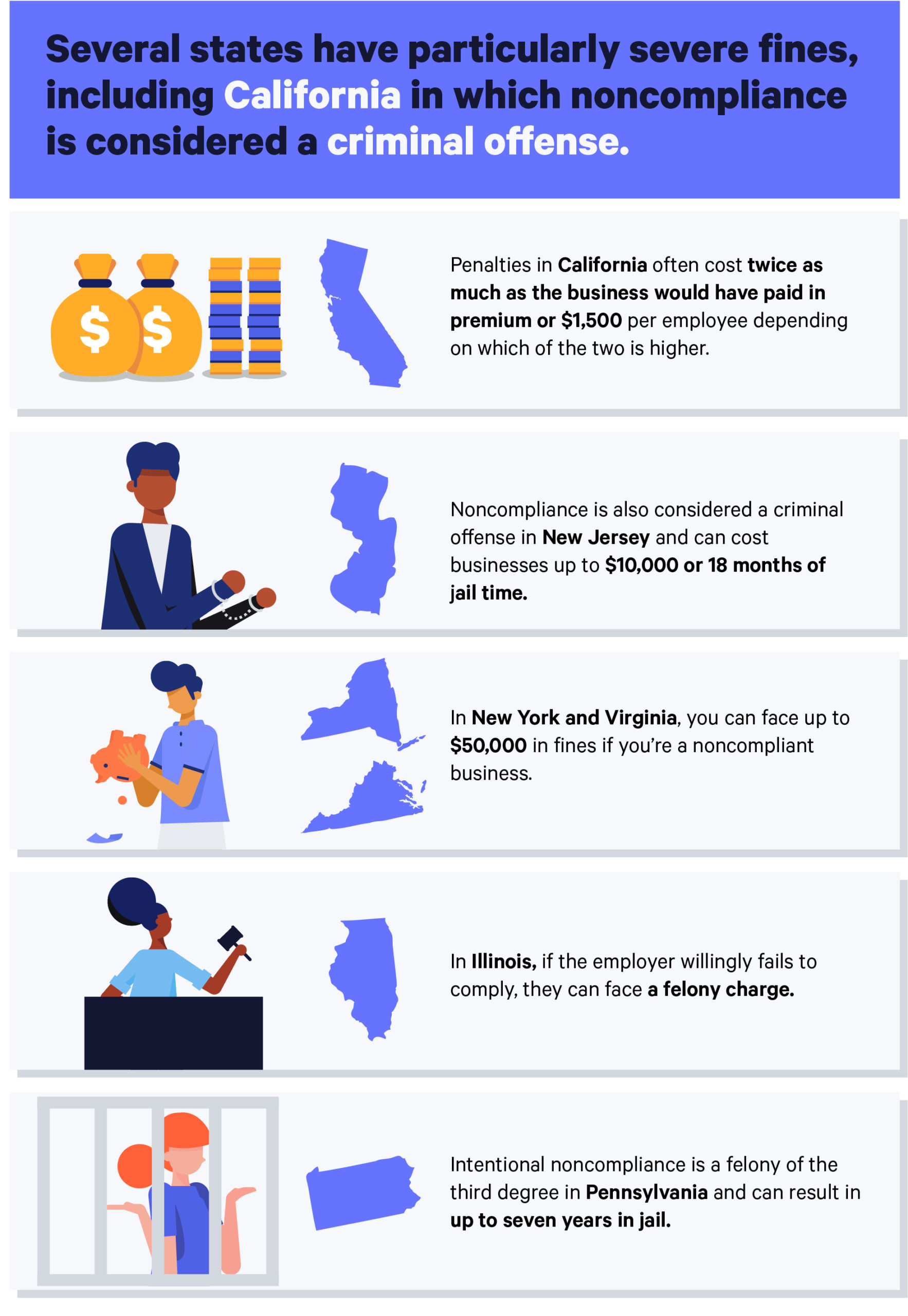
- Section 52 Fines: An employer can be fined up to $2,000 for every 10 days of non-compliance. It is not uncommon for small businesses to face fines exceeding $50,000 for a year of lapsed coverage.
- Criminal Charges: Failure to provide coverage for more than five employees is a felony in New York.
- Personal Liability: If an uninsured worker is injured, the business owners are personally liable for all medical costs and lost wages. The state's Uninsured Employers Fund (UEF) will pay the worker and then aggressively pursue the employer for reimbursement.
- Stop Work Orders: The WCB has the authority to shut down business operations immediately until insurance is secured and fines are paid.
Steps to Take After a Workplace Injury
To protect your business and ensure your insurance policy functions correctly, you must follow specific procedures when an injury occurs in your Ozone Park facility.
- Seek Immediate Medical Attention: Ensure the employee receives the necessary care. In NY, the employee can choose any doctor authorized by the WCB.
- Report the Incident: The employee must notify the employer in writing within 30 days of the accident.
- File Form C-2F: The employer must report the injury to their insurance carrier and the WCB within 10 days of the incident using the Electronic Case Folder (ECF) system. Failure to report timely can result in separate administrative fines.
- Maintain Records: Keep a detailed log of the accident, witness statements, and any safety equipment involved. This documentation is vital for the insurance carrier’s investigation.
Strategies to Reduce Your Premiums
While rates are largely regulated, Ozone Park business owners can take proactive steps to lower their annual insurance spend:
- Implement a Safety Program: Documented safety training and "Toolbox Talks" can reduce the frequency of claims, eventually lowering your MOD factor.
- Formal Return-to-Work Program: Bringing an injured worker back in a "light-duty" capacity as soon as medically possible reduces the "indemnity" (lost wage) portion of a claim, which has the biggest impact on your future premiums.
- Verify Subcontractors: Always collect a Certificate of Insurance (Form C-105.2) from any contractor you hire. If they are uninsured, their payroll will be added to your audit, potentially costing you thousands in unplanned premiums.
- Audit Your Class Codes: Ensure your employees are classified correctly. If a worker spends 100% of their time in the office but is classified as a "driver," you are paying a significantly higher rate than necessary.
Frequently Asked Questions
Is workers' comp required for family members working in my Ozone Park business?
Yes. In New York, if a family member is compensated for their work, they are considered an employee and must be covered. The only common exception is for a business owned by a sole proprietor where the only "employees" are the owner’s spouse, but even this has specific nuances depending on the business structure.
Does a "waiver of subrogation" affect my costs?
A waiver of subrogation is often required by general contractors in Ozone Park before you can start a job. It prevents your insurance company from seeking repayment from the general contractor if they were partially at fault for an injury. Most carriers charge a flat fee or a small percentage of the premium (typically 2-5%) to add this endorsement to your policy.
Can I use a PEO for workers' compensation?
Professional Employer Organizations (PEOs) are popular for small businesses in Queens. By entering into a co-employment agreement, your employees are covered under the PEO’s large-scale workers' compensation policy. This can provide more stable rates and reduce the administrative burden of audits, though you should carefully compare the PEO fee against the cost of a standalone policy.
What happens if an employee is injured while working off-site in Brooklyn or Manhattan?
Your NYS workers' compensation policy covers your employees anywhere they are working within the state of New York. If your Ozone Park-based crew is performing a renovation in another borough, they remain covered under your primary policy. If they work outside of NY state, you may need an "Other States" endorsement.
Are sole proprietors required to cover themselves?
Sole proprietors, partners, and members of LLCs with no employees are not legally required to carry workers' compensation for themselves. However, they may choose to "elect in" to coverage. Furthermore, many hiring entities in New York will refuse to work with a sole proprietor unless they carry a policy or provide a certificate of exemption (Form CE-200).
Next Steps for Ozone Park Business Owners
To ensure you are fully protected in 2026, begin by reviewing your current payroll projections and job descriptions. Contact a licensed New York insurance broker who specializes in the Queens market to run a comparative analysis between private carriers and the NYSIF. Ensure that your workplace safety protocols are documented and that all required WCB posters are prominently displayed in your place of business. Taking these steps not only ensures legal compliance but also stabilizes one of the most significant overhead costs for a New York business.
Image Gallery
Select an image to open it in a new tab.
Zara El-Hashem
Sociocultural Dynamics and Academics Writer
