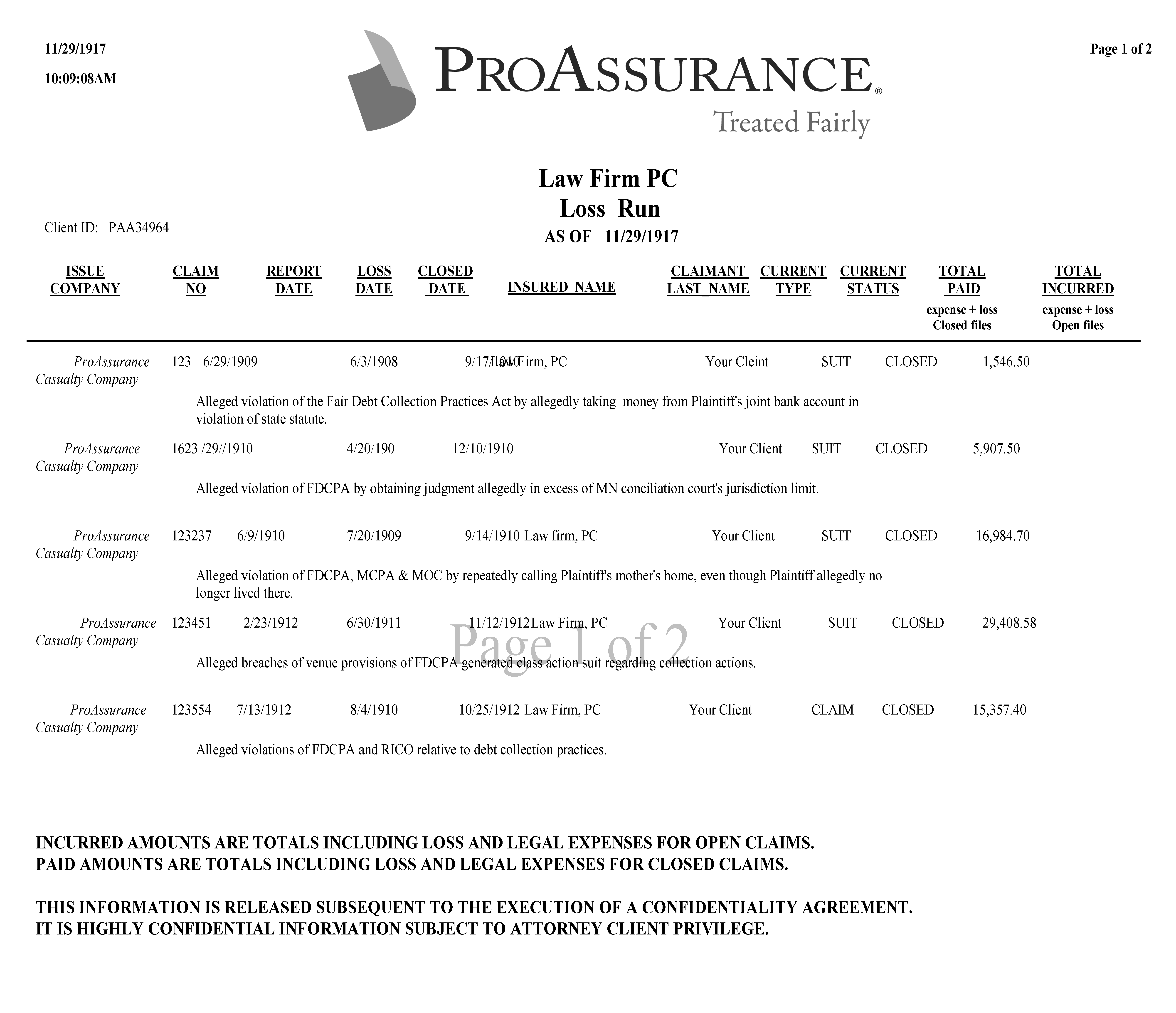
Loss runs are formal reports generated by insurance carriers that document the history of workers' compensation claims filed against a business's policy. These documents act as a financial and safety report card, detailing claim statuses, total costs incurred, and reserved funds. They are essential for calculating Experience Modification Rates (MOD), negotiating annual premiums, and identifying workplace safety trends.
In the 2026 insurance landscape, where data-driven underwriting is more prevalent than ever, understanding the nuances of a loss run report is no longer a task reserved solely for insurance brokers. For business owners, CFOs, and risk managers, mastering these reports is the first step toward controlling insurance costs and ensuring a safe environment for employees. A loss run report is not merely a list of past accidents; it is a strategic tool used to predict future risk and determine the financial viability of a company’s safety protocols.
The Definition and Purpose of Workers Compensation Loss Runs
A loss run report is a comprehensive ledger of all claims associated with a specific insurance policy over a defined period—typically the last three to five years. Think of it as a credit report for your business’s insurance history. Whenever an employee is injured on the job and a claim is filed, that event is recorded in the loss run.
The primary purpose of these reports is to provide transparency between the insurer and the insured regarding the costs of claims. For the insurance carrier, loss runs provide the empirical data necessary to assess the risk of renewing a policy or set the price for a new one. For the employer, these reports serve as an internal diagnostic tool. By reviewing loss runs, a company can see exactly where its money is going—whether toward medical treatments, lost wages (indemnity), or legal fees—and which departments or roles are most prone to injury.
In 2026, loss runs are often integrated into real-time risk management dashboards, but the fundamental data remains the same. They are required during the "quoting" process when a business seeks coverage from a new carrier. Most underwriters will refuse to provide a firm quote without at least three to five years of verified loss runs, as this data allows them to project the "expected losses" for the coming year.
Key Components of a Loss Run Report
To the untrained eye, a loss run report can appear to be an overwhelming spreadsheet of codes and figures. However, once you understand the standard columns and terminology, the data becomes a clear narrative of your company's risk profile.
Claim Identification and Status
Every entry starts with basic identifiers: the claim number, the claimant’s name, and the date of occurrence. This allows the business to cross-reference the report with internal incident logs. The status of the claim is perhaps the most critical field. A "Closed" claim means the insurer has finished all payments and does not expect further expenses. An "Open" claim means the case is ongoing, and the final cost is still unknown.
Financial Breakdown: Paid vs. Reserved
This is where the mathematical core of the report lies. A standard loss run breaks down costs into several categories:
- Paid Medical: The actual amount the insurance company has already paid to healthcare providers for the employee’s treatment.
- Paid Indemnity: The amount paid directly to the employee to compensate for lost wages due to their inability to work.
- Expenses (ALAE): Allocated Loss Adjustment Expenses (ALAE) include costs specific to the claim that are not payments to the claimant, such as legal fees, investigative costs, or expert witness fees.
- Reserves: This is an estimate of the future costs of an open claim. The adjuster "sets aside" these funds based on the expected trajectory of the injury. For example, if an employee requires future surgery, the reserve will be high.
- Total Incurred: This is the sum of all paid amounts plus the current reserves. Incurred = Paid + Reserved.
Claim Description and Type
The report will usually include a "Loss Description" (e.g., "Strain while lifting box") and a "Claim Type." Claims are generally categorized as Medical Only (the employee was treated but did not miss significant work) or Indemnity (the injury was severe enough to require wage replacement). Underwriters view these differently; a high frequency of medical-only claims suggests a messy but manageable environment, whereas a single high-cost indemnity claim suggests a severe safety failure.
The Critical Link Between Loss Runs and the Experience Modifier (E-Mod)
The Experience Modification Rate, or E-Mod, is a multiplier applied to your workers' compensation premium. A "neutral" E-Mod is 1.0. If your E-Mod is 0.85, you receive a 15% discount; if it is 1.25, you pay a 25% surcharge.
Loss runs are the raw data source for the E-Mod calculation, which is typically managed by the National Council on Compensation Insurance (NCCI) or a state-specific rating bureau. The E-Mod formula looks at your actual losses (found in your loss runs) compared to the "expected" losses for a business of your size in your specific industry.
It is important to note that loss runs impact the E-Mod on a delayed basis. The E-Mod for 2026 is usually calculated based on the loss runs from 2022, 2023, and 2024. The most recent year (2025) is typically excluded to allow claims to mature. This delay means that a bad year of safety today will haunt your insurance premiums for several years in the future. Conversely, improvements in safety today won't be fully reflected in your E-Mod for another two years.
How to Request and Manage Loss Run Reports
In 2026, most major carriers provide loss runs through an online "Policyholder Portal." However, the process still requires proactive management.
The Request Process
If your carrier does not provide an automated portal, you must submit a written request for loss runs. Legally, insurance companies are required to provide these reports, usually within 10 to 30 days depending on state regulations. It is best practice to request updated loss runs at least 90 days before your policy renewal date. This gives you time to review the data for errors before the information is sent to the NCCI for E-Mod calculation.
Verifying Accuracy
Errors on loss runs are surprisingly common and can be extremely costly. Common issues include:
- Duplicate Claims: The same injury listed twice under different claim numbers.
- Incorrect Status: A claim that was settled and closed months ago still showing as "Open" with high reserves.
- Clerical Errors: Incorrect payroll figures or job classification codes, which skew the "expected vs. actual" loss ratio.
- Subrogation Neglect: If a third party was responsible for the injury (e.g., a car accident where your employee was not at fault), the insurer should seek "subrogation" to recover costs. If they succeed, your loss run should show a credit, reducing your total incurred costs.
Technical Analysis: Frequency vs. Severity
When an underwriter looks at your loss runs, they are performing a "Frequency vs. Severity" analysis. Understanding this distinction allows you to address the root causes of your insurance costs.
- Frequency: This refers to how often claims occur. A high frequency of small claims is often seen as a greater risk than a single large claim. Why? Because high frequency suggests a fundamental breakdown in safety culture and "near misses" that will eventually lead to a catastrophic injury.
- Severity: This refers to the cost of the claims. A business might have only one claim in five years, but if that claim costs $500,000, it is a high-severity event.
Underwriters prefer to see "low frequency, low severity." If you have high frequency, you need to implement stricter safety training. If you have high severity, you might need better equipment or more stringent "Return to Work" programs to get injured employees back to light-duty tasks, which lowers indemnity costs.
Loss Run Comparison and Data Fields
The following table summarizes the key fields you will encounter and why they matter for your 2026 workers' compensation strategy.
| Field Name | Description | Impact on Premium |
|---|---|---|
| Valuation Date | The "snapshot" date when the data was pulled. | Claims change daily; ensure you have the most recent valuation for renewal. |
| Reserved Amount | Funds set aside for future payments on open claims. | High reserves inflate your E-Mod just as much as actual payments. |
| Medical Only | Claims involving healthcare costs but no lost time. | Usually carries a "70% discount" in the E-Mod formula in most states. |
| Indemnity Claim | Claims involving lost wages and disability. | These have the highest negative impact on your E-Mod and total costs. |
| Claim Description | A brief summary of how the injury occurred. | Used to identify trends (e.g., are all injuries happening in the warehouse?). |
| Total Incurred | The total cost of the claim (Paid + Reserved). | The primary figure used by underwriters to determine your risk level. |
Valuation Dates and the Importance of Timing
A loss run is a "snapshot" in time. Because claims are dynamic—medical bills are paid weekly and reserves are adjusted as more information becomes available—the Valuation Date is critical.
For E-Mod calculations, the NCCI uses data "valued" as of six months prior to the policy effective date. For example, if your policy renews on January 1, 2026, the data used for your E-Mod was likely valued in July 2025. If a major claim was closed or a reserve was significantly reduced in August 2025, it wouldn't be reflected in your 2026 E-Mod. This "valuation window" is why it is vital to work with your insurance adjuster to close claims or lower excessive reserves before the valuation date.
Strategic Use of Loss Runs for Risk Management
Beyond just getting a lower insurance quote, loss runs provide the intelligence needed to run a better business. By performing a "Trend Analysis," you can spot patterns that are invisible in day-to-day operations.
- Departmental Trends: Are claims concentrated in one specific department? This might indicate a lack of supervision or faulty equipment in that area.
- Temporal Trends: Do injuries happen more often on Monday mornings (suggesting weekend-related issues) or Friday afternoons (suggesting fatigue)?
- Injury Type Trends: If 80% of your claims are "Slips and Falls," you have a clear mandate to improve floor surfaces or footwear requirements.
- Lag Time Analysis: Look at the "Report Date" vs. the "Occurrence Date." If employees are waiting three days to report an injury, the claim cost often doubles. Encouraging immediate reporting can drastically reduce the severity of claims on your loss run.
Frequently Asked Questions
How many years of loss runs do I need for a quote?
Most insurance carriers require the "currently valued" year plus the four prior years. In 2026, if you are seeking a quote for the 2027 policy year, you should have records spanning back to at least 2022. This provides a statistically significant sample of your business's safety performance.
Can I get loss runs if my previous carrier went out of business?
Yes, but it is more difficult. You may need to contact the state’s Department of Insurance or the state’s "guaranty fund" which takes over the liabilities of insolvent carriers. In some cases, the NCCI may have the historical data on file, though it may not be as detailed as a carrier-generated report.
Why is an "Open" claim so much worse than a "Closed" claim?
An open claim represents uncertainty. Underwriters often assume the "worst-case scenario" for open claims, meaning they may view the total reserved amount as if it were already spent. Closed claims are a known quantity, which allows for more predictable financial modeling.
Can I dispute a reserve amount on my loss run?
While you cannot unilaterally change a reserve, you can request a "Claim Review" with your carrier. If you provide evidence that an employee has returned to full health or that a legal settlement is lower than anticipated, the adjuster may agree to lower the reserve, which will eventually improve your E-Mod.
Does a "Medical Only" claim affect my E-Mod?
In most NCCI states, "Medical Only" claims are subject to the Experience Rating Adjustment (ERA), which reduces the impact of those claims on your E-Mod by 70%. This encourages employers to report all injuries without fear of massive premium hikes for minor incidents.
Practical Recommendations
To maintain control over your workers' compensation costs, implement a Quarterly Loss Run Review. Do not wait until renewal season to look at your data. By reviewing these reports every three months, you can identify open claims that should be closed, check for clerical errors, and address safety trends before they become chronic problems.
Work closely with your broker to ensure they are performing "Reserve Advocacy." A broker who proactively challenges high reserves can save a company thousands of dollars in future premiums. Finally, treat your loss run as a roadmap for your safety committee; let the data dictate where you invest in training and equipment.
Image Gallery
Select an image to open it in a new tab.
Zara El-Hashem
Sociocultural Dynamics and Academics Writer
