
Three USC quarterbacks have officially won the Heisman Trophy: Carson Palmer (2002), Matt Leinart (2004), and Caleb Williams (2022). While the University of Southern California was historically known as "Tailback U," these three elite signal-callers redefined the program’s identity, making the Trojans a modern powerhouse for Heisman-winning quarterback play.
The Transformation of USC’s Heisman Identity
For decades, the University of Southern California (USC) was the gold standard for producing elite running backs. From Mike Garrett and O.J. Simpson to Charles White and Marcus Allen, the "Tailback U" moniker was earned through a relentless commitment to the ground game. However, as college football evolved into a more pass-oriented sport at the turn of the millennium, USC successfully pivoted its offensive philosophy to become a premier destination for elite quarterbacks.
This shift was not merely a change in play-calling; it was a fundamental transformation of the program's brand. Starting with the arrival of Pete Carroll in 2001 and continuing through the Lincoln Riley era in the early 2020s, the Trojans proved that they could produce the best passers in the country. Today, the lineage of Heisman-winning quarterbacks at USC stands as a testament to the school's ability to adapt and dominate across different eras of football history.
As of 2026, the Heisman Trophy remains the ultimate individual achievement in college sports, and USC continues to be one of the most decorated programs in the award's history. With eight total winners (including the reinstated trophy of Reggie Bush), the quarterbacks represent the modern cornerstone of this prestigious legacy.
Carson Palmer: The 2002 Breakthrough
Carson Palmer’s 2002 Heisman campaign is widely regarded as the catalyst for the modern USC dynasty. Entering his senior year, Palmer was a highly-touted prospect who had struggled with consistency and injury throughout his earlier seasons. However, under the tutelage of offensive coordinator Norm Chow and head coach Pete Carroll, Palmer orchestrated one of the most impressive late-season surges in college football history.
The 2002 Season Context
The 2002 season began with modest expectations, but Palmer’s performance grew stronger as the schedule became more difficult. He completed 309 of 489 passes for 3,942 yards and 33 touchdowns. The turning point for his Heisman candidacy came during the final stretch of the season, particularly in high-profile victories over rivals UCLA and Notre Dame. In the season finale against the Fighting Irish, Palmer threw for 425 yards and four touchdowns, a performance that effectively sealed the Heisman vote in his favor.
Impact on the Program
Palmer was the first USC quarterback to win the award, breaking the drought for the position and proving that a Trojan signal-caller could garner national acclaim. His win signaled to recruits across the country that USC was no longer just a place for running backs to shine. It also set the stage for the NFL's interest in USC quarterbacks, as Palmer went on to be the #1 overall pick in the 2003 NFL Draft.
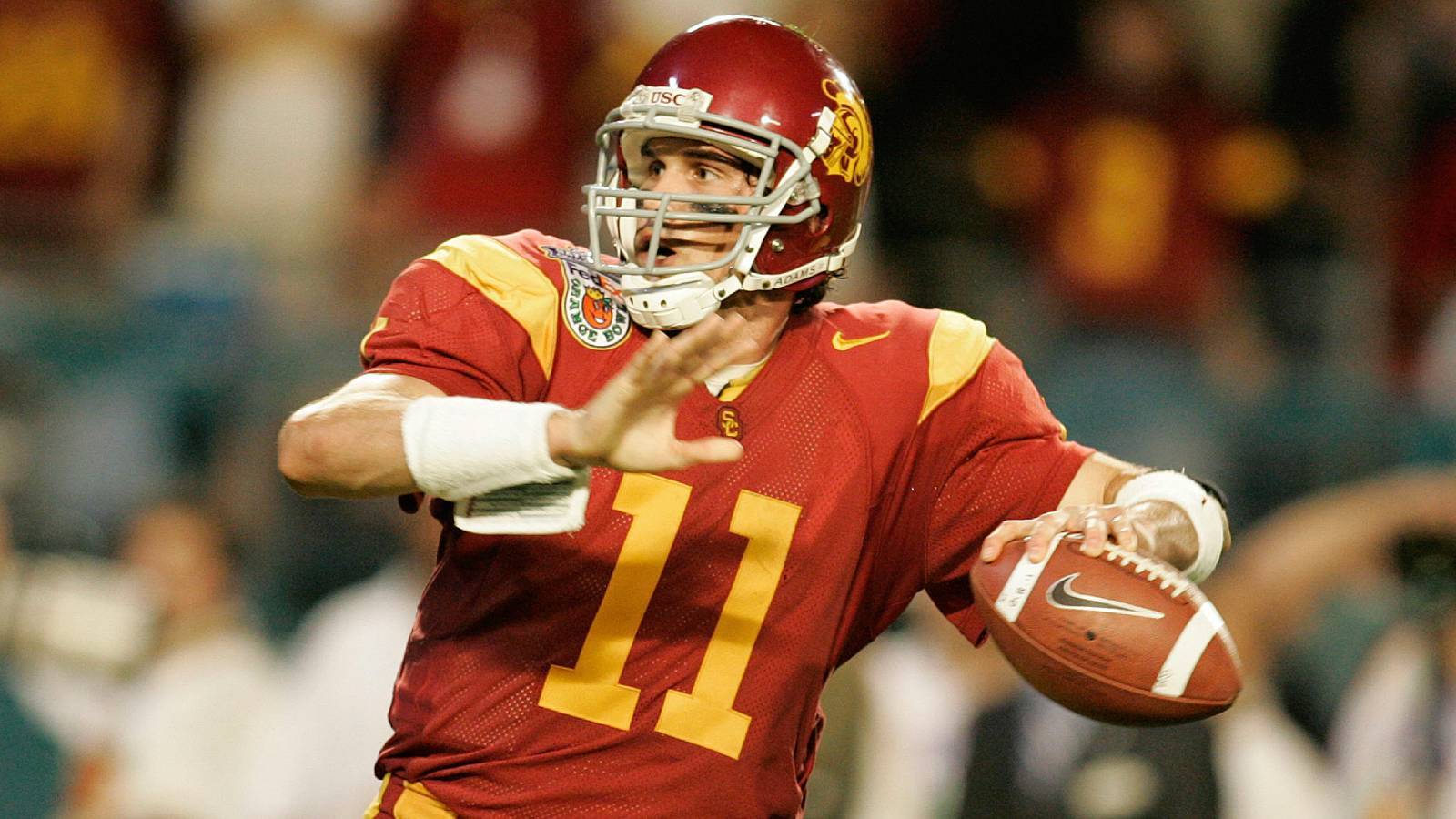
Matt Leinart: The Architecture of a Dynasty
Following Palmer's departure, Matt Leinart took the reins in 2003 and quickly became the face of college football. By 2004, Leinart had led the Trojans to an undefeated season and a BCS National Championship, culminating in his own Heisman Trophy win.
The 2004 Campaign
Leinart’s 2004 season was defined by efficiency and leadership. He threw for 3,322 yards and 33 touchdowns with only six interceptions. Unlike Palmer’s late-season surge, Leinart was a frontrunner from start to finish. His ability to manage a star-studded roster that included future Heisman winner Reggie Bush and elite receivers like Mike Williams and Dwayne Jarrett demonstrated his mastery of the position.
The peak of Leinart's Heisman season was the 2005 Orange Bowl (the national championship game for the 2004 season), where he threw five touchdown passes in a 55-19 rout of Oklahoma. While the Heisman is awarded before the bowl games, this performance validated the voters' decision.
Legacy of "Leinart Era"
Leinart is often remembered for his decision to return for his senior season in 2005, a move that was rare for Heisman winners at the time. Although he finished third in the 2005 Heisman voting, his three-year run as a starter remains one of the most successful in the history of the sport. He brought a "Hollywood" glamour to the position, combining elite on-field production with a high-profile public persona that epitomized the USC brand during the mid-2000s.
Caleb Williams: The Modern Masterclass
After a nearly two-decade gap between quarterback Heismans, Caleb Williams arrived at USC in 2022 and immediately revitalized the program. Following coach Lincoln Riley from Oklahoma through the transfer portal, Williams delivered a season that many analysts consider the greatest individual performance by a USC quarterback in history.
The 2022 Statistical Explosion
In 2022, Williams redefined the expectations for a dual-threat quarterback at USC. He threw for 4,537 yards and 42 touchdowns while adding 382 yards and 10 touchdowns on the ground. His ability to create "out-of-structure" plays—extending drives with his legs and making off-platform throws—became his trademark.
Williams’ Heisman moment occurred during a pivotal two-week stretch where USC defeated top-ranked rivals UCLA and Notre Dame. In those games, Williams combined for nearly 800 total yards and multiple scores, displaying a level of athleticism and arm talent that left voters with no other choice.
The Lincoln Riley Connection
The success of Caleb Williams solidified USC’s reputation as a "quarterback factory" under Lincoln Riley. Riley, who had already coached Heisman winners Baker Mayfield and Kyler Murray at Oklahoma, proved that his system could produce similar results in Los Angeles. As of 2026, Williams' impact is still felt in the program’s recruiting efforts, as elite high school quarterbacks continue to view USC as the primary path to the Heisman and the NFL.
Comparing USC’s Heisman Quarterbacks
The three winners each represented a different era of offensive football. Palmer was the quintessential pro-style passer; Leinart was the highly efficient distributor in a balanced attack; and Williams was the modern, creative dual-threat playmaker.
| Feature | Carson Palmer (2002) | Matt Leinart (2004) | Caleb Williams (2022) |
|---|---|---|---|
| Passing Yards | 3,942 | 3,322 | 4,537 |
| Passing TDs | 33 | 33 | 42 |
| Interceptions | 10 | 6 | 5 |
| Rushing TDs | 4 | 3 | 10 |
| Team Record | 11-2 | 13-0 | 11-3 |
| NFL Draft Pick | #1 Overall (2003) | #10 Overall (2006) | #1 Overall (2024) |
| Coach | Pete Carroll | Pete Carroll | Lincoln Riley |
The "Almost" Winners: USC QB Heisman Finalists
While only three have won the award, several other USC quarterbacks have come remarkably close, finishing in the top five of the voting. These players contributed to the program's prestige and maintained the high standard required of a Trojan signal-caller.
- Rodney Peete (1988): Peete was the runner-up to Oklahoma State’s Barry Sanders. He was the first USC quarterback to truly challenge the "Tailback U" narrative, leading the Trojans to a Rose Bowl and proving he could win with both his arm and his legs.
- Matt Barkley (2011): Barkley finished sixth in the Heisman voting in 2011 after a stellar season where he threw for 39 touchdowns and 3,528 yards. Despite USC being ineligible for the postseason at the time due to NCAA sanctions, Barkley’s individual excellence was recognized nationally.
- Caleb Williams (2023): Returning as the defending winner, Williams remained in the Heisman conversation for much of the 2023 season. Although USC's defensive struggles hampered the team's record, Williams' individual stats remained elite, earning him a trip to New York as a finalist for the second consecutive year.
The Context of the Heisman at USC
To understand the magnitude of USC's quarterback history, one must look at the school's total Heisman count. As of 2026, USC officially claims eight Heisman Trophies, tying them for the most of any school in history alongside programs like Ohio State, Notre Dame, and Oklahoma.
The reinstatement of Reggie Bush's 2005 Heisman Trophy in 2024 was a landmark moment for the university. While Bush was a running back, his presence on the field during the Matt Leinart era created a "gravity" that benefited the quarterback position. The synergy between elite backfield talent and elite quarterback play has been the hallmark of USC's most successful periods.
Why USC Quarterbacks Win
Winning the Heisman as a USC quarterback requires three main ingredients:
- Individual Dominance: High statistical output, particularly in passing touchdowns and yardage.
- Team Success: The Trojans are usually in the hunt for a conference title or a spot in the College Football Playoff during Heisman years.
- The "Big Stage": USC’s schedule often features high-profile, late-season games against Notre Dame and UCLA. Success in these "rivalry weeks" provides the "Heisman Moment" necessary to sway voters in the final weeks of the season.
The Future of the Position at USC
As college football enters the latter half of the 2020s, the blueprint for USC quarterback success is well-established. The program continues to leverage its location in the Los Angeles media market, its historic brand, and a quarterback-friendly coaching staff to attract the nation's best talent.
The transition from the Pac-12 to the Big Ten Conference has also changed the landscape. USC quarterbacks now compete on a national stage against traditional Midwestern and East Coast powers every week. This increased visibility has only heightened the chances for future Trojan signal-callers to add to the school’s Heisman trophy case.
Frequently Asked Questions
How many USC quarterbacks have won the Heisman?
As of 2026, three USC quarterbacks have won the Heisman Trophy: Carson Palmer (2002), Matt Leinart (2004), and Caleb Williams (2022). While other players like Reggie Bush and Marcus Allen have won the award for USC, they played different positions (Running Back).
Who was the first USC quarterback to win the Heisman?
Carson Palmer was the first USC quarterback to win the award in 2002. Before his victory, all of USC's Heisman winners had been running backs. Palmer's win marked a significant shift in the program's offensive identity and paved the way for future quarterback success.
Did Matt Barkley win the Heisman at USC?
No, Matt Barkley did not win the Heisman, though he was a prominent candidate. His best finish was 6th place in 2011. Despite setting numerous school records, the lack of a postseason opportunity for the team that year due to sanctions likely affected his final vote tally.
Has any USC quarterback won the Heisman twice?
No. While Caleb Williams attempted to become the second player in history (after Archie Griffin) to win the award twice, he was unable to repeat his 2022 victory in 2023. Matt Leinart also finished in the top three during his second attempt in 2005 but did not win a second trophy.
Who coached the most Heisman-winning quarterbacks at USC?
Pete Carroll coached two of USC's Heisman-winning quarterbacks: Carson Palmer and Matt Leinart. Lincoln Riley coached the third, Caleb Williams. It is worth noting that Lincoln Riley has coached a total of three Heisman-winning quarterbacks across his career (Mayfield, Murray, and Williams).
Recommendations for Further Research
If you are interested in the detailed statistics and game-by-game breakdowns of these legendary seasons, the following resources provide verified historical data:
- The Heisman Trust (heisman.com): The official source for voting totals, historical context, and official biographies of every winner.
- USC Athletics History (usctrojans.com): Provides comprehensive archived statistics for Palmer, Leinart, and Williams, including their career records and accolades.
- NCAA Statistics Database: Useful for comparing USC winners against their contemporaries in any given year to understand the strength of their candidacy.
For fans looking to experience the legacy firsthand, the Heritage Hall on the USC campus in Los Angeles houses the actual Heisman Trophies won by these athletes. Seeing the trophies in person offers a unique perspective on the physical history of the program.
Image Gallery
Select an image to open it in a new tab.
Zara El-Hashem
Sociocultural Dynamics and Academics Writer
