Average Lake Michigan Temperature: A Complete Guide to Seasonal and Regional Trends

The average surface temperature of Lake Michigan varies significantly by season and location, typically ranging from a low of 32°F (0°C) in mid-winter to a peak of 65°F to 75°F (18°C to 24°C) in late summer. Because the lake spans over 300 miles from north to south, southern shores near Chicago often remain 5 to 10 degrees warmer than the northern reaches near the Straits of Mackinac.
Understanding the Thermal Dynamics of Lake Michigan
To understand the average temperature of Lake Michigan, one must first look at the lake not as a single body of water, but as a complex, stratified thermal system. As the second-largest Great Lake by volume and the only one located entirely within the United States, Lake Michigan’s thermal behavior is governed by its immense depth—reaching 923 feet at its deepest point—and its north-south orientation.
Water possesses a unique physical property: it is densest at approximately 39.2°F (4°C). This characteristic dictates the "overturn" or "turnover" process that occurs twice a year. In the spring, as surface ice melts and the sun warms the top layer to 39.2°F, that water becomes heavier and sinks, forcing the oxygen-rich but colder water from the bottom to the surface. This mixing ensures that the lake's deep-water temperatures remain remarkably stable, hovering near 39°F year-round, regardless of what is happening at the surface.
By 2026, long-term data from the National Oceanic and Atmospheric Administration (NOAA) Great Lakes Environmental Research Laboratory (GLERL) indicates a steady trend toward shorter ice seasons and faster spring warming cycles. This shifting baseline means that "average" temperatures are increasingly influenced by milder winters, leading to higher-than-normal heat storage in the water column as we enter the summer months.
Monthly Breakdown of Average Surface Temperatures
The surface temperature of Lake Michigan follows a predictable but lagging curve relative to air temperatures. Because water has a high specific heat capacity, it takes a long time to warm up in the spring and a long time to cool down in the autumn.
Winter (December – February)
During the winter months, the average surface temperature hovers between 32°F and 35°F. While the entire lake rarely freezes over completely—the record high ice cover was 93.1% in 1977—the near-shore areas and northern bays frequently see significant ice formation. In January and February, the lake acts as a massive heat sink, slowly releasing the energy it gathered during the summer. This interaction between the cold arctic air and the relatively "warm" 32-degree water is the primary engine behind the famous "lake-effect snow" that hammers the Michigan and Indiana shorelines.
Spring (March – May)
Spring is a period of rapid transition. In March, temperatures remain near the winter lows, often between 34°F and 37°F. As the "thermal bar" forms—a vertical wall of water at maximum density (39.2°F) that separates the rapidly warming near-shore water from the cold offshore pool—temperatures begin to climb. By late May, southern surface temperatures may reach 50°F, while the deeper mid-lake regions remain stuck in the low 40s.
Summer (June – August)
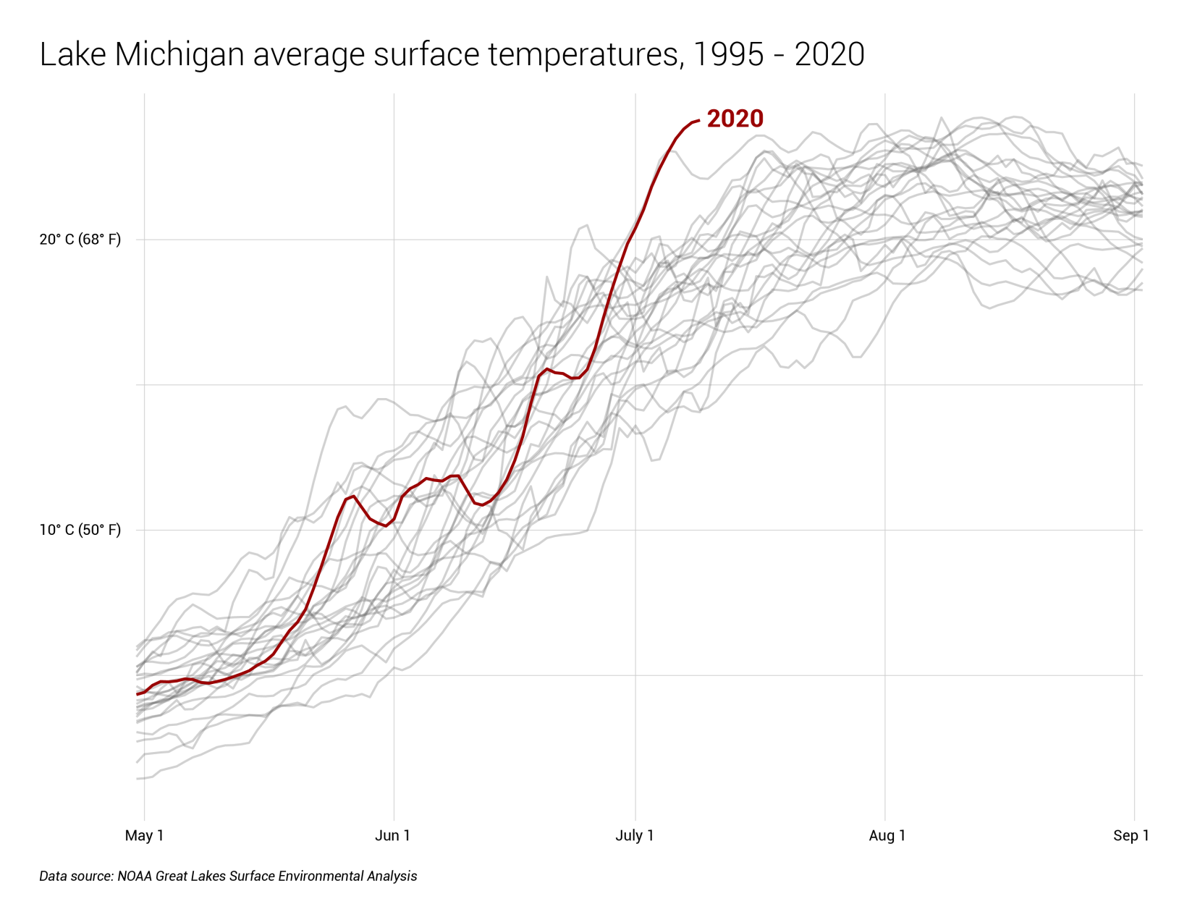
This is the peak season for recreation, but the water remains "refreshing" (or bone-chilling, depending on your perspective) well into June. In 2026, as in previous years, the lake achieves thermal stratification in July. This is when a warm upper layer (the epilimnion) sits atop a cold, deep layer (the hypolimnion), separated by a sharp temperature gradient called the thermocline. By mid-August, surface temperatures typically peak. In the southern basin near Chicago and Michigan City, averages hit 72°F to 75°F, while northern areas like Petoskey or Beaver Island may only see 64°F to 68°F.
Autumn (September – November)
September often provides the most comfortable swimming conditions because the water has reached its maximum heat content. Even as air temperatures drop, the water remains in the mid-60s. However, as the sun’s angle lowers and wind speeds increase, the lake begins to lose heat rapidly. October marks the beginning of the "fall turnover," where the cooling surface water becomes dense enough to sink and mix with the deeper layers. By late November, the surface has usually cooled back down to the mid-40s.

Regional Variations: Why Location Matters
The "average" temperature of Lake Michigan is often a misleading metric because of the massive disparity between the northern and southern basins.
- The Southern Basin (Chicago, Gary, St. Joseph): This area is shallower and located at a lower latitude. It absorbs more solar radiation and warms up significantly faster in the spring. In a typical summer, the beaches of Northwest Indiana can feel almost like the Atlantic coast, with water temperatures occasionally touching 80°F during extreme heatwaves.
- The Northern Basin (Straits of Mackinac, Traverse City, Manistique): The water here is much deeper and exposed to colder Canadian air masses. Even in the height of summer, the average temperature rarely exceeds 68°F. The proximity to Lake Huron via the Straits also allows for water exchange that can influence local temperatures.
- The Mid-Lake Plateau: Far from the influence of the shoreline, the central part of the lake is much more stable. Surface temperatures here fluctuate less wildly than near the beaches because the vast volume of water buffers against short-term weather changes.
The Phenomenon of Upwelling
One of the most frustrating experiences for a Lake Michigan visitor is arriving at the beach on a 90-degree day in July only to find the water temperature has plummeted to 50°F overnight. This is caused by a process known as upwelling.
Upwelling occurs when strong, sustained offshore winds (winds blowing from the land toward the lake) push the warm, buoyant surface water away from the coast. To replace this displaced water, the frigid, nutrient-rich water from the depths of the lake rises to the surface. Along the eastern shore of Lake Michigan (the Michigan side), a strong easterly wind can trigger an upwelling event that drops the temperature by 20 degrees in just a few hours. Conversely, on the western shore (the Wisconsin/Illinois side), westerly winds are the primary driver of this phenomenon.
Average Surface Temperatures by Month (Regional Comparison)
The following table provides the 2026 estimated average surface temperatures based on historical NOAA data and recent warming trends. These figures represent the surface layer where most recreational activity occurs.
| Month | Southern Basin Avg (°F) | Northern Basin Avg (°F) | Mid-Lake Avg (°F) |
|---|---|---|---|
| January | 35° | 33° | 36° |
| February | 33° | 32° | 34° |
| March | 37° | 34° | 35° |
| April | 44° | 39° | 40° |
| May | 54° | 46° | 45° |
| June | 64° | 56° | 54° |
| July | 71° | 64° | 63° |
| August | 74° | 68° | 69° |
| September | 68° | 62° | 65° |
| October | 58° | 53° | 57° |
| November | 49° | 45° | 48° |
| December | 41° | 38° | 42° |
Long-Term Trends and Climate Impacts in 2026
As of 2026, the scientific community has documented a clear increase in the average annual temperature of Lake Michigan. Data from the NOAA Great Lakes Environmental Research Laboratory (GLERL) shows that the lake is warming faster than the surrounding land in many seasons.
Several factors contribute to this:
- Reduced Ice Cover: When there is less ice in the winter, the water begins to absorb solar radiation earlier in the spring. This "head start" leads to higher peak temperatures in the summer.
- Longer Stratification Periods: The period during which the warm upper layer is separated from the cold bottom layer is lengthening. This can lead to ecological challenges, such as the formation of hypoxic "dead zones" where oxygen levels are too low for fish to survive.
- Meteorological Shifts: Changing wind patterns influence the frequency of upwelling and downwelling, which redistributes heat throughout the lake.
These changes have significant implications for the local economy, from the fishing industry (as cold-water species like trout and salmon seek deeper, cooler waters) to the tourism sector, which benefits from a longer swimming season.
Safety and Recreational Considerations
For those planning to enter the water, understanding the temperature is a matter of safety, not just comfort.
Hypothermia Risks
Water temperatures below 70°F can cause "cold shock" in unsuspecting swimmers. This physiological response leads to an involuntary gasp for air, which can be fatal if the person is underwater. Even in the height of summer, if an upwelling event has occurred, the water can be cold enough to cause hypothermia within 30 to 60 minutes of exposure.
Best Times for Swimming
If you prefer warmer water, the "sweet spot" for Lake Michigan swimming is generally between July 20th and September 10th. During this window, the thermal mass of the lake has been sufficiently heated, and the likelihood of the surface layer being deep enough to resist minor wind-driven upwellings is highest.
Checking Real-Time Data
Before heading to the beach, it is highly recommended to check real-time buoy data. The National Weather Service (NWS) and various Great Lakes observing systems provide live updates from buoys stationed throughout the lake. These buoys measure temperature at various depths, providing a much more accurate picture than a general monthly average.
FAQs About Lake Michigan Temperature
Why is Lake Michigan so much colder than a typical swimming pool?
Even in the peak of summer, Lake Michigan rarely reaches the 82°F–85°F temperature of a heated swimming pool. This is due to its immense volume and depth. The sun's energy can only penetrate the top few meters of water, and the massive reservoir of 39°F water at the bottom constantly acts as a cooling agent. Furthermore, constant water movement and wind-driven mixing prevent the surface from reaching the high temperatures seen in smaller, inland lakes.
Does the temperature of the lake affect the weather on land?
Yes, profoundly. Lake Michigan creates its own microclimate. In the spring and early summer, the cold water chills the air above it, often creating a "lake breeze" that keeps coastal cities like Milwaukee and Muskegon 10 to 15 degrees cooler than inland areas. In the fall and winter, the relatively warm water adds moisture and heat to the air, resulting in moderated temperatures but increased cloud cover and snowfall.
Is Lake Michigan getting warmer every year?
While there is year-to-year variability based on specific weather patterns, the multi-decadal trend is one of warming. Over the last 40 years, the average surface temperature of the Great Lakes has risen significantly. This trend is linked to shorter durations of winter ice cover, which allows the water to start warming earlier in the year.
What is the warmest Lake Michigan has ever been?
Historically, surface temperatures in the southern basin have occasionally hit 80°F to 82°F during prolonged heatwaves, such as those seen in the summers of 2012 and 2020. However, these are localized spikes and do not represent the average temperature of the lake as a whole.
Can you swim in Lake Michigan in June?
Swimming in June is possible but usually quite cold. Surface temperatures in early June often range from 50°F to 55°F. By late June, they may reach 60°F. Most people find water below 70°F uncomfortable for extended swimming without a wetsuit.
Practical Recommendations for 2026 Visitors
If you are planning a trip to Lake Michigan in 2026, keep the following tips in mind to ensure a safe and enjoyable experience:
- Monitor the Wind: Before you go, look at the wind direction. If you are on the Michigan side and the wind has been blowing from the east for 24 hours, expect cold water due to upwelling. If the wind is from the west, the warm surface water is being pushed toward the beach, making for much better swimming conditions.
- Use Buoy Apps: Utilize mobile apps that tap into the Great Lakes Observing System (GLOS). These provide real-time data from buoys like the ones near Chicago, Wilmette, and South Haven.
- Prepare for Extremes: Always bring a jacket to the beach, even if it’s 85°F inland. The "lake effect" can mean that the air temperature at the water's edge is significantly lower than it is just a mile away.
- Safety First: If the water is below 60°F, treat it with extreme caution. Ensure children and weak swimmers are wearing life jackets, as cold water can sap physical strength much faster than warm water.
Lake Michigan remains one of the most dynamic and beautiful natural resources in North America. Whether you are interested in its average temperature for fishing, sailing, or a summer beach day, understanding the underlying physics of this "Inland Sea" will help you make the most of your time on its shores.
Image Gallery
Select an image to open it in a new tab.

Celine Dubois
Contemporary Living and Global Arts Columnist
