
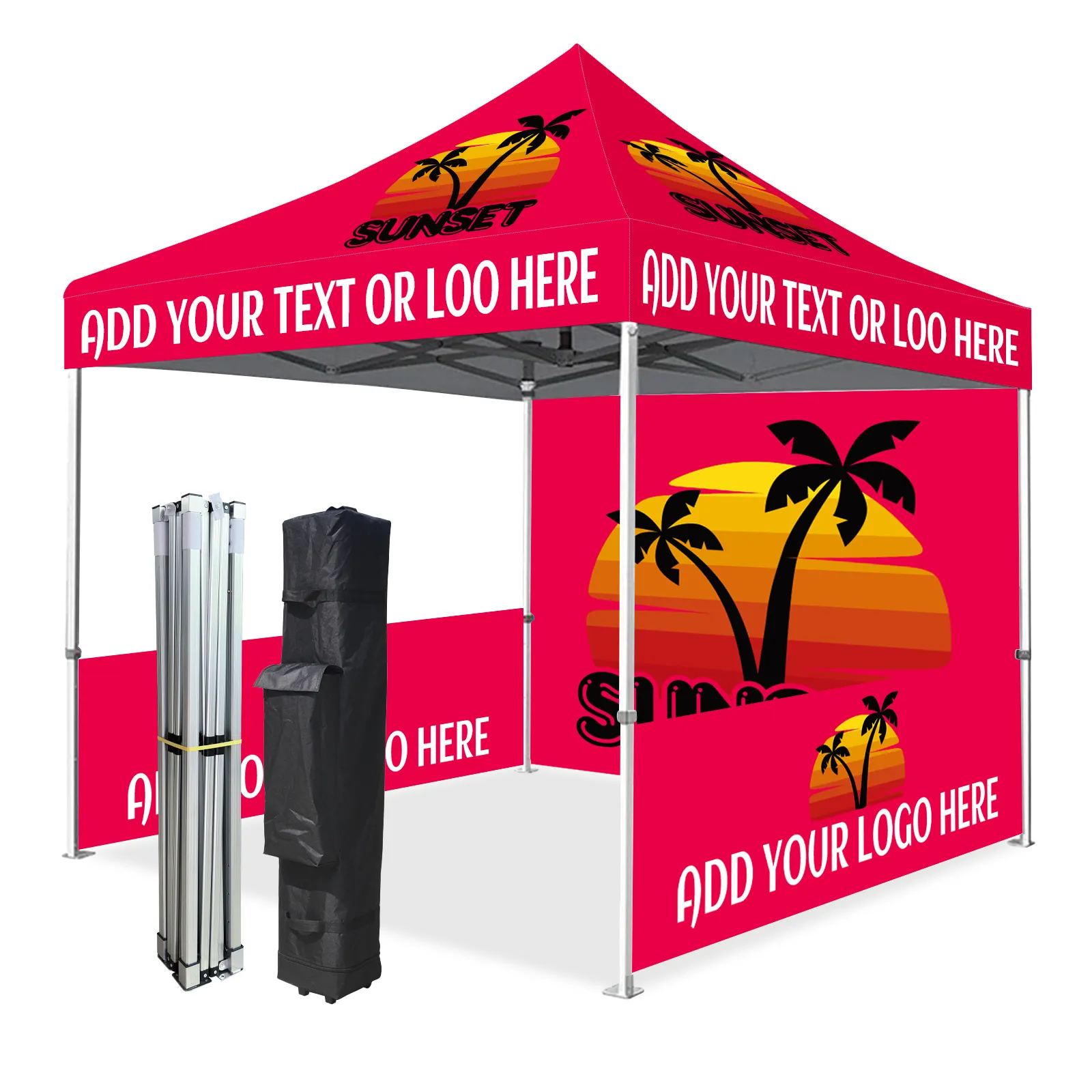
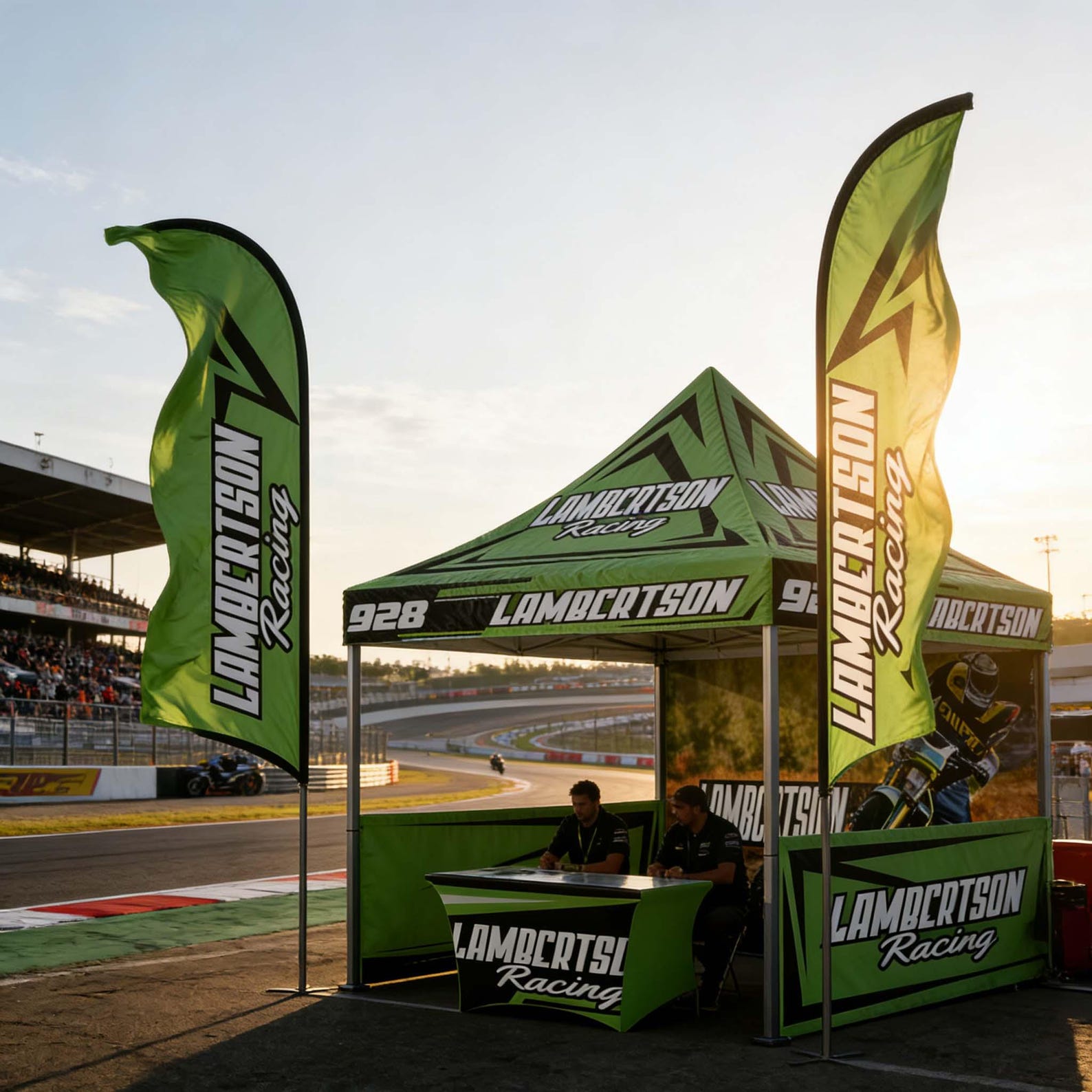
A custom logo canopy tent is a portable outdoor structure featuring custom-printed graphics, brand logos, and colors applied to a weather-resistant canopy fabric supported by a collapsible frame. Used extensively at trade shows, corporate events, athletic competitions, and outdoor markets, these branded tents combine structural stability with high-impact visual marketing.
Key Components of Commercial-Grade Custom Canopy Tents
Selecting the optimal custom logo canopy tent requires a thorough evaluation of both the structural framework and the canopy material. The performance, durability, and visual appearance of a branded shelter depend directly on how these two main components are engineered.
- Custom Printed Canopy Top (500D/600D Fire-Retardant Polyester)
- Peak Graphics
- Valance Graphics
- Structural Frame:
- Scissor Truss
- Hex Leg
- Push-Pin Lock
- Anchoring:
- Sandbag / Cast Iron Weight
- Ground Anchor
Frame Materials: Powder-Coated Steel vs. Extruded Aluminum
The structural frame provides the core support and wind resistance for the canopy structure. Frame design varies significantly across price points and intended applications:
- Powder-Coated Steel Frames:
- Construction: Formed from cold-rolled steel tubing coated with a protective polymer powder finish to resist corrosion.
- Characteristics: Steel offers high physical weight, which provides inherent stability in minor breezes. However, it is heavier to transport and prone to internal oxidation if the outer powder coating is scratched or chipped.
- Best Use: Fixed-location seasonal use or budget-conscious setups where weight is not an operational constraint.
- Extruded Aluminum Frames:
- Construction: Manufactured using structural aluminum alloys (such as 6005-T5 or 6063-T6) engineered with internal reinforcement ribs.
- Characteristics: Aluminum provides an exceptional strength-to-weight ratio and natural resistance to rust and atmospheric corrosion. While lightweight for transport, premium aluminum frames utilize thicker tube walls and specialized profile geometries to surpass steel in wind load resistance.
- Leg Geometries: Entry-level frames typically use square legs (28mm to 32mm), whereas heavy-duty commercial frames utilize hexagonal legs (40mm to 50mm outer diameter) or octagonal legs. The multi-faceted design of hex and octagonal legs distributes lateral wind force far more effectively than four-sided tubing, minimizing structural deflection.
| Frame Feature | Standard Steel Frame | Commercial Hex Aluminum Frame |
|---|---|---|
| Leg Profile | 28mm–32mm Square | 40mm–50mm Hexagonal |
| Material Thickness | 0.7mm – 1.0mm | 1.2mm – 2.0mm |
| Weight (10x10 Frame) | ~45 – 55 lbs | ~32 – 42 lbs |
| Corrosion Resistance | Moderate (Coating dependent) | Superior (Naturally rustproof) |
| Joint Connectors | Stamped Steel / Thin Plastic | Molded Nylon / Cast Aluminum |
Canopy Fabric Construction: Denier Ratings and Protective Coatings
The fabric top acts as both the weather barrier and the visual display canvas. Canopy fabrics are rated primarily by thread density and coating treatments.
- Understanding Denier (D): Denier measures the linear mass density of fibers, defined as the mass in grams per 9,000 meters of yarn. A 600D Polyester fabric uses threads weighing 600 grams per 9,000 meters, yielding a tighter weave, higher tensile strength, and greater puncture resistance than a 300D or 400D fabric.
- Weatherproof Coatings:
- Polyurethane (PU) Coating: Applied to the underside of the polyester fabric to create a hydrostatic head rating (typically 1500mm to 3000mm). PU coatings block liquid water penetration while keeping the fabric flexible enough to fold repeatedly without cracking.
- Polyvinyl Chloride (PVC) Coating: Offers complete waterproofing and high durability, but adds significant weight and can become stiff or crack in sub-zero temperatures.
- UV Inhibitors: Protect the underlying polyester fibers from ultraviolet degradation and prevent custom-printed graphics from rapidly fading under direct sunlight.
- Fire Retardancy Standards: Commercial event venues and municipal ordinances frequently require tent fabrics to meet recognized flame propagation standards. The most common certifications include:
- NFPA 701: National Fire Protection Association standard for textile flame propagation.
- CPAI-84: Canvas and Synthetic Tent Materials specification.
- California State Fire Marshal (CSFM) Title 19: Stringent flame-resistance testing required for public gatherings in California and recognized nationwide.
Printing Technologies for Custom Tent Graphics
The selection of printing technology directly dictates the visual crispness, color accuracy, and long-term durability of a custom logo canopy tent.
Dye-Sublimation Process:
- Solid Ink on Transfer Paper + Heat (400°F) & Pressure
- Ink converts directly to Gas
- Polymer fibers expand & capture dye
- Permanent, continuous-tone graphic embedded IN fiber
Full-Color Dye-Sublimation Printing
Dye-sublimation is the gold standard for commercial custom canopy tent production.
- The Process: Disperse dyes are printed onto a temporary transfer paper in reverse. The paper and polyester canopy fabric are passed through heat rollers at approximately 380°F to 400°F (193°C to 204°C) under high pressure. The heat causes the solid ink particles to transition directly into a gas without passing through a liquid state, while simultaneously expanding the polyester fibers. The gaseous ink penetrates the open polymer matrix and solidifies inside the fiber as it cools.
- Key Advantages:
- Durability: Because the graphic is embedded within the yarn rather than lying on the surface, dye-sublimated graphics will not crack, peel, or scratch off when folded.
- Full-Bleed Flexibility: Allows complete edge-to-edge printing across every panel, peak, and valance with photographic fidelity and smooth color gradients.
- Washability: Dye-sublimated fabrics can be cleaned without stripping the image pigments.
Custom Screen Printing
Screen printing involves pressing liquid ink through a woven mesh stencil onto the surface of the pre-dyed fabric.
- The Process: Each distinct color in the logo requires a separate screen and color pass. Inks sit on the outer surface of the fabric and are cured using thermal tunnels.
- Key Advantages:
- Cost Efficiency: Highly cost-effective for large production runs of identical non-complex designs (e.g., 50+ tents featuring a single 1-color or 2-color logo).
- Color Opacity: Yields extremely dense, solid spot colors on dark base fabrics.
- Limitations: Ineffective for multi-color gradients or photographic art; high set-up fees for low-volume orders; ink layer can crack over time after repeated folding.
Heat Transfer Vinyl and Direct-to-Film (DTF)
- The Process: Designs are printed onto a vinyl or film medium and thermally pressed onto pre-manufactured stock-color canopy fabric using heat-activated adhesives.
- Best Use: Ideal for rapid turnarounds, single-unit orders, or small logo placements on stock color canopies.
- Limitations: The localized transfer creates a stiff patch on the tent, and the adhesive bonds may degrade under prolonged UV exposure or extreme thermal expansion.

Customization Options and Module Configurations
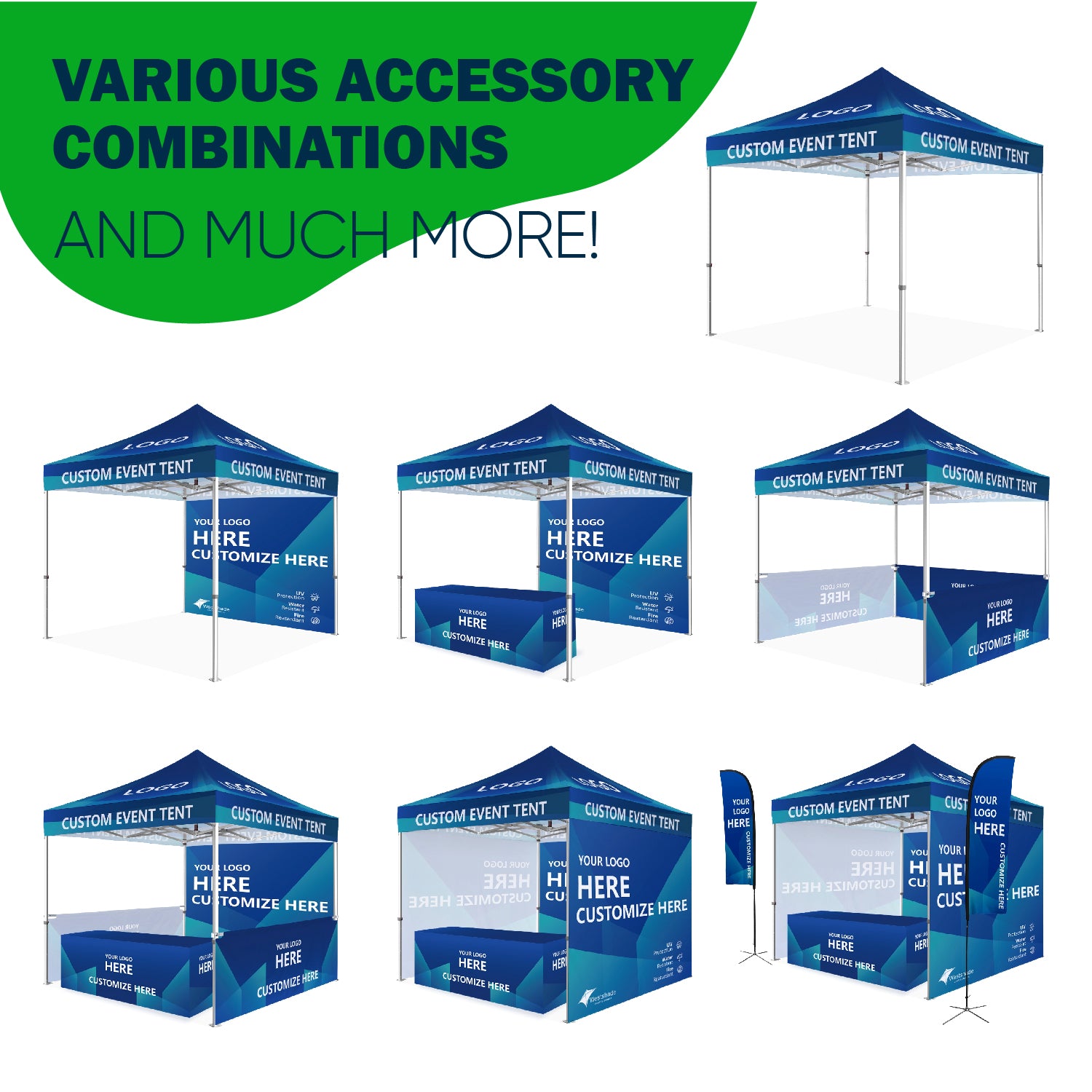
A commercial custom canopy setup can be configured using modular components to control traffic flow, provide wind protection, and maximize branded surface area.
Peak Graphic (Visible from long distance)
Valance Graphic (Eye-level main identity)
Backwall (Full-bleed branding)
Side Walls
Canopy Top Sections:
- Valance (Eaves): The flat, vertical border hanging down from the perimeter frame. This is the primary position for eye-level corporate text, websites, and secondary brand icons.
- Peak (Pinnacle Panels): The triangular upper sections of the canopy. Ideal for large primary logos that need visibility from distance across crowded event fields.
Full Backwalls: Solid fabric walls spanning the rear structure. Available as single-sided (blank or printed on one side with a white reverse) or double-sided (two printed layers sandwiching a light-blocking silver liner to prevent graphic bleed-through under direct sunlight).
Half Walls / Side Rail Walls: Lower-profile fabric barriers supported by a dedicated horizontal aluminum support bar clamped between frame legs. They serve as crowd control boundaries while providing lower-level display space.
Modular Accessories:
- Fitted/Stretch Table Covers: Matched to the canopy color palette using dye-sublimation.
- Flag Hardware Clamps: Mounts that attach directly to the outer canopy leg to hold feather flags, extending visual height up to 15–20 feet.
- Peak Banners: Modular dynamic banners suspended above the apex of the pop-up tent frame.
Technical Guidelines for Artwork Preparation
To achieve sharp line definition and exact brand color matching on custom printed canopies, prepress artwork files must adhere to strict technical parameters.
Correct Artwork Workflow:
- Vector Graphics: AI / EPS / PDF
- Convert All Text to Outlines (Ctrl+Shift+O)
- Assign Pantone PMS Solid Coated Colors
- Set CMYK Raster Images to Min 150 DPI @ 1:1 Scale
- Export to Print-Ready Vector Template
Vector Formats vs. Raster Images
- Vector File Standard: Logo art, iconography, and text must be authored in native vector formats (
.AI,.EPS, or vector-based.PDF). Vector graphics rely on mathematical equations to define lines and curves, allowing them to scale infinitely to 10-foot or 20-foot tent dimensions without loss of resolution. - Font Conversion: All typography within vector files must be converted to outlines or curves prior to submission. This converts font files into static geometric shapes, avoiding font substitution errors at the print pre-press stage.
- Handling Raster Images: Photographs or complex art components that cannot be vectorized must be provided at a minimum resolution of 150 DPI (Dots Per Inch) at 100% full print scale, or 300 DPI at 1:10 scale. Lower resolutions produce visible pixelation and blurring on large-scale fabric panels.
Color Systems: CMYK and Pantone Matching System (PMS)
Printing devices output color using cyan, magenta, yellow, and key/black (CMYK) ink channels. Digital art created in RGB (Red, Green, Blue) color space—designed for electronic screens—will shift significantly when converted to physical dye-sublimation inks.
- Pantone Matching System (PMS): To ensure corporate brand consistency across textile materials, designers should specify spot colors from the Pantone Solid Coated library.
- Substrate Color Shift: Fabric finishes absorb light differently than gloss paper. Print providers run color profile targets (ICC profiles) adjusted specifically for 500D or 600D polyester to translate PMS spot colors accurately.
Bleed, Safety Zones, and Stitch Line Planning
Canopy graphics are printed onto flat fabric panels and subsequently stitched together by industrial sewing machines.
- Bleed Area: Fabric extends beyond the visible finished boundary to allow for hem stitching and tensioning stretch. Artwork must extend fully into designated bleed zones to eliminate unprinted white edges.
- Safety Margin: Critical text and core brand logos should remain at least 2 to 3 inches inside the inner template cut line. This prevents critical details from being caught in heavy seam welds, corner reinforcement patches, or Velcro retention straps.
Technical Specifications Comparison
When evaluating custom canopy models, match the structural components and print techniques to your operational frequency and wind exposure requirements.
| Specification Parameter | Light-Duty / Promotional | Commercial Trade Show | Heavy-Duty Industrial / Outdoor |
|---|---|---|---|
| Typical Frame Material | Powder-Coated Steel | 40mm Hex Aluminum | 50mm Anodized Hex/Octagon Aluminum |
| Leg Tube Wall Thickness | 0.6mm – 0.8mm | 1.2mm – 1.5mm | 1.8mm – 2.0mm |
| Fabric Grade | 300D Polyester | 500D PU-Coated Polyester | 600D Heavy-Duty PU Polyester |
| Printing Technology | Heat Vinyl / Screen Print | Dye-Sublimation | Dye-Sublimation (UV-Coated) |
| Fire Certifications | None / Standard CPAI-84 | NFPA 701, CPAI-84 | NFPA 701, CPAI-84, CSFM Title 19 |
| Hydrostatic Head (Waterproof) | 800mm – 1000mm | 1500mm – 2000mm | 3000mm+ |
| Connector Joint Material | Plastic | High-Impact Molded Nylon | Cast Aluminum / Heavy Nylon |
| Weight (10x10 Complete) | ~35 - 45 lbs | ~50 - 60 lbs | ~70 - 85 lbs |
| Wind Threshold (Anchored) | Up to 12-15 mph | Up to 20-25 mph | Up to 28-35 mph |
Anchoring, Safety Protocols, and Wind Load Ratings
Unanchored canopy tents pose severe safety risks. Wind creates dynamic uplift underneath the canopy top, effectively turning the tent structure into an unguided sail.
Wind Force & Ballast Dynamics:
- Wind Direction creating Uplift Force on Canopy Top
- Frame Structure
- Ballast Weight (Min. 40 lbs/leg)
Recommended Ballast Mass by Footprint Size
Proper ballasting requires securing weight directly to the base of each vertical frame leg, ideally combined with upper-frame guy line tie-downs. Standard weight guidelines for calm to moderate outdoor conditions (winds under 20 mph) include:
- 10x10 ft Canopy: Minimum 40 lbs (18 kg) per leg (Total: 160 lbs minimum).
- 10x15 ft Canopy: Minimum 50 lbs (22.5 kg) per leg (Total: 200 lbs minimum).
- 10x20 ft Canopy: Minimum 60 lbs (27 kg) per leg (Total: 360 lbs minimum for 6 legs).
Types of Ballast Systems
- Cast-Iron Interlocking Plates: Specifically contoured to slot tightly around square or hex legs. They lower the center of gravity, eliminate tripping hazards, and maintain a professional appearance.
- Heavy-Duty Sandbags: Dual-zippered fabric bags wrapped around lower leg joints. Highly effective and inexpensive, but require manual filling and periodic fabric inspections for abrasion leaks.
- Water Weight Bags/Drums: Easy to transport empty and fill on-site. However, they occupy a larger physical footprint around the leg and can leak if punctured on rough concrete.
- Ground Stakes and Ratchet Straps: On grass or dirt surfaces, heavy spiral steel earth anchors driven deep into the ground—paired with high-tensile strength polyester ratchet straps attached to upper scissor joints—provide maximum resistance against uplift.
Operational Safety Thresholds
Pop-up commercial custom canopy tents are temporary structures. They are not engineered to withstand severe weather events.
- Wind Speed Limits: Standard commercial pop-ups should be continuously monitored if wind speeds exceed 20 mph (32 km/h). If sustained winds or gusts exceed 30 mph (48 km/h), the fabric top must be detached and the frame collapsed immediately, regardless of ballast weight.
- Shedding Wind Drag: If unexpected wind arises during an event, immediately remove all sidewalls and backwalls. Solid walls act as drag sails that increase lateral force on the aluminum legs exponentially.
- Water Accumulation (Ponding): In heavy rain, ensure the canopy top remains fully tensioned via the central peak pole mechanism. Accumulated water weight on slack fabric can bend scissor trusses and collapse frames instantly.
Maintenance, Cleaning, and Storage
Proper maintenance extends the operational lifespan of custom printed canopy fabric and keeps frame mechanics functioning smoothly over years of deployment.
Seasonal Maintenance Checklist:
- Clean Canopy Fabric: Soft brush + mild soap (No Bleach)
- Air-Dry 100%: Crucial: Prevents mold & delamination
- Inspect Framework: Tighten bolts & lubricate scissor joints
- Storage Environment: Dry, climate-controlled, inside protective bag
Fabric Care and Wash Protocols
- Cleaning Method: Wash custom printed polyester canopy tops using a soft-bristle brush, warm water, and a mild, non-detergent soap (such as dishwashing liquid).
- Prohibited Cleaners: Never use bleach, ammonia, or harsh industrial solvents. Bleach degrades the polyurethane waterproof backing and strips dye-sublimated pigments. Never place a commercial canopy top into a residential washing machine or dryer, as high thermal cycles and mechanical agitation destroy seam tapes and structural coatings.
- Drying Imperative: Allow the fabric top to air-dry 100% completely while fully pitched before folding or packing. Storing wet or damp polyester leads to rapid mildew growth, foul odors, and moisture-induced delamination of the inner PU waterproof layer.
Frame Maintenance Procedures
- Hardware Inspection: Periodically check all hex-head screws, truss bolts, and corner bracket joints using a standard Allen key or wrench. Tighten any loose fittings, but do not over-tighten plastic or nylon bracket sleeves.
- Joint Lubrication: Apply dry silicone spray to the sliding corner joints, push-pin assemblies, and scissor truss pivot points once per season. Avoid petroleum-based lubricants (like standard grease or oil), which attract dirt, sand, and abrasive dust into the moving tracks.
- Transport and Storage: Store the collapsed frame and folded canopy top in a padded roller bag equipped with rigid base plates. Store the unit upright or flat in a dry, climate-controlled storage environment away from direct sunlight and pest access.
Frequently Asked Questions
What is the difference between 500D and 600D polyester for custom canopy tents?
Denier (D) indicates the thread weight and thickness of the fabric weave. 600D polyester uses thicker yarns than 500D, offering higher resistance to punctures, tears, and physical abrasion. While both grades accommodate full-color dye-sublimation printing, 600D provides a sturdier feel, enhanced wind shear resistance, and a longer overall lifespan under heavy weekly usage.
Are custom printed canopy tents fully waterproof and fire retardant?
Quality commercial canopy tents are water-resistant and treated to resist fire, but compliance varies by manufacturer. Waterproofing relies on an internal Polyurethane (PU) coating and heat-sealed seam taping. Fire retardancy requires specific flame-inhibiting chemical treatments certified under standards such as NFPA 701 or CPAI-84. Always request official fire testing certificates from your tent supplier before participating in regulated indoor or outdoor venues.
Can I replace just the custom printed canopy top without buying a new frame?
Yes, provided your original tent frame uses standard industry dimensions and peak pole heights. Frame geometries differ among manufacturers—particularly peak height pitch, corner bracket attachment styles, and valance Velcro locations. It is safest to buy replacement canopy fabric from the original manufacturer or provide precise frame measurements to ensure proper fit and tensioning.
How do I ensure my corporate logo colors print accurately on the canopy?
To ensure accurate printing, submit your artwork using vector files (.AI, .EPS, or vector .PDF) with all colors designated as Pantone Matching System (PMS) Solid Coated spot colors. Avoid relying on screen visuals or RGB settings. Reliable print vendors use custom substrate ICC profiles to calibrate dye-sublimation printers, matching target Pantone colors as closely as synthetic polyester fibers allow.
What tent frame size is standard for commercial trade shows and outdoor events?
The most widely used commercial size is the 10x10 ft (3x3 meter) canopy tent. It fits within standard outdoor event spaces and indoor trade show booths. For larger exhibit footprints, 10x15 ft and 10x20 ft frames offer wider coverage while utilizing the same pop-up assembly mechanics.
Purchasing and Implementation Checklist
Before placing an order for a custom logo canopy tent, run through this step-by-step technical checklist:
- Verify Space & Venue Rules: Check local fire marshal requirements (e.g., NFPA 701 certification) and maximum footprint dimensions for your planned event venues.
- Select Frame Spec Based on Usage: Opt for a 40mm or 50mm hexagonal aluminum frame if deployed weekly or in outdoor environments with unpredictable wind. Choose powder-coated steel only for light indoor or seasonal use.
- Confirm Fabric & Printing Spec: Require a minimum of 500D PU-coated polyester with full-color dye-sublimation printing for max graphic longevity and resistance to cracking.
- Prepare Vector Artwork: Ensure all graphics are created in vector format, text is converted to outlines, raster images are at least 150 DPI at 1:1 scale, and colors are defined using Pantone Solid Coated spot codes.
- Procure Sufficient Ballast: Calculate mandatory ballast weights—at least 40 lbs per leg for standard 10x10 ft setups—and include rubber/cast iron plate weights or heavy-duty sandbags in your equipment budget.
Image Gallery
Select an image to open it in a new tab.




Ingrid Bjornson
Global Cyber Policy and Regulation Analyst
