The Rise of Famous Women Scientists in History: Pioneers, Discoveries, and Cultural Evolution

The rise of famous women scientists in history represents a shift from systemic exclusion to global recognition. By overcoming educational barriers and the "Matilda Effect"—the denial of credit to female researchers—women like Marie Curie and Rosalind Franklin transformed physics, biology, and chemistry, laying the groundwork for the inclusive scientific landscape seen in 2026.
The Foundations of Female Inquiry: Antiquity to the Enlightenment
The history of women in science did not begin with the modern era; rather, it began with individuals who pursued natural philosophy despite a lack of formal institutional support. In the ancient world, scientific inquiry was often reserved for the elite, yet women managed to leave indelible marks. Hypatia of Alexandria (c. 350–415 AD) stands as one of the earliest documented female mathematicians and astronomers. Her work on conic sections and her role as a teacher in a male-dominated society established a precedent for female intellectual authority. However, her tragic death also signaled the risks women faced when their intellectual influence challenged social or religious hierarchies.
As we moved into the Enlightenment, the "rise" of women scientists remained gradual and often obscured by domestic roles. During this period, science was frequently viewed as a "gentleman’s hobby," which occasionally allowed wives and sisters to participate as "invisible assistants." Caroline Herschel, working alongside her brother William, was the first woman to discover a comet and eventually received a salary from King George III for her work. This era was characterized by the tension between the intellectual curiosity of the individual and the rigid social structures that barred women from universities and scientific academies.
The significance of these early pioneers lies not just in their specific discoveries but in their role as proof of concept. They demonstrated that scientific aptitude was not gendered, even if access to scientific tools was. By the early 19th century, the stage was set for a more assertive presence of women in specialized fields like paleontology and mathematics.
Breaking the Institutional Barrier: The 19th Century Revolutionaries
The 19th century marked a critical turning point where women began to transition from assistants to primary investigators, though often without the titles or pay to match. Mary Anning (1799–1847) is a quintessential example of this struggle. A self-taught paleontologist from a working-class background, Anning discovered the first complete Ichthyosaurus and Plesiosaurus skeletons. Despite her expertise, she was never admitted to the Geological Society of London, which at the time excluded women. Her rise was a testament to the fact that empirical observation and field excellence could occasionally bypass institutional gatekeeping.
Simultaneously, in the realm of abstract theory, Ada Lovelace (1815–1852) was articulating the potential of mechanical computation. Working with Charles Babbage on the Analytical Engine, Lovelace realized that the machine could do more than mere calculation; it could manipulate symbols to create music or art if programmed correctly. Her "Notes" on the engine contain what is widely considered the first computer algorithm. Lovelace’s contribution was foundational, yet it took over a century for the computing world to fully acknowledge her as a visionary rather than a mere interpreter of Babbage's work.
These 19th-century figures represent the "rise" through sheer meritocracy. They operated on the fringes of the scientific establishment, yet their work was so significant that it could not be ignored by the history of their respective disciplines. Their legacy provided the momentum for the formal entry of women into scientific professions at the dawn of the 20th century.
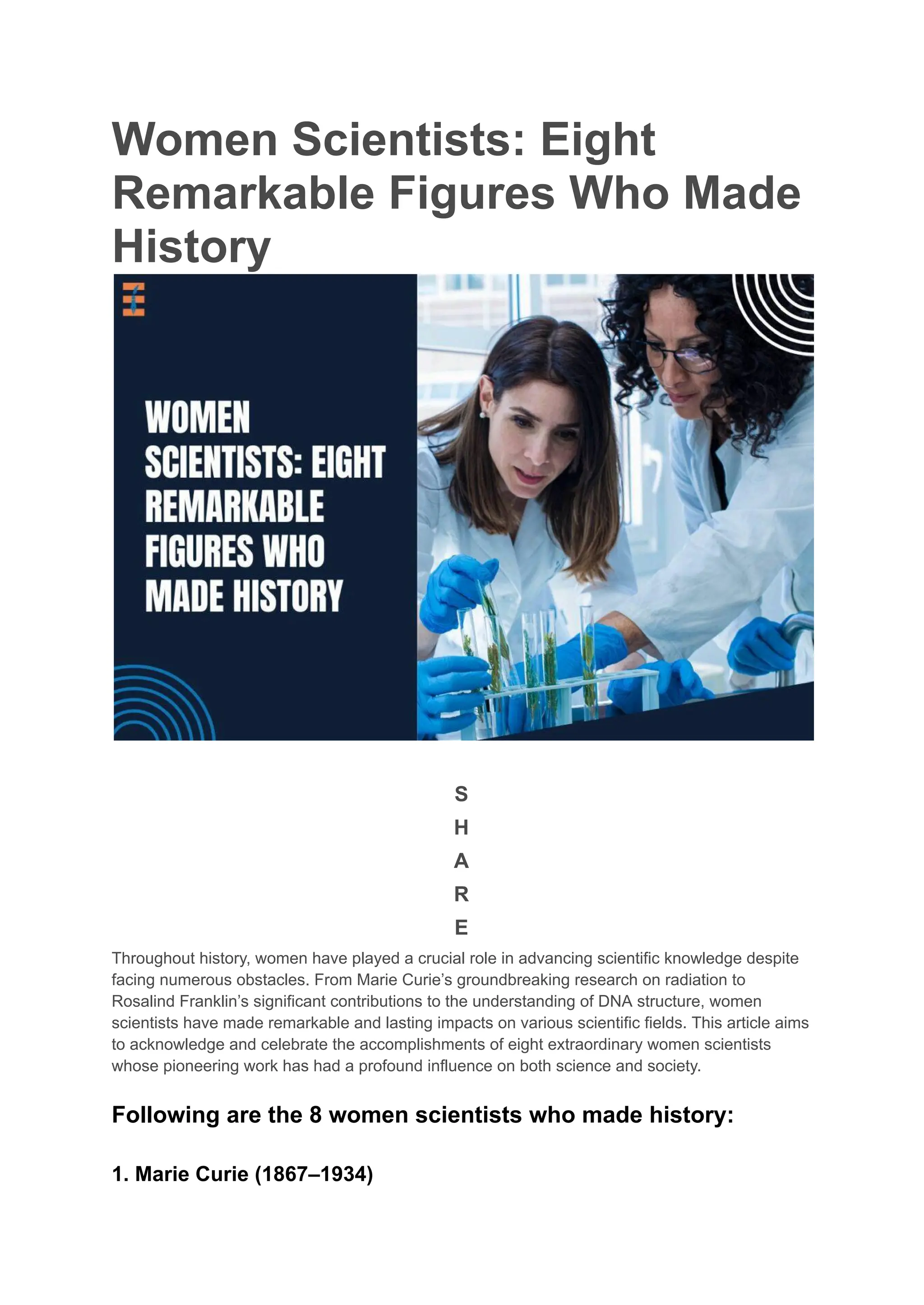
The Nobel Era: Marie Curie and the Formalization of Recognition
The rise of famous women scientists reached a peak of visibility with Marie Skłodowska-Curie (1867–1934). Curie’s career is a masterclass in persistence and technical brilliance. She was the first woman to win a Nobel Prize, the only woman to win in two different fields (Physics and Chemistry), and the first female professor at the University of Paris. Her discovery of polonium and radium and her development of the theory of radioactivity fundamentally altered our understanding of atomic physics.
Curie’s success was not just a personal victory; it was a structural disruption. When the Nobel Committee initially intended to honor only Pierre Curie and Henri Becquerel for the 1903 prize, Pierre insisted that Marie’s essential contributions be recognized. This moment highlighted a recurring theme in the history of women in science: the necessity of advocacy in the face of institutional bias. Marie Curie’s legacy established a "gold standard" for female excellence, proving that a woman could not only participate in science but lead an entire field into a new era.
The "Curie effect" inspired a generation of women to pursue higher education in the sciences. However, it also created a high bar of "exceptionalism," where only the most brilliant women were deemed worthy of recognition, while their male peers enjoyed more standard career paths. The mid-20th century would see women fighting to normalize their presence in labs, universities, and government agencies.
The Mid-20th Century: Genetics, Computing, and the Space Race
By the mid-1900s, women were making foundational contributions to the most cutting-edge fields of the era: molecular biology and computer science. Rosalind Franklin (1920–1958) provided the critical evidence needed to determine the structure of DNA. Her "Photo 51," an X-ray diffraction image, revealed the double-helix structure. However, her work was used without her knowledge by James Watson and Francis Crick, who later received the Nobel Prize. Franklin’s story is often cited as a primary example of the Matilda Effect, where female scientists' work is attributed to their male colleagues.
In the United States, the pressures of World War II and the Cold War opened doors in government research that had previously been closed. Grace Hopper (1906–1992), a rear admiral in the U.S. Navy, was a pioneer in computer programming who developed the first compiler and helped create COBOL, one of the first high-level programming languages. Her philosophy of "user-friendly" computing paved the way for the digital revolution.
The Space Race also highlighted the "Hidden Figures" of NASA—African American women like Katherine Johnson, Dorothy Vaughan, and Mary Jackson. These mathematicians performed the complex orbital mechanics calculations that made John Glenn’s orbit and the Apollo moon landings possible. Their rise was doubly difficult, as they had to navigate both gender-based discrimination and Jim Crow-era racial segregation. Their eventual recognition in the 21st century has become a symbol of the broader movement to recover lost histories in science.
Analyzing the Impact of Famous Women Scientists
To understand the scope of this historical rise, it is helpful to compare the contributions and the specific barriers faced by these scientists. The following table highlights key figures whose work changed the trajectory of scientific thought.
Comparison of Key Historical Figures in Science
| Scientist | Primary Field | Key Contribution | Primary Barrier Overcome |
|---|---|---|---|
| Hypatia | Mathematics/Astronomy | Commentary on Diophantus' Arithmetica | Religious/Political persecution |
| Mary Anning | Paleontology | First Ichthyosaurus/Plesiosaurus skeletons | Lack of formal education/Gender exclusion |
| Ada Lovelace | Computer Science | First computer algorithm | Victorian social expectations |
| Marie Curie | Physics/Chemistry | Discovery of Polonium and Radium | Lack of institutional funding/Bias |
| Lise Meitner | Nuclear Physics | Discovery of nuclear fission | War-time exile and gender bias |
| Rosalind Franklin | Molecular Biology | X-ray diffraction of DNA (Photo 51) | Unauthorized use of data/Matilda Effect |
| Katherine Johnson | Mathematics | Orbital mechanics for NASA missions | Racial segregation and gender bias |
| Tu Youyou | Medicine | Discovery of Artemisinin (Malaria cure) | Lack of Western academic recognition |
Understanding the Matilda Effect and Systemic Change
The "rise" of women in science is not merely a list of names; it is a history of overcoming the Matilda Effect. Coined by historian Margaret W. Rossiter in 1993, this term describes the systematic repression and denial of the contributions of female scientists. For decades, the work of women was often published under their husbands' names, or they were relegated to "technician" roles despite performing the intellectual labor of a lead investigator.
The shift toward the modern era involved two major changes:
- Educational Access: The opening of PhD programs to women in the late 19th and early 20th centuries allowed them to gain the credentials necessary for authority.
- Peer Review and Transparency: As the scientific community moved toward more transparent peer-review processes, it became harder (though not impossible) to elide the contributions of female co-authors.
In 2026, the rise of women in science is viewed through the lens of "retrospective justice." Organizations like the Nobel Foundation and NASA have made concerted efforts to highlight historical figures who were previously overlooked. This cultural shift is essential for encouraging the next generation of researchers, as it provides a more accurate and diverse set of role models.
The Modern Landscape: Women in Science as of 2026
As of 2026, the rise of women in science has transitioned from a movement of "firsts" to a period of institutional integration. While parity has not been reached in every field—specifically in certain engineering and high-level physics disciplines—the visibility of women at the highest levels of scientific leadership is at an all-time high. The success of researchers like Jennifer Doudna and Emmanuelle Charpentier (CRISPR-Cas9) and Katalin Karikó (mRNA vaccines) has solidified the role of women as the primary drivers of 21st-century biotechnology.
Current data from the National Science Foundation (NSF) and UNESCO indicate that while women now earn more than half of the bachelor’s degrees in biological sciences in many regions, the "leaky pipeline" (the loss of women at higher career stages) remains a point of focus for policy-makers. The rise in 2026 is measured not just by discoveries, but by the creation of supportive environments, including flexible tenure tracks and mentorship programs specifically designed for underrepresented groups in STEM.
Frequently Asked Questions
Who was the first woman to win a Nobel Prize?
Marie Curie was the first woman to win a Nobel Prize. She received the Nobel Prize in Physics in 1903, shared with Pierre Curie and Henri Becquerel, for their research on radiation. She later won a second Nobel Prize in Chemistry in 1911 for her discovery of the elements radium and polonium.
What is the Matilda Effect in the history of science?
The Matilda Effect is the phenomenon where the accomplishments of female scientists are attributed to their male colleagues. It was named by Margaret W. Rossiter after Matilda Joslyn Gage, a 19th-century suffragist who first observed this bias. Examples include Lise Meitner’s exclusion from the Nobel Prize for nuclear fission and Rosalind Franklin’s role in DNA discovery.
Why are the "Hidden Figures" important to the history of NASA?
The "Hidden Figures"—Katherine Johnson, Dorothy Vaughan, and Mary Jackson—were essential because they performed the manual and mechanical calculations required for early spaceflight. Their story highlights the intersection of gender and racial barriers and shows that scientific progress at NASA relied heavily on the intellectual labor of Black women who were often segregated from their white male counterparts.
How has the representation of women in STEM changed by 2026?
By 2026, representation has improved significantly in life sciences and medicine, though challenges remain in computer science and engineering. There is now a much greater emphasis on "DEI" (Diversity, Equity, and Inclusion) initiatives and the "recovery" of historical female figures, ensuring that women’s contributions are documented and celebrated from the start of their careers.
Who is considered the first computer programmer?
Ada Lovelace is widely considered the first computer programmer. In 1843, she published a set of notes on Charles Babbage’s Analytical Engine. Her "Note G" contained an algorithm for calculating Bernoulli numbers, which is recognized as the first complete program designed for a machine.
Recommendations for Further Exploration
To truly understand the rise of women in science, one should move beyond general biographies and look at the primary sources of their work. Reading Marie Curie’s laboratory notebooks or Ada Lovelace’s correspondence provides insight into their technical rigor and the societal pressures they navigated. For those interested in supporting the continued rise of women in science in 2026, contributing to scholarship funds for women in STEM or participating in mentorship programs through organizations like the Association for Women in Science (AWIS) are practical and impactful next steps.
Image Gallery
Select an image to open it in a new tab.



Akira Tanaka
International Academic Trends Correspondent
