Mastering Forex Time Zones and Understanding Market Hours

The foreign exchange market operates continuously 24 hours a day, five days a week, by shifting across four major global financial centers: Sydney, Tokyo, London, and New York. Understanding these time zones and their overlapping sessions is essential for traders looking to capitalize on high liquidity, manage volatility, and optimize execution timing.
Navigating the global currency market requires more than just knowing technical chart patterns and fundamental economic indicators. Because currencies are traded globally without a centralized exchange, price action and market liquidity ebb and flow depending on which financial hubs are open for business. To trade efficiently, participants must synchronize their strategies with the opening and closing hours of the world's primary financial centers. This dynamic structural reality shapes spread costs, execution speeds, and the overall probability of trend continuation or reversal during any given trading day.
The Core Architecture of the 24-Hour Forex Market
Unlike traditional equity markets that open and close at fixed daily bells on specific domestic exchanges, the foreign exchange market is an Over-the-Counter (OTC) network. This decentralized setup means institutional participants, commercial banks, central banks, and retail brokers trade directly with one another across the globe via electronic networks.
The market week begins on Sunday evening at approximately 22:00 Universal Time Coordinated (UTC) as financial institutions in New Zealand and Australia open their trading desks. It concludes on Friday evening at roughly 22:00 UTC when trading ceases in New York. This continuous loop allows participants to react to geopolitical events, macroeconomic data releases, and central bank announcements at any hour. However, continuous operation does not mean uniform activity. Liquidity fluctuates significantly depending on the time of day, creating distinct trading sessions defined by the awakening and closing of major capital centers.
The Four Major Trading Sessions
The global trading day is conventionally broken down into four dominant sessions, named after the principal financial hubs that anchor them:
- The Sydney (Australian) Session: Serving as the unofficial start of the new trading day, Sydney opens the institutional flow. While generally experiencing lower volatility and thinner liquidity compared to London or New York, it provides crucial early-week price action and reacts to Asia-Pacific economic data.
- The Tokyo (Asian) Session: Often referred to as the Asian session, Tokyo sees increased volume, particularly in currency pairs involving the Japanese Yen, Australian Dollar, and New Zealand Dollar. Range-bound trading strategies frequently characterize this period due to the absence of European and North American institutional weight.
- The London (European) Session: London is the undisputed heavyweight of global foreign exchange trading, accounting for a massive share of daily turnover. The opening of London injects substantial liquidity into the market, frequently establishing directional trends that persist well into the North American session.
- The New York (North American) Session: Anchored by Wall Street and the broader U.S. financial ecosystem, New York is the second-largest trading center. It handles a massive volume of transactions, particularly during its overlap with the London session, when economic data from the United States is released.
Global Session Schedules and Daylight Saving Time Shifts
To track market hours accurately, traders must convert local times to a standard reference point, typically UTC or Eastern Time (ET) in the United States. However, calculating these hours is complicated by the fact that different countries observe Daylight Saving Time (DST) on mismatched schedules.
For instance, the United States and Canada typically adjust their clocks forward in mid-March and backward in early November. Meanwhile, European Union nations follow a slightly different schedule for transitioning between Central European Time (CET) and Central European Summer Time (CEST). Australia and New Zealand, situated in the Southern Hemisphere, experience seasons opposite to the Northern Hemisphere, shifting their clocks backward when North America and Europe are moving theirs forward.
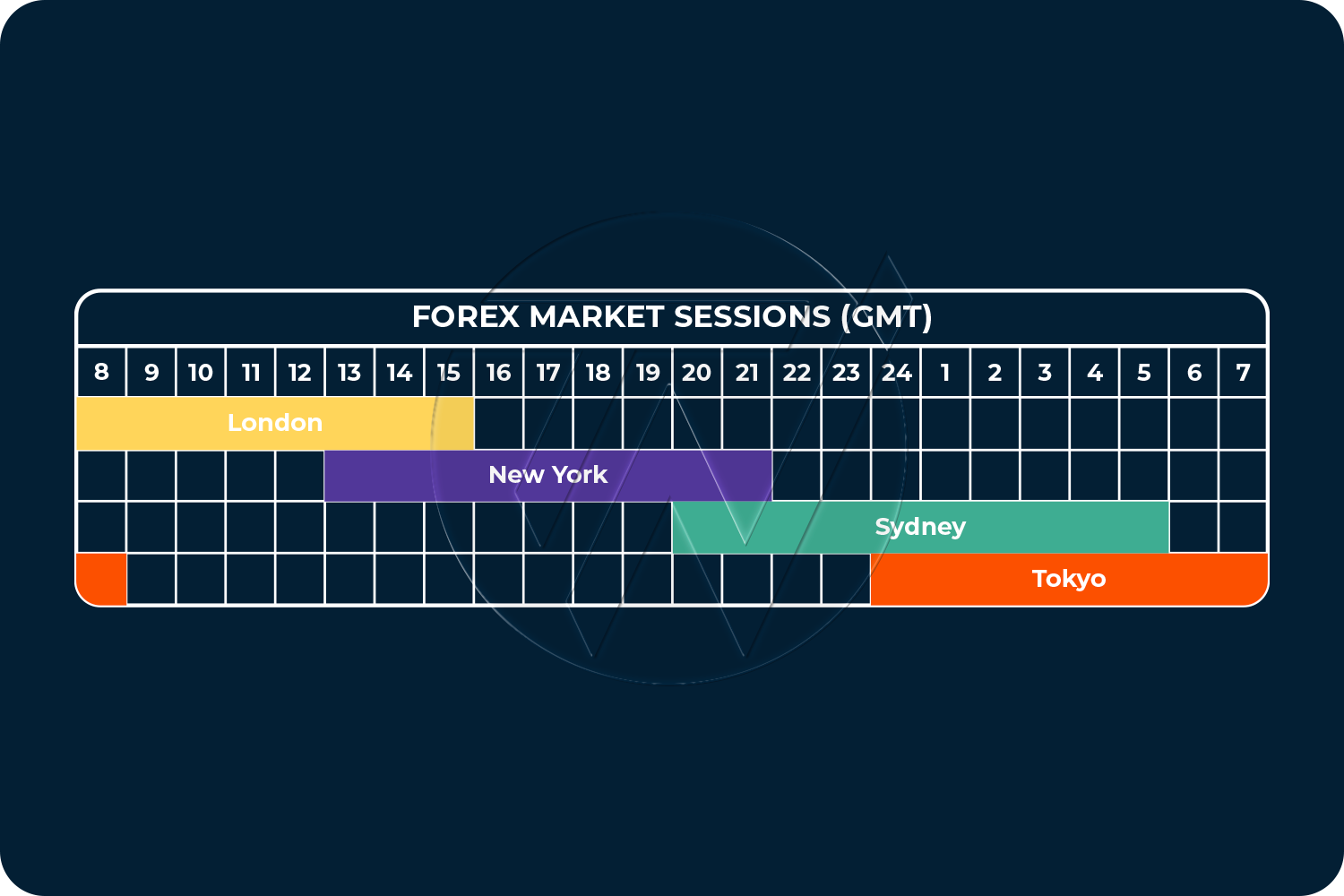
These discrepancies mean that the absolute UTC times for market openings and closings shift by one hour twice a year. Below is a general structural breakdown of standard session hours relative to UTC during the Northern Hemisphere winter months:
| Trading Session | Opening Time (UTC) | Closing Time (UTC) | Key Characteristics |
|---|---|---|---|
| Sydney | 22:00 (Sunday) | 07:00 (Friday) | Low volatility; focused on AUD, NZD, and JPY pairs. |
| Tokyo | 00:00 | 09:00 | Moderate volume; Asian macroeconomic releases; range-bound tendencies. |
| London | 08:00 | 16:00 | Massive liquidity; high volatility; major trend establishment. |
| New York | 13:00 | 21:00 | Heavy volume, US economic data, high liquidity overlap with London. |

The Power of Market Overlaps
While individual sessions have distinct characteristics, the most critical periods for active currency traders occur when two major sessions overlap. During these windows, the volume of active institutional participants multiplies, leading to tighter bid-ask spreads, deeper order books, and intensified price volatility.
The London and New York Overlap
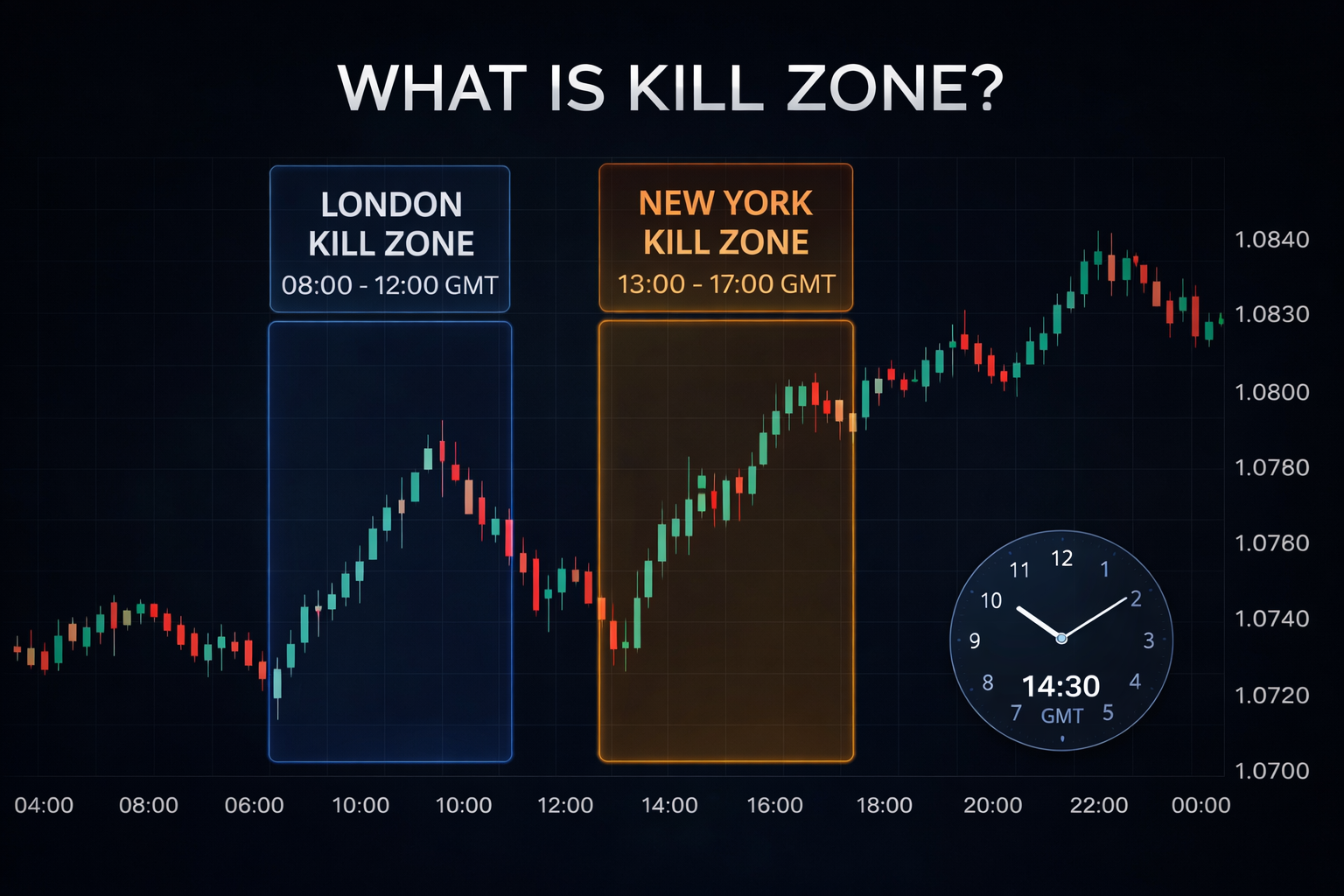
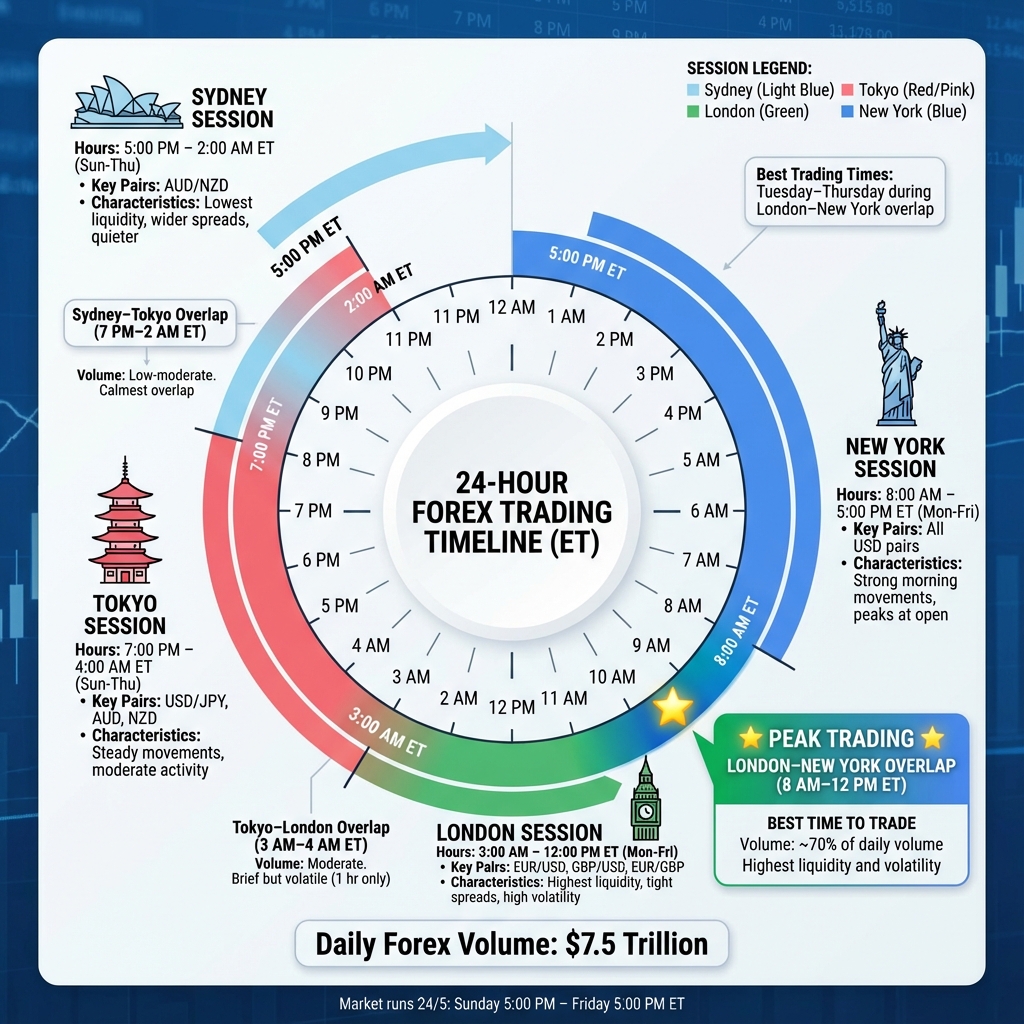
The most heavily traded window of the entire 24-hour cycle is the overlap between the London and New York sessions, occurring between 13:00 UTC and 16:00 UTC (8:00 AM to 11:00 AM Eastern Time). During these three hours, the world's two largest financial capitals are active simultaneously. Institutional desks in Europe are finishing their trading day while North American market participants are hitting peak operational capacity.
Major macroeconomic data releases from the United States, such as Non-Farm Payrolls (NFP), Consumer Price Index (CPI) reports, and Federal Reserve rate decisions, typically drop right at the beginning of this window. Consequently, this overlap frequently produces the most reliable trend breakouts, highest intraday volume, and tightest spreads for major currency pairs like the EUR/USD and GBP/USD.
The Tokyo and London Overlap
Another notable, though less volatile, overlap occurs between the Tokyo and London sessions, spanning from 08:00 UTC to 09:00 UTC. During this one-hour bridge, Asian trading desks are wrapping up their day while European participants are logging in. While liquidity increases during this brief window, it is generally considered a transition phase rather than a prime engine for major trend continuation.
Strategic Implications of Forex Market Hours
Trading without regard to time zones exposes participants to unnecessary friction, including wider spreads, erratic price spikes, and low liquidity traps. Understanding market hours allows traders to align their tactical execution with institutional behavior.
Liquidity, Spreads, and Slippage
Liquidity is the lifeblood of efficient trading. When market depth is high—such as during the London-New York overlap—large institutional orders can be filled with minimal price disruption, resulting in tight bid-ask spreads (the difference between the buying and selling price). Conversely, during the late-night hours between the close of New York and the opening of Sydney (roughly 21:00 to 22:00 UTC), liquidity dries up significantly.
During these low-liquidity periods, spreads widen considerably. Retail traders attempting to execute market orders may experience slippage, where the executed price differs unfavorably from the requested price due to a lack of opposing order book depth.
Matching Strategies to Specific Sessions
Different market hours favor distinct trading styles:
- Breakout and Trend Traders: Often focus their efforts during the London session and the London-New York overlap. The heavy volume during these hours helps sustain directional momentum, reducing the likelihood of false breakouts.
- Range and Scalping Traders: Frequently look to the Tokyo session or the quiet inter-session periods. During these times, currency pairs like the AUD/USD or USD/JPY often respect established technical support and resistance boundaries due to steadier, lower-volume flows.
Frequently Asked Questions
What are the best hours to trade the foreign exchange market?
The optimal hours to trade depend on your strategy, but the period featuring the London and New York session overlap (13:00 UTC to 16:00 UTC) offers the highest liquidity and tightest spreads. Major currency pairs see their peak trading volume during this window, making it ideal for trend-following and momentum strategies.
Does the forex market actually stay open 24 hours a day?
Yes, the retail and institutional spot markets operate 24 hours a day from Sunday evening through Friday evening. This continuous availability is made possible by the global network of interbank dealers passing trading activity from Sydney to Tokyo, then to London, and finally to New York.
How do Daylight Saving Time changes affect market hours?
Daylight Saving Time shifts cause market opening and closing times to move by one hour relative to UTC, depending on the time of year. Because the United States, Europe, and Australia transition to and from summer time on different dates, there are brief transitional weeks where standard schedule calculations must be adjusted.
Why do bid-ask spreads widen during certain hours?
Spreads widen when market liquidity decreases, typically during the transition between the New York close and the Sydney open, or during major holiday closures. With fewer buyers and sellers active in the order book, brokers increase spreads to compensate for the higher risk of holding open positions.
Can I trade forex on weekends?
Retail and institutional spot markets are officially closed over the weekend, starting on Friday evening (around 22:00 UTC) and reopening on Sunday evening. While some brokers offer weekend crypto or synthetic index trading, traditional currency pairs cannot be traded during this window, though weekend news events can cause significant price gaps when the market reopens.
Practical Next Actions for Traders
To put this knowledge into practice, start by auditing your current trading schedule against the UTC session times outlined in this guide. Configure your trading platform's time zone settings to match either your local time or UTC to eliminate confusion during daylight saving shifts. Next, identify the specific currency pairs you intend to trade and observe how their volatility and spread structures change across different sessions over the course of a week. By synchronizing your execution windows with peak institutional liquidity, you can reduce transaction costs and improve your overall trading efficiency.
Image Gallery
Select an image to open it in a new tab.



Lars Thomsen
Global Labor Markets and Economic Strategy Editor
