When you take a partial surrender from a permanent life insurance policy or a non-qualified annuity, the IRS treats the distribution according to specific statutory rules that determine whether the withdrawal is taxable income or a tax-free return of your principal. Understanding these tax implications is essential for policyholders and investors who rely on cash value accounts for supplemental income, emergency funds, or retirement planning, as failing to navigate the nuances of cost basis, FIFO, and LIFO accounting can trigger unexpected tax liabilities and penalties.
Introduction to Partial Surrenders and Cash Value Vehicles
Financial products like permanent life insurance (such as whole life or universal life) and fixed, indexed, or variable annuities accumulate cash value over time. Accumulation occurs through premium payments and credited interest, dividends, or market gains. When a contract owner needs liquidity without terminating the entire policy, they can execute a partial surrender—withdrawing a portion of the accumulated cash value while keeping the underlying insurance or annuity contract active.
However, withdrawing funds from these contracts is not as simple as withdrawing money from a traditional bank savings account. The Internal Revenue Service (IRS) enforces strict rules governing how distributions from cash value products are taxed. These regulations depend heavily on whether the contract is structured as a life insurance policy or an annuity, the relationship between the withdrawal amount and the contract's cost basis, and whether the policy is classified as a Modified Endowment Contract (MEC).
Navigating partial surrender taxation requires a firm grasp of underlying concepts such as cost basis, gross distributions, and statutory ordering rules. This guide breaks down the mechanics of partial surrenders, explores the distinct tax treatments for life insurance versus annuities, highlights the dangers of Modified Endowment Contracts, and offers practical strategies to minimize your tax exposure.
Understanding Cost Basis and Its Role in Taxation
At the heart of partial surrender taxation is the concept of cost basis (often simply called "basis"). Your cost basis represents the total amount of after-tax money you have invested into the contract. For most life insurance policies and annuities, the cost basis is equal to the sum of all the premiums you have paid, minus any previous tax-free withdrawals or dividends you have already received.
The fundamental tax principle governing partial surrenders is that a return of your own principal—money that has already been taxed—is generally not subject to income tax. You are only taxed on the portion of the distribution that exceeds your cost basis, which represents earnings, interest, or investment gains generated within the policy.
To determine the exact tax consequences of any withdrawal, you must compare the amount of the partial surrender against your current cost basis. If your withdrawal is less than or equal to your remaining cost basis, the entire transaction is typically tax-free. If the withdrawal exceeds your cost basis, the excess amount is treated as taxable ordinary income.
Tax Treatment of Partial Surrenders in Life Insurance Policies
The taxation of partial surrenders from life insurance policies depends primarily on whether the policy passes standard tax tests or has been reclassified as a Modified Endowment Contract due to excessive funding.
Non-MEC Life Insurance Policies: The FIFO Rule
For standard (non-MEC) life insurance policies, the IRS generally applies the FIFO (First-In, First-Out) accounting method to partial surrenders during the early years of the contract, or treats them as a return of basis first under Internal Revenue Code (IRC) Section 72.
Under the standard operational rules for non-MEC policies:
- Return of Basis: Withdrawals are treated as coming from your cost basis first. Therefore, as long as your cumulative withdrawals do not exceed your total premium payments, the distributions are entirely income tax-free.
- Exceeding Basis: Once your partial surrenders exhaust your entire cost basis, any subsequent withdrawals or distributions are treated as taxable income (earnings out).
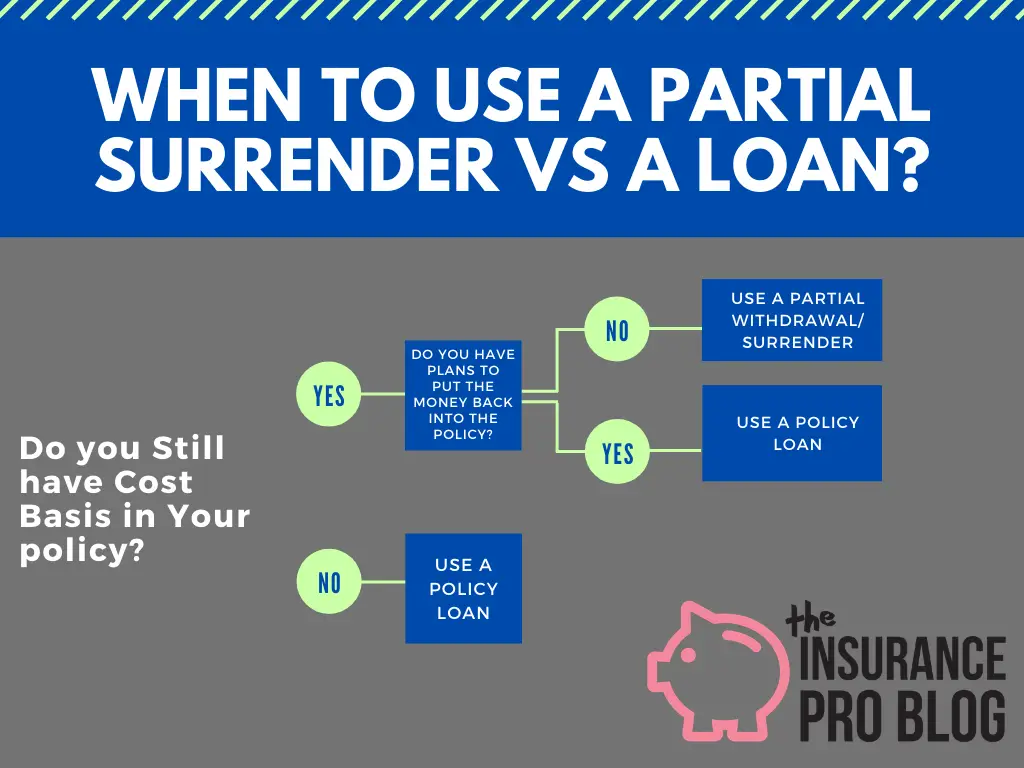
Note on Policy Loans: Many policyholders choose to take policy loans against their cash value instead of executing a partial surrender. Policy loans are generally not treated as taxable distributions, provided the policy remains in force and does not lapse. However, if a policy with outstanding loans lapses or is surrendered entirely, the outstanding loan balance is treated as a cash distribution and can trigger a massive tax liability if it exceeds the cost basis.
Modified Endowment Contracts (MECs) and the LIFO Rule
If a life insurance policy receives too much premium relative to its death benefit within the first seven years of the contract—or after a material change—it fails the "7-pay test" established by Congress in 1988 and becomes a Modified Endowment Contract (MEC).
Once a policy is classified as a MEC, the tax rules change dramatically:
- LIFO Accounting: Partial surrenders and policy loans from a MEC are governed by LIFO (Last-In, First-Out) rules. This means the IRS assumes that all withdrawals consist of accumulated earnings first, before any return of principal.
- Immediate Taxation: Every dollar withdrawn from a MEC is treated as taxable ordinary income until all earnings within the policy have been completely exhausted.
- Early Withdrawal Penalties: If you take a partial surrender or policy loan from a MEC before you reach age 59½, the taxable portion of the distribution is subject to an additional 10% IRS early withdrawal penalty, much like a traditional IRA or 401(k).
Tax Treatment of Partial Surrenders in Annuities
Annuities operate under different statutory rules than life insurance policies. Whether your annuity is tax-qualified (funded with pre-tax dollars, such as an IRA or 403(b)) or non-qualified (funded with after-tax dollars) drastically alters how partial surrenders are taxed.
Non-Qualified Annuities
Non-qualified annuities are purchased with after-tax funds. However, unlike standard life insurance policies, non-qualified annuities are strictly subject to LIFO (Last-In, First-Out) taxation rules under IRC Section 72(e).
When you take a partial surrender from a non-qualified annuity:
- Earnings First: The IRS views the distribution as coming out of your accumulated earnings first.
- Ordinary Income Tax: You must pay ordinary income tax on the entire withdrawal amount until all the interest and investment gains inside the annuity have been fully withdrawn. Only after every dollar of earnings has been taxed can you begin withdrawing your original cost basis tax-free.
- 10% IRS Penalty: If you take a partial surrender from a non-qualified annuity before age 59½, the earnings portion of the withdrawal is subject to a 10% early withdrawal penalty, subject to narrow statutory exceptions (such as death, disability, or annuitization through substantially equal periodic payments).
Qualified Annuities
Qualified annuities are held inside retirement accounts like traditional IRAs, SEP IRAs, or employer-sponsored plans. Because the contributions to these accounts were made with pre-tax dollars (or tax-deductible contributions), the entire balance—both principal and earnings—has never been taxed.
Consequently, any partial surrender or distribution from a qualified annuity is 100% taxable as ordinary income in the year it is received. Furthermore, withdrawals taken before age 59½ are subject to the standard 10% early withdrawal penalty unless an IRS exemption (such as age 59½, death, disability, or specific medical expenses) applies.
Comparison of Partial Surrender Taxation Rules
| Financial Product Type | Accounting Rule (FIFO vs. LIFO) | Taxation of Withdrawals | Penalty Before Age 59½ |
|---|---|---|---|
| Non-MEC Life Insurance | FIFO (Basis First) | Tax-free up to cost basis; taxable income thereafter. | None (unless policy lapses with loans). |
| Modified Endowment Contract (MEC) | LIFO (Earnings First) | 100% taxable as ordinary income until all earnings are depleted. | 10% penalty on the taxable portion of the withdrawal. |
| Non-Qualified Annuity | LIFO (Earnings First) | 100% taxable as ordinary income until all earnings are depleted. | 10% penalty on the taxable portion of the withdrawal. |
| Qualified Annuity (Traditional IRA/etc.) | N/A (100% Pre-Tax) | 100% taxable as ordinary income upon distribution. | 10% penalty on the full distribution, with standard IRS exceptions. |
Mechanics, Surrender Charges, and Contractual Fees
Beyond federal and state income taxes, policyholders and annuity owners must account for the contractual costs associated with partial surrenders. Insurance companies and financial institutions often impose fees that can severely erode your cash value.
Surrender Charges
Most permanent life insurance policies and deferred annuities feature a surrender charge schedule that lasts for a specific period (frequently 7 to 15 years) following contract inception or subsequent premium payments. If you execute a partial surrender during this surrender charge period, the insurer will deduct a percentage fee from the withdrawn amount.
- Impact on Basis: It is vital to understand how your insurer calculates the reduction in your cost basis when surrender charges apply. In many cases, the reduction to your basis equals the gross withdrawal amount (including the surrender fee), even though you received a smaller net payout. This can accelerate the point at which your basis is exhausted and future withdrawals become taxable.
- Free Withdrawal Provisions: Many contracts allow owners to withdraw a specific percentage of the cash value annually (typically 10%) without incurring surrender charges. However, these contractual fee waivers do not exempt the withdrawal from federal income tax rules.
Reduction in Death Benefit and Cash Value
A partial surrender permanently reduces the cash value of your contract by the exact gross amount withdrawn. In permanent life insurance, this reduction often triggers a proportional or dollar-for-dollar reduction in the policy's death benefit. If the death benefit drops too low relative to the cash value, it can compromise the policy's tax-qualified status or increase future internal insurance costs (cost of insurance charges), potentially causing the policy to lapse prematurely.
Common Mistakes to Avoid
Navigating cash value withdrawals involves several technical pitfalls. Avoiding these common errors protects your financial standing:
- Assuming All Life Insurance Withdrawals Are Tax-Free: Failing to check whether a life insurance policy has become a Modified Endowment Contract (MEC) is a severe error. Mistakenly applying FIFO rules to a MEC will result in unexpected tax bills and IRS penalties.
- Ignoring the Tax Impact of Policy Surrender: Walking away from a policy by executing a full surrender without calculating outstanding loans can create a "phantom income" tax liability, where you owe taxes on money you never actually received in cash.
- Overlooking State Income Taxes: In addition to federal income taxes, states levy income taxes on taxable distributions from annuities and MECs. Always factor state tax rates into your net liquidity calculations.
- Failing to Track Cost Basis: Insurance companies do not always report historical cost basis accurately on every annual statement, especially after multiple partial withdrawals, dividend elections, or policy changes. Contract owners should maintain independent records of all premium payments and past distributions.
Frequently Asked Questions
Are withdrawals from a cash value life insurance policy considered taxable income?
Generally, withdrawals from a standard, non-MEC life insurance policy are not taxable up to the amount of your cost basis (total premiums paid). Once your withdrawals exceed your cost basis, the excess is treated as taxable ordinary income. However, if the policy is classified as a Modified Endowment Contract, all withdrawals are taxed as earnings first under LIFO rules.
What is the difference between a policy loan and a partial surrender?
A partial surrender permanently removes cash value and reduces your death benefit, and it cannot be repaid. A policy loan allows you to borrow against your cash value while keeping the funds inside the policy to earn interest or dividends. Loans are not immediately taxable unless the policy lapses or is surrendered with an outstanding loan balance that exceeds the cost basis.
How do I know if my life insurance policy is a Modified Endowment Contract (MEC)?
Your insurance carrier is legally required to notify you if a premium payment causes your policy to violate the 7-pay test and become a MEC. You can also request an in-force illustration or a formal compliance status report from your insurance agent or carrier customer service department.
Can I avoid the 10% penalty on annuity withdrawals before age 59½?
Yes, the 10% IRS penalty on early annuity distributions can be avoided under specific statutory exceptions, including distributions made due to the owner's death or disability, or when taking distributions as a series of substantially equal periodic payments (SEPP) under IRC Section 72(q). However, ordinary income tax still applies to the taxable portion of the withdrawal regardless of penalty exemptions.
Conclusion and Next Actions
Partial surrender taxation depends entirely on the legal classification of your contract, your accumulated cost basis, and statutory accounting rules like FIFO and LIFO. Before requesting a withdrawal from a permanent life insurance policy or annuity, review your annual contract statement to verify your current cost basis, check for applicable surrender charges, and confirm whether your policy is classified as a Modified Endowment Contract. Because tax laws regarding insurance and annuity products are complex and subject to individual financial circumstances, consult a qualified tax professional or certified financial planner before executing any major cash value transactions.
Image Gallery
Select an image to open it in a new tab.
Ingrid Bjornson
Global Cyber Policy and Regulation Analyst
