
CyberArk Software serves as a foundational component of modern identity security by focusing on the protection of privileged accounts—the digital "keys to the kingdom"—that grant administrative control over critical infrastructure, applications, and data. By mitigating the risks associated with excessive permissions, the platform provides specialized controls to monitor, manage, and audit privileged sessions across cloud, on-premises, and hybrid environments.
The Role of Privileged Access Management (PAM)
Privileged Access Management (PAM) is a specialized subset of Identity and Access Management (IAM). While standard IAM focuses on granting users access to the specific resources required for their daily tasks, PAM specifically targets accounts that possess elevated permissions. These include domain administrators, database administrators, service accounts, and root-level credentials.
In a modern enterprise environment, these privileged accounts represent the highest level of risk. If a standard user account is compromised, the impact is generally limited to that user’s access. However, if a privileged account is compromised, an attacker can theoretically gain full control over the network, exfiltrate sensitive data, or install ransomware across the entire organization. CyberArk provides a centralized architecture to discover these accounts, vault them in secure environments, and rotate passwords automatically to ensure that compromised credentials have a limited shelf life.
Core Capabilities of CyberArk Software
The CyberArk Identity Security Platform operates through a suite of modules designed to address various aspects of the privileged access lifecycle. Understanding these core functions is essential for organizations attempting to map their security posture against the CyberArk ecosystem.
Privileged Session Management
One of the primary concerns for security teams is not just who has access to a system, but what they do while they are inside it. CyberArk’s session management tools act as a proxy between the administrator and the target server. All activity is recorded, providing a high-fidelity audit trail that is resistant to tampering. This allows compliance officers to verify exactly what changes were made during an administrative session, satisfying requirements for regulatory frameworks such as HIPAA, GDPR, or PCI DSS.
Credential Vaulting and Rotation
Manual password management for infrastructure is a significant security vulnerability. CyberArk provides a secure "digital vault" where administrative credentials reside. Rather than IT staff knowing the raw root password to a production server, they log into the CyberArk interface. The platform injects the credentials directly into the target machine, meaning the human user never sees or touches the actual password. Furthermore, the platform automatically rotates these passwords at regular intervals or after every session, rendering static password theft ineffective.
Discovery and Remediation
Organizations often struggle with "privileged sprawl," where administrative accounts are created for projects and never deleted. CyberArk’s discovery engines scan the network to identify hidden accounts, hard-coded credentials in scripts, and orphaned administrative rights. By bringing these under management, the platform eliminates blind spots in the infrastructure.
Technical Architecture and Deployment Options
CyberArk can be deployed in various configurations depending on the architectural needs of the organization, ranging from self-hosted data centers to fully managed Software-as-a-Service (SaaS) environments.
- Self-Hosted (On-Premises): Traditionally favored by large enterprises with strict data sovereignty requirements. This approach requires the organization to manage the underlying infrastructure, including the vault servers and redundant components, offering total control over updates and configuration.
- CyberArk Cloud/SaaS: This is increasingly the standard for modern deployments. By leveraging a SaaS model, organizations reduce the operational overhead associated with patching, hardware maintenance, and scaling. The platform integrates via secure connectors that bridge the cloud-hosted control plane with the local network assets.
- Hybrid Deployments: Many organizations choose a hybrid approach, using the SaaS version for modern cloud-native applications while maintaining specific on-premises components for legacy systems that cannot be easily exposed to public cloud management tools.
Comparing Privileged Access Management Approaches
| Feature | Legacy Manual Access | CyberArk Managed Access |
|---|---|---|
| Credential Storage | Local files or sticky notes | Encrypted, hardened vault |
| Password Updates | Manual intervention required | Automated, policy-driven rotation |
| Visibility | Logs limited to target system | Full, immutable video session logs |
| Risk of Compromise | Persistent, long-term exposure | Just-in-time access; single-use |
| Compliance Audit | Difficult, requires aggregation | Centralized reporting and analytics |
The "Just-in-Time" Security Philosophy
A significant shift in 2026 security trends is the movement toward "Just-in-Time" (JIT) access. Instead of granting an administrator standing privileges—where they hold administrative rights 24/7—CyberArk allows organizations to grant rights only when requested and only for a specific duration.
Under a JIT model, a server may be "locked down" by default, with no active privileged sessions. When a technician requires access to perform a patch, they request access through the platform. CyberArk verifies the identity, potentially triggers a Multi-Factor Authentication (MFA) prompt, and then grants temporary elevation. Once the session expires, the privileges are automatically revoked. This reduces the "attack surface" significantly, as an attacker would need to breach the system during the exact window when the privilege was elevated.
Challenges and Operational Considerations
While CyberArk provides robust security, it is not a "set it and forget it" tool. Implementation requires careful planning to avoid disrupting IT operations.
- Integration Complexity: Connecting the platform to legacy systems, niche industrial controllers, or custom-built internal applications can require custom development or specialized connectors.
- Cultural Change: Moving from a model where IT staff "know" the root passwords to one where they must request them through an interface can cause resistance. Clear internal policies and training are required to ensure the transition does not hamper productivity.
- High Availability: Because the platform controls access to the entire infrastructure, any downtime for the vault is a potential outage for the whole enterprise. Robust disaster recovery and redundant cluster configurations are mandatory for any enterprise-grade deployment.
Frequently Asked Questions
1. Does CyberArk replace standard Active Directory accounts? No. CyberArk complements Active Directory by managing the elevated rights associated with specific accounts. It provides a layer of security on top of your existing identity infrastructure to ensure that if a domain controller is targeted, the most sensitive credentials are protected within a hardened vault.
2. How does CyberArk handle off-network access for remote IT teams? The platform supports secure remote access via encrypted gateways. IT staff connect to the CyberArk portal, and the platform proxies the session to the target asset inside the corporate network. This eliminates the need for VPNs in some scenarios and ensures all remote administrative work is recorded.
3. Is CyberArk suitable for small to mid-sized businesses? Historically, CyberArk was viewed as an enterprise-only solution due to its complexity. However, the maturation of their SaaS offerings has made it more accessible to mid-market organizations, though it remains a significant investment that requires dedicated security expertise to manage effectively.
4. Can CyberArk manage non-human, machine-to-machine credentials? Yes. This is a critical feature known as "Secrets Management." CyberArk can manage the credentials used by applications, CI/CD pipelines, and automated scripts to communicate with one another, preventing hard-coded passwords in source code.
5. What happens if the CyberArk vault goes offline? Properly architected CyberArk environments utilize high-availability clusters and disaster recovery sites. If the primary vault fails, the system is designed to failover to a standby node to maintain operational continuity.
Recommendation for Implementation
For organizations beginning their journey with CyberArk, the recommended first step is a discovery audit. Rather than attempting to vault all accounts immediately, utilize the discovery features to map exactly where privileged accounts exist and prioritize them by risk. Focus on the "crown jewels"—the servers, databases, and network appliances that hold the most sensitive data—and implement session recording for those assets first. This provides immediate security value and creates a blueprint for scaling the implementation to the rest of the organization while minimizing the risk of operational disruption.
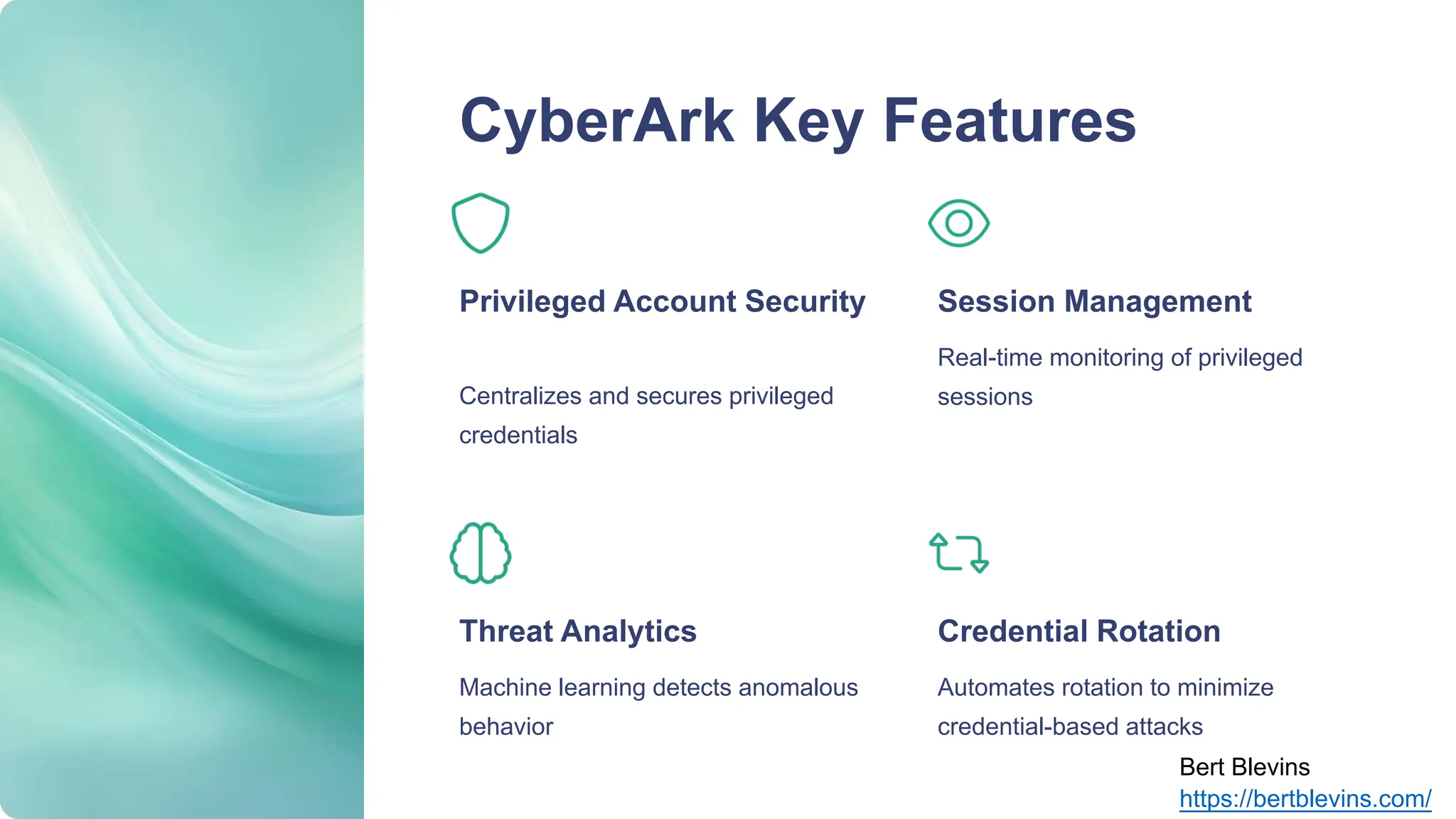
Image Gallery
Select an image to open it in a new tab.

Mateo Castillo
Decentralized Finance and E-Payments Strategist
