The PC Racing Game 2000s Era: Golden Age of Arcade Simulators and Modding

The personal computer racing game sector of the 2000s era represents a transitional golden age defined by the maturation of physics engines, the rise of online multiplayer matchmaking, and a vibrant modding community that kept legacy titles alive long past their commercial lifecycles. Spanning from the turn of the millennium to the dawn of the 2010s, this decade bridged the gap between sprite-based arcade pixelation and deeply detailed aerodynamic simulations, establishing foundational software platforms that developers still reference today.
The Evolution of PC Racing Physics and Graphics in the 2000s
The opening years of the decade inherited a landscape shaped by raw arcade thrills, but the rapid advancement of consumer graphics processing units (GPUs) and central processing units (CPUs) fueled a relentless pursuit of realism. Early 2000s titles like Need for Speed: High Stakes (1999) and its immediate successor Need for Speed: Porsche Unleashed (2000) demonstrated that home computers could handle complex vehicle handling models and detailed damage systems.
As the decade progressed, specialized physics engines transformed how cars interacted with virtual asphalt. Developers moved away from simple tile-based grip calculations toward complex tire-slip angle modeling, suspension telemetry, and dynamic weight transfer. Titles released by Image Space Incorporated (ISI) and SimBin introduced modular physics architectures that allowed enthusiasts to alter center-of-mass attributes, brake bias, and differential locking parameters. This technical depth shifted the platform away from casual gamepad play toward dedicated hardware peripherals. The widespread commercial availability of force-feedback steering wheels, such as the Logitech MOMO Racing and the Logitech G25—the latter introduced in 2006 with a genuine six-speed H-pattern shifter and clutch pedal—permanently altered the enthusiast landscape.
Graphically, the era was characterized by the transition from DirectX 7 to DirectX 9. Pixel and vertex shaders allowed for unprecedented visual fidelity, bringing real-time reflections, dynamic lighting, and highly detailed polygonal models to computer screens. However, hardware requirements escalated dramatically. Players frequently found themselves upgrading graphics cards and adding RAM just to maintain stable frame rates while rendering large grids of AI opponents or high-resolution track textures.
Defining Subgenres: Arcade Street Racers versus Hardcore Simulations
The 2000s PC racing catalog cleanly bifurcated into two distinct experiences: accessible arcade street racers focused on illegal car culture, and unapologetic hardcore simulations designed for motorsport purists.
Arcade Street Culture and Open Worlds
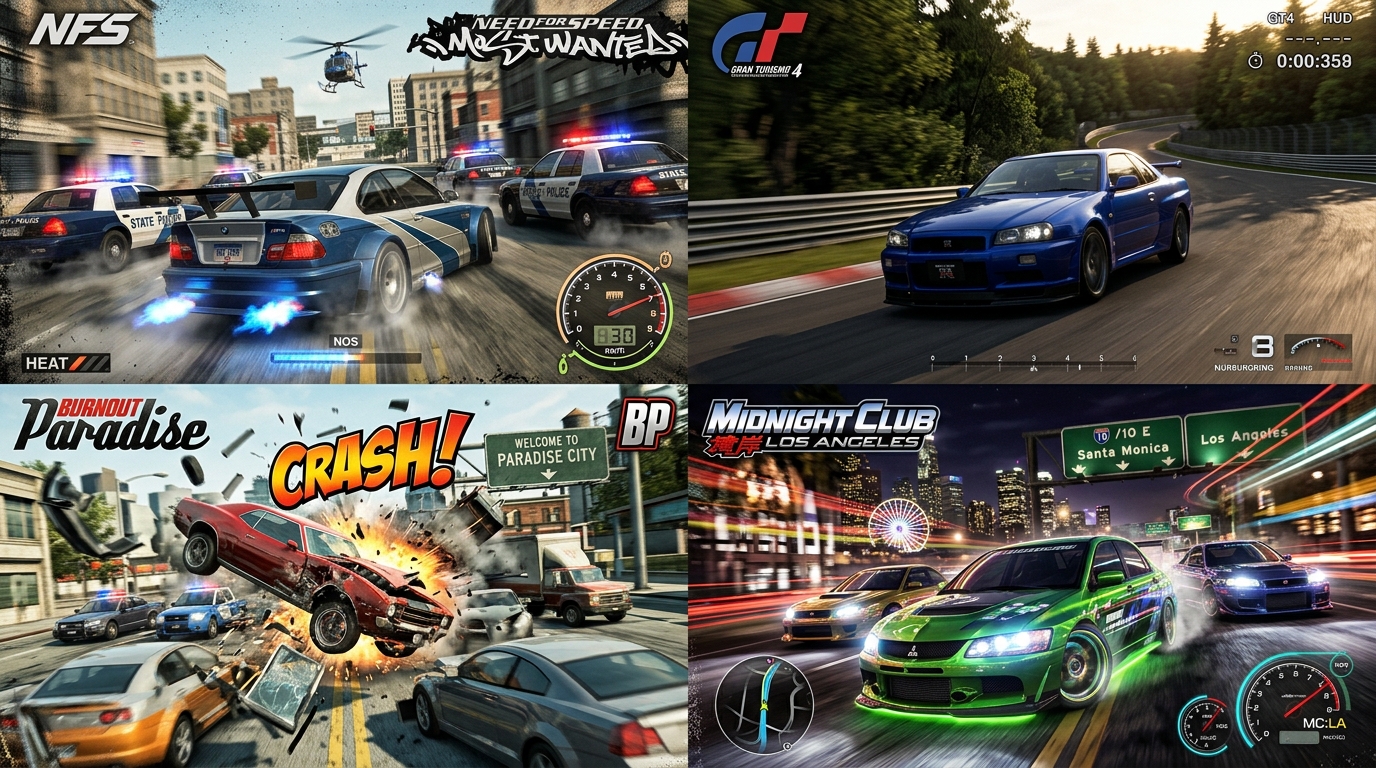
Fueled largely by mainstream pop culture phenomena and the massive commercial success of Need for Speed: Underground (2003) and its sequel Need for Speed: Underground 2 (2004), the early-to-mid 2000s were dominated by nocturnal street racing, neon underglow, body kits, and licensed turbocharged import cars. These games prioritized immediate thrills, nitrous-oxide boosts, and aggressive drifting mechanics over mechanical setup tuning.
Later in the decade, Criterion Games revolutionized the arcade formula with Burnout Paradise (released for PC in 2009), offering a seamless open-world environment where progression was tied to finding events scattered across a sprawling fictional city, capped off with satisfyingly destructive crash physics.
Hardcore Track Simulations
Conversely, simulation racing found its true footing on the PC platform. SimBin Studios became a dominant force, releasing titles like GTR: FIA GT Racing Game (2004), GTR 2 (2006), and Race 07 (2007). These titles offered painstakingly licensed real-world series, laser-scanned or meticulously hand-modelled circuits, and deeply accurate tire wear and fuel consumption calculations.
Similarly, Live for Speed, an independently developed simulation released via progressive alpha and beta builds throughout the decade, gained a cult following for its netcode stability and uncompromising physics model, proving that small independent teams could rival major publishers in simulation fidelity.
| Game Title | Release Year | Primary Subgenre | Standout Technical Feature |
|---|---|---|---|
| Need for Speed: Underground | 2003 | Arcade / Street | Comprehensive visual customization and night-racing atmosphere |
| GTR: FIA GT Racing Game | 2004 | Hardcore Simulation | Dynamic weather cycles and realistic FIA GT championship licensing |
| GTR 2 | 2006 | Hardcore Simulation | Advanced tire thermodynamics and driving school tutorials |
| RBR (Richard Burns Rally) | 2004 | Hardcore Rally Simulation | Unforgiving weight transfer physics and gravel stage realism |
| Race 07 | 2007 | Track Simulation | Support for massive multi-class grids and extensive expansion packs |
The Community-Driven Modding Ecosystem
One of the most defining characteristics of the 2000s PC racing ecosystem was the unprecedented level of user-generated content. Unlike closed console ecosystems, PC titles often shipped with or eventually inspired community modding tools that allowed players to inject custom vehicles, scratch-built tracks, sound packs, and physics overhauls into existing games.
Platforms built on the ISI Motor engine, such as F1 Challenge '99-'02 (2003) and rFactor (2005), served as massive sandboxes for community creativity. Enthusiast forums functioned as digital workshops where modding teams worked for months or years to release complete total conversion mods replicating historical Formula One seasons, endurance racing series, and regional touring car championships. This modding culture created an environment of longevity. While console games of the era became obsolete the moment a new hardware generation launched, PC racing titles routinely maintained active communities for a decade or more after their initial release through continuous community updates.
Technical Preservation and Modern Accessibility
Running software from the 2000s on modern hardware running Windows 10 or Windows 11 presents unique technical challenges. Operating system architecture changes, the deprecation of legacy DirectX components, and the implementation of obsolete digital rights management (DRM) systems—such as the controversial SafeDisc and SecuROM copy protection schemes—frequently prevent original discs from launching without modification.
To access and play these historical titles today, enthusiasts often rely on community-made patches, executable wrappers, and widescreen fix utilities. Furthermore, because many of these titles were distributed exclusively on physical compact discs and have long since been delisted from digital storefronts due to expired automotive and music licensing agreements, legal acquisition frequently requires tracking down secondhand physical copies or navigating complex digital rights grey areas.
When configuring legacy titles for modern high-refresh-rate monitors and multi-axis USB peripherals, players must frequently edit configuration text files, adjust affinity settings in the Windows Task Manager to restrict the game to a single CPU core to prevent physics speed bugs, and utilize third-party input mappers to ensure modern DirectInput steering wheels are recognized correctly.
Frequently Asked Questions
Why do PC racing games from the 2000s still have active player bases?
Many enthusiasts prefer the specific handling models, lack of modern intrusive monetization, and deep modding support found in titles from this era. Furthermore, games like Richard Burns Rally offered a level of pure rally simulation difficulty that modern mainstream titles rarely replicate, ensuring enduring appeal for hardcore purists.
Can I run 2000s PC racing games on Windows 11?
Yes, but most require troubleshooting. Common fixes include running executables in compatibility mode for Windows XP or Windows 98, installing unofficial community patches to bypass defunct DRM, and applying custom resolution patches to support modern widescreen monitors.
What steering wheels work best with 2000s PC racing titles?
Older USB force-feedback wheels from Logitech, such as the Driving Force Pro, MOMO Racing, and G25, offer native driver support and configuration menus tailored directly to the era's input architecture, making them ideal companions for these historical games.
Are these games available on digital storefronts like Steam or GOG?
Most are not. Due to expired vehicle manufacturer licensing, music licensing, and corporate acquisitions, the vast majority of 2000s racing games are currently unavailable on modern digital storefronts, requiring players to rely on physical media or community preservation archives.
How did the 2000s era change multiplayer racing on PC?
The decade marked the transition from local LAN parties and rudimentary direct-IP connections to centralized matchmaking servers and lobby systems. This allowed global communities to organize structured leagues, time-trial ladders, and endurance racing events with standardized rulesets.
Practical Recommendations for Playing Classic PC Racers
If you are looking to dive into the PC racing game 2000s era, start by identifying whether your primary interest lies in casual arcade progression or rigorous motorsport simulation. For arcade thrills, locate a copy of Need for Speed: Underground 2 or Burnout Paradise, keeping in mind that you will likely need a community-made widescreen fix to run the game natively at 1080p or 4K resolutions. If simulation is your goal, secure a copy of rFactor or GTR 2, join dedicated retro sim-racing forums for setup guides and community patches, and ensure your USB steering wheel is calibrated with appropriate deadzones to match the older input handling routines.
Image Gallery
Select an image to open it in a new tab.



Mateo Castillo
Decentralized Finance and E-Payments Strategist
