A Comprehensive Guide to British Subcultures: History, Evolution, and Cultural Impact

British subcultures are distinct social groups that emerged primarily in the post-World War II era, defined by their unique fusion of music, fashion, and social rebellion. These movements, ranging from the 1950s Teddy Boys to the 1990s Ravers, represent a collective response to the United Kingdom’s shifting economic, political, and class-based landscapes.
The history of the United Kingdom is inextricably linked to its youth movements. While mainstream culture often dictates the national narrative, it is the "underground"—the fringes of society—that has frequently provided Britain with its most recognizable exports. From the sharp tailoring of the Mods to the shredded aesthetics of Punk, British subcultures have functioned as a vital survival mechanism for youth seeking identity in an often-rigid class system. As of 2026, these movements are viewed not just as historical curiosities, but as the foundational pillars of modern global street style and digital identity.
The Genesis of British Youth Culture: The Teddy Boys
Before the 1950s, the concept of the "teenager" as a distinct consumer and social entity barely existed in Britain. Young people generally transitioned directly from childhood into the adult world of work and marriage, dressing in smaller versions of their parents' clothing. The emergence of the Teddy Boys (or Teds) in the early 1950s shattered this trajectory.
Taking their name from the "Edwardian" style of dress—specifically long drape jackets, velvet collars, and "drainpipe" trousers—the Teddy Boys were primarily working-class youths. They appropriated the high-fashion styles of Savile Row, which were originally intended for wealthy young men in the post-war period, and recontextualized them with a rebellious edge. This was paired with the arrival of American Rock ‘n’ Roll, creating a volatile mix of British class resentment and transatlantic coolness.
The Teddy Boys were significant because they were the first group to use clothing as a weapon of social differentiation. Their presence was often associated with the "flick-knife" and public disturbances, most notably during the screenings of the film Blackboard Jungle. They established the template for every British subculture that followed: a specific uniform, a devotion to a particular sound, and a desire to shock the establishment.
The Great Divide: Mods and Rockers
By the early 1960s, the British youth landscape had split into two distinct and often clashing camps: the Mods and the Rockers. This rivalry peaked in 1964 with highly publicized clashes in seaside towns like Brighton and Margate, events that the sociologist Stanley Cohen used to coin the term "moral panic."
The Modernists (Mods)
The Mods were characterized by an obsession with "clean living under difficult circumstances," as famously described by Peter Meaden. They were focused on Italian-style tailoring, French cinema, and American R&B and Soul music. The Mod lifestyle was fueled by amphetamines, which allowed them to stay awake through all-night dance sessions at clubs like the Scene in Soho. Their primary mode of transport was the Italian scooter—Vespas and Lambrettas—which allowed them to travel in their expensive suits without getting covered in oil, a practical necessity that became a stylistic hallmark.
The Rockers
In stark contrast, the Rockers (or Ton-Up Boys) centered their identity on the motorcycle and the 1950s American grease-culture. Clad in heavy leather jackets, Levi’s jeans, and engineer boots, the Rockers were the heirs to the Teddy Boy tradition. Their music was classic Rock ‘n’ Roll—Elvis Presley, Gene Vincent, and Eddie Cochran. For the Rocker, the motorcycle was not just transport; it was a symbol of rugged individualism and mechanical prowess. They congregated at transport cafes like the Ace Cafe in London, representing a more traditional, masculine rebellion compared to the perceived effeminacy of the Mods.
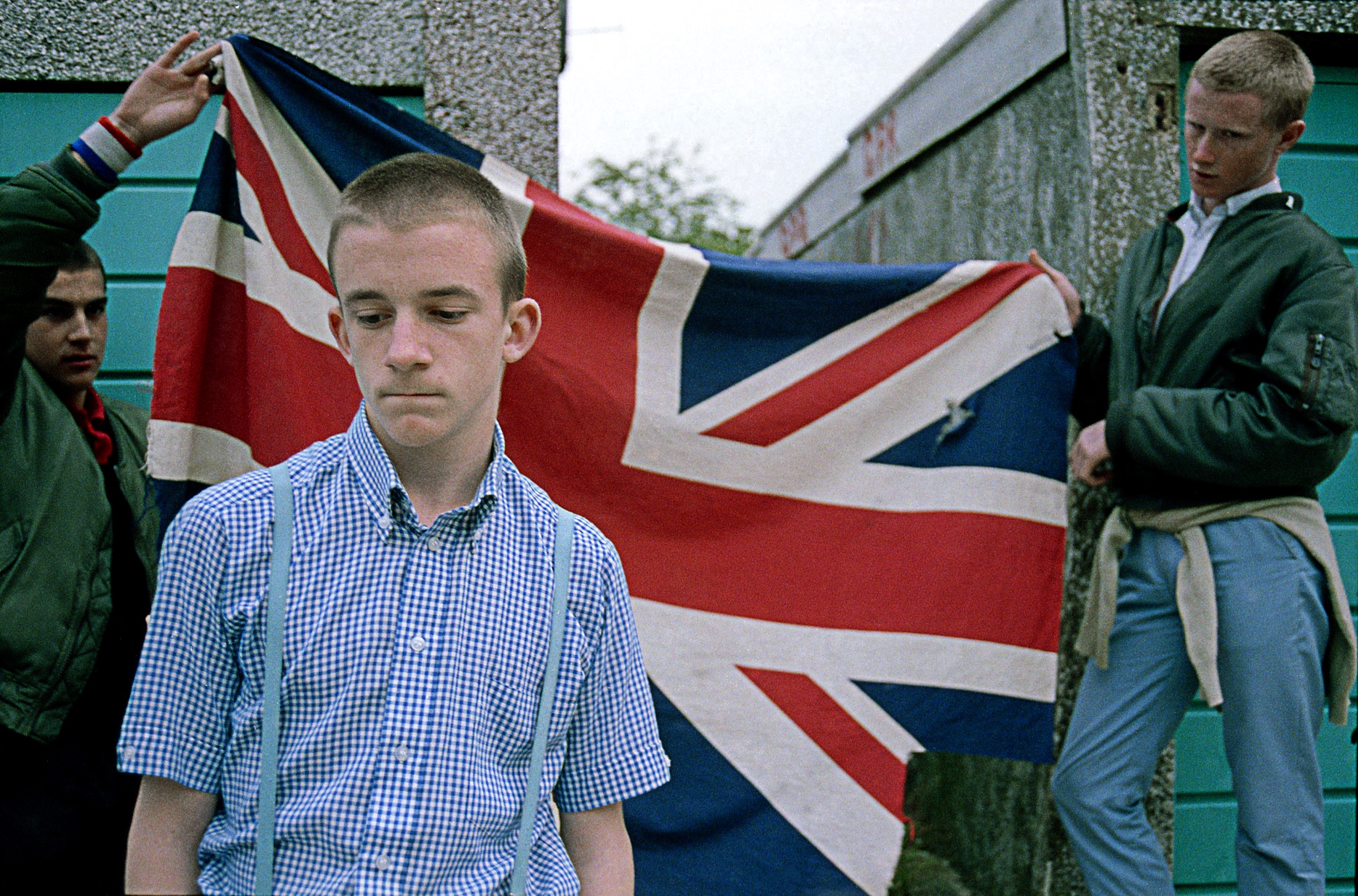
Skinheads and the Spirit of '69
The Skinhead subculture is perhaps the most misunderstood in British history, largely due to its later co-option by far-right political movements in the late 1970s and 80s. However, the original Skinhead movement of the late 1960s—known as the "Spirit of '69"—was a multi-racial, working-class phenomenon.
The subculture grew out of the "Hard Mod" scene. As some Mods moved toward the psychedelic "Peacock" fashion of the late 60s, others doubled down on their working-class roots. They cropped their hair short for practical reasons (to avoid it being caught in machinery or pulled in fights) and adopted a uniform of Dr. Martens boots, Brutus Trimfit shirts, and Sta-Prest trousers.
Crucially, early Skinhead culture was deeply influenced by Jamaican immigrants. The "Rude Boy" style and the sounds of Ska, Rocksteady, and early Reggae were central to the movement. This era represented a rare moment of cross-cultural integration in British urban centers, where white working-class youths and West Indian immigrants shared the same dance floors.
The Punk Explosion: 1976–1979
If previous subcultures were about aspiration or class pride, Punk was about negation. Emerging in the mid-1970s against a backdrop of economic stagnation, high unemployment, and the "Winter of Discontent," Punk was a DIY (Do It Yourself) explosion that democratized creativity.
The Sex Pistols, managed by Malcolm McLaren and dressed by Vivienne Westwood through their shop SEX on the King’s Road, became the face of the movement. Punk fashion was intentionally confrontational: ripped clothes held together by safety pins, bondage gear, and hair dyed in unnatural colors. Musically, it rejected the complexity of progressive rock in favor of three-chord songs played with aggressive speed.
Punk's legacy is its insistence that anyone could start a band, publish a fanzine, or design clothing. This DIY ethos survived long after the initial shock of 1977 wore off, influencing everything from the indie music scene to modern graphic design. The movement eventually fractured into various offshoots, including Post-Punk, Anarcho-Punk, and the more melodic New Wave.
The 1980s: Goths, New Romantics, and Casuals
As the 1980s began, the aggression of Punk gave way to two very different directions: the theatricality of the New Romantics and the dark introspection of Goth. Simultaneously, a more subtle, sport-centric subculture was forming on the football terraces.
- New Romantics: This group rejected the "poverty chic" of Punk in favor of glamour and decadence. Influenced by David Bowie and Roxy Music, and centered around London's Blitz club, New Romantics wore extravagant, gender-bending costumes inspired by historical periods (e.g., pirates or French aristocrats). Bands like Spandau Ballet and Duran Duran brought this aesthetic into the mainstream.
- Goths: Emerging from the Post-Punk scene, Goth subculture embraced a macabre aesthetic. Drawing inspiration from 19th-century Gothic literature, horror films, and the music of Bauhaus and The Cure, Goths were identifiable by their black clothing, pale makeup, and crimped black hair. Unlike many other subcultures, Goth has proved remarkably resilient, maintaining a global presence into 2026.
- Casuals: While Goths were in the clubs, Casuals were at the football stadiums. This subculture was unique because it eschewed traditional "subcultural" markers like boots or leather jackets to avoid police detection. Instead, they wore expensive European sportswear—brands like Ellesse, Fila, Sergio Tacchini, and later, Stone Island and Burberry. The "Casual" look was a display of wealth and travel (often acquired during European away games), and it remains a dominant force in British street fashion today.
Rave Culture and the Second Summer of Love
The late 1980s saw the final great physical explosion of British subculture: Rave. Powered by the arrival of Acid House music from Chicago and the widespread use of MDMA (Ecstasy), the 1988–1989 period became known as the "Second Summer of Love."
Rave was a radical departure because it de-emphasized the individual performer in favor of the collective experience. It broke down the traditional barriers of the British class system; on the dance floor of a warehouse or a field off the M25, it didn't matter where you were from. The fashion was functional and bright: oversized t-shirts, dungarees, and "smiley face" logos.
The movement faced heavy state repression, culminating in the Criminal Justice and Public Order Act 1994, which famously targeted gatherings characterized by music "wholly or predominantly characterized by the emission of a succession of repetitive beats." Despite this, Rave culture moved into the legal club sphere and birthed genres like Jungle, Drum and Bass, and eventually Dubstep and Grime.
Comparison of Key British Subcultures
The following table summarizes the defining characteristics of the most influential British subcultures across the 20th and early 21st centuries.
| Subculture | Peak Era | Primary Music Genre | Iconic Fashion Items | Social Roots |
|---|---|---|---|---|
| Teddy Boys | 1953–1958 | Rock 'n' Roll | Drape jackets, Creepers | Working-class / Edwardian revival |
| Mods | 1962–1966 | Modern Jazz, Soul, R&B | Italian suits, Parkas, Scooters | Aspiring working/middle class |
| Rockers | 1960–1970 | 50s Rock 'n' Roll | Leather jackets, Motorcycles | Traditional working-class |
| Skinheads | 1968–1972 | Ska, Reggae, Rocksteady | Dr. Martens, Brutus shirts | Multi-racial urban working-class |
| Punk | 1976–1979 | Punk Rock | Safety pins, Tartan, DIY | Anti-establishment / Youth |
| Casuals | 1980–1995 | Synth-pop, Indie | Designer sportswear, Trainers | Football terrace culture |
| Goth | 1981–Present | Post-Punk, Gothic Rock | Black lace, Velvet, Makeup | Middle-class / Artistic |
| Ravers | 1988–1994 | Acid House, Techno | Neon, Baggy clothing | Cross-class / Hedonistic |
British Subcultures in 2026: The Digital Shift
By 2026, the traditional model of the British subculture has undergone a significant transformation. The physical "territory"—the specific street corner, club, or record shop—has been largely replaced by digital spaces. Platforms like TikTok, Instagram, and specialized Discord servers have fragmented subcultures into "micro-aesthetics."
However, the influence of the original British subcultures remains a potent force. The "heritage" of these movements is preserved by institutions like the Museum of Youth Culture, which archives the photography and ephemera of these eras. In 2026, we see a "looping" of culture where young people adopt the signifiers of 90s Jungle or 70s Punk, but they do so through a lens of digital curation rather than physical membership in a localized gang or group.
Furthermore, British subcultures have become a significant part of the UK’s "soft power" and tourism industry. Areas like Camden Market or Carnaby Street continue to trade on the ghosts of Punks and Mods, showing that while the live movements may have changed, their visual and musical language is a permanent part of the global cultural lexicon.
Common Challenges and Misconceptions
Understanding British subcultures requires navigating several historical misconceptions.
- Homogeneity: It is a mistake to think all members of a subculture felt or acted the same. Within "Punk," there were massive disagreements between those who viewed it as a political movement and those who viewed it as a fashion statement.
- Violence: While the media focused on the "Battle of Brighton" or football hooliganism, for the vast majority of participants, subcultures were about music, friendship, and escaping the drudgery of work.
- The "End" of Subculture: Critics often claim subculture is "dead" because of the internet. It is more accurate to say it has moved. The "Grime" scene of the 2000s and 2010s followed the exact same patterns as the Mods or Punks: localized, specific slang, unique fashion, and a sound that the mainstream initially found threatening.
Frequently Asked Questions
Which British subculture was the most influential?
While subjective, Punk is widely considered the most influential due to its "DIY" philosophy. It didn't just change music and fashion; it changed how people approached graphic design, publishing (fanzines), and political activism. Its ripples are still felt in 2026 across almost every creative industry.
Why are many British subcultures associated with specific brands?
Brands like Fred Perry, Dr. Martens, and Lonsdale became iconic because they represented a specific mix of utility and "attainable luxury." For a working-class youth, saving up for a Fred Perry shirt was a way to claim a piece of a "better" life while still remaining grounded in their community. These brands often have a "dual life"—the one intended by the manufacturer and the one defined by the subculture.
Did British subcultures exist outside of London?
Absolutely. While London was a hub, many movements started or found their strongest expression in the North and the Midlands. The "Northern Soul" scene, which grew out of Mod culture, was almost entirely centered on clubs in Manchester, Wigan, and Stoke-on-Trent. Similarly, the "Casual" movement was heavily driven by fans of clubs like Liverpool, Everton, and Manchester United.
How did the government react to these subcultures?
The state response was typically one of suppression. This ranged from the "Mods and Rockers" laws of the 60s to the 1994 Criminal Justice Act targeting ravers. Ironically, this opposition often strengthened the subculture by giving it a common enemy and reinforcing the "us vs. them" mentality that is essential for subcultural cohesion.
Is it still possible to join a subculture in 2026?
Yes, though the "joining" process is different. There are still vibrant "traditionalist" scenes—such as weekenders for Mods or Goth festivals like Whitby Goth Weekend. However, most modern subcultural participation involves a mix of physical attendance at events and digital engagement with global communities.
Next Steps for Enthusiasts
For those looking to explore British subcultures further, the following actions are recommended:
- Visit Archives: The Museum of Youth Culture in London offers extensive digital and physical exhibitions.
- Explore Music History: Listen to the seminal albums of each era, starting with "The Rise and Fall of Ziggy Stardust" (Bowie), "Never Mind the Bollocks" (Sex Pistols), and "Original Pirate Material" (The Streets).
- Field Research: Visit historical hubs such as the 100 Club in London, the Ace Cafe, or the various independent record stores in Manchester's Northern Quarter.
Image Gallery
Select an image to open it in a new tab.


Mateo Castillo
Decentralized Finance and E-Payments Strategist
