How the Lead Role in Netflix's Maid Transformed Margaret Qualley's Career

Margaret Qualley’s performance as Alex Russell in the 2021 Netflix limited series Maid represented a fundamental career shift, moving her from a recognized supporting player into a critically lauded leading actress. The role earned her Primetime Emmy, Golden Globe, and Screen Actors Guild nominations, establishing her capacity to carry complex narrative television and opening doors to high-profile auteur cinema.
The Pre-Maid Career: Building a Reputation as a Scene-Stealing Supporting Player
Before taking on the lead role in Maid, Margaret Qualley established herself as one of Hollywood's most promising young talents through a series of striking supporting performances. Initially trained as a professional ballerina at the American Ballet Theatre and having worked briefly in fashion modeling, Qualley made her feature film debut in Gia Coppola’s Palo Alto (2013). However, her breakout to mainstream television audience came through HBO’s acclaimed drama series The Leftovers (2014–2017), created by Damon Lindelof and Tom Perrotta.
Playing Jill Garvey, the troubled adolescent daughter of Justin Theroux’s character, Qualley demonstrated a rare ability to convey internal angst, grief, and emotional displacement without relying on theatrical overstatement. Over three seasons, her character evolved from a rebellious high school student into a grounded emotional anchor within the show’s bleak, post-apocalyptic reality. Industry casting directors quickly noted her natural screen presence and physical expressiveness.
Qualley's Early Career Progression:
- Palo Alto (2013)
- The Leftovers (2014–2017)
- Once Upon a Time in Hollywood (2019)
- Fosse/Verdon (2019)
Qualley expanded her feature film footprint in Quentin Tarantino’s 2019 period film Once Upon a Time in Hollywood. Portraying Pussycat, a charismatic member of the Manson Family, she shared extended screen time with Brad Pitt. Despite relatively brief total screen time, her performance became one of the film’s most talked-about elements, showcasing her raw magnetic appeal and improvisational rhythm.
That same year, Qualley earned her first Primetime Emmy Award nomination for her portrayal of dancer and actress Ann Reinking in the FX biographical miniseries Fosse/Verdon (2019). The role drew heavily on her classical dance background, requiring intricate choreography alongside intense emotional scene work opposite Sam Rockwell and Michelle Williams. While these roles highlighted her versatility, they framed her primarily as an exceptional ensemble player or scene-stealer rather than a performer who could carry an entire production.
Maid as the Breakthrough Shift: Carrying a Central Narrative
When Netflix released Maid on October 1, 2021, the ten-episode limited series transformed the industry's perception of Qualley’s capabilities. Created by Molly Smith Metzler and inspired by Stephanie Land’s bestselling memoir Maid: Hard Work, Low Pay, and a Mother's Will to Survive, the series put Qualley in virtually every frame of its ten-hour runtime.
Alex Russell Character Arc:
- Physical Exhaustion & Manual Labor
- Bureaucracy & Legal Navigations
- Emotional Trauma & Domestic Abuse
- Maternal Devotion (Mother to Maddy)
- Creative Ambition (Aspiring Writer)
Qualley played Alex Russell, a young mother who flees an emotionally abusive relationship with her toddler daughter, Maddy. With no savings, no support network, and no stable shelter, Alex takes a grueling job cleaning luxury homes for a cleaning service while navigating the Byzantine US social safety net.
Navigating Emotional Realism and Physicality
The demands of playing Alex required a radical departure from Qualley's previous roles. Rather than relying on stylized dialogue or energetic charm, the narrative demanded grounded realism, quiet endurance, and visceral exhaustion. Qualley had to physically embody the weight of chronic poverty, from the literal strain of scrub brushes and heavy trash bags to the psychological burden of counting dollars at a grocery register.
Key narrative beats depended on her ability to convey complex internal states:
- The Nuance of Intimate Partner Violence: The series carefully illustrated non-physical, emotional, and financial abuse. Qualley portrayed the confusion, shame, and hyper-vigilance of an abuse survivor without resorting to melodrama.
- Systemic Bureaucracy: Qualley conveyed the crushing frustration of navigating government assistance, where securing subsidized housing required employment, but securing employment required subsidized childcare.
- Maternal Resilience: The central driver of the story was the unbreakable bond between Alex and Maddy (played by Rylea Nevaeh Whittet). Qualley maintained a delicate balance between showing overwhelming fatigue and radiating absolute warmth toward her screen daughter.
Onscreen Dynamics with Andie MacDowell
A major factor in the authenticity of Maid was Qualley’s decision to suggest her real-life mother, veteran actress Andie MacDowell, for the role of Alex’s mother, Paula. Paula is an undiagnosed bipolar artist whose manic episodes and unstable lifestyle complicate Alex’s struggle for security.
The real-life mother-daughter relationship added profound texture to their shared scenes. Their onscreen dynamic was charged with painful role reversal, where the child assumes the burden of parenting the parent. Critics widely praised their joint scenes, noting that Qualley matched MacDowell’s chaotic energy with rooted, protective restraint.
Critical Acclaim and Industry Impact
Maid quickly became one of Netflix’s most-watched limited series, drawing over 67 million household views within its first month of release. Beyond its popularity, the show achieved widespread critical acclaim, with reviewers singling out Qualley’s performance as the core foundation of its success.
Critical Recognition for Margaret Qualley in 'Maid' (2021–2022):
- Primetime Emmy Award Nomination: Outstanding Lead Actress in a Limited Series
- Golden Globe Award Nomination: Best Actress – Miniseries or Television Film
- Screen Actors Guild (SAG) Nomination: Outstanding Performance by a Female Actor in a TV Movie/Limited Series
- Critics' Choice Television Award Nomination: Best Actress in a Limited Series
The success of Maid fundamentally altered Qualley’s career trajectory in three distinct ways:
- Validation as a Lead Actor: It proved she could carry a multi-hour drama without losing audience engagement or emotional nuance.
- Auteur Attraction: Leading directors began casting her as the central lead in independent and mid-budget feature films, recognizing her ability to handle demanding character studies.
- Broad Industry Prestige: Major award nominations solidified her status among elite dramatic actors of her generation, expanding her options beyond typical Hollywood starlet casting.
Post-Maid Trajectory: Auteur Collaborations and Bold Character Choices
Following the massive critical success of Maid, Qualley leveraged her elevated status to select ambitious, director-driven projects rather than conventional commercial blockbusters. Her post-Maid filmography reflects a deliberate push toward psychological complexity, dark comedy, and physical genre work.
Post-'Maid' Filmography Expansion:
- Sanctuary (2022)
- Poor Things (2023)
- Drive-Away Dolls (2024)
- The Substance (2024)
Dominatrix Dynamics in Sanctuary (2022)
In Zachary Wigon’s psychological thriller Sanctuary, Qualley starred opposite Christopher Abbott as Rebecca, a professional dominatrix locked in a high-stakes power struggle with her wealthy client. The film was almost entirely set within a single hotel suite, requiring intense verbal dexterity, emotional manipulation, and commanding physical authority—a sharp departure from the vulnerable, impoverished mother she played in Maid.
Collaborations with Yorgos Lanthimos
Qualley joined the ensemble of visionary Greek director Yorgos Lanthimos, appearing in his Academy Award-winning film Poor Things (2023) as Felicity, alongside Emma Stone. She extended this artistic partnership by starring in Lanthimos’s follow-up anthology feature Kinds of Kindness (2024), where she took on multiple distinct roles across interconnected vignettes, showcasing her comfort with surrealist, absurdist drama.
Leading Roles in Drive-Away Dolls and The Substance
In 2024, Qualley headlined Ethan Coen’s solo directorial effort Drive-Away Dolls, playing Jamie, an uninhibited, free-spirited Texan involved in a chaotic road-trip mix-up. Later that year, she starred in Coralie Fargeat’s body-horror thriller The Substance alongside Demi Moore. Playing Sue, the youthful, idealized clone of Moore’s aging celebrity character, Qualley delivered a physical performance that required intense choreography, prosthetic work, and body horror execution, earning widespread acclaim at the Cannes Film Festival.
Comparative Analysis: Margaret Qualley's Career Progression
To understand how the role of Alex in Maid redefined Qualley's professional path, the table below compares key metrics across three distinct phases of her career.
| Career Phase | Key Titles | Primary Role Types | Narrative Responsibilities | Industry & Critical Status |
|---|---|---|---|---|
| Early / Supporting Era (2013–2020) | The Leftovers, Once Upon a Time in Hollywood, Fosse/Verdon, My Salinger Year | Supporting cast, troubled teens, eccentric scene-stealing figures, historic figures | Subplot support, background world-building, high-energy focal points in ensemble casts | Rising star, notable character actor, first Emmy nomination (Supporting Actress) |
| Breakthrough Lead Era (2021) | Maid | Central protagonist, struggling single mother, working-class survivor | Solitary lead driving every scene, structural narrative heart across 10 hours | A-list television lead, major award nominee (Emmy, Golden Globe, SAG) |
| Auteur / Feature Lead Era (2022–Present) | Sanctuary, Stars at Noon, Poor Things, Drive-Away Dolls, The Substance | Complex anti-heroes, surrealist leads, genre-bending central characters | Co-leading auteur films, physically and emotionally demanding genre vehicles | Established dramatic and genre leading lady, frequent collaborator with top-tier directors |
Performance Analysis: The Technical Craft of Margaret Qualley in Maid
Qualley’s work in Maid stands as a masterclass in understated dramatic acting. Rather than relying on big emotional speeches, her performance relies heavily on non-verbal communication, physical fatigue, and micro-expressions.
Technical Elements of Qualley's Performance:
- Financial Anxiety Representation: Internalizing numerical stress during cash register scenes.
- Physical Embodiment: Slouching shoulders, worn posture, and authentic manual labor mechanics.
- Emotional Restraint: Holding back tears to protect her child from witnessing trauma.
- Vocal Tone Shifts: Whispered, deferential tones with officials vs. warm, rhythmic playfulness with Maddy.
The Economy of Facial Expression
Throughout Maid, Alex is repeatedly forced to swallow her pride when dealing with unhelpful social workers, hostile landlords, or demanding clients. Qualley uses subtle shifts in eye contact, tight jaw movements, and suppressed sighs to communicate deep frustration while keeping her character outwardly polite for survival.
When Alex receives news of housing assistance denial or legal setbacks, Qualley demonstrates emotional restraint. Instead of crying openly, she shows a character actively calculating her next move while attempting to stay composure in front of her daughter.
The Realism of Physical Labor
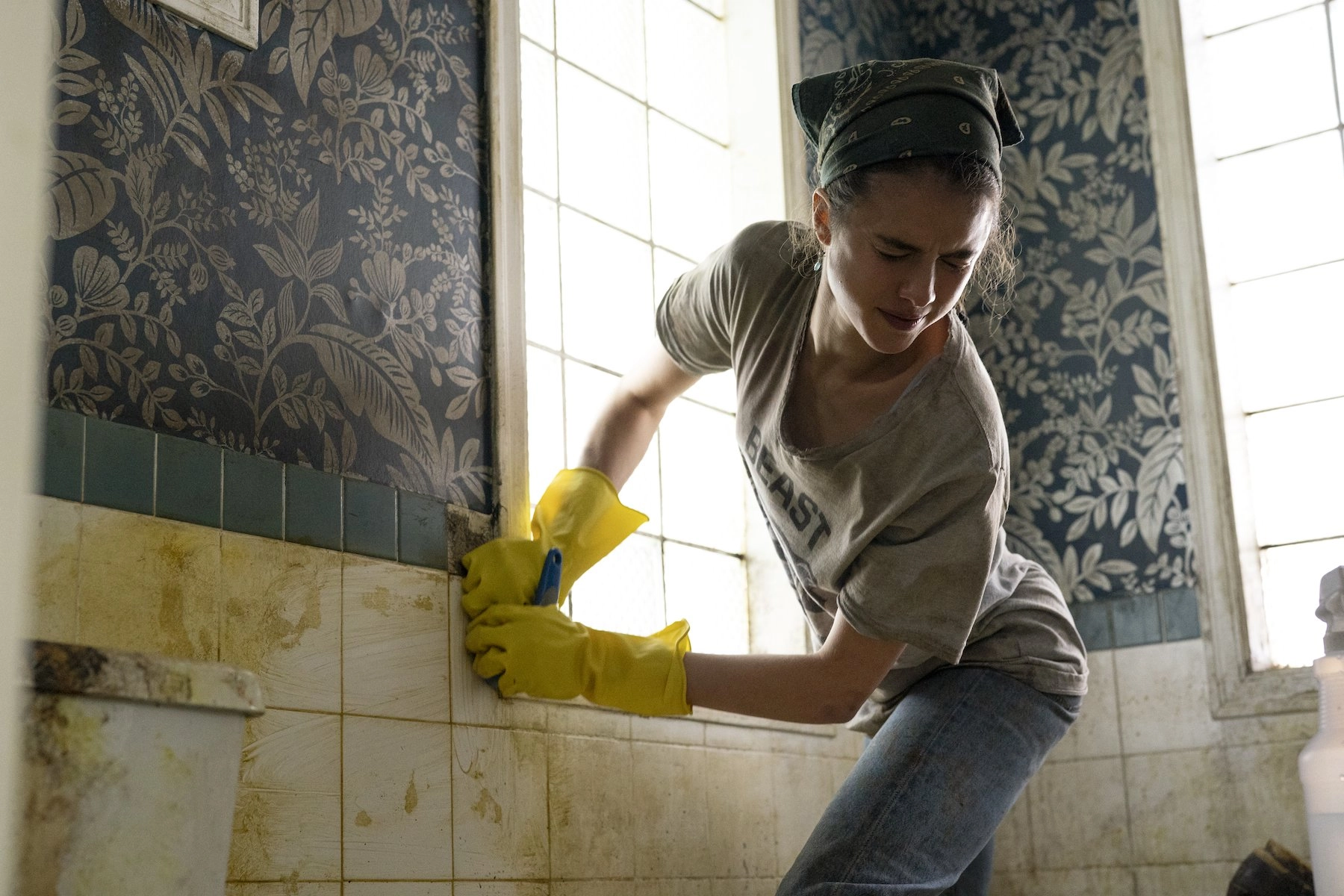
Actors playing working-class roles often stumble when executing manual labor convincingly on camera. Qualley’s background in classical dance gave her an acute awareness of movement and stamina. In cleaning sequences, she shows authentic physical strain—how to properly scrub tile grout, carry heavy vacuum cleaners up apartment staircases, and manage physical exhaustion after a twelve-hour shift. This physical authenticity grounds the series in raw reality.
Strategic Lessons for Film and Television Actors
Qualley’s transformation through Maid offers practical insights into career management for actors navigating the modern media landscape.
- Prioritize Narrative Substance Over Franchise Scale: Rather than rushing into studio superhero franchises, Qualley chose a grounded, character-focused limited series that highlighted her dramatic range.
- Embrace Unpolished Realism: Taking on roles that require minimal makeup, physical strain, and emotional vulnerability often creates a stronger impression on critics and casting directors than glamorous roles.
- Leverage Chemistry and Personal Connections: Proposing her mother Andie MacDowell for Maid transformed a potential gimmick into one of the show's strongest narrative selling points.
- Diversify Post-Breakthrough Roles: Following a major dramatic success, pivot to distinct genres (such as psychological thrillers, dark comedies, and body horror) to avoid being typecast in similar dramatic roles.
Frequently Asked Questions
What was Margaret Qualley's role in the Netflix series Maid?
Margaret Qualley played Alex Russell, the main protagonist of the 2021 Netflix limited series Maid. Alex is a young mother who flees an abusive relationship and takes a job as a house cleaner to survive and build a stable life for her daughter, Maddy.
Was Margaret Qualley's performance in Maid based on a real person?
Yes. The character of Alex Russell is based on author Stephanie Land, who wrote the 2019 memoir Maid: Hard Work, Low Pay, and a Mother's Will to Survive, detailing her real-life experiences with domestic abuse, poverty, and cleaning homes.
Did Margaret Qualley win any awards for her role in Maid?
While she did not take home the final awards, Qualley received major nominations for her performance in Maid, including a Primetime Emmy Award for Outstanding Lead Actress in a Limited Series, a Golden Globe Award nomination, a Screen Actors Guild Award nomination, and a Critics' Choice Television Award nomination.
Is Margaret Qualley related to Andie MacDowell in real life?
Yes, Margaret Qualley is the daughter of actress Andie MacDowell and model/musician Paul Qualley. In Maid, Andie MacDowell played Paula, the eccentric screen mother of Margaret Qualley's character.
How did starring in Maid affect Margaret Qualley's career choices afterwards?
Starring in Maid established Qualley as a reliable leading actor capable of carrying central dramatic narratives. It allowed her to transition from supporting ensemble roles to starring vehicles in auteur cinema, such as Sanctuary, Drive-Away Dolls, and The Substance.
Practical Viewing Recommendations and Next Steps
For film studies students, industry professionals, and television viewers interested in analyzing performance evolution, tracing Margaret Qualley’s work before and after Maid offers a compelling look at contemporary actor development.
- To Understand Her Ensemble Roots: Watch HBO’s The Leftovers (Seasons 1–3) and Quentin Tarantino’s Once Upon a Time in Hollywood (2019) to analyze her early scene-stealing supporting technique.
- To Study Her Dramatic Apex: Watch Netflix’s Maid (2021) in full, paying close attention to episodes 1 ("Dollar Store"), 3 ("Sea Glass"), and 5 ("Thief") for technical mastery of non-verbal fatigue and maternal warmth.
- To Explore Her Modern Range: Compare her performance in Maid with her leading roles in Sanctuary (2022) and The Substance (2024) to see how she applies her physical control to wildly different genres.
Image Gallery
Select an image to open it in a new tab.

Celine Dubois
Contemporary Living and Global Arts Columnist
