
The best cot bed mattress for safe sleep is one that is consistently firm, perfectly flat, and fits the cot frame with a gap of no more than 3cm. It must comply with the BS EN 16890 safety standard, feature a waterproof, removable cover for hygiene, and provide high breathability to assist with infant temperature regulation.
Choosing a mattress for a cot bed is one of the most critical decisions new parents make. Unlike adult mattresses, where "comfort" is often equated with plushness or "sink-in" softness, an infant's sleep surface must prioritize structural integrity and safety above all else. In 2026, the market offers a wide variety of materials—from traditional pocket springs to innovative plant-based foams—but the fundamental safety requirements remain anchored in evidence-based guidelines designed to reduce the risk of Sudden Infant Death Syndrome (SIDS).
The Fundamentals of Safe Sleep Science
To understand what makes a mattress "the best" for safe sleep, we must first look at the physiological needs of an infant. Newborns and young babies have limited neck strength and motor control. If a sleep surface is too soft, the baby’s head can sink into the material, potentially obstructing the airway or causing "rebreathing," where the infant breathes in exhaled carbon dioxide trapped in the depressions of the mattress.
The Firmness Requirement
A safe cot bed mattress must be firm enough that it does not conform to the shape of the baby’s head. This is often a point of confusion for parents who worry a firm surface looks "uncomfortable." However, infants do not have the same pressure point sensitivities as adults; a firm, flat surface provides the necessary support for their developing bones and ensures the airway remains clear. In 2026, reputable manufacturers use the "sphere test" (part of the BS EN 16890 testing protocol) to objectively measure whether a mattress is firm enough to prevent suffocation risks.
The Importance of Flatness
Elevated or inclined sleep surfaces have been strongly discouraged by health organizations such as the Lullaby Trust and the American Academy of Pediatrics. A mattress must remain perfectly flat. While some products claim to help with reflux by providing a slight incline, these are generally not recommended for unsupervised sleep because they can cause a baby’s head to slump forward (chin-to-chest), which can lead to positional asphyxia.
Decoding Safety Standards and Certifications
When shopping for a cot bed mattress in 2026, certifications are your primary tool for verification. These are not merely marketing labels; they are rigorous testing benchmarks.
- BS EN 16890:2017+A1:2021 (and later updates): This is the gold standard for mattress safety in the UK and Europe. It covers everything from firmness and dimensions to the strength of seams and the risk of small parts (like zipper pulls) becoming choking hazards.
- BS 7177: This standard relates to fire safety. Every cot bed mattress sold must meet these stringent flammability requirements without relying on harmful levels of flame-retardant chemicals.
- OEKO-TEX Standard 100: This certification ensures that the fabric and foam used in the mattress have been tested for harmful substances. Since babies spend up to 16 hours a day with their faces close to the mattress surface, ensuring the absence of VOCs (Volatile Organic Compounds) is essential for long-term health.
- CertiPUR: If you are choosing a foam mattress, look for the CertiPUR label, which guarantees the foam is made without mercury, lead, or heavy metals and meets specific environmental and health standards.
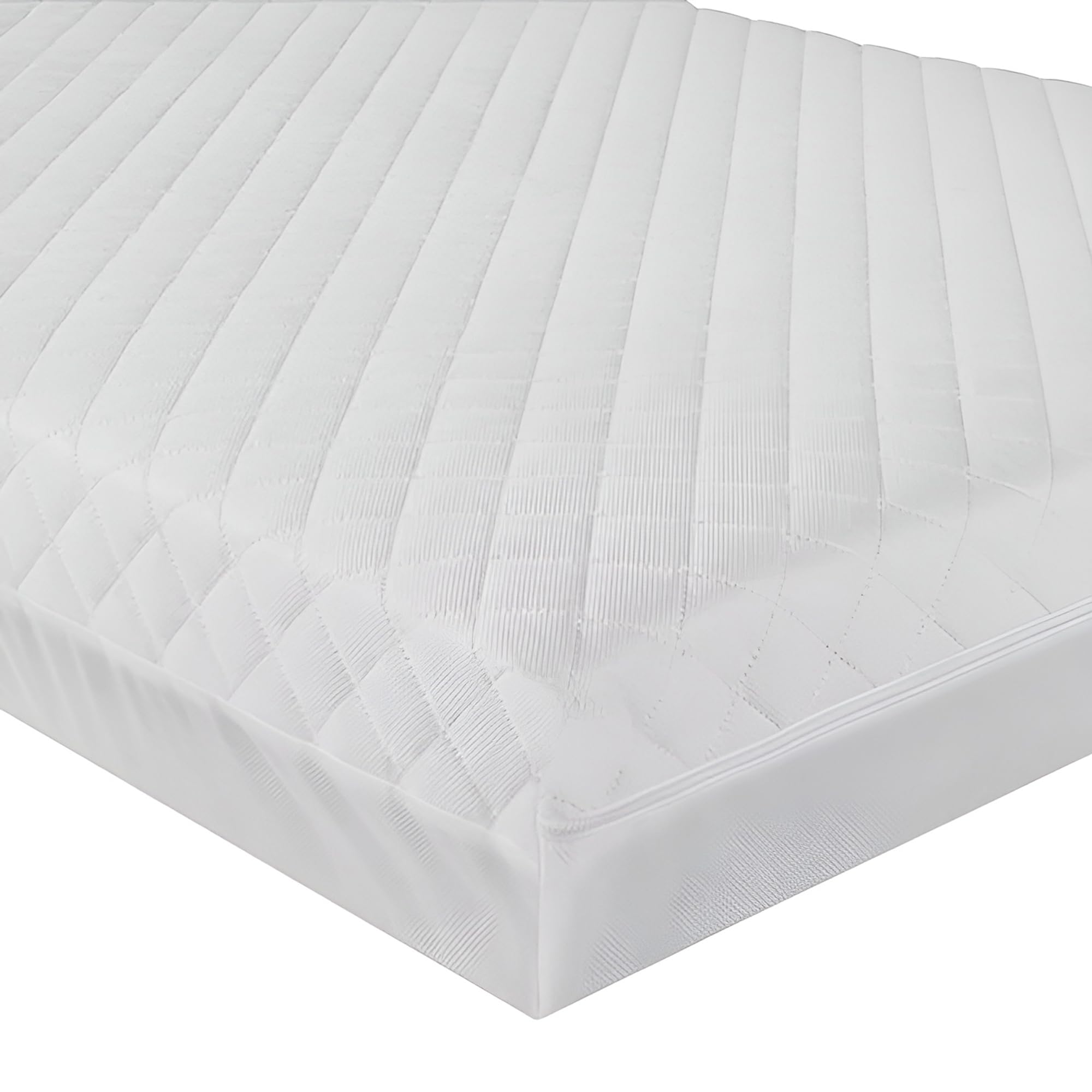
Comparing Cot Bed Mattress Types
The "best" material often depends on your budget and how long you intend to use the cot bed. A standard cot bed mattress typically measures 140cm x 70cm, designed to last from birth until approximately age four or five when the cot bed is converted into a toddler bed.
| Mattress Type | Primary Material | Pros | Cons |
|---|---|---|---|
| Foam | High-density polyether | Lightweight, affordable, easy to move for sheet changes. | Can retain heat; lower-density foam may sag over several years. |
| Pocket Spring | Individual steel springs | Excellent longevity, superior support for toddlers, highly breathable. | Heavier and more expensive than foam options. |
| Natural Fiber | Coconut coir, wool, latex | Naturally breathable, chemical-free, sustainable, naturally anti-dust mite. | Firmest feel (can be quite hard), usually the most expensive. |
| Dual-Sided | Combination (Firm/Soft) | Features a very firm side for infants and a slightly more cushioned side for toddlers. | Requires careful labeling to ensure the correct side is used for the baby's age. |
High-Density Foam Mattresses
Foam mattresses are the most common entry-level choice. For safe sleep, you must ensure the foam is "high-density." Low-density foam may feel comfortable initially but can lose its shape and firmness quickly, creating dangerous dips. In 2026, many foam mattresses utilize "open-cell" technology to improve airflow, addressing the traditional complaint that foam retains too much body heat.
Pocket Sprung Mattresses
These are often considered the premium choice for cot beds. Because each spring is encased in its own fabric pocket, the mattress responds to the child’s weight distribution. This is particularly beneficial as the child grows from a 4kg newborn into a 15kg toddler. The space between the springs also allows for natural air circulation, helping to keep the baby cool.
Natural and Organic Options
For parents concerned about synthetic materials, natural fiber mattresses use coconut coir (husk) bound with natural latex, layered with wool. Wool is a remarkable material for safe sleep; it is naturally flame-retardant, eliminating the need for some chemical treatments, and it is highly efficient at moisture-wicking and temperature regulation.
The Breathability vs. Waterproofing Dilemma
One of the most debated topics in 2026 is the balance between a "breathable" mattress and a "waterproof" one.
Why Breathability Matters
Babies cannot regulate their body temperature as effectively as adults. Overheating is a significant risk factor for SIDS. A mattress with a breathable cover—often featuring a 3D mesh or "spacer" fabric—allows air to circulate under the baby, helping to dissipate excess heat.
The Necessity of Waterproofing
Hygiene is a safety issue. If milk, vomit, or urine penetrates the core of a mattress, it becomes a breeding ground for bacteria and mold. A safe cot bed mattress must have a waterproof layer. In the past, this was a thick, crinkly plastic sheet that made the baby hot. In 2026, the best mattresses use sophisticated "breathable-waterproof" membranes (like PU coatings) that block liquids while allowing microscopic water vapor (sweat) to escape.
Expert Tip: Even if a mattress claims to be fully washable, the Lullaby Trust recommends using a separate waterproof mattress protector. This ensures the mattress core stays dry and clean, which is vital if you plan to use the mattress for a second child (though new mattresses are always preferred).
Proper Fit and the 3cm Rule
A mattress is only safe if it fits the cot bed frame correctly. If the mattress is too small, a baby can become trapped in the gap between the mattress and the cot side, leading to serious injury or suffocation.
When purchasing, you must check the dimensions specified by the cot manufacturer. In the UK and Europe, the standard size is 140cm x 70cm, but some brands (especially those from the US or bespoke designers) may use different dimensions.
The Gap Test: Place the mattress in the cot. There should be no more than a 3cm gap anywhere around the edges. If you can fit more than two fingers between the mattress and the cot side, the mattress is too small and is not safe for use.
Maintenance and Longevity: Keeping the Surface Safe
A cot bed mattress is a long-term investment. To maintain its safety profile throughout the years:
- Rotation: Unless the manufacturer specifies otherwise, rotate the mattress (head-to-foot) every few months to ensure even wear. Do not flip a mattress if it has a specific "top" layer (like a 3D mesh or a dual-sided design).
- Cleaning: Choose a mattress with a cover that is removable and machine-washable at 60°C. This temperature is necessary to kill dust mites and neutralize allergens.
- Inspection: Regularly check for any signs of sagging, tears in the cover, or protruding springs. If the mattress no longer returns to a flat shape after the child gets up, it has lost its structural integrity and must be replaced.
Common Mistakes to Avoid
- Buying Second-Hand: It is generally recommended to buy a new mattress for each child. Research has suggested a link between used mattresses and an increased risk of SIDS, potentially due to the breakdown of materials or the presence of bacteria from previous use.
- Using Toppers or Pillows: Never add a mattress topper or a thick padded "breathable" liner to a cot bed. These products introduce soft surfaces that negate the safety of the firm mattress underneath.
- Ignoring the Base: Ensure the cot bed base is in good condition. A sagging base will cause a perfectly good mattress to sag, creating an unsafe sleep environment.
- Leaving the Plastic Packaging: Always remove all plastic packaging before use. While this seems obvious, some parents leave it on thinking it provides waterproofing. This is a major suffocation and overheating risk.
Frequently Asked Questions
Is a dual-sided mattress worth the extra cost?
Yes, for a cot bed, a dual-sided mattress can be a practical investment. These mattresses feature a very firm side for infants (under 12 months) and a slightly more resilient, comfortable side for toddlers. This acknowledges the changing support needs of a growing child while maintaining safety for the vulnerable first year.
How do I know if my mattress is firm enough?
You can perform a basic "firmness check" by pressing your hand down firmly in the center of the mattress. When you remove your hand, the mattress should spring back instantly. If it leaves an indentation for more than a second, it may be too soft. For a technical verification, check for the BS EN 16890 certification.
Should I choose a mattress with "anti-allergy" claims?
If there is a family history of asthma or eczema, anti-allergy features are beneficial. These usually involve covers treated with probiotics or natural materials like wool and latex that are naturally resistant to dust mites. However, the most effective "anti-allergy" strategy is a waterproof cover and regular washing of bedding at 60°C.
Can I use a cot bed mattress in a toddler bed?
Yes. Most cot beds are designed to convert into toddler beds using the same 140cm x 70cm mattress. Because of this longer lifespan (4-5 years), it is worth investing in a higher-quality pocket sprung or natural fiber mattress that won't lose its shape as the child gets heavier.
Final Recommendation
When selecting the best cot bed mattress for safe sleep in 2026, prioritize firmness and fit above all other features. Look for a mattress that explicitly states compliance with BS EN 16890, features a high-density core (whether spring or foam), and includes a washable, breathable-waterproof cover. While "luxury" materials like organic wool and 3D spacer fabrics provide excellent temperature regulation, the core safety of the mattress is defined by its ability to provide a flat, firm, and snugly-fitting surface for your child every single night.
Image Gallery
Select an image to open it in a new tab.
Mateo Castillo
Decentralized Finance and E-Payments Strategist
