
You can use a 401k to buy real estate by taking a plan loan, making a hardship withdrawal, or utilizing a self-directed Solo 401k. While a loan allows you to borrow up to $50,000 tax-free for a primary residence, a self-directed Solo 401k enables direct investment in rental properties without personal tax penalties.
Understanding the Primary Methods of Accessing 401k Funds
Using retirement savings to fund a real estate purchase is a significant financial maneuver that requires navigating complex Internal Revenue Service (IRS) regulations. As of 2026, the landscape for retirement accounts has been influenced by the long-term implementation of the SECURE Act 2.0, which streamlined certain withdrawal processes, yet the fundamental restrictions on using tax-advantaged funds for tangible assets remain stringent.
There are three primary pathways to facilitate a real estate purchase using 401k assets: the 401k loan, the hardship withdrawal, and the transition to a self-directed retirement vehicle. Each pathway serves a different objective. If your goal is to buy a home to live in, the loan and withdrawal options are most relevant. If your goal is to build a portfolio of investment properties, the self-directed Solo 401k or a Rollover for Business Startups (ROBS) structure is typically required.
The 401k Loan for Primary Residences
Most employer-sponsored 401k plans allow participants to borrow against their vested balance. This is technically not a distribution, meaning it does not trigger immediate income tax or the 10% early withdrawal penalty (if you are under age 59½).
Under current IRS guidelines, the maximum loan amount is generally the lesser of $50,000 or 50% of your vested account balance. However, if your vested balance is less than $10,000, you may be able to borrow up to the full amount, depending on the specific terms of your employer's plan. While standard 401k loans must be repaid within five years, loans used specifically for the purchase of a primary residence often qualify for extended repayment terms, sometimes stretching to 15 or 30 years, mirroring a traditional mortgage.
Hardship Withdrawals and the "Safe Harbor" Rules
A hardship withdrawal is an actual distribution of funds that you do not intend to pay back. The IRS allows "safe harbor" distributions for specific "heavy and immediate financial needs," which explicitly includes costs directly related to the purchase of a principal residence.
Unlike a loan, a hardship withdrawal is permanent. The amount withdrawn is added to your taxable income for the year, and if you are under age 59½, you will generally owe an additional 10% early withdrawal penalty. While this provides immediate liquidity for a down payment or closing costs, the long-term cost is high due to the loss of compound interest and the immediate tax erosion of your capital.
The Self-Directed Solo 401k for Investment Property
For individuals with self-employment income, the Solo 401k (also known as an Individual 401k) offers the most powerful mechanism for real estate investing. Unlike standard corporate 401ks, a self-directed Solo 401k allows the plan itself to hold title to real estate. In this scenario, you are not "taking money out" to buy a house; rather, your 401k is diversifying its portfolio by purchasing an investment property. All rental income flows back into the 401k tax-deferred (or tax-free in a Roth Solo 401k), and all expenses are paid by the plan.
The Mechanics of a 401k Loan for Real Estate
When using a 401k loan to facilitate a home purchase, you act as both the lender and the borrower. The interest rate is typically set at the prime rate plus 1% or 2%. The "advantage" here is that the interest you pay goes back into your own account rather than to a commercial bank.
Eligibility and Limits
To qualify, your employer’s plan must specifically permit loans. While most do, some restrictive plans do not. You must also be an active employee; if you have already left the company, you generally cannot take a new loan from that 401k.
The $50,000 ceiling is a hard limit across all 401k accounts you own. If you have $200,000 in your account, you are still capped at $50,000. This often makes the 401k loan a supplementary tool for a down payment rather than a source for the entire purchase price, especially in high-cost-of-living areas in 2026.
The Risk of Accelerated Repayment
The most significant risk of a 401k loan is the "separation from service" clause. If you leave your job—whether voluntarily or through termination—before the loan is repaid, the remaining balance is typically due in full by the tax filing deadline (including extensions) for that year. If you cannot repay the balance, the IRS treats the outstanding amount as a taxable distribution. This could result in a massive, unexpected tax bill and penalties at a time when you may have just lost your primary source of income.

Investing in Real Estate via a Self-Directed Solo 401k
If your intent is "using a 401k to buy real estate" for investment purposes, the Solo 401k is the superior vehicle. It provides "checkbook control," meaning you can sign purchase contracts and pay for repairs directly from the 401k’s bank account without needing a third-party custodian to approve every transaction.
Avoiding Prohibited Transactions
The IRS maintains strict rules under Internal Revenue Code Section 4975 regarding "disqualified persons." You, your spouse, your parents, and your children are all disqualified persons. This means:
- You cannot live in a property owned by your Solo 401k.
- Your 401k cannot buy a property you already own personally.
- You cannot perform "sweat equity" (doing the repairs yourself) on a 401k-owned property, as your labor is considered an unallowed contribution to the plan.
Leverage and the UDFI Advantage
One of the most technical but vital aspects of using a 401k for real estate is the treatment of debt. If a Self-Directed IRA (SDIRA) uses a mortgage to buy property, the portion of the profit attributed to the borrowed money is subject to Unrelated Debt-Financed Income (UDFI) tax.
However, under IRC Section 514(c)(9), 401k plans are generally exempt from UDFI tax on real estate acquisitions. This makes the Solo 401k significantly more tax-efficient than an IRA for investors who plan to use leverage (non-recourse loans) to purchase multiple properties.
Financial Comparison of 401k Real Estate Strategies
| Feature | 401k Loan | Hardship Withdrawal | Solo 401k Investment |
|---|---|---|---|
| Maximum Amount | $50,000 or 50% of balance | Up to "heavy need" amount | 100% of plan balance |
| Tax Status | Tax-free (if repaid) | Taxed as ordinary income | Tax-deferred within plan |
| Early Penalty (10%) | None | Applies (if under 59½) | None |
| Property Usage | Primary Residence | Primary Residence | Investment Only |
| Repayment | Required (with interest) | Not Required | N/A (Income returns to plan) |
| UDFI Tax | N/A | N/A | Exempt |
Tax Implications and Long-Term Considerations
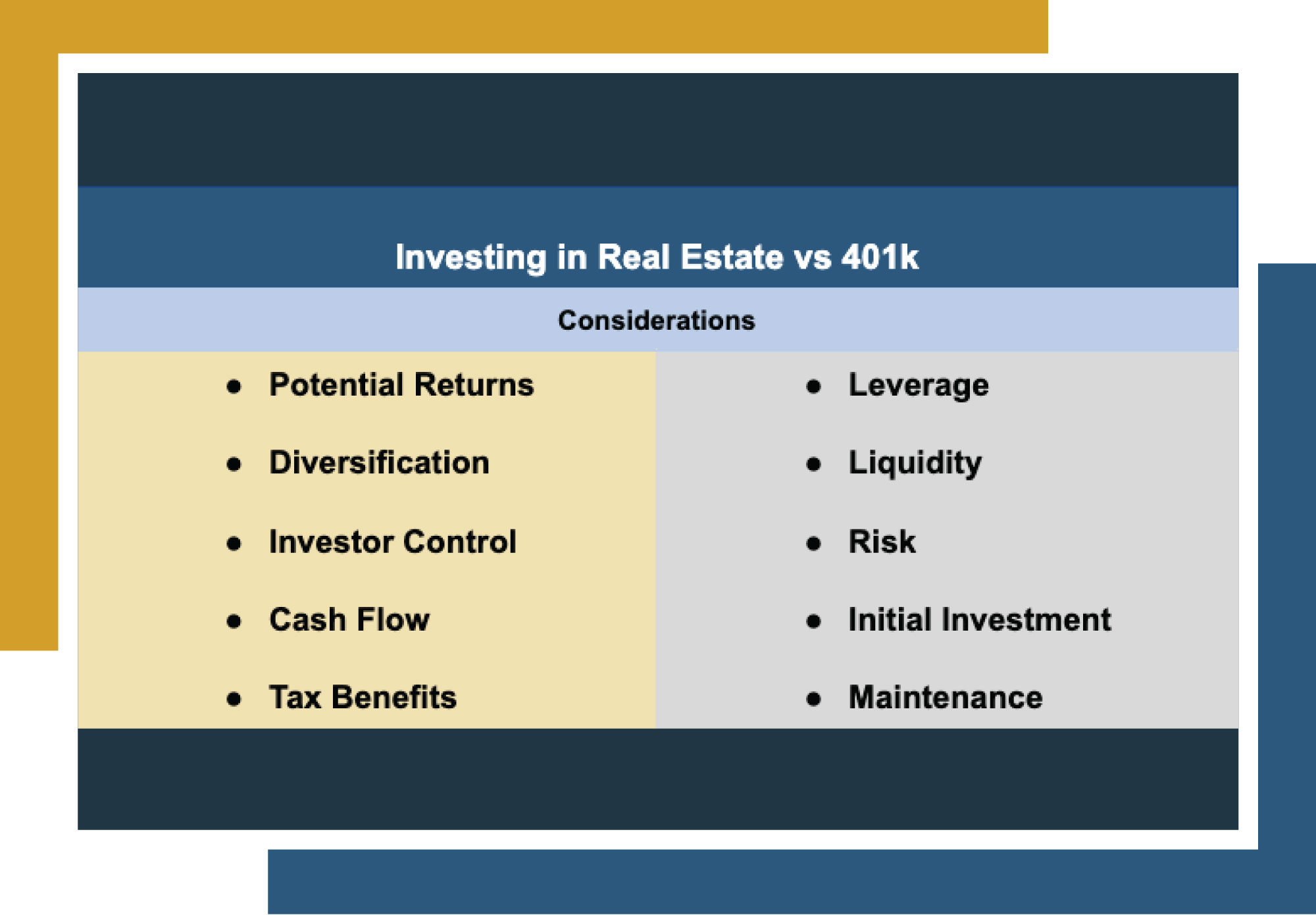
Before utilizing 401k funds for real estate, you must calculate the "opportunity cost." Retirement accounts are designed for long-term growth through compound interest in liquid equities. When you move those funds into real estate, you are trading market exposure for property appreciation and rental income.
The Double Taxation Trap of 401k Loans
While 401k loan interest is paid back to yourself, it is paid with after-tax dollars. When you eventually retire and withdraw those funds, they are taxed again as ordinary income. Essentially, you are paying taxes twice on the interest portion of your loan. For a small loan, this may be negligible, but for a $50,000 loan over 15 years, the tax drag can be substantial.
Valuation and Required Minimum Distributions (RMDs)
By 2026, the age for Required Minimum Distributions (RMDs) has stabilized under the SECURE Act 2.0 provisions. If your 401k owns real estate, you must ensure the plan has enough liquidity to meet these RMD requirements once you reach the age of 73 or 75 (depending on your birth year). If the 401k is "asset-rich but cash-poor," you might be forced to sell the property or take a "partial distribution" of the property deed to satisfy the IRS, which is a complex legal process.
Step-by-Step: How to Execute the Purchase
- Review Plan Documents: Request the "Summary Plan Description" from your HR department to see if loans or hardship withdrawals are permitted.
- Consult a Tax Professional: Real estate in a 401k involves prohibited transaction risks that can result in the entire account being disqualified and taxed immediately.
- Establish a Self-Directed Entity: If you are self-employed, set up a Solo 401k with a provider that allows for "alternative assets."
- Rollover Funds: If using an old 401k from a previous employer, roll those funds into your new Self-Directed Solo 401k or SDIRA.
- Identify the Property: Ensure the property is for the correct use case (Primary residence for loans; Investment for Solo 401ks).
- Execute the Transaction: For a Solo 401k, the buyer on the contract must be the plan (e.g., "The [Name] 401k Trust"). For a loan, the funds are deposited into your personal account, and you buy the home in your own name.
Common Pitfalls to Avoid
- Using a Loan for a "Flip": 401k loans are best suited for long-term stability. Using a loan for a high-risk real estate flip can be dangerous if the project stalls and you cannot make the monthly loan repayments to your plan.
- Neglecting Property Expenses: If a Solo 401k owns a rental property, you cannot pay for a new roof out of your personal pocket. All expenses must come from the 401k. If the 401k runs out of cash, you may have to make an annual contribution to the plan to cover the costs, subject to yearly contribution limits.
- Defaulting on the Loan: If you cannot repay the loan, it is treated as a distribution. In 2026, with higher tax brackets for some earners, this could push you into a 35% or 37% marginal tax bracket unexpectedly.
Frequently Asked Questions
Can I use my 401k to buy a vacation home?
You cannot use a 401k loan for a vacation home unless it is your primary residence. You also cannot use a Self-Directed Solo 401k to buy a vacation home that you or your family intend to use personally. The Solo 401k must treat the property strictly as a third-party investment. Any personal use of a 401k-owned property is a prohibited transaction.
What is a non-recourse loan in a Solo 401k?
If your Solo 401k wants to buy a $500,000 property but only has $250,000 in cash, it must use a non-recourse loan for the balance. A non-recourse loan is a specific type of debt where the lender’s only recourse in the event of default is the property itself. The lender cannot go after the other assets in your 401k or your personal assets. Not all banks offer these loans, and they typically require a 30% to 40% down payment.
Is a 401k loan better than a HELOC?
This depends on interest rates in 2026. A 401k loan does not require a credit check and doesn't appear on your credit report, which can help your debt-to-income (DTI) ratio when applying for a primary mortgage. However, a Home Equity Line of Credit (HELOC) does not carry the risk of accelerated repayment upon job loss.
Can I use 401k funds to pay off an existing mortgage?
Yes, you can take a 401k loan to pay down or pay off a mortgage. However, you generally cannot take a hardship withdrawal for this purpose unless it is specifically to prevent foreclosure on your principal residence.
How do I report a 401k real estate investment to the IRS?
If you have a Solo 401k with more than $250,000 in total assets (including the value of the real estate), you must file Form 5500-EZ annually. This form informs the IRS of the plan's value and ensures compliance with retirement plan regulations.
Final Recommendation
Using a 401k to buy real estate is a powerful strategy for those who are either "house-poor" and need a down payment for a primary residence or for seasoned investors looking for tax-advantaged growth. For most employees, the 401k loan remains the safest and most accessible path for a primary home. For the self-employed, the Solo 401k offers unparalleled advantages in leveraging retirement funds for commercial or residential rentals. Always verify your specific plan's "Loan Procedure" document before making an offer on a property.
Image Gallery
Select an image to open it in a new tab.

Ingrid Bjornson
Global Cyber Policy and Regulation Analyst
