Understanding Money in Thailand: A Comprehensive Guide to the Thai Baht and Financial Systems

Understanding money in Thailand involves mastering the Thai Baht (THB), navigating a highly advanced digital payment ecosystem dominated by PromptPay, and adhering to cultural norms regarding physical currency. Whether you are traveling or living as an expat in 2026, knowing how to exchange, spend, and discuss money is essential for seamless daily life.
The financial landscape in Thailand has shifted significantly over the last decade. While cash remains king in rural areas and local "wet" markets, Thailand has become one of the world's leaders in digital payment adoption. To truly understand money in this context, one must look at the physical currency, the digital infrastructure, the linguistic nuances of financial transactions, and the regulatory environment managed by the Bank of Thailand.
The Physical Currency: Understanding the Thai Baht (THB)
The official currency of Thailand is the Thai Baht, abbreviated as THB and symbolized by ฿. The Baht is divided into 100 satang, though in 2026, satang are rarely used outside of large supermarkets or utility bills.
Banknotes in Circulation
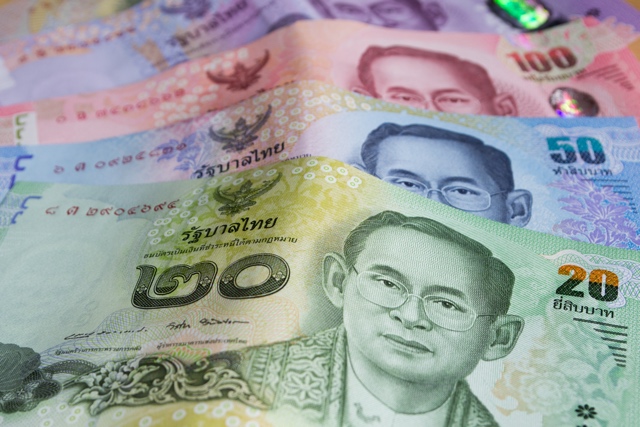
Thai banknotes are issued by the Bank of Thailand. As of 2026, the most common series in circulation is Series 17, which features the portrait of His Majesty King Maha Vajiralongkorn (Rama X).
- 20 Baht (Green): The most common note for small purchases, street food, and tips.
- 50 Baht (Blue): Frequently used for convenience store purchases and short taxi rides.
- 100 Baht (Red): A standard denomination used everywhere from markets to malls.
- 500 Baht (Purple): Often used for larger grocery hauls or restaurant bills.
- 1,000 Baht (Gray/Brown): The largest denomination. While widely accepted in malls and hotels, small vendors may struggle to provide change for a 1,000-Baht note early in the day.
Coins and Satang
While inflation has diminished the utility of smaller coins, they remain a part of the ecosystem.
- 1, 2, 5, and 10 Baht coins: Used frequently for vending machines, public transport (like the BTS Skytrain), and exact change.
- 25 and 50 Satang: These are small, copper-colored coins. You will mostly receive these at 7-Eleven or large retailers like Lotus’s or Big C. Many locals keep a jar for these as they are cumbersome for daily street transactions.
Security Features and Handling
Thai currency is printed on high-quality polymer (for the 20 Baht) and specialized paper. Key security features include:
- Watermarks: Visible when held up to the light.
- Holographic Stripes: On higher denominations (100, 500, 1,000 Baht).
- Tactile Marks: Raised ink patterns to assist the visually impaired.
Cultural Note: In Thailand, money is treated with high respect because it bears the image of the Monarch. Stepping on a coin or note to stop it from rolling away is considered a grave insult and can technically be a legal offense under Lèse-majesté laws. Always handle money with care and avoid crumpling it unnecessarily.
The Digital Revolution: PromptPay and QR Payments
By 2026, Thailand has reached a point where "cashless" is the default in urban centers like Bangkok, Chiang Mai, and Phuket. The backbone of this revolution is PromptPay.
What is PromptPay?
Launched as part of the National e-Payment initiative, PromptPay allows users to link their bank accounts to their mobile phone number or National ID. For users, it manifests primarily as QR Code payments. Every merchant, from high-end boutiques to roadside fried chicken vendors, usually displays a QR code.
How to Use It
To use PromptPay, you generally need a local Thai bank account and the corresponding mobile app (such as K-Plus from Kasikornbank or SCB Easy from Siam Commercial Bank). You simply scan the merchant's QR code, enter the amount, and the transfer happens instantly with zero transaction fees for the consumer.
For tourists, several regional partnerships now allow travelers from countries like Singapore (PayNow), Malaysia (DuitNow), and Indonesia (QRIS) to scan Thai QR codes directly using their home country's banking apps. If you are from outside these regions, you may still need to rely on cash or international travel cards.

Banking and ATMs for Foreigners
Navigating the banking system as a non-resident requires an understanding of fees and specific institutional rules.
ATM Usage and Fees
ATMs (tu ATM) are ubiquitous in Thailand. However, they are famous for the 220 Baht foreign card fee. Every time you use a non-Thai debit or credit card, the Thai bank will charge you 220 Baht (approx. $6.50 USD) on top of whatever fees your home bank charges.
- Withdrawal Limits: Most ATMs allow a maximum of 20,000 to 30,000 Baht per transaction.
- DCC (Dynamic Currency Conversion): When an ATM asks if you want to be charged in your "home currency" or "Thai Baht," always choose Thai Baht. Choosing your home currency allows the bank to apply a significantly worse exchange rate.
Currency Exchange
For the best rates, avoid exchanging money at airport counters. Instead, look for established private exchange brands like SuperRich (Green or Orange). These kiosks consistently offer rates that are 1–3% better than commercial banks. You will need to present your physical passport by law for any currency exchange transaction.
| Method | Best For | Typical Fees/Spread |
|---|---|---|
| SuperRich Kiosks | Cash-to-Cash exchange | 0.2% - 0.5% |
| Local ATMs | Convenience | 220 THB + 1-3% FX fee |
| PromptPay | Daily local spending | 0% (for local account holders) |
| Credit Cards | Hotels and Luxury Malls | 2.5% - 3% (Foreign Transaction Fee) |
| Wise/Revolut | Large transfers/Expats | Mid-market rate + small fixed fee |
Understanding Money in the Thai Language
To navigate transactions effectively, learning basic Thai financial vocabulary is helpful. The Thai language uses a unique numbering system, though Arabic numerals are used on all currency.
Basic Financial Vocabulary
- Money: Ngoen (เงิน)
- Baht: Baht (บาท)
- Change (Money back): Ngoen thon (เงินทอน)
- Discount: Suan lot (ส่วนลด)
- Expensive: Phaeng (แพง)
- Cheap: Thuk (ถูก)
- How much?: Tao rai? (เท่าไหร่)
- Bill/Check please: Kep tang or Check bin (เก็บตังค์ / เช็คบิล)
The Numbering System
While "one million" is nueng lan, daily transactions usually hover in the hundreds or thousands.
- 100: Nueng roy
- 500: Ha roy
- 1,000: Nueng phan
- 10,000: Nueng muen (Note: Thai uses a specific word for ten-thousand, unlike the English "ten thousand").
When bargaining in markets (where appropriate), knowing your numbers in Thai often signals to the vendor that you are a resident or a savvy traveler, which can sometimes lead to fairer "local" pricing.
Financial Regulations and Carrying Cash
The Bank of Thailand (BOT) and the Ministry of Finance set strict rules regarding the movement of currency.
- Reporting Requirements: If you are entering or leaving Thailand with more than $20,000 USD (or equivalent) in any currency, you must declare it to Customs.
- Bringing Thai Baht In/Out: You can bring unlimited Baht into the country, but there are limits on taking it out to neighboring countries (usually up to 2,000,000 Baht to bordering countries, and 50,000 Baht elsewhere without permit).
- Proof of Funds: Technically, tourists on certain visas can be asked to show proof of 10,000 to 20,000 Baht in cash upon entry to ensure they are self-sufficient, though this is sporadically enforced.
Practical Advice for Managing Money in Thailand
For Short-Term Travelers
The most efficient way to manage money in 2026 is to carry a mix of a high-limit travel debit card (like Wise or Charles Schwab) and a small amount of "emergency" physical cash in a major currency (USD, EUR, GBP). Use the ATM to withdraw the maximum amount (30,000 Baht) once to minimize the 220 Baht fee, then use that cash for smaller purchases. For everything else, use a credit card that offers no foreign transaction fees.
For Long-Term Expats
If you are staying for more than a few months, opening a local bank account is highly recommended. While it can be difficult on a tourist visa, those on Work, Retirement, or Elite visas can do so easily. Having a local account gives you access to PromptPay, which eliminates the need to carry bulky coins and allows you to pay for everything from electricity bills to street-side pad thai with your phone.
Common Pitfalls and Scams
- The "Closed" Attraction: A tuk-tuk driver might tell you a temple is closed and offer to take you to a "jewelry export center." This is a classic scam designed to get you to spend money on overpriced or fake gems.
- Unmetered Taxis: Always ensure the meter is turned on. In 2026, ride-hailing apps like Grab and Bolt provide transparent pricing and are generally safer than hailing a random cab on the street.
- The 1,000 Baht Swap: When paying with a 1,000 Baht note in a crowded, dark bar, explicitly state the denomination: "One thousand, okay?" This prevents a dishonest vendor from claiming you only handed them a 100 Baht note.
FAQ
Can I use US Dollars or Euros directly in Thailand?
No. While some high-end hotels might accept them at an abysmal exchange rate, the vast majority of businesses only accept Thai Baht. You must exchange your foreign currency at a bank or exchange booth.
Is tipping mandatory in Thailand?
Tipping is not traditional in Thailand, but it is increasingly common in tourist areas. In small local eateries, it is not expected. In mid-range restaurants, leaving the change (small coins) is common. In high-end hotels, a 10% service charge is often already included in the bill.
What is the best way to send money to Thailand from abroad?
In 2026, platforms like Wise and Revolut offer the best combination of speed and low fees. Standard SWIFT bank transfers are reliable for very large amounts (like buying a condo) but come with higher fees and slower processing times.
Are credit cards widely accepted?
Yes, in malls, supermarkets, hotels, and upscale restaurants. However, small shops and street vendors generally do not accept them unless they have a specific minimum spend requirement (often 300–500 Baht). Most local vendors prefer PromptPay or cash.
How do I recognize counterfeit Thai Baht?
Counterfeit notes are rare but exist. Check for the "shadow" of the King's portrait in the white circle when held to the light, and feel the "Bank of Thailand" text; it should be slightly raised (intaglio printing).
Summary of Recommendations
To navigate money in Thailand effectively, prioritize digital payments where possible via regional QR links or a local bank account. Keep a reserve of 100 and 500 Baht notes for taxis and markets. Always reject Dynamic Currency Conversion at ATMs to save 3-5% on exchange rates. Finally, remember that physical money carries cultural weight; treat it with the same respect you would show any other symbol of Thai national identity. By combining technological savvy with cultural awareness, you can manage your finances in Thailand with confidence and ease.
Image Gallery
Select an image to open it in a new tab.
Celine Dubois
Contemporary Living and Global Arts Columnist
